
What do you mean by Team Dynamics in Hiring?
“Coming together is a beginning, staying together is progress, and working together is success.” – Henry Ford.
When a candidate joins a team, there are only two possible outcomes. His personality, communication style, and work ethic can either be an addition to the existing team’s engagement or affect it negatively.
In other words, team dynamics in hiring means recruiting people, keeping in mind the interplay of chemistry between individuals.
Companies don’t just hire for skills; they also look at whether a candidate will add more fluidity or friction to the existing team chemistry. In other words, they are looking to see whether you’re a culture-fit or not.
What are the key levers of Team Dynamics in hiring?
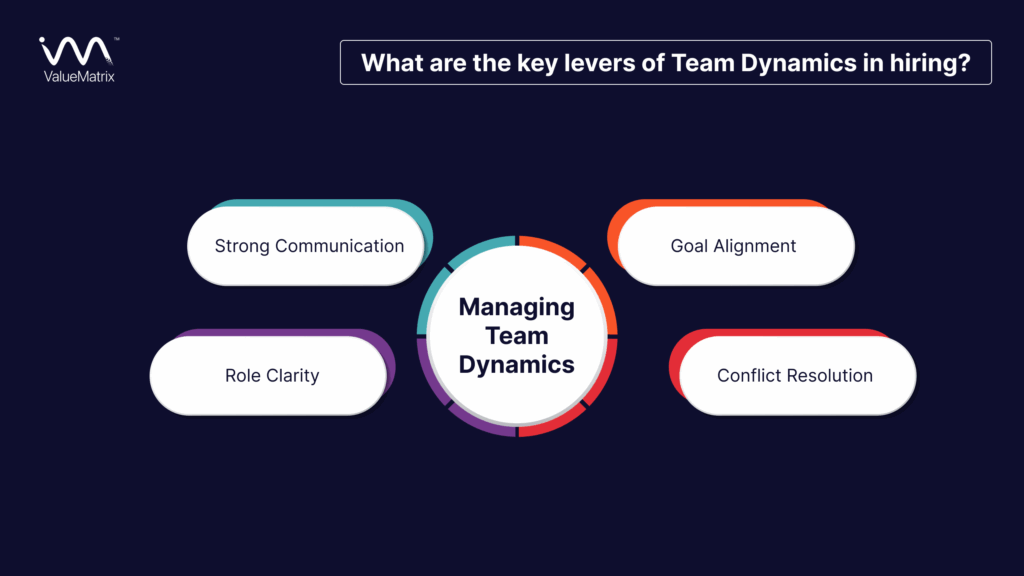
- Strong Communication– Strong communication is integral to Team Dynamics in hiring. A team with robust team dynamics bounces ideas off each other, shares feedback, fires quick responses to queries, and creates an environment of psychological safety and trust. Team members feel valued when their inputs are taken constructively and vice versa.
Guesswork joins the fray when there is a breakdown of communication. People start assuming things about others, egos come into play, and the environment becomes fraught.
- Role Clarity– When team members understand their assigned roles without any confusion, they overachieve. Effective delegation means assigning clear, specific tasks to employees. Meanwhile, it’s important to tell them what to do; the employees should also be clear on what they “do not” need to do.
- Goal Alignment– If there are 20 people on a bus, they are an aggregate of individuals, but if the bus breaks down, and they band together, and push it to the nearest mechanic shop, they suddenly become a team. Why?
Because all of a sudden, they shared a common goal. A goal works as a binding force for the team. Employees who share a common goal with their team are more likely to be motivated to go above and beyond in delivering value.
When CHROs look for team dynamics in hiring, they should have clear and identifiable organizational goals.
- Conflict Resolution– Conflicts are inevitable in a competitive environment, but you should have built-in redressal systems that put out the flames of discontent immediately. Any discontent when not addressed in time turns into a grudge, which then turns into resentment. Don’t let any unresolved conflicts simmer, either between teams or individuals.
Ingroup vs Outgroup: A Case Study.
Any effective team working towards a common goal should not have an In-group vs out-group mentality. Let’s take the infamous example of Apple. In the early eighties, Steve Jobs divided engineers into two teams: ‘Pirates’ vs ‘Navy’. The Pirates team was in charge of the Mcintosh project, and the Navy team was handling Lisa computer.
Steve openly supported the “Pirates”, calling them passionate, innovative, and rebellious while bad-mouthing the Navy team as slow, unimaginative, and bureaucratic.
There was a constant tussle between the two teams for resources and validation.
The result was that the Lisa project completely tanked and cost Apple millions, and Steve Jobs ended up getting fired for creating a toxic work culture.
Why AI is the present and the future of Work Team Fit/Team Dynamics in hiring?
In just a few years, AI has gone from “nice to have” to a “must have” in the hiring process. It’s no longer a competitive edge as everyone is using it. It has become more of a baseline in recruiting, without which you would really struggle..
AI has already introduced tools that outperform recruiters in assessing a candidate’s culture fit, which is another way of saying that AI has a better success rate at predicting whether the candidate will impact team dynamics negatively or positively than humans.
Here’s how AI models help you achieve strong team chemistry.
- Better candidate matching- AI tools like Psychometric tests,Predictive Analytics, and Gamified assessments can achieve far greater insights into a candidate’s mind than a recruiter ever could. These models not only provide quantifiable data about a candidate’s cognitive ability, but also their behavioral traits and aptitude. These models help you assess various essentials for a strong team dynamic, such as EQ, Adaptability, Collaborative effort, Problem-solving, etc. Gamified assessments can especially tell a lot about how adept they are at reading to risk-to-reward ratio in a situation.
- Bias reduction– Before AI made inroads in hiring, bias in recruiting was commonplace. Sometimes it was deliberate, many times it was unconscious, but it was ubiquitous.
But it’s only natural. Sitting at the office all day, one feels charmed when a person from your hometown walks in, or someone with a similar surname, or perhaps someone you knew from college. Similarly, there is another kind of bias known as the halo effect, in which you are too enamored of a candidate’s degree or his college.
We are all susceptible to these deep-seated psychological pulls. But that doesn’t mean it’s good for business. There is no guarantee that your acquaintance from college, whom you feel obligated to help, or that one candidate flashing a fancy degree will be a net positive for the team dynamics.
That’s why we need science-backed levers in place to screen out these hiring malpractices. Here’s how AI Systems help us fight our in-built biases:
(a) Anonymizing Candidate Data: AI models scrub irrelevant identifiers like Name, Age, Gender, and even Postal Code, so that unconscious bias seeps into the minds of recruiters.
(b) Feature Masking: AI models can mask certain Halo effect features from a candidate’s resume, like his elite universities, references, which could be signs of privilege.
(c) Blind Resume Screening: Works similarly to feature masking, it removes all identifiers that can trigger bias when the resume reaches recruiters.
These bias-reducing models help recruiters focus on metrics that are important to building strong team dynamics rather than wasting time on metrics that are irrelevant.
- Engenders diversity– One of the natural outcomes of implementing these bias-reducing AI models is an increase in diversity hiring. When all the markers and identifiers of wealth are stripped away from the hiring funnel, you get a more equitable workforce from a diversified talent pool. Diversity may seem like an unrelated metric to team dynamics, but it is, in fact, essential to team performance.
McKinsey’s Diversity Wins report (2020) says that companies with high ethnic and cultural diversity outperform peers by 36% in profitability because of stronger collaborative dynamics.
- Promotes a positive work culture and psychological safety– AI models like Predictive Analytics are one of the main pillars shaping team dynamics in hiring. Predictive Analytics scans past hiring data, such as performance reviews, turnover records, and successful career trajectories, analyzes what worked and what didn’t, to forecast future hiring outcomes.
Predictive models can read the patterns between two teams, detect disengagement, and predict future conflicts in advance.
This allows the team managers to intervene in time to resolve these budding conflicts, which not only saves time and resources but also protects people’s mental health by saving them from unnecessary stress and toxicity.
What are the best practices for leveraging AI to improve Team dynamics in hiring?
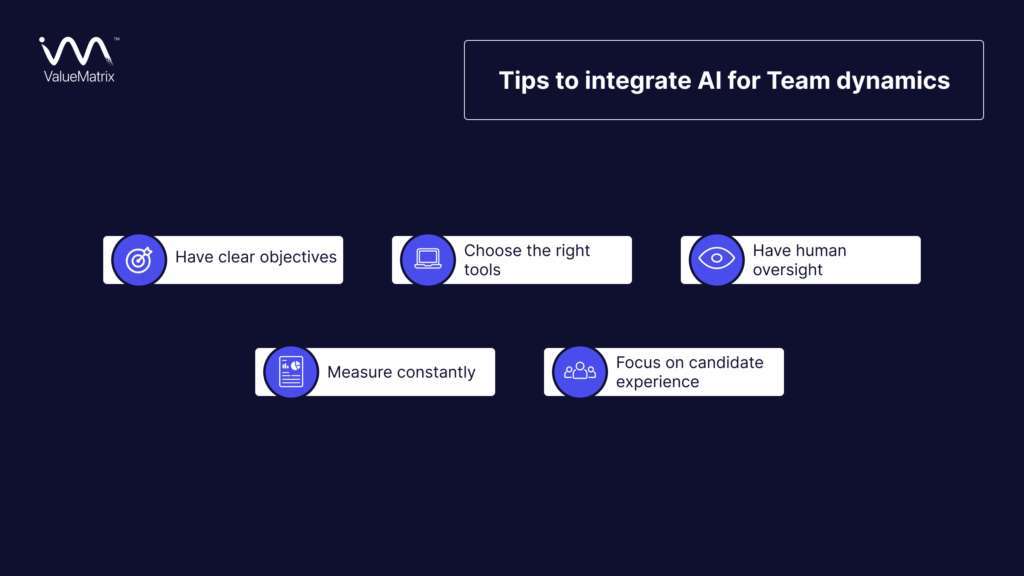
1. Have Clear Objectives
Are you goal-focused in your AI onboarding, or are you jumping on the bandwagon? You must have a clear vision in mind of your end goal that you want to achieve. What is it that you actually want to achieve? DEI, reduce bias, improve retention, or reduce team conflicts in your organization? You must be very clear about your “WHYs”.
“Before integrating AI into onboarding, companies must first identify pain points. AI can boost productivity, but clear objectives ensure the tools actually meet business needs.”
– Bala Krishnapillai, VP & Head of IT (Americas), Hitachi
The key to successful AI onboarding lies in having clearly defined goals and proper tools to measure your progress in achieving them.
2. Choose the Right Tools
Most companies are currently suffering from “shiny object syndrome”, excitedly onboarding new, flashy technology with a lot of bells and whistles without so much as an afterthought. But the question again boils down to having a clear vision. If those fancy tools help you achieve your goals, go for it; if not, you might want to step back and take an inventory of your process.
For example, a mid-sized auto component manufacturer will not benefit from integrating VA tools that read micro-expressions, as their job relies more on hands-on skills than inter-departmental communication.
3 warning signs you might be overdoing it-
- The Recruitment Dashboard looks too busy– If your dashboard overwhelms you with different graphs and ven diagrams showcasing a thousand other things. And it requires a serious mental effort and time to parse the data; chances are, you might have overdone it.
- Tool Fatigue– If recruiters simply begin to ignore certain data points on the screen, chances are that the tools showcasing those data points might not be important to the functioning of your company.
- Human insights are overlooked- When a hiring team’s concern is cross-checked by a metric flashing on the screen, chances are you have gone too far in your AI tool dependency.
3. Have Human Oversight
“AI should be regarded strictly as a tool to support human decision-making, not a substitute for it.
Rumman Chowdhury, CEO of Humane Intelligence
Amazon built an AI to recruit top talent. Over a period of time, it started downvoting resumes that had the word “woman” in them“. Amazon had to scrap the entire project.
A 2021 German report found that seemingly irrelevant elements like a candidate’s background items (bookcases, decor), lighting, or appearance affected personality scores given by AI in video interviews.
Such incidents should serve as a cautionary tale for any company thinking of handing over the entire reins of recruitment to AI without any checks or guardrails.
In fact, many tech giants are second-guessing this unchecked takeover by AI. Google CEO Sundar Pichai has rolled back the use of video interviews and says that AI is failing to identify the right talent.
AI without human oversight is like a wild mustang without a rider. AI is ethically impaired and context-deaf. It doesn’t grasp the concept of discrimination or racial bias. So, when an AI model tracks the history of recruitment and figures out that women tend to take more leaves without learning the context behind it, as we saw in the case of Amazon, it simply begins to screen out resumes with the word “woman” in them as an “effective” hiring policy.
4. Measure Constantly
This is where human insight comes into play. As we have already discussed, AI is ethically and contextually impaired. It can misinterpret data and implement certain malpractices as an “effective hiring strategy”.
Lack of nightwatching has left many companies red-faced and has invited class action lawsuits against the AI service providers. When you read about such incidents, it becomes very apparent that AI needs a watchman on the high tower. And a human oversight provides that.
5. Focus on Candidate Experience
Automation is fun, but we must not forget that the process is still about people and not tools. The truth is, a lot of people still prefer human interactions over VAs and chatbots, because they are still used to the nuanced judgment, emotional context, and trust a human provides.
For example, a candidate with a thick accent would feel more comfortable in front of a recruiter who could understand the cultural context behind her accent, as opposed to a virtual interviewing model, which will just flag her responses for using words “incorrectly”.
And any hiring funnel where candidates aren’t asked for their input will feel very cold and closed to them. So always make sure to have
- Transparency in your systems, keeping them in the loop every step of the way,
- Fair assessments with no scope for bias to earn their trust, and
- Ask for their feedback about your hiring process to keep on improving.
Practices to Avoid
We have spoken at great length about the best practices you can implement to improve your team dynamics in hiring using AI. Now, let’s talk about some of the pitfalls to avoid.
Do away with these malpractices.
1. Not understanding the True meaning of Team Dynamics
When it comes to hiring talent, many companies confuse culture-fit with culture sameness, or outside-of-work camaraderie.
Culture-fit is not someone who shares the same political or cultural values with you, or someone who is “nice to grab a drink with.” Culture-fit ot tea-fit means someone who adds fluency to the team dynamics by adding value, someone who is aligned with the vision of your company.
2. Using a one-size-fits-all approach in hiring
Cultural alignment also doesn’t mean cultural rigidity. Candidates who come from varied backgrounds can have different definitions of collaboration and team effort.
For example, one candidate might constantly update you about his work, and the other might ping you once a week. Different approaches, but one might need pockets of solitude to perform better, while the other might need constant affirmation of the work she is doing. The ultimate metric is the human insight.
3. Ignoring cross-cultural nuances in AI training data
A team leader in Western markets may have a loud, hands-on approach. At the same time, their Southeastern counterpart might prefer a quiet leadership style. If we apply the same metrics worldwide, AI will downrank people who do not fit the mould of American leadership.
That’s why it becomes essential to consider cultural nuances when evaluating team dynamics during the hiring process.
Conclusion
AI is the writing on the wall for HR.
An increasing number of companies have moved from skills to team-fit-based hiring. Enhancing team dynamics in hiring with AI has turned out to be a slippery slope till now, but the future looks promising. What we can glean from the developments so far is that AI can’t be trusted with complete takeover of the hiring process, and that a nuanced human insight is still a valuable skill. But we can’t gloss over the fact that, despite its minor shortcomings, AI has proven to be a powerful tool in augmenting the hiring process.
AI is not just being used for screening resumes anymore. Its models are an integral part of shaping the team dynamics of an organization through their psychometric and gamified assessment models.
And not just that, we saw how AI/ML models can not only predict conflicts between two pods of a company, but also resolve them beforehand. Something like this was unheard of a couple of years ago.
AI is here to stay; it will be a staple for every mid to large-sized company, so it becomes more important for the companies to have their own rulebooks or directives in place for these AI models to follow, as an unfettered AI implementation will bring more chaos than order.
About Us
ValueMatrix is an AI-powered talent intelligence platform that helps companies hire better, faster, and without bias. We go beyond resumes to assess skills, behavioral traits, and cultural fit using advanced AI and proven psychological frameworks. Our platform delivers data-driven insights that improve hiring accuracy, reduce time-to-hire, and elevate candidate quality.
ValueMatrix AI enables hiring teams to make confident hiring decisions and build high-performing teams at scale.
FAQs
Q. A lot of emphasis is laid on team dynamics and culture-fit. Does skill-based hiring still hold any value in the current scenario?
While culture alignment is very crucial to the long-term success of the company, skill remains a crucial metric. AI doesn’t completely discard skill, but finds a balance between the two metrics for the optimal functioning of the group. So yes, skill is very important.
Q. What ethical frameworks can CHROs adopt for AI?
CHROs should always check for the following metrics-
- Transparency– Proper feedback loop.
- Bias– Check for biases.
Candidate Experience- Always ask candidates about the good and “not so good” aspects of your hiring process.
Q How can a hiring manager know that AI is practicing bias in the hiring process? Are there any specific metrics or signs one must follow?
Here are a few signals you can monitor to sniff out bias-
Disproportionate Outcomes– If you witness an overflow of shortlisted candidates from one specific gender, region, or ethnicity, there is a good chance that bias has crept into the system.
Advanced AI hiring platforms can tell you which variables influenced a decision. If irrelevant factors (zip code or college name) carry undue weight, then remove those tags.
Always cross-compare amongst different departments.
Q. What are some of the AI blind spots hiring managers should be leery of?
The biggest blind spot is a lack of sentience. AI has no cultural context because it has no “lived experience” that a human does.
Q. As a hiring manager, how will I know whether my AI onboarding strategy has been a success or a failure?
Hiring is a long-term game, so Immediate success would be hard to measure. But over time, certain metrics will tell you a story. If you have an effective hiring process in place, your-
- Bounce rate will drop
- Employee retention will improve
- The hiring cycle will shorten
- Productivity will increase.
These are the best indicators for determining the success or failure of your hiring strategy.