

Vidya, a job candidate at Infoysis, was in for a surprise when she found herself giving one of her final-round interviews, not to a human, but an AI chatbot.
The interview started with her self-introduction and pivoted to domain-specific questions.
The AI chatbot even responded with filler words like “um” and “totally”, just as a human would.
When Vidya finally landed the coveted role, she was among thousands of candidates who were hired by this paradigm-shifting technology of the AI recruitment concept.
According to Resume Builder, more than half (51%) of companies are leveraging AI technology in their hiring processes. By the end of 2025, 68% of companies will be using AI to acquire new talent. Larger companies are more likely to adopt these technologies.
7 in 10 Companies Will Use AI in the Hiring Process in 2025, Despite Most Saying It’s Biased – ResumeBuilder.com
Neeti Sharma, CEO of Teamlease Digital, revealed that IT firms rely on AI for 70–80% of initial screenings. AI-led processes are boosting interview success rates by 53%.
Sanjeev Jain, COO of Wipro, also confirms this upward hiring trend among tech giants. Wipro has started using AI pilots for initial resume screening and first-level interviews. This includes communication assessments, background checks, onboarding, and even simulations for client interviews.
Here’s how AI is changing the recruitment landscape
1. Stronger Job-Candidate Fit.
Artificial Intelligence has been a game-changer in scouting talent that fits the job requirements.
The AI algorithms can parse thousands of resumes and shortlist the most relevant candidates in minutes. It identifies the most job-appropriate qualifications and experience mentioned in the resume.
Indeed has recently unveiled itsSmartSourcing tool, which analyzes metrics such as resume data, skills, experience, education, and past searches, and aligns them with job requirements, thereby boosting accuracy in match recommendations.
Raj Mukherjee, executive vice president and general manager at Indeed, says,“ Gone are the days of spray and pray, for both sides of the equation.”
It’s not just Indeed. Hired, another job search platform, uses AI to match job seekers with job openings based on their skills and experience.
According to CEO Josh Brenner, hiring professionalssaves an average of 45 sourcing hours for each role using Hired’s platform.
A recent survey from Indeed and Harris Poll found that 63% of hiring managers have reached out to candidates who are not a good fit. Such mistakes contribute to time and money wastage.
AI can help organisations not only recruit high-quality hires but also prevent time and money overspend by avoiding unsuitable candidates.
2. Equal Opportunity Hiring
The DEI score has become another important metric for HR.
It is not just a checkbox to be ticked off. DEI improves an organisation’s market attraction, talent reach, and performance. This Financial Times report says that younger professionals believe “diversity and inclusion are a firm’s signal of purpose and future‑readiness.”
And AI has already proven to be a potent force in improving DEI for organizations.
The startup Moonhub has an AI hiring agent that encourages hiring teams to build diversity into their process and flag potentially biased searches. Moonhub is used by more than 100 companies globally, ranging from NGOs to technology and finance startups.
Unilever is another multinational goods company that adopted a psychometric-based assessment, which helped them reduce hiring bias by 16%.
Even after the current setbacks, DEI remains one of the focal points of recruiters, and 69% of recruiters view it as a force for good in the world.
Mechanism: Here is how AI is fighting hiring Bias
- Blind Screening Algorithms: It scrubs identifiable data from resumes like names, gendered pronouns, graduation dates, and university names.
- NLP(Natural Language Processing): These models can scan job descriptions for gendered, ableist, or racially coded language. NLPs can detect and neutralize gendered or exclusionary language that may deter diverse applicants from applying. An NLP-based interview tool might rate two candidates equally for clarity and problem-solving, even if one speaks with an accent or uses less “corporate” language.
- Gamified Assessments: These are neuroscience-based cognitive and behavioral tests that evaluate candidates on markers like memory, attention span, learning ability, emotional regulation, and risk-taking tendencies. They ignore irrelevant metrics like degrees, area code, accents, speech patterns, etc., creating a level playing field for candidates across diverse backgrounds.
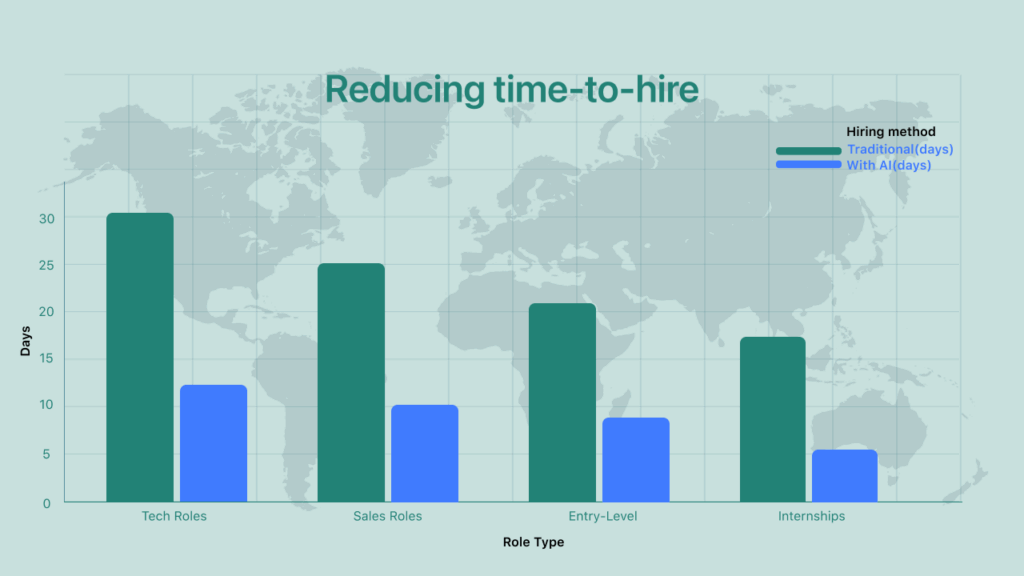
- Reducing time-to-hire: Time-to-hire has been a money-guzzling metric for companies. A long hiring funnel is not only expensive but also time-consuming. A vacant position means unrealized output.
A 2023 Lightcast and Fiverr Pro study found that unfilled roles cost U.S. employers approximately $1 trillion in lost opportunities. On average, an open position costs around $25,000 per month in missed revenue, and STEM roles can exceed $42,000/month.
So, you understand why companies make serious efforts to reduce their time-to-hire.
AI has been especially effective in draining this swamp. A global survey of recruiters (via Statista, LinkedIn, and shared by DemandSage) reported that approximately 86.1% of recruiters say AI makes the hiring process faster. Let’s take a closer look at two of the most impressive examples.
- Unilever processed 250,000 applications for 800 roles using AI-powered assessments, reducing its time‑to‑hire by 90%, slashing 70,000 staff hours, and generating over £1 million in annual savings.
- Hilton Worldwide implemented AI resume screening and video interviewing and reduced hiring time from approximately 42 days to just 5 days, an 88 to 90% decrease in time‑to‑hire.
The Mechanics behind how AI speedruns hiring
- Automated Resume Screening
AI saves a major chunk of the hiring time in parsing thousands of resumes in seconds. AI not only screens resumes but also ranks candidates based on predefined criteria.
This enables recruiters to focus on top talent and make quicker hiring decisions.
- Sourcing & Matching
AI can scan multiple job board databases and find passive candidates, improving sourcing efficiency and match quality.
- Scheduling & Engagement Automation
Chatbots and virtual assistants can handle scheduling, follow-ups, and FAQs, reducing hiring-funnel bottlenecks and unclogging shallow work that burdened hiring managers in the past.
Recruiter’s role in the AI era
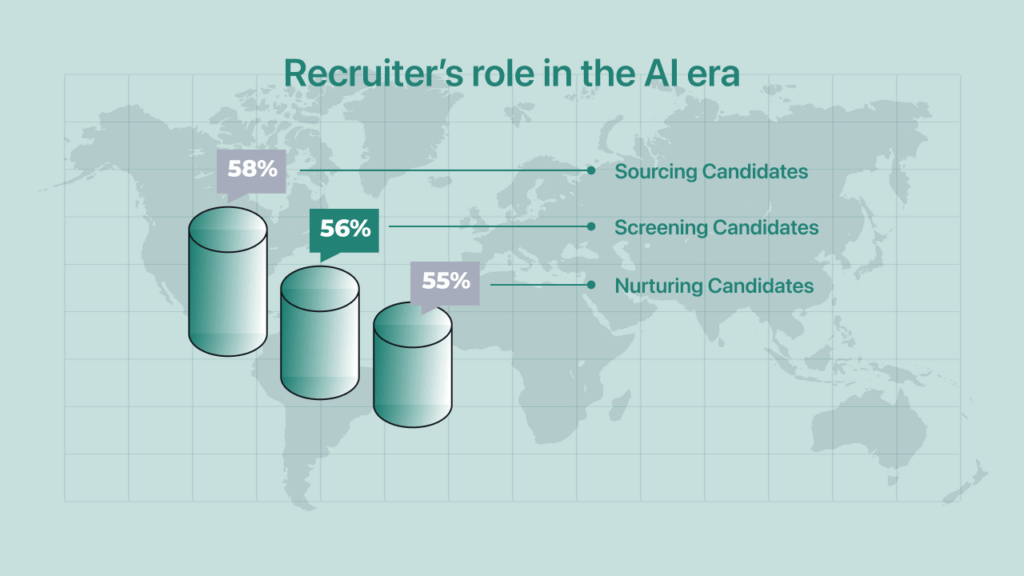
Pat Griffin, the Chief Revenue Officer at Randstad Digital, still doesn’t see recruiters as obsolete. As a recruiter with decades of experience, Griffin sees AI not as a replacement, but as an amplifier, freeing recruiters from routine screening so they can engage with candidates in a more meaningful manner.
He also explained how hybrid workflows, where AI handles volume and humans handle nuance, lifted candidate satisfaction by 25 percent.
Pat shares an incident where an AI screening tool flagged a perfect candidate as unfit, despite her matching every metric. Further inspection by a seasoned recruiter in his firm revealed that AI had flagged the candidate’s answer to a career setback as a disqualifier, whereas it spoke to her resilience.
A human insight rescued the candidate from being discarded by a machine.
This incident highlights the pitfalls of AI in the talent acquisition space. While AI is great at scanning candidates at initial touchpoints, it also tends to neglect nuanced indicators such as tone, passion, and cultural fit that highlight a candidate’s true potential.
So AI can’t be given unbridled power; it’ll need guardrails. That’s where human recruiters come into the picture. They will need to be the watchmen on the high tower. Rather than both sides looking to replace each other, we can expect a more symbiotic relationship between AI and recruiters.
What are the Concerns and Challenges?
An academic study by Wilson & Caliskan(2024) analyzed an LLM–based resume screening system using 1000 real resumes. It led to some shocking revelations.
The study found that white‑associated names were favored over other groups in 85.1% of cases, while Female‑associated names were favored in only 11.1% of the cases. Black men received the worst end of the bargain; they suffered discrimination in up to 100% of cases.
Amazon faced a similar fiasco when its AI recruiting tool started downvoting resumes with the word “women” in them. It caused such a PR nightmare that the company scrapped the entire project with immediate effect.
Class action lawsuits, out-of-court settlements, and red-faced companies having to tender public apologies tell you that AI is not inherently unbiased. It operates on the algorithm fed by humans. And sometimes, the unconscious biases of humans slip into these algorithms.
How to stop AI from playing favorites?
- Diversify training data. One of the most effective ways to combat AI bias is to ensuretraining data is inclusive, diverse, and representative of a wide range of candidates. This meansincluding data from diverse racial, ethnic, gender, socioeconomic, and educational backgrounds.
- Conduct regular bias audits. Companies should conduct frequent and thorough audits of AI systems for bias and discrimination. This includes its decision-making processes and studying its impact on different demographic groups.
- Build in Fairness Rules. Some modern AIs include “fairness constraints”. Fairness constraints are rules that enforce AI to make unbiased hiring decisions.
Summary
Unliever was among the pioneers to integrate AI models into their recruitment drives. Intel, IBM, and Vodafone quickly followed suit. After 2020, AI hiring has seen a burgeoning growth, with every big and small company adopting the technology. In a mere 6 years, from 2016 to 2022, the usage has gone from 10% to 50%.
We are looking at a future where it will go from cutting-edge to standard practice.
The AI recruitment market size is expected to witness significant growth, expanding from an estimated USD 1.5 billion in 2023 to a projected USD 5.9 billion by 2032, with a CAGR of 16.5% during the forecast period.
Needless to say, AI will become a staple for attracting top-quality candidates, given its promising results.
But it has not been all sunshine and roses; there have been a few hiccups along the way. As mentioned earlier, AI tends to exhibit bias. So, for now, human recruiters will need to keep a close vigil on the operations of these platforms.
The last thing an organization needs is bad press for hiring malpractices in this day and age.
About Us
ValueMatrix helps organizations build culturally cohesive teams with AI-powered recruitment and retention strategies. We educate corporate leaders on the importance of involving and encouraging all generations to adopt enterprise values and participate actively to achieve excellence.
Our AI-powered platform transforms talent acquisition with intelligent hiring techniques backed by established psychological frameworks. We partner with HR professionals to conduct unbiased and holistic assessments for aspiring candidates.
FAQs
Q1: Can AI assess the ‘coachability’ of a candidate?
To a degree. Gamified assessments are neuroscience-based games that help you evaluate the candidate on metrics like risk tolerance, perseverance, impulse control, empathy, and stress handling.
These assessments don’t give you a clear yes or no answer, but their data can provide a pretty clear outline of a candidate’s hireability, based on your company’s ethos.
Q2: Who should have the last word in hiring a candidate, the recruiter or AI?
It is a synergetic process. Recruiters can’t compete with AI models on scalability and work rate, but humans are needed to understand cultural context and ethical oversight.
Furthermore, AI doesn’t have the sentience to detect its own algorithmic bias.
So the answer lies in balance. Let AI do the grunt work, and let recruiters deal with the human elements.
Q3: Can late adopters of AI in recruitment still gain a competitive edge?
AI hiring tools are still in their pilot stage.
No, you’re not late. Your “lateness” allows you to observe what has worked and what hasn’t for others, and you can adopt best practices accordingly.
Also, the technology is changing by the minute. New models are being launched every day, making the old ones obsolete. That means there is no bad timing.