
Table of Contents
- Executive Summary: The 2026 Imperative
- What is Green HRM in the Age of AI?
- The Pillars of Sustainable & Fair Hiring with AI
- Operational Strategy: How AI Drives Green HRM Initiatives
- The Circular HR Model: A 2026 Innovation
- Green AI Infrastructure: Managing the Tech Footprint
- Sustainable Onboarding: Embedding Culture via AI
- The Decarbonized Talent Value Chain: Scope 1, 2, and 3
- Regulatory Compliance: Navigating the 2026 ESG Mandates
- Addressing Challenges: Bias, Greenwashing, and Privacy
- The ROI of Green HRM & AI: Financial & Ethical Dividends
- Conclusion: Beyond Compliance to Competitive Advantage
- Frequently Asked Questions (FAQs)
Key Takeaways
- Carbon Reduction: Green HRM and AI significantly reduce hiring-related carbon emissions through optimized digital workflows.
- Data-Driven Decisions: AI enables precise, real-time sustainability tracking across the entire talent lifecycle.
- Enhanced Fairness: A skills-first approach powered by AI improves workforce diversity and reduces algorithmic bias.
- Automated Compliance: ESG reporting is simplified through automated AI analytics, ensuring audit readiness for 2026 mandates.
- Stronger Brand: Implementing sustainable hiring practices improves employee retention and attracts top-tier Gen Z and Alpha talent.
Executive Summary: The 2026 Imperative
The Global Corporate Environment of 2026 Faces A Comprehensive Transformation. The Environmental, Social, and Governance ESG standards have evolved into fundamental evaluation methods that now determine investment decisions and consumer trust levels. The organization uses Green HRM as its main strategic tool to achieve its transformation goals through advanced technology, which connects human capital development with environmental sustainability.
Organizations can shift from minimal sustainable actions to complete data-based environmental management through the convergence of AI in Green HRM technology. The Growth Managers need to develop talent acquisition and development capabilities through environmental assessment methods because organizations now require them to comply with stricter carbon taxation and radical transparency regulations.
The 2026 mandate exists to establish Organizational Orchestration that extends past efficiency. The combination of AI with Green HRM enables businesses to guarantee that their new employees possess both the necessary skills and specific values that support a low-carbon future. The guide presents a method to create building infrastructure that will help organizations achieve their three essential goals of financial success, social responsibility, and environmental sustainability.
The Green AI movement exists to support sustainable longevity. The organization sustains its operational strength through sustainable hiring practices, which protect it from climate-driven market disruptions. Through your implementation of Green HRM and AI technology, you create a talent pipeline that maintains its viability throughout the upcoming regulatory transformations in the following ten years.
What is Green HRM in the Age of AI?
Green HRM and AI represent the application of artificial intelligence technology to streamline human resource procedures, which support environmental sustainability efforts. The organization uses data-driven methods to achieve two goals, which include decarbonizing the talent lifecycle and decreasing operational waste while establishing employee management practices that comply with worldwide ESG regulations.
The integration of AI in Green HRM provides the analytical “eyes” to see environmental waste that was previously invisible. AI can now track the carbon cost of a single recruitment cycle—from the electricity used by high-performance servers to the Scope 3 emissions generated by candidate travel. This level of granularity allows HR leaders to make informed, data-backed decisions that actually move the needle on corporate sustainability goals/
Green HRM uses human resource policies to achieve sustainable resource use and environmental protection. In 2026, this definition has reached its complete development. The process now extends beyond paperless operations and office supply recycling to include all activities that achieve talent lifecycle decarbonization.
AI in Green HRM assesses environmental waste through its analytical capabilities, which function as the analytical “eyes”. The system tracks all carbon emissions produced during a single recruitment process, from server electricity consumption to candidate travel emissions, which are classified as Scope 3 (Source: PwC). The level of detail provided allows HR leaders to base their decisions on actual data, which enables them to achieve corporate sustainability objectives.
Organizations can establish Eco-Scoring evaluation systems for their recruitment pipelines through the implementation of Green HRM and AI technologies. The process involves assessing the carbon emissions of various job boards, recruitment agencies, and software vendors to determine their environmental impact. The enterprise achieves sustainability across its supply chain through this ripple effect, which extends from its internal green practices.
Green HRM with AI produces a framework that defines essential environmental skills through the development of the Green Competency Framework. AI tools assess existing workforce gaps in Green Skills, which force workers to learn environmental knowledge needed for 2026 economic development. The organization secures essential knowledge capacity through proactive talent mapping, which enables it to develop sustainable innovation.
The definition now includes “Autonomous Stewardship”, which appears during the Agentic AI era. The company now programs its AI systems to automatically deny high-emission travel requests while providing sustainable logistics suggestions for major recruitment events, as the company establishes sustainability as its standard operating procedure.
How does AI enable Green HRM?
Green HRM receives its support from AI through three functions, which include environmental metric tracking, automation, and resource allocation optimization, and the transition from carbon-intensive manual methods to digital-first processes. The system provides necessary forecasting capabilities that allow the prediction of environmental effects resulting from employee expansion and hiring activities.
AI functions as a strategic engine for Green HRM because it uses sustainability policies to create automated workflows that produce minimal environmental effects. AI uses its ability to process large datasets because it can identify talent lifecycle inefficiencies that human supervisors might overlook.
The comparison between traditional HR operations and the AI-driven Green HRM model shows how the shift occurs.
| HR Activity | Traditional Model | Green HRM + AI Model |
| Documentation | Paper-based contracts & physical filing. | 100% digital, cloud-encrypted workflows. |
| Recruitment | High-travel interviews & broad ad spend. | Virtual-first loops & energy-efficient targeting. |
| Onboarding | Physical welcome kits & manual training. | Digital “Green Kits” & AI micro-learning. |
| Office Management | Fixed climate control & lighting. | Smart-office AI synced to HR attendance data. |
| Vendor Selection | Cost & speed-focused. | Automated ESG & Carbon-Neutral verification. |
The Digital Transformation of Documentation marks the first significant outcome that results from this transition. The AI-powered systems execute digital management for all contract processes, background verification, and benefit registration tasks. The system enables large companies to stop wasting thousands of tons of paper every year.
AI technology provides Geographic Intelligence support. The system uses office hub locations with talent distribution data to decide which roles require remote-first work or office-based work. The process decreases energy usage by eliminating daily commuting and unneeded business travel.
👉 See how ValueMatrix enables sustainable hiring — Request a Demo
What Are the Key Pillars of Green HRM and AI?
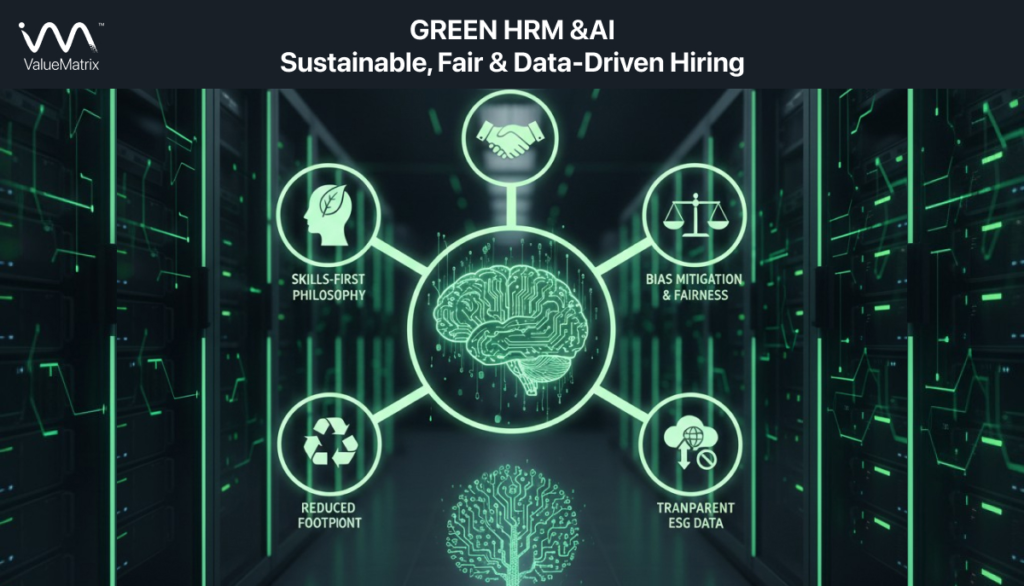
The main elements that support Green HRM and AI operation consist of four aspects, which include environmental protection methods, algorithmic fairness standards, data accessibility rights, and skills-first employment approach. The human resource technology system needs to achieve two goals, which include decreasing carbon emissions through its operations and delivering ethical and transparent talent management processes.
- Algorithmic Fairness: Ensuring Green HRM with AI doesn’t inadvertently filter out diverse talent. Inclusive hiring is a form of social sustainability. Make Sure Inclusivity is Part of Your AI Implementation Plan.
- Data Transparency: Providing auditable ESG data. In 2026, stakeholders demand proof of “Green” claims. AI provides the real-time tracking necessary for this.
- Skills-First Philosophy: Moving away from biased credentials to objective skill verification. AI Skill Assessment in Recruitment Improves Hiring Process.
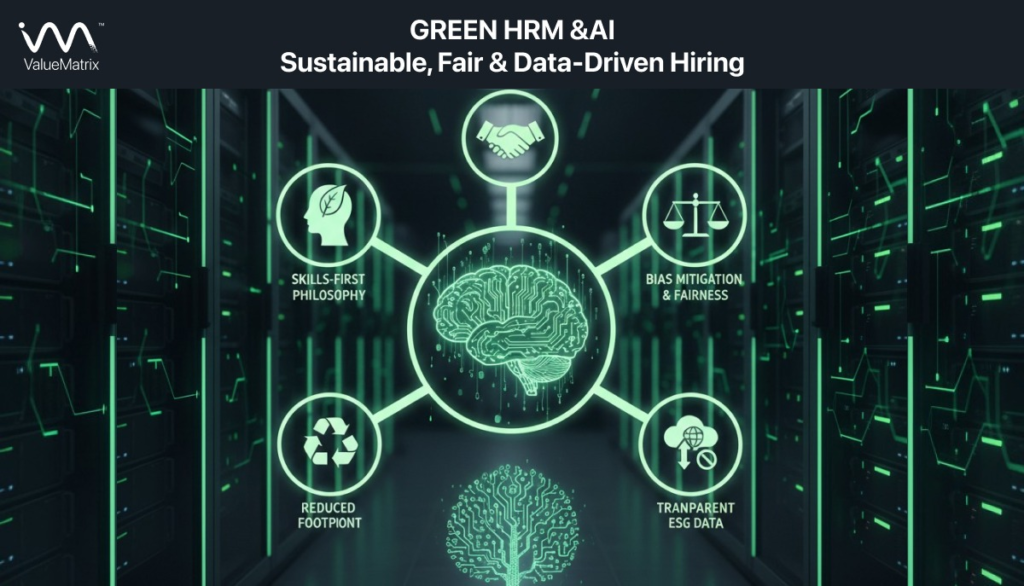
AI requires four essential principles that create sustainable hiring processes through their ethical preservation and environmental protection.
- Environmental Impact Mitigation: AI develops virtual interview programs using geographic talent mapping to reduce Scope 3 emissions.
- Algorithmic Fairness: The Green HRM with AI must provide access to diverse talent pools that need to be selected in the hiring process. The practice of inclusive hiring creates pathways for social sustainability development. Your AI implementation requires you to establish inclusivity requirements in your planning process.
- Data Transparency: The organization must establish a system that enables public verification of its environmental, social, and governance (ESG) information. Stakeholders require proof of “Green” claims from organizations by 2026. The AI system enables the organization to monitor progress toward its operational goals at all times.
- Skills-First Philosophy: The organization should base its credentialing system on unbiased skill verification instead of using biased educational requirements. The hiring process improves through AI skill assessment, which enables organizations to identify qualified candidates.
The organization built an ethical foundation through these three pillars of the framework. The “skills-first” approach of AI helps organizations identify talents who possess green innovation skills instead of those who only attended specific universities. The green economy becomes accessible to everyone while ensuring that top talents maintain control over its progress.
The three pillars of the system create a self-sustaining mechanism that maintains its operations. The data transparency enables auditors to examine fairness across the organization, while the fair process creates an environment that attracts diverse talent needed to solve environmental problems. The organization demonstrates mature AI and Green HRM capabilities through its complete Green HRM implementation system.
The “Governance-as-Code” system enables organizations to set environmental restrictions that their technology operations must abide by. The governance layer enables the automatic replacement of any energy-intensive AI assessment model with a more efficient “Lean AI” model.
Knowing the Operational Strategy: How AI Drives Green HRM Initiatives?
AI in Green HRM powers through its capacity to transform operational plans into green HRM execution. Through AI Green HRM strategic implementation processes, the organization achieves sustainability beyond its policy handbook into its automated workflows. The Digital Transformation of Documentation starts with the first major impact. The AI-driven platforms enable organizations to manage all aspects of contracts, background checks, and benefit enrollments through digital processes, which eliminate the need for paper documents, leading to annual savings of thousands of tons of waste for large companies.
AI supports Geographic Intelligence through its ability to analyze talent locations, which people know from their work at office hubs and project sites. The AI system analyzes talent distribution across two locations to determine whether workers should adopt remote-first roles or implement “low-travel” recruitment methods. The system helps organizations achieve lower energy consumption by decreasing their need for office-based staff members who have to commute to work every day and travel for business purposes.
AI helps organizations optimize their recruitment marketing through its AI-powered solution. Green HRM and AI implement digital advertising systems that use less energy by connecting with specific users who match their candidate profile, instead of showing ads to everyone. The organization achieves a “Low-Impact” digital footprint through its advertising network, which decreases energy use by reducing website server demands for running those advertisements.
AI screens applicants through its energy-efficient platform. The system starts with basic text analysis, which requires minimal computational power, and then moves to video interviews for final candidates, leading to substantial energy savings across the whole recruitment process.
AI provides organizations with the tools they need to achieve carbon-neutral vendor management. The HR department establishes AI technology to supervise its technology providers while they provide current data about their environmental impact. The AI system identifies compliance risks when vendors use non-renewable energy as their primary source of power.
What is the Circular HR Model in Green HRM and AI?
The Circular HR Model is a sustainable approach to managing talent, prioritizing internal employee movement and skill development before considering external candidate recruitment. The system uses AI to identify workers who are experiencing job changes and to map their current skills to emerging environmental employment roles within the company.
The Circular HR Model will become a groundbreaking development in 2026 through its operation based on Green HRM and AI systems. Traditional HR processes follow a linear path, which includes hiring and using employees until they leave the organization. Circular HR focuses on “Retention and Redeployment” as its core operational principle. AI identifies internal talent whose roles may be becoming obsolete and maps their skills to new, “Green” roles within the company.
The model decreases both the environmental footprint and financial expenses that organizations face when they require new staff members from outside their current workforce. The “recycling” of talent enables organizations to keep their institutional knowledge while removing the need for new recruitment cycles, which create carbon emissions.AI in Green HRM is the engine to track skill differences, which enable employees to transition into new roles.
The Circular HR model extends to Knowledge Sustainability. AI systems enable companies to collect knowledge from their departing employees while preserving the “Sustainability Intelligence” within their organization. The process of “Brain Drain” leads to organizations restarting their environmental programs because they require complete data collection from all their workers.
The circular design approach applies to all types of equipment and hardware products throughout the system. AI tracks the lifecycle of employee laptops and mobile devices, ensuring they are refurbished or recycled through proper “E-Waste” channels. The HR-managed workforce will not send its digital tools to landfills.
The organization implements sustainable outplacement through its circular HR program. The AI system matches employees who need to find new work with “Green” companies from the ecosystem. The environmental training organization will create ongoing benefits for the planet, even when the organization no longer requires its specific environmental training courses.
How Does AI Infrastructure Impact Green HRM Sustainability?
The Circular HR Model is a sustainable approach to managing talent, prioritizing internal employee movement and skill development before considering external candidate recruitment. The system uses AI to identify workers who are experiencing job changes and to map their current skills to emerging environmental employment roles within the company.
Machine learning models in 2026 face criticism because they generate their own greenhouse gas emissions. To achieve complete environmental sustainability, Green HRM with AI needs to operate on Green AI Infrastructure, which uses environmentally friendly AI systems. The process requires organizations to select AI providers who operate carbon-neutral data centers and use data processing methods that depend on “Sparsely Activated” models, which consume less power for their operations.
AI tools used by Growth Managers require evaluation to determine their power consumption efficiency. Organizations should implement Green HRM and AI according to their environmental needs by selecting algorithms that meet their requirement for “Lean by Design” operations. The most effective AI tools in 2026 combine high accuracy with minimal need for processing power, thus decreasing the environmental costs that remain hidden within digital HR systems.
Organizations have begun implementing “Data Pruning” methods to cut down their data storage needs. AI identifies redundant, obsolete, or trivial data, which it then removes from the system. The reduction of candidate data storage leads to a major decrease in cloud storage energy consumption, which organizations need to support their Green HRM practices.
Organizations have begun transitioning to “Temporal Computing” systems. The system schedules AI processing of non-urgent tasks (such as large-scale resume parsing or internal skill audits) during periods when the power grid receives excess renewable energy from wind and solar resources to decrease carbon emissions from the technology infrastructure.
The shift toward Edge AI technology gains momentum throughout the world. The HR department decreases its energy needs by moving data processing from cloud-based systems to local device processing. The situation holds particular importance for mobile-first recruitment systems, which operate in emerging markets that face challenges with grid stability and high energy costs.
How Does AI Enable Sustainable Onboarding?
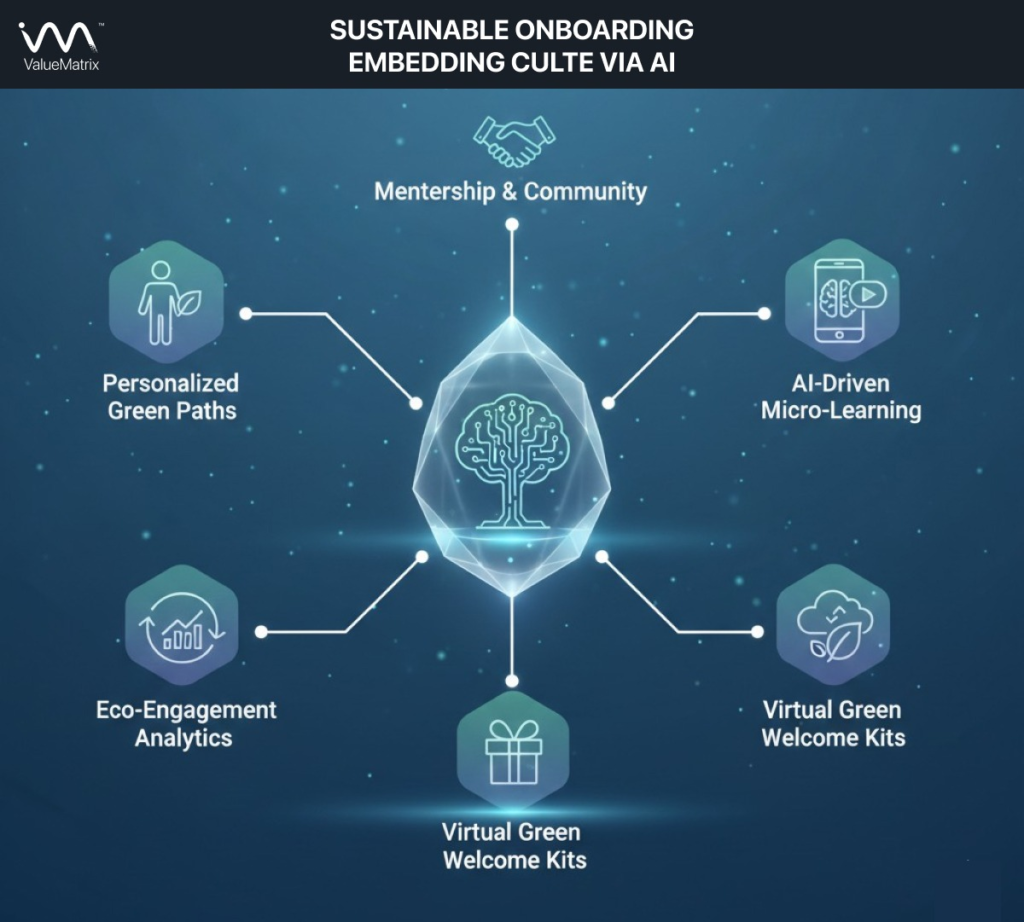
The process of sustainable onboarding, which uses AI technology, replaces conventional onboarding methods, which require excessive resources through the creation of customized digital pathways. The system uses artificial intelligence to connect new employees with designated Green Mentors while it handles the automated distribution of virtual welcome packages and delivers micro-learning content with low bandwidth requirements to introduce environmental culture from the first day.
The first 90 days of an employee’s tenure are critical for establishing a “Green” mindset. Green HRM and AI transform onboarding into a sustainability experience rather than treating it as a compliance requirement. AI-powered “Green Onboarding” pathways create customized experiences that demonstrate to new hires how their roles support the company’s goal of attaining carbon neutrality.
AI helps organizations identify “Green Mentors” who act as mentors for newly hired employees. Green HRM with AI uses social graph analysis and shared environmental interests to build connections that improve the company’s internal sustainability network. The practice establishes a culture of environmental protection from the first day of employment.
AI-based Micro-Learning platforms provide employees with short sustainability training sessions. The system provides employees with ongoing updates about personal and professional environmental responsibility through low-bandwidth channels instead of conducting an energy-intensive seminar. “Green” becomes a regular point of focus for employees throughout their careers.
AI systems autonomously handle the process of sending “Virtual Green Kits” to recipients. AI-based onboarding solutions replace physical swag items, which require plastic and shipping, with digital sustainability platform subscriptions and carbon offset credits for the employee’s first year and digital vouchers for local sustainable shops to enable corporate consistency in the “welcome” experience.
AI systems keep track of how much new employees participate in Eco-Engagement activities. AI enables HR leaders to obtain data about department sustainability strategies by monitoring employee participation in environmental initiatives and sustainability training programs.
What is the Decarbonized Talent Value Chain?
The decarbonized talent value chain framework evaluates carbon dioxide emissions through three measurement approaches, which include office energy usage for Scope 1 and digital energy consumption for Scope 2, and all activities, which include candidate travel and third-party vendor services for Scope 3.
In 2026, “Green” becomes a defined term that requires assessment through the Greenhouse Gas (GHG) Protocol. Green HRM and AI now enable organizations to assess their emissions across all three scopes of their talent value chain.
- Scope 1 (Direct Emissions): The AI system controls the smart office environment through real-time HR data, which detects actual personnel presence to operate climate control and lighting systems, thus decreasing building emissions.
- Scope 2 (Indirect Energy): The HR department ensures that its digital operations maintain a carbon-free status by selecting AI vendors who utilize renewable energy sources for their operations.
- Scope 3 (Other Indirect): The Other Indirect category presents the most significant obstacle. AI technology helps shift work-from-home ratios while checking the emission levels of “Third-Party Recruiters” to maintain compliance throughout the complete talent supply chain.
AI detects high-travel recruitment techniques used by a particular recruitment company through its investigation of Scope 3 emission data. The Green HRM and AI system will then recommend that the company switch its contract to a digital-first vendor, which will instantly raise the company’s ESG score.
The AI system enables employees to monitor their work-related carbon emissions for personal tracking. The “Eco-Dashboard” system encourages employees to transform their individual Scope 3 impact through a gamified approach, which includes selecting environmentally friendly commuting methods and building efficient setups for their home offices.
The AI system creates predictive models that show how workforce changes (such as a 20% workforce increase) will change the organization’s future carbon obligation commitments. Organizations can create proactive mitigation strategies to tackle potential issues instead of needing to respond to emergencies.
How Do You Ensure ESG Compliance in Green HRM?
Organizations need AI systems to gather and report data on workforce diversity and retention rates and environmental impacts to maintain their ESG compliance requirements. This system enables organizations to achieve their auditing needs by delivering EU CSRD and SEC climate disclosure standards with complete accuracy.
Global environmental reporting requirements started in 2026 because the European Union established its Corporate Sustainability Reporting Directive (CSRD) and the SEC introduced several climate disclosure mandates. The combination of Green HRM with Artificial Intelligence serves as the sole solution for managing the extensive data requirements needed to meet compliance standards.
Artificial Intelligence systems collect and analyze information about workplace diversity rates, employee retention statistics, and the environmental impact of Human Resources operations. The organization uses the processed information to create annual reports which maintain audit readiness throughout the entire year. The system decreases HR teams’ workload through automated processes while eliminating all potential human errors during the reporting process.
AI-driven “Compliance Sentinels” monitor changing global laws in real-time. All AI systems designed for Green HRM with AI system screening must update their protocols when new jurisdictional laws concerning “AI bias in recruitment” are implemented.
AI supports all Vendor Compliance activities through its various functions. The organization evaluates all HR technology vendors based on their compliance with global sustainability requirements, which include ISO 14001 standards. The company’s “Green” status will remain intact because the non-compliant third-party vendor will not affect its certification status.
The transparent operations of AI technology function as a protective barrier against all regulatory financial penalties. Companies can demonstrate their hiring process logic and the environmental consequences of HR decisions, which prevents them from facing the multi-million dollar fines that 2026 regulators impose on opaque or non-compliant firms.
Addressing Challenges: Bias, Greenwashing, and Privacy
The Green HRM and AI combination holds great potential, but organizations must solve important challenges to achieve its full advantages, which include solving algorithmic bias problems and preventing organizations from committing “greenwashing” violations. AI systems that operate without limits create dangers because they strengthen human biases, which leads to unfair treatment of employees who implement green HRM. Organizations must use Green HRM to establish their ethical AI framework, which they require to decrease algorithmic bias. The organization needs training datasets that contain various and representative data for ongoing bias evaluations according to their operational requirements.
To prevent algorithmic bias, organizations must implement ethical AI in Green HRM by utilizing training datasets that contain diverse and representative data while performing ongoing bias audits. The hiring decisions made through algorithms require transparency tools like Explainable AI (XAI), which people depend on to comprehend their decision-making processes. From Data to Decisions: Predictive Analytics in HR.
Organizations use greenwashing to create a false image that they practice environmentally friendly activities while hiding their actual environmental impact. AI systems for automated green claims require two fundamental verification steps, which include complete data verification and independent organization-based external verification. Organizations need to show results on all digital operations that reduce carbon emissions from recruitment activities through public reporting.
Data Privacy stands as one more element that organizations must tackle. The organization collects sensitive data to track employee and candidate behavior for its “green” metric system. Green HRM and AI systems must use “Privacy-Preserving Computation” methods, which include differential privacy, to protect individual privacy rights. The second challenge people face is called “Over-Automation,” which shows that people need to work despite AI system improvements that boost productivity. Organizations need to create a “Green HRM” experience that maintains a human touch instead of turning into an automated system. The “Human-in-the-Loop” (HITL) model is a crucial requirement for final hiring and redeployment decisions, which require empathetic understanding and cultural knowledge.
What is the ROI of Green HRM and AI?
The return on investment for Green HRM and AI technologies gets assessed through three specific outcomes, which include a 40% reduction in hiring expenses, a 30% decrease in energy costs, and a 25% drop in staff turnover rates. The solution provides direct savings, which enable capital cost reductions of up to 12% because ESG investors prefer to invest in companies that demonstrate strong sustainability performance.
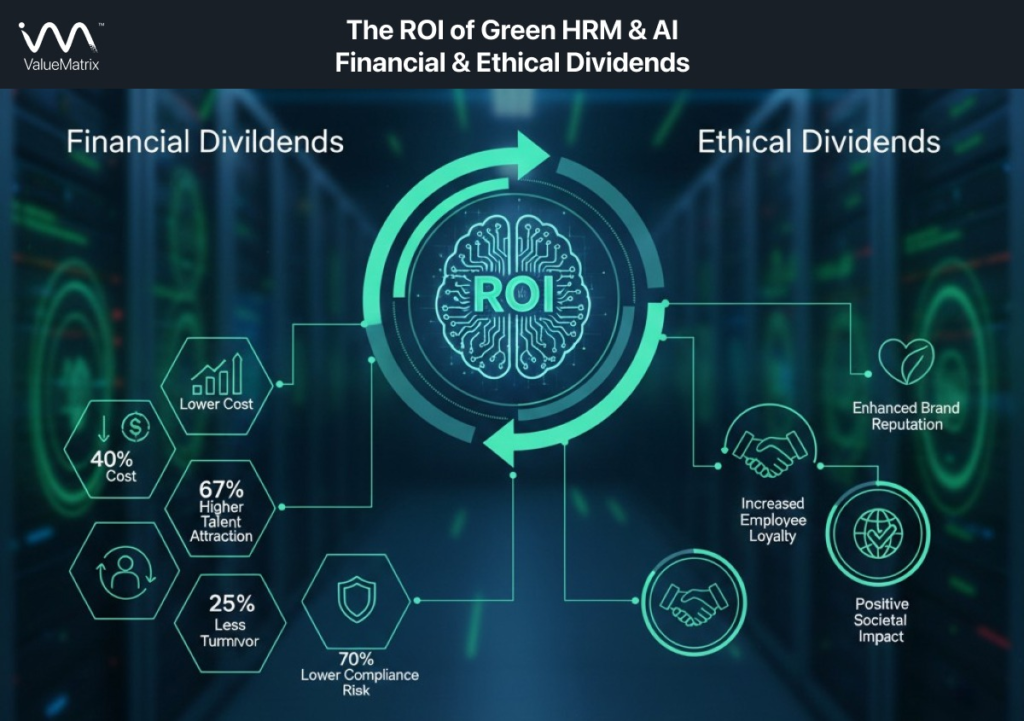
The investment in Green HRM & AI results in major financial returns because it creates business value beyond its ethical implications. The organization measures its ROI through four different business sectors that will exist in 2026.
| Metric | Traditional Hiring | Green HRM & AI Impact | 2026 Financial Benefit |
| Recruitment Cost | High (Travel/Paper/Agencies) | 40% Lower | Reduced overhead & automation. |
| Talent Attraction | Passive Brand | 67% Higher Application Rate | Gen Z/Alpha prefer Green firms. |
| Employee Turnover | 15-20% Annual | 25% Lower | Purpose-driven work increases loyalty. |
| Energy Costs | High Cloud/Office Waste | 30% Reduction | Efficient MLOps & Smart Offices. |
| Compliance Risk | Manual/Prone to Bias | 70% Lower Litigation | Predictive Analytics in HR |
The Brand Equity, which exists as intangible assets, creates additional value because it extends beyond the calculated numerical data. The companies that bankers and ESG investors identify as “Sustainability Leaders” during 2026 will experience 12 per cent lower capital costs because their financial institutions view their operational assets as less hazardous.
The implementation of Green HRM with AI generates “Innovation ROI” for organizations. Organizations create sustainable products by hiring and training employees with environmental awareness, thereby generating new business opportunities in the circular economy.
The company’s productivity generates return on investment. Employees who feel their company’s values align with their own (such as environmental stewardship) are 30% more engaged and productive. The “discretionary effort” is the primary driver of corporate expansion for businesses in 2026.
Why Choose ValueMatrix for Green HRM and AI?
The reasons to select ValueMatrix for Green HRM and AI implementation are explained in Section 16. The 2026 workforce transformation begins with ValueMatrix as our company base. Our platform goes beyond hiring automation because it enables your human capital strategy to support environmental sustainability efforts.
AI-Driven Hiring: Manual screening processes, which consume excessive energy, can be replaced by lean models that deliver high-accuracy results.
ESG Alignment: The system generates all required reports, which your company needs to fulfill worldwide compliance obligations (CSRD/SEC).
Predictive Analytics: The system predicts workforce growth patterns, which will determine your organization’s future carbon emission reduction commitments.
👉 Discover how ValueMatrix transforms hiring — Request a Demo
Summary: The Future of Sustainable Talent
The sustainable talent market will advance according to the upcoming trends, which will occur until 2026. The combination of Green HRM with AI technology enables organizations to achieve both their environmental goals and their business growth targets. The transition to purpose-driven operational models enables organizations to achieve two advantages, which include decreasing operational expenses and enhancing their ability to attract top talent. Your organization achieves decade-long transformation readiness through talent value chain decarbonization, which establishes resilience and compliance.
Frequently Asked Questions (FAQs)
1. What is Green HRM, and why is it a priority in 2026?
Green HRM requires organisations to connect their human resource activities, including hiring and training, and employee management, with their environmental sustainability objectives. The year 2026 requires this because climate regulations become more stringent while carbon costs remain high, and 76 per cent of job seekers choose environmentally friendly companies as their top preference.
2. How does AI in Green HRM reduce the carbon footprint of hiring?
AI in Green HRM reduces carbon footprints by optimizing virtual interview loops to eliminate travel using “Lean AI”. These models consume less server energy and utilize geographic data to suggest remote-first or local hiring strategies that minimize commuting emissions.
3. Do Green HRM and AI help with diversity and inclusion?
Yes. In 2026, “Social Sustainability” will become a key element of Green HRM operations. AI functions as a tool that eliminates hiring process bias for companies that want to construct their “Green Economy” workforce from diverse talent pools. The “Sustainability Gap” occurs when different demographic groups experience unequal access to emerging green job opportunities.
4. Can small businesses implement Green HRM with AI effectively?
Absolutely. Small businesses can access “Green SaaS” platforms, which function as HR tools to achieve their business objectives since they need to comply with carbon-neutral cloud operating standards. The company can reach the same financial return on investment and compliance achievements as large corporations through this approach without needing to spend on extensive research and development.
5. How does AI ensure fairness in Green HRM?
AI fairness is established through its use of skills-based assessments, which replace traditional credential-based screening methods that contain bias. The Green HRM framework considers “Social Sustainability” to be its third fundamental element in 2026 as AI systems undergo auditing to eliminate algorithmic bias in the inclusive transition to green economic practices for all workers.
6. What are the primary challenges of implementing Green HRM and AI?
The main difficulties arise from handling data privacy issues, preventing “greenwashing” practices, and controlling algorithmic bias problems. Organizations need to adopt “Privacy-Preserving Computation” methods to secure candidate information while applying “Explainable AI” (XAI) for transparent ethical hiring decisions that reflect genuine environmental impact instead of misleading environmental claims.
7. How do Green HRM and AI improve employee retention?
Green HRM and AI help organizations retain employees by matching their work responsibilities with their personal beliefs and dedication to environmental sustainability. Employees become 30% more dedicated to their job when their organization shows commitment to environmental protection, according to the data. Employees will stay with their organization for 25% longer because AI helps them discover growth opportunities within the company.
8. How do AI-driven Green HRM tools track ESG metrics?
AI-driven tools track ESG metrics through their automated data collection process, which monitors recruitment, energy consumption, workforce diversity, and digital waste. The system generates real-time dashboards that maintain audit readiness for 2026 regulation requirements, such as the CSRD, to enable businesses to demonstrate their sustainability progress through verified documents to stakeholders.