
Positive work culture and highly engaged employees lead to 21% higher profitability for the company, as per a study by Gallup. You can imagine what that kind of metric can drive people to do in their businesses.
If the title wasn’t a dead giveaway already, perhaps you, as an employer or employee, might be indulging, or getting indulged in similar tactics to either think you are providing a positive work experience, or working in a company that offers a positive work culture.
No need to fret, we’ve all been there. And as you proceed through this piece, you might find yourself asking questions that you didn’t give a second thought to earlier. Having a positive work culture matters, not just in increasing profitability, but also in decreasing attrition rates and preserving the company’s goodwill. It’s the way that most of us go about it that throws a wrench in the works.
Can you define light without darkness or positives without negatives? Contrasts bring across why we prefer one thing over another. And it’s the right mix of bittersweet experiences that make working at a place fun.
That is essentially what most of us have forgotten in the mad rush of trying to prove a point by aping big texts and kowtowing to societal norms. Let’s talk about some popular myths or assumptions about positive work culture:
Popular myths or assumptions about positive work culture
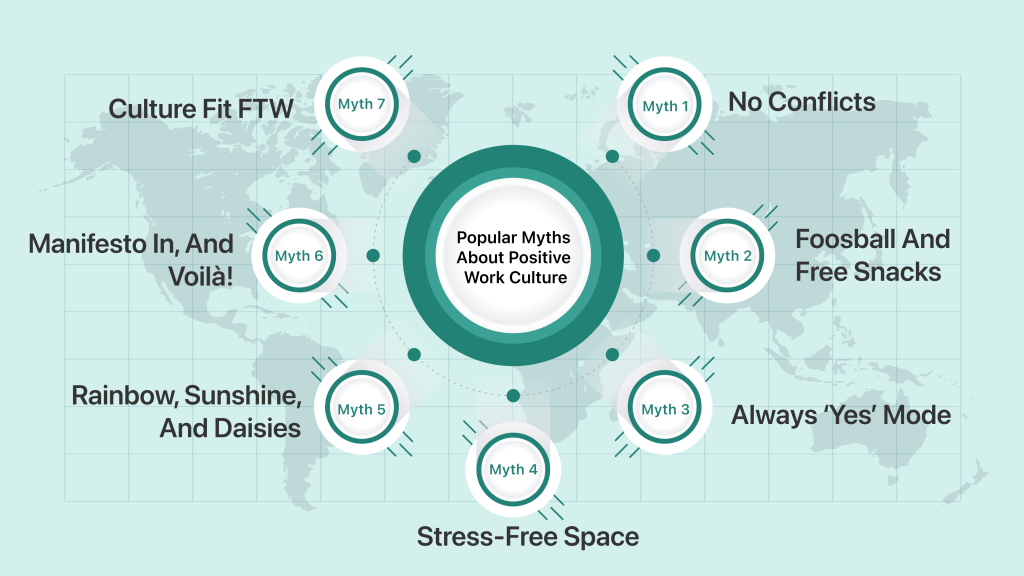
1. No Conflicts
This is the most absurd assumption ever for a positive work culture. Yes, we are not speaking about bar fights and brawls, but constructive disagreements are the backbone for growth, innovation, and improvements. If you get a ‘yes-boss’ dude for every hire, you might as well create clones of yourself to work for you. While they will not have the same efficiency as you in the task you excel at, they will fail at everything you can’t understand or do. Diverse, qualitative, and quantifiable arguments form the bedrock of a positive work culture.
2. Foosball and Free Snacks
Even free lunches cannot ensure people will stay engaged. If you have even a bit of understanding of how politicians play the game in democracies, you know freebies go the opposite way of improving an economy. Trust, transparency, communication, and mutual trust are the ways to convey why perks or reward systems exist, and they, in turn, drive engagement.
3. Always ‘Yes’
This point kinda bears similarity with the first one, but different in a way that employees or employers do not always need to agree with each other. Understanding their POV is one thing, but charting out boundaries and realistic workloads is also important. Saying ‘No’ can be a way to further creativity.
4. Stress-free Space
Stress is like friction. You might curse it, but it has to be. Even the human body produces cortisol because stress is inescapable. What’s important is having the tools and methods to handle or alleviate stress. Namely, teamwork, open dialogues, flexibility in work, etc.
5. Rainbow, Sunshine, and Daisies
No, a workplace or even a personal space cannot be nice all the time, realistically. Trying to achieve that will drive things to become even worse. Through authenticity and accountability, you can counter superficial niceties.
6. Manifesto In, and Bob’s Your Uncle
A positive work culture takes time to build. It’s not a one-time process, especially if your employees aren’t immortal. Also, if you’re hiring new ones as the situation deems fit. Think of it as working on SEO for your website; you’ll have to keep tweaking it.
7. Culture Fit FTW
Yes, and no. While hiring for culture fit is all the rage nowadays, you want to avoid groupthink and internal cell formation. Out goes the positive workplace culture because then, no one outside your ‘culture’ can contribute their brains to your business.
Instead, hiring for ‘cultural add’ can be your mantra, where your workplace evolves in a way that makes the company grow.
I’m pretty sure by now you’d have mentally time-traveled back to some prime examples of the above. In case you’re new to the field, here are some examples. These are trivial, but are projected to be part of a positive work culture.
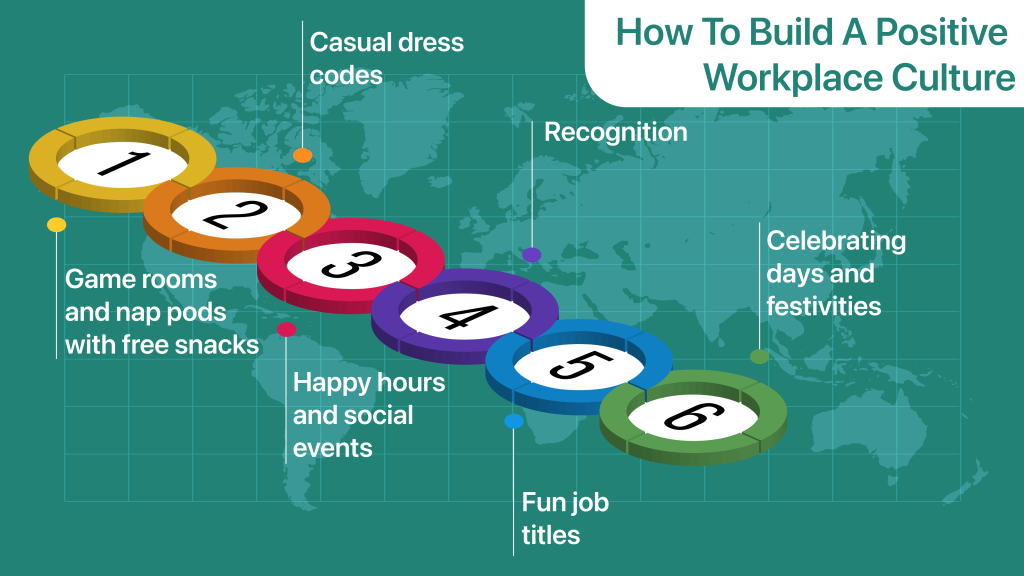
- Game rooms and nap pods with free snacks and beverages divert focus. It drives you from inapt compensation, unrealistic workloads, and a messed-up work-life balance.
- Casual dress codes are just ‘comment codes’. They do not offer any functional help, neither to the company nor to the employees. When was the last time your jeans helped you reach your targets?
- Happy hours and social events are no excuse for team collaboration and timely feedback, or support. Plus, you don’t know who is being pressured to attend something just for the sake of it.
- While recognition plays an important role, making it a regular thing makes it mundane, introducing unnecessary conflict and bias, leading to no quantifiable results. A prime example is the “Employee of the Month/Quarter/Year” award.
- Fun job titles are ‘fun’ only to those who got them approved. They are unclear to the world outside and diminish the importance of the roles and responsibilities involved. Though it makes for a great gimmick in projecting a positive work culture.
- Celebrating days and festivities for the sake of ‘diversity’ without having any business impact or connection to them makes the effort hollow. It might get you a few likes on social media, but deep down, everyone has already understood this ploy, yesterday.
- Trivial things like perks and events are often overemphasized to project a positive culture. They can be hollow without addressing the fundamental elements of a supportive, inclusive, and growth-oriented work environment.
In reality, creating a positive work culture is about fostering an environment where employees feel valued, supported, and empowered to do their best work, not about removing discomfort or offering surface-level perks.
About us
ValueMatrix helps organizations build culturally cohesive teams with AI-powered recruitment and retention strategies. We educate corporate leaders to involve and encourage all generations to adapt to enterprise values and participate actively to gain excellence.
Our AI-powered platform transforms talent acquisition with intelligent hiring techniques backed by established psychological frameworks. We partner with HR professionals to conduct unbiased and holistic assessments for aspiring candidates.