
In recent years, we have seen a dramatic shift in the way companies hire. They now receive hundreds of thousands of applicants for a single position. How do you deal with such immense data? How do you hire the right fit? Conventional recruitment methods are inadequate, to say the least. Manual screening of CVs takes days out of your recruitment team and increases the chances of a qualified candidate just slipping through the cracks. Your time-to-hire is up from days to weeks, and top talent has decided to move to an offer elsewhere. All in all, not an efficient process.
One practical solution that has come up is using Natural Language Processing (NLP) to solve this bottleneck. The global NLP market isexpected to be valued at around 26.01 billion dollars in 2025 and show a CAGR of 23.4% to reach a valuation of up to 213.54 billion dollars by 2035. Specifically, in the recruitment segment, 67% of companies are now employing some kind of AI in their hiring processes, and 58% ofHR professionals think investing in AI is their top choice for new tech integration. The results speak for themselves: organizationsusing AI report 89.6% greater hiring efficiency, 85.3% time savings, and 77.9% cost savings.
This article examines four proven use cases where NLP transforms hiring: resume screening and parsing, intelligent candidate matching, interview assessment and sentiment analysis, and bias detection in job descriptions. Each application addresses real recruitment pain points with measurable results.
Use Case 1: How Do You Cut Through Noise?
Resume screening and parsing might be the answer.
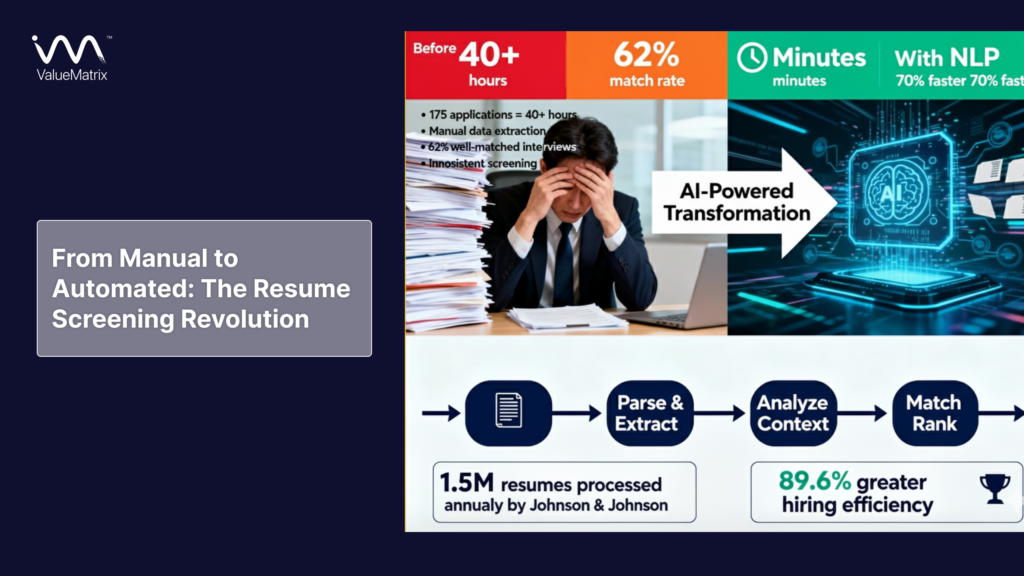
Of all the activities under the umbrella of recruitment, screening of heaps of CVs still remains the most labor-intensive stage. The hiring team spends hours reviewing each application, extracting relevant skill-related data, qualifications, and experience. This process gets overwhelming for high-volume positions. A single software developer rolecan attract 175 applications, requiring 40+ hours of manual review.
NLP-powered resume parsing technology processes this workload in minutes rather than days. AI-powered systems are able to scan CVs in any format, be it PDF, Word, or plain text. It can parse and extract relevant information in seconds. What’s more important is that NLP understands context. It’s not just matching simple keywords. If a candidate describes “leading cross-functional teams to deliver projects under tight deadlines,” the system recognizes project management skills even without that exact phrase appearing.
There are several distinct steps in this parsing process. Firstly, the system translates resume text, which is typically unstructured, into something that it understands, i.e., machine-readable data. It then figures out different sections like work experience, skills, and education, and creates a recognizable pattern and fit for natural language understanding. Next, it identifies specific data points such as company names, job titles, employment time, certification & education degrees, and technical competencies. The data shows high levels of efficiency. Advanced NLP models have achieved 94% in CV parsing and 89% accuracy in matching the right skills.
Consider thepractical impact. Global pharma giant Johnson & Johnson deployed an NLP-powered hiring system. It processes 1.5 million per year, assessing 50+ data points for each candidate. This system saved J&J 70% of their screening time. It also increased candidate diversity by 17% and raised the well-matched candidate interview rate to 85%, up from 62%. These are not incremental improvements. It’s a fundamental transformation in how recruitment teams use their time.
The technology also handles variations in how candidates present their experience. A candidate with “5+ years of experience in managing Python-driven data processes” and another with “extensive experience in data engineering using Python” are both labelled as Python developers. The NLP hiring system understands synonyms, related technical skills, and concepts that simple keyword filters tend to miss. This contextual knowledge helps recruiters to keep hold of qualified applicants instead of them being filtered out of the top end of the funnel due to faulty resume formatting or incorrect word choice.
Companies using AI-powered hiring software for screening CVs have seena 70%drop in overall time-to-hire. This gives them a sort of nimbleness to secure the best talent quickly. Such nimbleness can give them a competitive advantage in the long run without sacrificing quality. In fact, new age AI-powered hiring systems showaccuracy of over 90% in finding the right candidates, which significantly exceeds that of humans on such high-volume tasks.
Use Case 2: How Do You Find the Right Fit?
The Answer Might Be Intelligent Candidate Matching
Matching applicants to job requirements is much more than simply ticking off the qualification list. The right candidate has the perfect combination of relevant experience, technical knowledge, and growth potential. Manual hiring leans a lot on the experience and intuition of a recruiter. And it can lead to inconsistent results across various hiring managers.
NLP-led hiring process turns this subjective process into a more data-driven assessment. The tech examines job descriptions as well as candidate profiles to understand the semantic relation needed between the given qualifications and experiences. The algorithm then compares profiles to the requirements through a sophisticated matching engine and gives out compatibility scores on various factors.
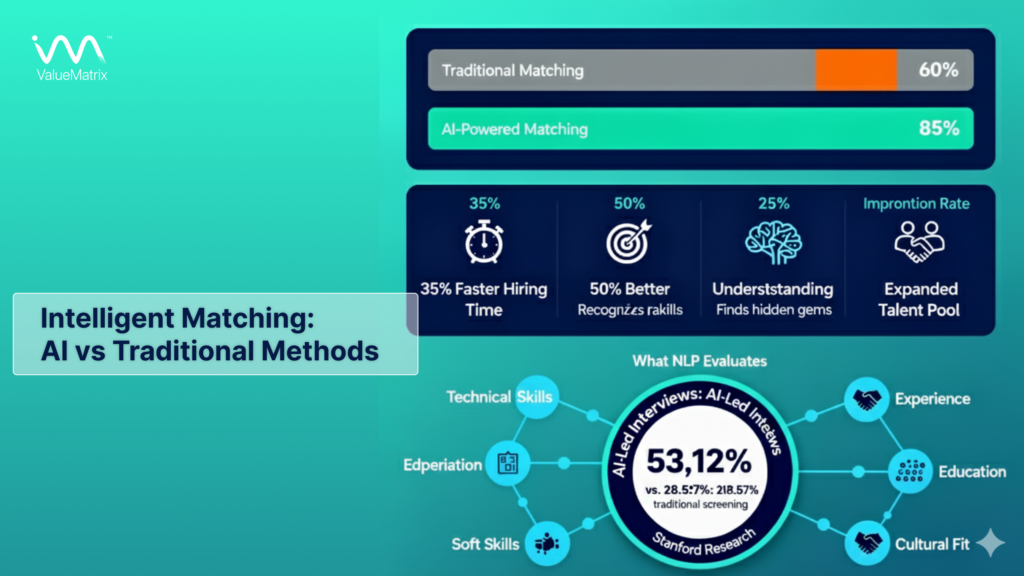
The matching is done on the basis of technical skills, experience in relevant domains, education, and other up-skills, career path, and role-specific competencies. AI-driven job matchinghas achieved 85% accuracy compared to 60% by conventional processes. This improvement of 25 percentage points can directly translate into better hiring and lower turnover.
Finding semantic similarity allows the system to identify that “agile project management” is connected to “scrum methodology” and “sprint planning.” An applicant with agile project management experience qualifies for Scrum roles, even if they did not explicitly mention the keyword on their CV. This contextual understanding helps you expand the pool of candidates while keeping a set quality.
The technology also examines cultural fit and soft skill indicators with the help of language analysis. The system can determine the communication style, problem-solving approach, and leadership potential through candidates describing their experience and achievements. This is a holistic evaluation that offers recruiters a 360-degree view of the candidate instead of a simple qualification checklist.
In its research,Stanford found that applications that gave AI-led interviews were able to crack the following human interviews. The number was 53.12% vs 28.57% compared to regular resume screening. The NPL hiring approach verified competencies upfront and enabled recruiters to concentrate solely on candidates with the right abilities instead of spending time on screening interviews.
Some real-world numbers underline the fact. Hiring teams using AI-based NLP hiring and matchinghave shown 35% quicker hiring times. Their quality of hire metric has improved by 50%. Better matching has also helped in retaining top talent for a longer period. Companies have reported a 25% increase in retention using an NLP hiring approach that focused on aligning candidates’ preferences and skills with the job description. Moreover, lower turnover led to considerable cost savings. Finding a replacement can typically cost 1.5 to 2 times the annual salary of an employee, given the recruitment expense, training, and loss of productivity.
Use Case Three: How to Conduct Interviews And Analyze Sentiment?
The Answer Might Just Be Reading Between the Lines
Conventional interviews typically lean on the ability of the interviewer to evaluate candidates in real-time while taking notes and figuring out the next questions. This can be jarring. We know that. And such “cognitive load” can lead to missed information, inconsistent assessment, and decisions influenced by confirmation or recency bias. Throw in the factor of multiple hiring managers across the company without a set evaluation framework, and assessing interviews becomes even more challenging.
NLP-powered hiring approach helps you address these limitations. It analyzes candidate responses with objective criteria and consistency. It then assesses various dimensions of the interview simultaneously. Is the clarity in the way a candidate communicates? Was their answer structured? How were the confidence levels and emotional tone? Do they possess the required technical knowledge and problem-solving approach?
Sentiment analysis becomes very important in such an evaluation. The system doesn’t just examine what candidates say, but how they speak, changes in their tonality, stress patterns, hesitations, or pauses. For example, while talking about past milestones, candidates typically show positive sentiment markers such as confident and fluent speaking, and energetic tone. Candidates merely reciting prepped answers give out neutral sentiment and a generic description.
The analysis checks facial expressions and voice patterns in video interviews. It scans micro-expressions to try to measure emotions like confidence or frustration. It also checks out voice intonations, pitch changes, and speaking rate variations that may indicate certainty or nervousness. These non-verbal cues offer a more complete picture of applicants’ authenticity and engagement.
Unilevercompletely transformed its campus recruitment. It deployed HireVue’s NLP-powered platform. Candidates gave video responses to standard questions, which the system assessed for sentiment, competency signals, and any potential biases. The platform then transcribed the interviews, found insights, and gave out standardized scores. The results were phenomenal. The hiring timeline was cut down from 4 months to weeks. Diversity increased by 16%. Recruiters saved 100,000 hours per year, and there was a 25% improvement in the retention rate of new hires.
Global fashion giant L’Oréal deployed NLP-powered chatbot “Mya” toachieve similar benefits. The chatbot engages with applicants and asks qualifying questions about their experience. It then schedules interviews by syncing with the hiring manager’s calendar. It also answers role-specific inquiries with the help of the company’s knowledge base. Results:
- 40% reduction in time-to-hire
- 92% candidate satisfaction score (up from 78%)
- 53% growth in application completion rate
- 20 hours saved each week on admin tasks.
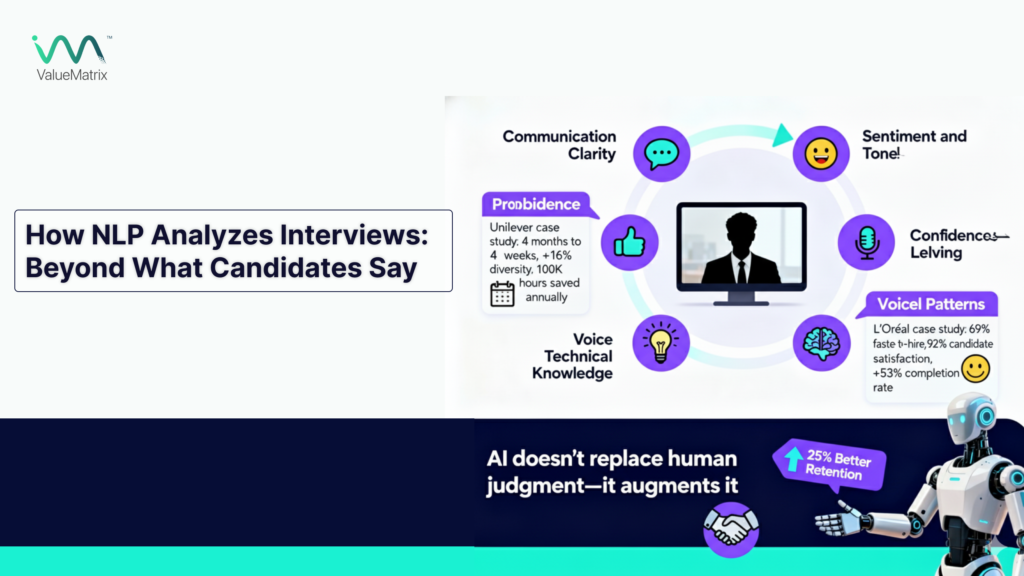
This shows that the technology is not brought in to replace human judgment, but rather to augment it further. AI-powered hiring interviews showed considerably higher conversational quality and better relevancy compared to human-led ones. These interviews were also well-structured and consistent across all candidates. Recruiters get structured summaries with key highlights, potential concerns, and evidence supporting specific assessments. This helps in less biased and more informed decision-making.
Use Case 4: How to Detect Bias in Job Descriptions?
The Answer Lies in Opening the Talent Pipeline
Job descriptions are always the first point of contact between a candidate and the hiring organization. The language used in crafting these descriptions can induce an inadvertent bias, which in turn can deter qualified applicants from underrepresented segments. Terms like “dominant”, “aggressive”, and “competitive” resonate more with male candidates. On the other hand, “supportive”, “collaborative”, “supportive” is perceived to be more female-candidate friendly. These linguistic choices, however unintended, considerably impact who applies.
Research shows that nearly three-quarters of job seekers believe workforce diversity is necessary when applying. And a third would not apply if they do not think that the company doesn’t have theright diversity. Moreover, 81% of applicants check for the company’s diversity and inclusion policies before applying. 71% particularly review job posts for any inclusive language. Companies that do not address biased language are limiting their talent pool themselves even before the hiring process begins.
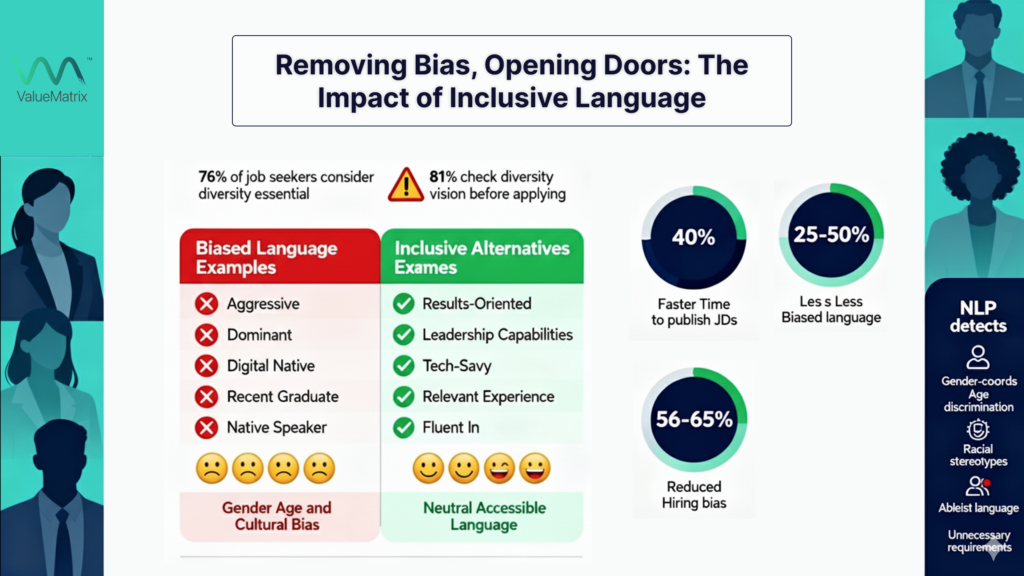
NLP hiring processes have detection tools that analyze job descriptions to figure out problematic language patterns and suggest neutral alternatives. These systems can look for gender-specific words, age-related terms like recent graduate or digital native, ethnic or racial stereotypes, and educational qualifications that might not be necessary for the role.
The technology does more than simple keyword flagging. Advanced NLP models use high-end architecture to learn context and identify subtle biases across race, gender, age, and disability parameters. Unlike conventional keyword-matching tools, these systems can understand that “young and energetic team” has an age bias even if the individual words aren’t problematic. Context-sensitive analysis can find discrimination that a rule-based system might miss.
NLP-powered hiring approach tweaks job requirements based on what candidates may search for and then analyzes tone and structure to improve clarity. The system then suggests different keywords that can improve visibility on job sites and search engines. It can also predict performance based on click-through rates, application rates, and then adjust language to attract particular demographics, while maintaining inclusivity.
Tools like Ongig and Textio offer real-time feedback as hiring managers write JDs. AI scores these JDs for inclusivity and raises flags if there are potentially biased terms. It also recommends alternatives. For example, instead of “native English speaker,” the alternative could be “fluent in English.” Instead of “strong leadership skills and aggressive drive,” it can be “demonstrated leadership capabilities and strong results orientation.”
Adopting NLP-hiring has showna measurable impact. Companies using AI-powered job descriptions have shown to reduce time-to-publish by nearly 40% and cut down biased language by nearly 25-50%. More importantly, having an inclusive job description also attracts a more diverse pool of applicants. Companies adopting bias detection tools show 8-14% improvement in representation.
Properly deployed AIcuts down hiring bias by 56-65% across educational, racial, and gender categories. The system continues to monitor and train over diverse databases. Also, it is not about optics and compliance. Diverse teams have shown outperformance over homogenous ones. McKinsey research has consistently shown that organizations with greater diversity tend to achieve increased innovation, better financial performance, and better decision-making.
What Are The Implementation Considerations and Challenges?
There are significant benefits of NLP hiring, but it needs considerable planning. Companies must be ready to address various considerations.
The very first hurdle is data quality. NLP systems rely heavily on training data quality and quantity. Systems using old, biased data will integrate that bias if not actively corrected. Companies need a broader database with wider demographic representation to train their models. They will also need regular audits to ensure fairness. Access to such large, high-quality databases can be challenging.
Another legitimate concern is algorithmic bias. In some studies, AI tools selected CVs with white-associated names 85% more than those with black-associated names. Addressing such issues needs a more diverse database integrated with anonymous personal information and blind screening techniques. It also needs human oversight over recommendations and transparent documentation of system design and decision rationale.
Integrating with current systems needs technical prowess. NLP tools must operate within existing systems, HR software, and recruitment workflows. This can create compatibility issues between the new tools and legacy systems. Companies should be ready with proper technical know-how and IT support for such retrofit integrations.
Another underrated but important challenge is change management. Hiring managers and employees may not take well to newer technologies, fearing job replacement or inherent distrust. Successful implementation needs well-thought-out awareness and phased integration to ensure end users adopt and adapt to the new technologies.
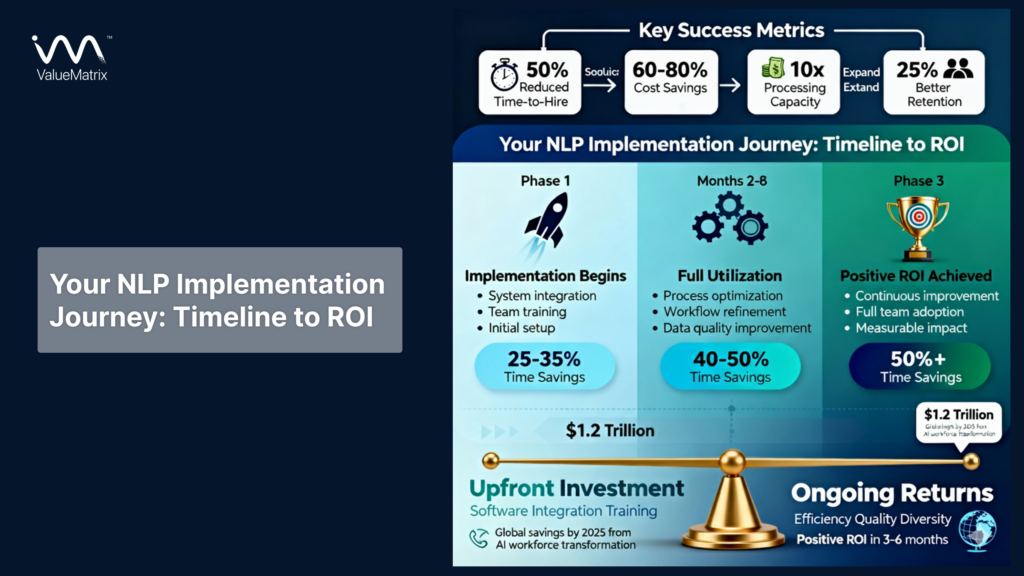
Cost and return on investment could be major roadblocks. NLP-powered systems need upfront investment in software, training, and integration. Companies implementing such solutions generally see positive ROI in 3 to 6 months. Teams show 20-40% lower cost per hire when NLP hiring AI software automates screening and scheduling.
What’s The Road Ahead?
NLP hiring technology is expected to grow rapidly in the coming years. Future developments will include multilingual NLP for global talent pools, emotion-aware systems that understand cultural context and communication styles, quantum-accelerated processing for complex matching algorithms, and industry-specific models trained on domain expertise.
The question isn’t whether to adopt NLP in hiring, but how quickly organizations can implement it effectively. Companies that treat AI as an experimental add-on will find themselves at a significant disadvantage compared to those implementing comprehensive AI-first approaches.
Companies that adopt NLP hiring gain a competitive advantage. Those that delay adoption risk losing top talent to faster, more efficient competitors. The technology has matured beyond the experimental phase—it delivers measurable, significant returns today.
Conclusion
NLP has moved from a theoretical possibility to a practical necessity in recruitment. Organizations implementing these technologies report dramatic improvements in efficiency, quality, and fairness.
ValueMatrix takes a holistic approach to recruitment transformation, combining NLP capabilities with personality analysis, cultural alignment assessment, and team dynamics evaluation. ValueMatrix ensures companies engage only with candidates who genuinely fit their organization. This comprehensive, science-backed approach moves beyond traditional hiring methods to build high-performing, cohesive teams.
FAQs
Modern NLP hiring systems show around 90%+ accuracy in identifying the right candidates. Often in high-volume screening scenarios, AI typically outperforms humans. However, AI works best when augmenting human judgment rather than replacing it entirely.
It is a concerning issue. AI systems can show biases if the inherent training data is biased, intentionally or unintentionally. But it is solvable. With proper human oversight, regular auditing, and timely corrective actions, organizations can stop NLP systems from perpetuating existing hiring biases.
It can typically take between 3 and 6 months to see the return on investment after implementing NLP hiring systems. There are significant cost savings and an increase in productivity in the long run.
No. HR professionals do not need to become data scientists to use the NLP hiring system effectively. Basic AI literacy and understanding of NLP language should help. Training on the specific tools being implemented is essential, along with change management to overcome resistance.
Yes definitely. They can save considerably on hiring metrics such as time to hire, retention rate, etc., over the long run.
About Us
ValueMatrix is an AI-powered talent intelligence platform that helps companies hire better, faster, and without bias. We go beyond resumes to assess skills, behavioral traits, and cultural fit using advanced AI and proven psychological frameworks. Our platform delivers data-driven insights that improve hiring accuracy, reduce time-to-hire, and elevate candidate quality.
ValueMatrix AI enables hiring teams to make confident hiring decisions and build high-performing teams at scale.