
Table of contents
- The Behavioral Foundations of Retention: How Measurement Shapes Intent to Stay
- What High-Retention Companies Understand Early
- Pillar 1: Metrics That Strengthen Role Stability & Clarity
- Pillar 2: Fairness-Driven Retention Indicators
- Pillar 3: Feedback Loops That Reinforce Commitment
- Pillar 4: Metrics That Can Uplift Manager–Employee Trust
- Pillar 5: Metrics That Reflect Growth, Mastery & Career Energy
- Practical Framework: Designing a 2026-Ready Retention Metric System
- Conclusion: Retention in 2026 Will Belong to Companies That Measure What Matters
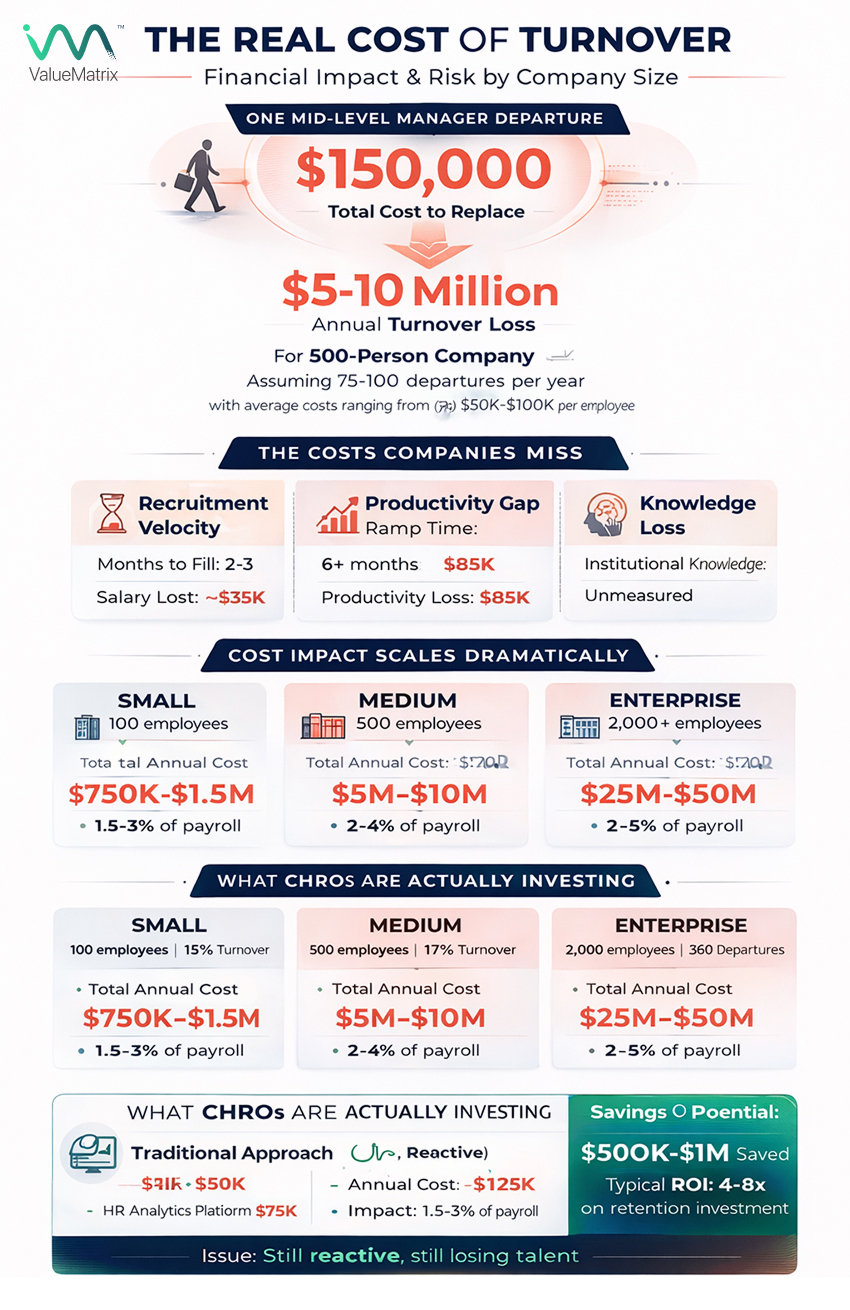
Imagine losing one mid-level manager. That’s not just a resignation. It is almost like $150,000 walking out the door in hidden costs. Now multiply that across your organization. So, today employee retention matrics is something every CHRO need to pay attetnion to.
Your company probably lost 15-20% of its workforce last year. You’ve got recruitment costs, onboarding expenses, lost productivity, and institutional knowledge gone. For a 500-person company, that’s $5-10 million in annual retention costs that nobody’s tracking properly.
But here’s the real problem: your HR analytics team is collecting mountains of employee retention metrics. Your dashboards flash with attrition prediction HR data. You’ve installed state-of-the-art HR analytics 2025 platforms and built predictive models.
Yet your top performer still shocked you with a resignation letter last Tuesday.
Most CHROs face an uncomfortable truth: having turnover analysis tools doesn’t guarantee you’ll see someone leaving until they’ve already mentally checked out. Why? This might be due to the fact that you are trying to measure the wrong things. You are just keeping track of what has happened (the past) instead of what will happen (the future).
This is where data-driven retention plans become critical. The companies winning at retention strategy optimization in 2026 understand this: retention metrics aren’t dashboards. They’re early-warning systems that reveal motivation, experience, and intent before employees update their LinkedIn profiles.
Traditional turnover tracking captures historical patterns. Your old retention KPIs tell you what happened in Q3. What you need are metrics capturing psychological signals—real-time indicators of how employees experience clarity, support, fairness, and progress daily. This is where predictive HR analytics becomes tactical, not theoretical.
Because research shows consistently, people don’t stay because attrition numbers look stable. They stay because they feel seen, supported, and progressing toward something meaningful.
The Behavioral Foundations of Retention: How Measurement Shapes Intent to Stay
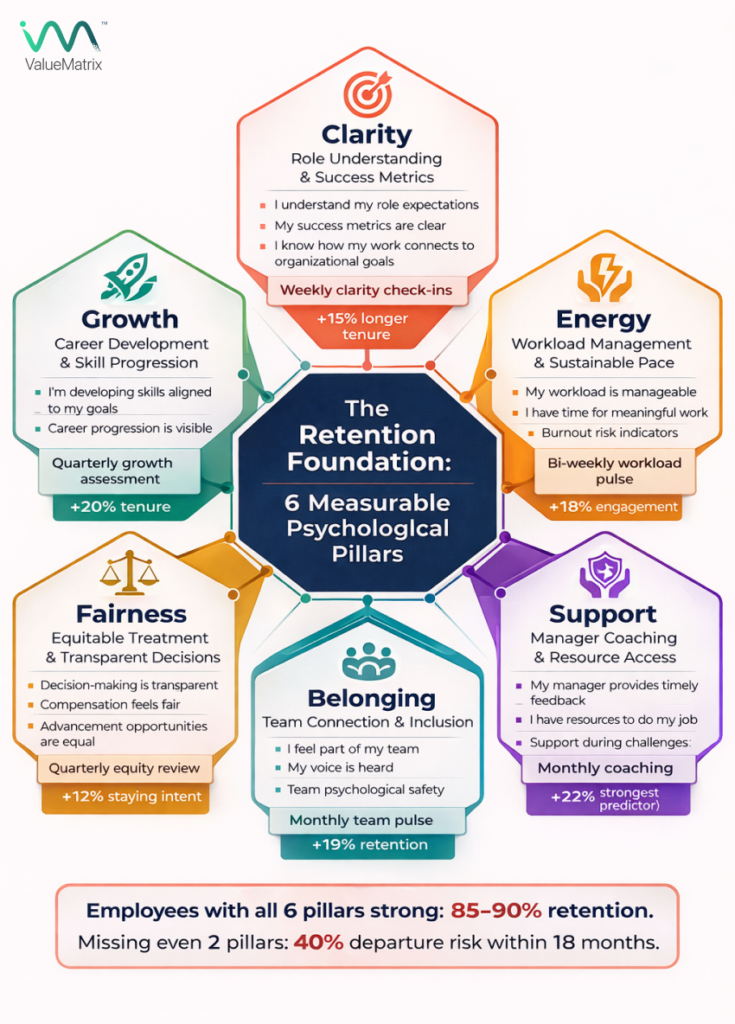
Retention isn’t just an outcome. It is a collective result of thousands of day-to-day psychological experiences.
What determines whether an employee feels energized or depleted? Clarity about their role. Energy to tackle workload. Support from their manager. Belonging to their team. Fairness in decision-making. A sense that their efforts matter and they’re growing.
These aren’t soft concepts; they’re measurable psychological states that predict whether someone stays or starts scanning job boards.
What you choose to measure fundamentally shapes these experiences. Clear metrics reduce uncertainty. When your employees understand what their success looks like and how their progress is being measured, they feel more secure and safe psychologically. In their minds, there is no constant guesswork of “how will my performance be measured?”
Poor measurement creates conditions for quiet disengagement. If your performance metrics are ambiguous and not really connected to the actual work experience, your employees will definitely feel the misalignment. Over time, this ambiguity will turn into confusion, distrust, and work fatigue. Result? They will decide to leave your company.
What leaders track becomes what employees believe matters. If you only measure output but never development, people conclude growth doesn’t matter here. If you track individual performance but ignore collaboration, teamwork withers.
Progress indicators strengthen persistence. When people see they’re moving forward, they’re psychologically invested in continuing that trajectory.
This is why intentional, behaviourally-anchored measurement systems predict turnover. They don’t just capture retention data; they actively shape the psychological conditions determining whether people stay.
What High-Retention Companies Understand Early
Organizations retaining top talent approach metrics differently. They don’t view measurement as administrative reporting. They understand metrics serve multiple strategic functions: orientation tools, diagnostic instruments, motivational catalysts, conversation starters, and transparency builders.
High-retention companies recognize that metrics are never neutral. Every indicator you track sends a signal about priorities and values. Every dashboard shapes how managers think about their teams.
The question isn’t whether to measure retention differently; it’s which behavioral signals predict who stays versus who leaves.
| Aspect | Traditional Metrics | 2026 Behaviour-Driven Metrics |
| Orientation | Turnover rates (lagging) | Intent-to-stay signals (leading) |
| Performance | Annual ratings | Continuous clarity & workload indicators |
| Engagement | Yearly survey | Monthly micro-pulse feedback |
| Development | Output-based skills | Growth-velocity metrics |
| Leadership | Manager ratings | Coaching quality & trust levels |
| System | Static dashboards | Dynamic early-warning systems |
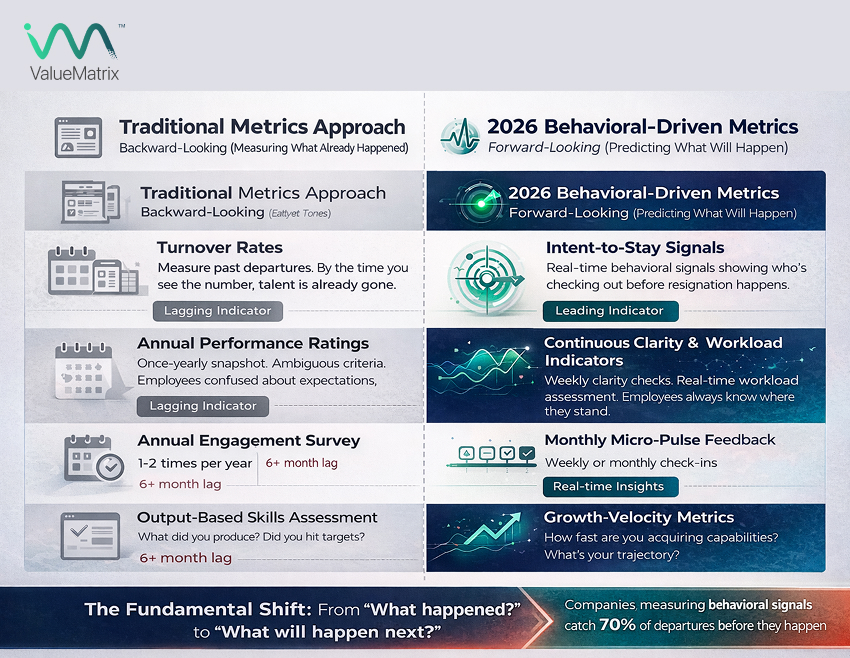
This reveals the fundamental shift: from backward-looking scorecards to forward-looking behavioral intelligence.
Pillar 1: Metrics That Strengthen Role Stability & Clarity
Employees stay when their work makes sense.
Role ambiguity predicts turnover powerfully. When people lack clarity about responsibilities or how decisions get made, cognitive load increases, and confidence erodes. The psychological strain becomes untenable.
High-retention companies track clarity rigorously:
Role definition clarity: Can employees articulate core responsibilities without hedging? Are role boundaries clear?
Priority alignment: Do individual priorities connect transparently to organizational goals? When priorities shift, is reasoning clear?
Workload stability: Are demands predictable? Or do people constantly operate in crisis mode?
Decision-making boundaries: Do employees know which decisions they own versus which require approval?
Direction metrics: How frequently do priorities change without explanation?
These are measurable through pulse questions, manager check-ins, and workload tracking tools that flag task list explosions.
Sophisticated retention systems create transparent alignment dashboards showing how work connects to broader objectives. This visibility motivates. When people understand the “why” behind efforts and track contribution, commitment deepens.
Two cautions: Overly rigid clarity metrics paradoxically reduce retention by eliminating the autonomy that knowledge workers crave. The goal is to reduce unnecessary ambiguity, not create bureaucratic constraints. Second, tracking too many indicators creates the confusion you’re eliminating. Focus on signals that matter most in your context.
Pillar 2: Fairness-Driven Retention Indicators
If tracking only one retention metric category, make it fair.
Perceived company-level justice can predict turnover intentions. It can also guess the actual turnover and the company’s work commitment more accurately than almost any other factor. People can tolerate a lot of workload, modest salaries, and even deal with difficult managers if they think the system is conceptually fair.
High-retention companies ensure measurement systems embody fairness through:
- Consistency in expectations: Are performance standards applied uniformly? Or do managers interpret ratings completely differently?
- Peer calibration: Do structured processes ensure “meets expectations” means the same in Engineering as Marketing?
- Reduced manager bias: Does your system have safeguards built against biases like recency bias or familiarity bias?
- Decision visibility: Does your average employee understand they are promoted or assigned to a project? What are the criteria behind their deployment?
When absent, even otherwise satisfied employees explore options. They’re not leaving for money but because they’ve lost faith in your system’s integrity.
If there’s unfairness or bias in the system, it can trigger emotional and cognitive responses. In an emotional sense, your employees may start resenting the organization and may feel psychologically unsafe. On the other hand, from a cognitive point of view, they will think twice before putting effort into a project as they think their contribution versus outcome is measured arbitrarily.
Two critical risks: Hidden or shifting expectations destroy trust faster than acknowledged challenges. If employees can’t discern what “good” looks like or if definitions keep changing, they disengage. Similarly, forced ranking systems reduce psychological safety and collaboration. Both are retention killers.
Pillar 3: Feedback Loops That Reinforce Commitment
Annual performance reviews are where retention dies.
Not because feedback is problematic, it’s essential, but because annual cycles misalign with how human motivation works.
People need regular progress visibility. They need real-time course corrections, not six months after a project ends. They need evidence that their efforts matter and they’re developing, not just maintaining.
High-retention companies shift to real-time feedback cycles combining multiple data streams:
- Continuous conversations happening weekly or bi-weekly, focused on specific work
- Progress dashboards visualizing skill development, project impact, and goal achievement
- Trend analysis showing improvement, plateau, or decline over time
The key is combining quantitative indicators with interpretive context. Raw data alone creates confusion and anxiety. “Your satisfaction score dropped 5 points” means nothing without understanding why and the implications.
Effective feedback systems provide data + interpretation + storytelling. They help employees construct narratives about performance that motivate continued effort.
Two risks: Over-monitoring increases surveillance anxiety and reduces autonomy. “Continuous feedback” can become “constant scrutiny.” Additionally, raw metrics without skilled interpretation cause confusion and defensiveness. Leaders need training using data for development conversations, not just presenting numbers.
Pillar 4: Metrics That Can Uplift Manager–Employee Trust
People don’t leave companies. They leave their managers.
The manager-employee relationship is still the strongest predictor of whether your employee wants to stay or leave your company. But this relationship exists within measurement contexts that shape every interaction.
High-retention companies track relational metrics seriously:
Manager accessibility: How frequently do employees have meaningful one-on-one time? Are conversations happening consistently or perpetually rescheduled?
Coaching quality: Are managers actually coaching—asking questions, exploring challenges, facilitating problem-solving—or just delegating tasks?
Perceived fairness: Do employees believe their manager evaluates fairly and advocates authentically?
Team climate: What’s the psychological safety level? Do people feel comfortable raising concerns and asking for help?
These are trackable through carefully designed pulse questions, 360 feedback, and behavioral observation.
Sophisticated systems create manager effectiveness dashboards showing how teams experience leadership. These are diagnostic tools for improving management, not weapons for evaluation. When this distinction blurs, managers game the system, and employees stop providing honest feedback.
Two critical risks: Using relational data punitively destroys the trust you’re measuring. If employees believe feedback will be weaponized, they provide useless responses. Additionally, leaders relying exclusively on dashboards miss emotional and contextual cues that often matter most. Numbers complement human judgment; they don’t replace it.
Pillar 5: Metrics That Reflect Growth, Mastery & Career Energy
People stay for who they’re becoming, not just what they’re doing today.
Learning opportunities consistently rank among the top reasons for staying or leaving. But most organizations track development poorly, measuring training hours completed rather than actual capability growth.
High-retention companies measure growth rigorously:
Skill-growth indicators: Are employees demonstrably more capable this quarter? Are they tackling complex problems, mentoring others, expanding expertise?
Role evolution metrics: How frequently do roles expand for growth? Or do people plateau because jobs are rigidly defined?
Internal mobility velocity: How long does it take talented employees to move into new roles? Are career paths transparent?
Work impact metrics: Can employees see how growing capabilities translate into greater organizational impact?
When people perceive an upward trajectory developing mastery, expanding influence, and increasing market value, they’re invested in continuing that arc. Leaving interrupts progress.
When growth stalls, people calculate opportunity costs. They think: “I could learn more elsewhere. My skills are stagnating. This role has become too small.”
Most effective growth metrics capture learning energy, not just completed modules, but genuine intellectual engagement and expanding capability. They track whether people are excited about development or checking boxes.
One crucial insight: Development metrics must feel authentic. If growth tracking requires documenting skills in an HR portal using incomprehensible taxonomy, it becomes a compliance theater. People ignore it, telling you nothing about retention risk.
Practical Framework: Designing a 2026-Ready Retention Metric System
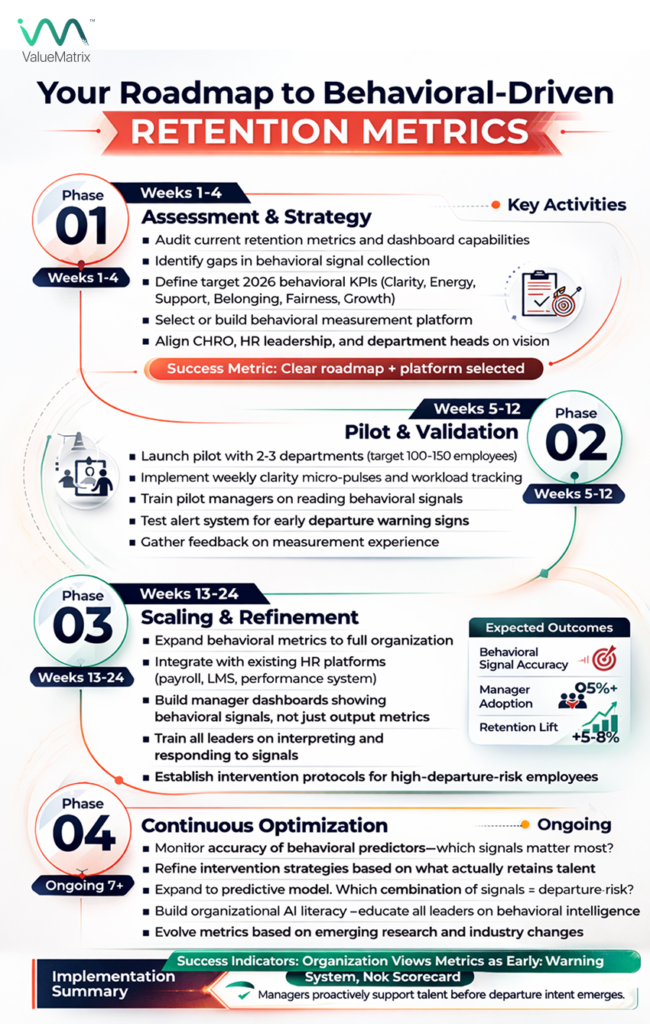
Here’s a practical playbook for CHROs upgrading retention intelligence:
Start with behavioral definitions: Define specific behaviors and psychological states, making people want to stay your specific retention drivers. Be precise.
Audit existing metrics ruthlessly: Map current retention metrics against behavioral definitions. Does this measure what predicts retention here? Or are we tracking it because we always have?
Blend quantitative and qualitative signals: Numbers miss context. Comments lack scale. Most powerful systems combine pulse data, behavioral indicators, manager observations, and open-ended feedback.
Apply psychometric principles: Use validated scales for psychological constructs like fairness or clarity. Random questions won’t give reliable data.
Streamline dashboards: Identify 5-8 core indicators predicting retention in your context. More metrics create noise.
Build multi-layer feedback loops: Individuals see their data. Managers see team patterns. Executives see enterprise trends.
Train leaders in interpretation: Most managers read dashboards. Few use data to facilitate meaningful retention conversations. Invest heavily here.
Communicate transparently: Employees need to understand why you’re measuring. Mystery metrics breed cynicism.
Run validation cycles: After implementing new metrics, check whether they predict retention. Are flagged flight risks actually leaving? Adjust quickly based on outcomes.
This is continuous refinement. Companies dominating retention in 2026 treat measurement systems as living infrastructure evolving with their workforce.
Conclusion: Retention in 2026 Will Belong to Companies That Measure What Matters
The retention landscape has fundamentally shifted. The organizations that will thrive aren’t the ones with the most data; they’re the ones with the right signals.
In 2026, competitive advantage in retention comes from nuanced, behavior-aware metrics that capture psychological reality, not just turnover history. It comes from measurement systems sophisticated enough to distinguish between someone who’s quietly disengaging and someone who’s simply having a bad week.
Yes, AI and advanced analytics can detect patterns humans miss. But technology amplifies garbage in, garbage out. If you’re tracking the wrong things, machine learning will just help you optimize for irrelevance faster.
The path forward requires CHROs to invest in five interconnected measurement pillars: clarity that reduces cognitive load, fairness that builds trust, feedback that reinforces progress, relational metrics that strengthen manager connections, and growth indicators that capture career energy.
These aren’t theoretical constructs. They’re measurable psychological states that directly determine whether your best people stay or start sending out resumes.
The companies already winning this game understand something crucial: retention isn’t about preventing people from leaving. It’s about creating conditions that make them want to stay. And you can’t create those conditions if you can’t measure them.