
Companies now hire much smartly, because Artificial Intelligence in recruitment truly helps them. This blog highlights the significant role of AI in recruitment. It acts as a very helpful friend. AI changes how businesses find staff and makes hiring tasks much smoother. This includes artificial intelligence-based resume screening, where smart learning tools also lend a hand. These are called machine learning tools in recruitment.
ML-based tools help find potential candidates quickly. They work fairly, accurately, and very well. Let’s see how artificial intelligence and recruitment can team up for a smoother hiring experience, where hiring becomes better for everyone. We will also pick smart AI-based tools and see how AI keeps great talent within the organization.
What role does AI play in Recruitment?
AI in recruitment often involves using smart computer programs that intend to help with different parts of the hiring process. Think of AI as your efficient assistant that can do repeated jobs, scan through vast information, and suggest appropriate fits, quickly. This approach makes hiring truly efficient and smarter for companies.
Finding the right person is significant. Imagine the task of hiring like a big, difficult puzzle, where you need the perfect piece to complete it. Hiring felt much like this before AI, as it was often slow-paced and manual work. It took much human effort, and companies truly struggled to keep pace. AI offers a new, modern way now.
This frees up your busy recruiters, and they can meet better candidates now. They can check the team fit very closely and make new people feel welcome. This change is not just about speed, but also means clearer hiring choices. The use of AI in recruitment helps companies succeed, and it also helps job seekers immensely. Everyone has a smoother journey that starts from applying to joining their job on their very first day.
How Does AI Make Hiring Smooth?
AI brings significant improvements now, as AI in recruitment makes hiring much easier. It also makes it quite effective, and this starts effectively from the very first step.
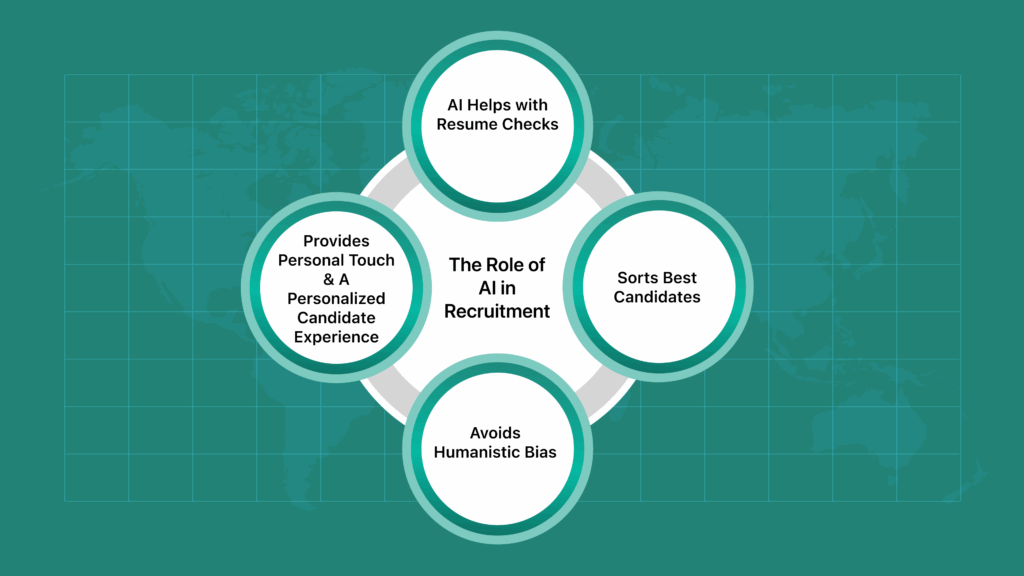
How Does AI Help with Resume Checks?
Artificial intelligence-based resume screening tools quickly scan and understand resumes in mere seconds. AI tools in recruitment can efficiently find keywords, skills, and past work history that perfectly align with the present job needs. This immensely cuts down on human work, helping you to find great candidates faster by automatically creating a shorter list of the most suitable candidates.
Recruiters check and scan many resumes daily. This takes enormous amounts of time, as one open job vacancy can get thousands of resumes.
Artificial intelligence resume screening shines here, as AI tools can swiftly and efficiently perform these tasks:
- Read Resumes Fast: These smart programs scan resumes and can understand them in mere seconds. They find relevant keywords and skills, and they check past work history. These match job needs perfectly and act like a super-fast reader. The best part, that AI never gets tired of working.
- Sort Candidates: AI creates a short list and finds the best people first. This cuts human work greatly, and most importantly, it saves a lot of team effort for you.
- Avoid Missing Out: Artificial Intelligence follows all its rules, and it does not get distracted easily. It helps find great candidates and ensures that no qualified candidate is missed by mistake. This proves to be a big help. Companies hire faster with AI, as they can hire up to 40% faster.They often get better people. This efficiency helps everyone.
How is Machine Learning Used in Recruitment?
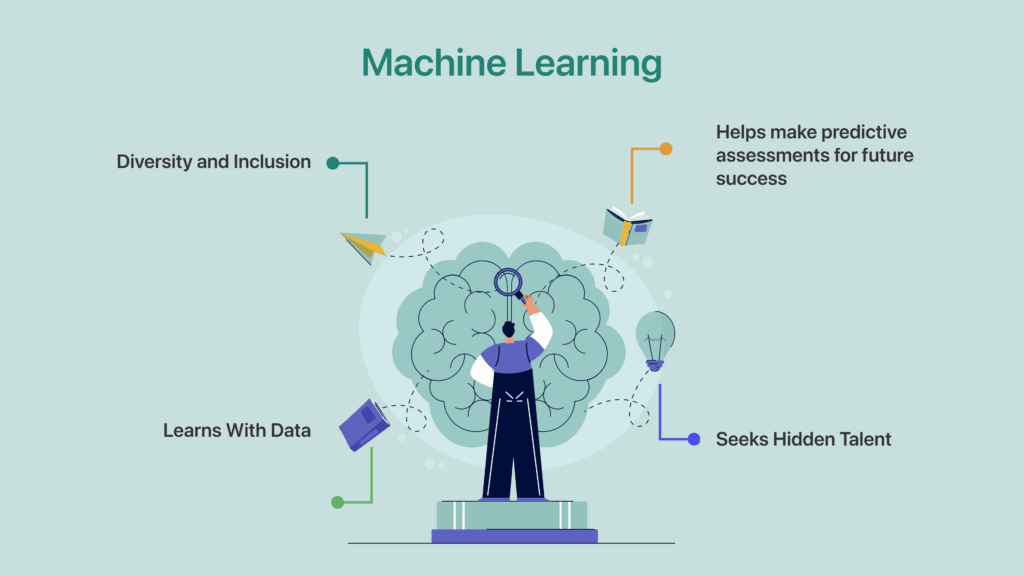
Machine learning in recruitment employs smart systems learned from past hiring successes. These smart systems could pass for über-intelligent students who sift data for hidden clues and patterns that prove useful in disambiguating and understanding who will perform well. This allows organizations to make predictive assessments for future success while recognizing incredible talent, which isn’t always clearly evident.
Artificial Intelligence is a boon in recruitment. The smart system learns a lot as the super-smart students do. Learning from every successful hire in the past and finding hidden clues now that will provide useful patterns. Thereby highlighting those who do extremely well.
Power of Artificial Intelligence in Hiring
- Prediction of Future Success: Machine learning shows who will succeed, as it helps find the person who will best fit within the company culture.
- Machine learning in recruitment is helping, as these smart systems are analytical and predictive learners, very similar to super-smart students. They learn from past successful hires and dig for hidden clues now, through which they see very useful patterns. This shows who shall do very well. This means: Predict Future Success: It finds the person best suited to fit in with your team spirit, and picks out the finer details for you.
- Seeks Hidden Talent: It locates the abilities that often elude human judgment, and paves the way to hire truly amazing candidates. Their former job title might not even fit, but their skill set is just what you might need.
- Learns With Data: This system gathers more data and learns, as it sees more information daily. They get better at making choices, as practice helps AI learn well.
It is quite incredible, as AI-chosen job seekers do well. They are 14% more likely to pass interviews, and are 18% more likely to take job offers. This is better than the old ways, an instance where AI became a skie instructor.
How Can AI Create a Better Experience for Job Seekers?
AI in recruitment can significantly help job seekers by providing immediate support and enhanced communication. AI chatbots offer quick answers, automatic scheduling that eases interviews, and personalized messages that make applicants feel important, taken care of, and informed right from their very first contact.
The artificial intelligence and recruitment partnership helps companies. It also greatly helps job seekers, as the journey becomes much smoother and more pleasant for them.
- Chatbots Ready to Help: Get instant answers easily via chatbots. Ask about your job application. Chatbots are always ready. They give quick updates and can do quick first checks. Hence, it improves the time-based efficiency and eliminates the need to wait for office hours.
- Easy Scheduling of interviews: AI can efficiently handle all interview setups. This results in no more endless back-and-forth emails. AI finds open times fast. It sends invites quickly.
- Personal Touches: Some AI tools send personal messages. They are right for each person, as job seekers feel valued, since they feel informed right away.
While AI offers immense benefits, a key issue is to maintain fairness, as AI systems learn from the data that may be marred by biases. To avoid this, companies must try to provide diverse learning materials, make sure to have human oversight at important stages, and maintain transparency about AI‘s role. This approach helps build truly fair hiring processes.
Fairness has always remained a very important topic. AI systems learn from the data given to them for training. If the training data are biased, AI systems can replicate such bias. For instance, if, in the past, the company hired more men for a position, then AI would inadvertently learn and adopt this bias.
Hiring Checklist for Hiring:
- Diverse Learning Material: AI has to learn from balanced information. This way, it teaches the AI-based tools to focus on skills and ignore surface details.
- Human Checks: Humans need to maintain deep involvement in the process. They vet the suggestions of AI. They ensure fair treatment of everyone. AI is just a tool, and it should be taken care of that it does not replace human judgment.
- Clarity and Transparency: Companies must be clear about how the AI works, as this creates trust among job seekers. It is in line with fair hiring conduct.
Artificial intelligence in human resources is rapidly growing. It will become a multi-billion-dollar market, estimated to be over $15 billion by 2030. Companies invest in fair tools. This growth means more focus. Ethical AI rules are the key.
How Do You Opt for the Right AI Tools for Hiring?
Opting for the right AI tool means finding one that is easy to use, fair, and fits your hiring needs. Search for tools that synchronize with your existing HR systems and offer strong customer support. An intelligent choice will ensure that your investment in the use of specific AI in recruitment truly works for your team.
Thinking about using AI for hiring? That is a smart move.
Plenty of options exist today. So, how do you choose the very best one? Here are simple things to note:
- Is it easy to use? Use of tools that support AI in recruitment should be very simple, so that your team can learn them quickly. If it’s too complex, no one uses it, and you might end up losing those benefits.
- Does it Fit Your Needs? Think about your hiring issues. Need help with artificial intelligence resume screening? Or with scheduling many interviews? Choose a tool for addressing your main problems.
- How Does it Handle Fairness? When evaluating AI tools, always consider their fairness. One should learn about their bias avoidance features and ensure they promote diverse candidates for the hiring process.
- Can It Talk to Your Other Systems? Do you use other HR software? Ensure the new AI tool resonates well with that, and this makes the work very smooth. No extra fuss is needed.
- What About Support? Even easy tools offer some help. It helps check on good customer support, and this helps with your questions.
Your choice of team is critical. Your choice ofartificial intelligence in recruitment would prove worth it.
Beyond Hiring: What role does AI play in Talent Management?
AI is more than offering new hires’ services; artificial intelligence in recruitment aids in retaining employees and developing their careers. Personalized onboarding plans are for drawing new employees as well as minimizing turnover and custom-devised paths for career growth. This continuous support helps create a workplace where employees feel happy, productive, valued, engaged, and visualize clear opportunities for their future.
AI helps after hiring, too. Human beings and artificial intelligence have just begun their great journey. AI supports employees every day.
- Helping New Hires Settle In: AI sets up personal plans and enables new hires to gain access to the right information. They are timely trained. They quickly feel welcome and are off the ground, working much sooner.
- Spotting Who Might Leave: AI helps analyze data. It looks at results from survey answers. It checks team feedback and warns if someone might leave. This is not about spying; rather, it helps leaders act early. They understand issues better and can keep good staff. It is up to 76.92% accurate, and companies can act early.
- Personalized Learning: AI helps suggest courses and also shows good career paths. These fit employee skills that match their goals well. People grow in the company, and they stay happier longer. AI-driven career growth increases retention by 20%.
- Matching Skills to New Opportunities: Employees learn new skills often. Machine learning in recruitment helps much. It finds internal jobs and new projects. These match new skills. This helps internal growth, and thus, true talent rests within any organization. AI shall assist beyond its hiring function, where better environments are created by a company. An employee shall thus feel strengthened in any such company, and also feel engaged in work, where they see a clear future.
Diversity and Inclusion Practices in Hiring?
AI holds tremendous promise aimed at increasing fairness and creating diverse teams by countering orthodox hiring biases. AI-powered tools achieve this fairness by scanning job descriptions that display biased language, making the applications anonymous to solely focus on the skills, and expanding talent searches to help in hiring qualified people from varied backgrounds, thus helping in promoting true inclusivity.
Traditional hiring often carries unconscious biases, and these biases can limit talent pools. Artificial intelligence systems directly solve these problems and can provide very helpful avenues as follows:
- Eliminate Biases from Language: AI very carefully analyzes the job qualifications and finds words that repel certain groups from applying. Then it gives suggestions for neutral, appropriate language, which would widen the range of attracting candidates.
- Anonymize Applications: AI can hide personal information such as names, ages, or genders, thereby steering the judgment criterion into decision-making skills alone.
- Broaden Talent Pools: At best, AI reaches across typical networks. It finds talented people from diverse backgrounds, as this helps uncover hidden gems. AI actively promotes inclusivity.
Companies using AI for diversity see benefits. One study shows a 72% increase in female hires. It also shows a 58% increase in hires from underrepresented ethnic groups for companies using AI-driven scoring. This makes workplaces richer.
How To Get Your Team Prepared for AI Adoption?
AI in your workplace affects major general and personal changes. Human Resources must therefore prepare for these new AI in recruitment changes. To help staff adapt to new AI tools, provide focused training. This builds a learning culture and openly addresses concerns about AI‘s role in their work, contributing to an effective AI in the hiring process. Focused training to use this technology in their everyday operation will promote a learning culture. It will also welcome any concerns about AI’s role at work!
Your HR Team Needs to Change:
Successful adoption of AI is all about preparing your organization carefully, and it involves training and communication. Here are key steps to consider:
- Educate Your Staff: Train Your Recruiters to Understand AI; its role should be enhanced with better work. Tell them that AI makes their work easier and does not replace them.
- Provide New Training: Train Teams on the Improvements Gained in Using New AI Tools. Educate them on interpreting data insights, and strengthen their associations with AI for improved results. This builds confidence on a long-term basis.
- Build a Learning Culture: Always encourage your company’s people to experiment with AI. Always celebrate and encourage small wins along the way. Create an environment where learning is given importance, as this promotes easier adoption of AI tools and technology.
- Openly Address Concerns: Be clear about the use of AI technology. Discuss the data privacy and ethical use issues, since this builds trust within the team. Openness related to AI tools and their usage is very important.
Companies with a clear AI strategy succeed greatly. While 42% of HR teams use AI, only 7% have a documented strategy. A plan ensures better outcomes.
So, What to Expect Ahead in the World of Talent Acquisition?
The field of talent acquisition is on the cusp of significant change. We’ll see even more sophisticated uses of AI in recruitment. Some advances to watch for encompass generative AI for content drafting, higher AI for conducting first interviews, complex predictive analytics for forecasting needs, in addition to immersive virtual reality experiences for candidates, and meanwhile deepening AI integration evermore. AI will empower recruiters to focus on strategic tasks like building relationships, while machine learning in recruitment provides deeper insights.
Keeping up with events is rather important: Here are some interesting developments:
- Generative AI for Content: AI is now writing job descriptions. Personalized outreach messages are produced. Interview questions are generated effectively as a huge time saver.
- AI for Interview Bots: Bots now conduct initial interviews. They accurately assess technical skills. Communication styles are evaluated. Finally, recruiters take their shot with the final candidates at the last stages.
- Predictive Analytics Advances: AI forecasts hiring needs better. It predicts employee retention more accurately and helps identify skill gaps proactively. This helps in strategic and long-term planning.
- They are creating immersive candidate experiences. Virtual reality tours are growing as candidates explore workplaces remotely. This offers engaging job previews and enhances candidate understanding.
The future means AI will become more integrated. Many tech companies now use AI for screening. Nearly 50% of mid-to-large tech companies use AI in some hiring process. This is indicative that AI and human collaboration will grow strongly.
The Future: Can Humans and AI Work Jointly?
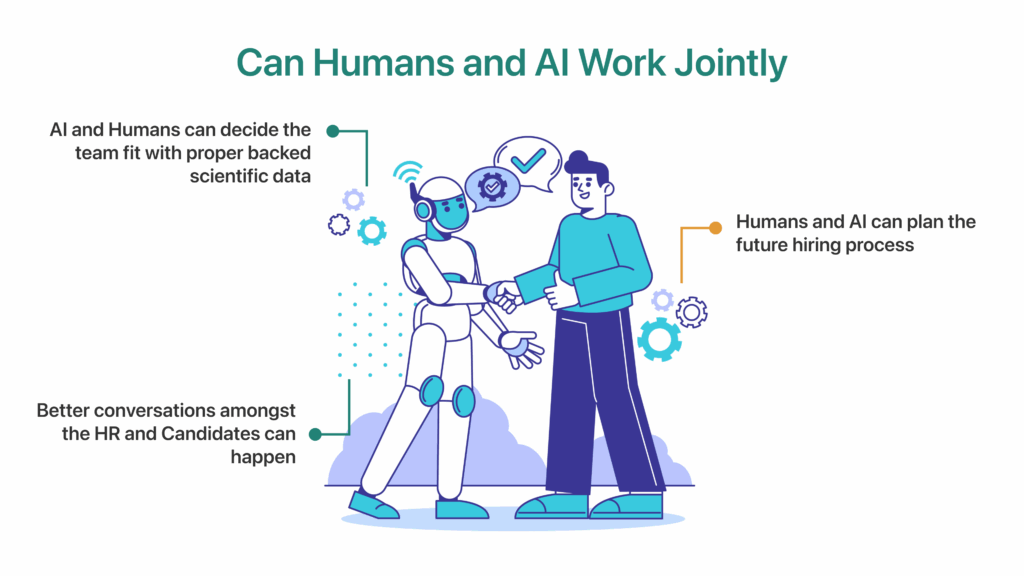
AI will not replace human jobs. It makes humans even stronger. This is the exciting part now, where Artificial intelligence and recruitment experts form a powerful team. AI handles big, time-consuming tasks and checks vast data. It does first-round checks. Human hiring teams focus on key tasks. These need a human touch always.
- Deep Conversations: Recruiters talk more deeply. They get to know candidates and proactively build real connections.
- Team Fit: They evaluate people’s soft skills now. How well does he or she communicate? How does the person work within a team? Does he fit the culture?
- Planning Forward: AI gives good insights to help recruiters plan future needs. Good talent is always ready, just that it needs to be brought to the fore.
- AI-Human Interaction: They build diverse and efficient teams. AI helps build successful teams and makes it easier for everyone to recruit. Hence, it is a win for everyone.
FAQs
Q1: What is artificial intelligence in recruitment?
Artificial intelligence in recruitment means using smart programs. It helps with hiring tasks. These programs automate processes, improve the whole system. They find good candidates by checking many resumes. They even talk to applicants.
Q2: How does artificial intelligence resume screening work?
Artificial intelligence resume screening tools read resumes fast. They find keywords quickly and find skills and past jobs. These match the job description. They help make a short list. This saves recruiters much time.
Q3: What does machine learning do in recruitment?
Machine learning in recruitment uses programs that learn. It learns from past hiring, finds hidden patterns, shows who fits best. This also improves job ads. It makes the candidate’s talks personal.
Q4: Does AI in recruitment make hiring completely fair?
AI helps make hiring fairer. It uses steady rules. It lessens human bias. But AI learns from its data. If data has bias, AI might repeat it. So, human checks are vital. Diverse data for AI is key.
Q5: What are the biggest benefits of using AI in hiring?
Benefits include faster hiring. You find better candidates. Job seekers have a smoother time. They get quick replies. Human teams focus on important tasks. These need human skills.
Q6: Can AI truly show if someone will succeed long-term?
Machine learning in recruitment helps. It analyzes past info, shows who might thrive. It gives strong clues. But human judgment is still vital. It gives a full picture, sees the team fit and future growth.
About Us
ValueMatrix helps organizations build culturally cohesive teams with AI-powered recruitment and retention strategies. We educate corporate leaders on the importance of involving and encouraging all generations to adopt enterprise values and participate actively to achieve excellence.
Our AI-powered platform transforms talent acquisition with intelligent hiring techniques backed by established psychological frameworks. We partner with HR professionals to conduct unbiased and holistic assessments for aspiring candidates.