
Executive Summary
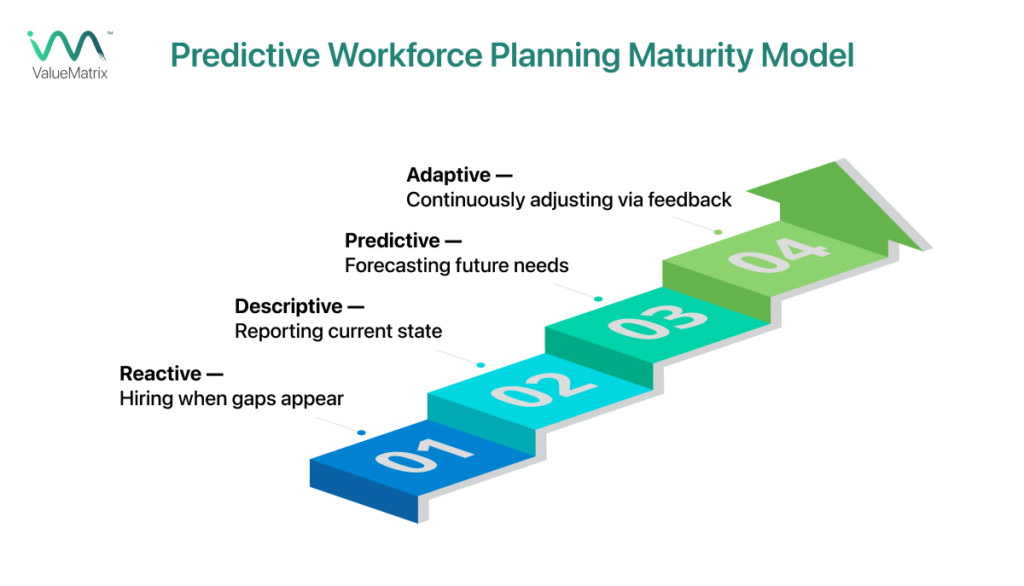
A more proactive strategy is provided by predictive workforce planning. Organizations may foresee future skill and talent requirements before gaps become serious by integrating workforce data, business strategy, and predictive analytics. Instead of responding to shortages after they happen, executives can spot potential dangers, create scenarios, and act quickly by internal mobility, targeted hiring, or upskilling.
From converting strategic priorities into capability signals to conducting skills gap analysis, using predictive models, and converting findings into tangible talent decisions, this article provides a useful, step-by-step approach to putting predictive workforce planning into practice. Additionally, it describes how AI may facilitate this process, what information is actually needed, and typical obstacles that organizations encounter while implementing this strategy.
Predictive workforce planning ultimately assists organizations in making the transition from reactive personnel management to proactive capability building, enhancing agility, lowering risk, and guaranteeing that the workforce changes in tandem with the business.
Table of contents
- Executive Summary
- Predictive Workforce Planning Explained
- The Reality of the Skills Gap Today
- The Predictive Workforce Planning Framework — Step by Step
- AI’s Role in Skill Gap Forecasting
- What Data You Need — Realistic and Actionable
- Case Studies That Illustrate Predictive Workforce Planning in Action
- Practical Challenges — and How to Overcome Them
- How This Fits Into a Broader Workforce Strategy
- Conclusion
- FAQs
Workforce planning was once thought of as an annual process that involved counting roles, projecting hiring, accounting for attrition, and repeating the process the next year. That strategy was effective when skill needs were largely constant, and job evolution was gradual.
The pace of skill change has accelerated dramatically. According to the World Economic Forum’s Future of Jobs Report 2025, 39% of core worker skills are expected to change by 2030. That means that nearly two out of every five skills your organisation depends on today will not look the same within the next few years. Planning using last year’s structure turns into a liability rather than a precaution when talents change this quickly.
This explains why many organizations follow the same pattern: learning programs are introduced after the gap has already begun to negatively impact performance, hiring becomes reactive and hurried, and projects are delayed due to a lack of necessary competencies. Conventional workforce planning finds it difficult to predict where and when those gaps would appear because it is mainly concerned with headcount and past trends.
Predictive workforce planning employs a new approach. Instead of looking backward, it looks forward using data, analytics, and scenario modeling. It combines workforce data, corporate strategy, and labor market signals to predict future talent and skill requirements before they become urgent problems. Being prepared is the aim, not making predictions for their own sake.
Through earlier recruiting, focused upskilling, and more intelligent internal mobility, predictive planning, when done correctly, assists organizations in moving from responding to skills shortages to actively filling skills gaps over time. Faster execution, greater use of personnel investments, and a staff that is focused on the company’s future rather than its past have all directly impacted the business.
| Traditional Workforce Planning | Predictive Workforce Planning |
| Annual or periodic | Continuous |
| Headcount-focused | Skills- and capability-focused |
| Backward-looking | Forward-looking |
| Reactive hiring | Proactive talent strategy |
| Titles & roles | Skills & proficiency |
| Lagging indicators | Leading indicators |
Predictive Workforce Planning Explained
Moving from planning based on past occurrences to planning based on anticipated future events is the essence of predictive workforce planning.
Headcount, which establishes how many workers are needed for each function, how many are anticipated to leave, and how many must be hired to fill the vacancy, is typically the first stage in traditional workforce planning. Although this method is primarily retrograde, it is helpful for operational stability and budgeting. It makes the assumption that the jobs, structures, and skill requirements of yesterday will still make sense in the future.
That perspective is broadened by predictive workforce planning. It focuses not just on the number of workers needed, but also on the skills and competencies that will be needed in the future and how those needs will change over time. It models situations including new positions, dwindling skills, changes in demand, and attrition risks in key talent pools using workforce data, business signals, and external labor market trends.
Practically speaking, this entails responding to inquiries such as:
- Which competencies are becoming more crucial when the business plan changes?
- In six, twelve, or eighteen months, where may we expect shortages?
- Which organizational divisions are most vulnerable to attrition in positions requiring a high level of skill?
- How long will it actually take to develop or obtain such skills?
The word “predictive” does not imply making certain predictions about the future. It involves estimating probabilities and ranges of outcomes using predictive analytics for workforce planning so that executives are not caught off guard by what is possible but can plan for what is most likely.
This is what sets predictive workforce planning apart from static forecasts or descriptive reporting. It includes more than just visualizing current data and projecting patterns. In order to make judgments on whether to invest in upskilling, when to hire ahead of demand, when to redesign jobs, and when to reevaluate how labor is organized, predictive insights must be produced.
This elevates workforce planning predictive analytics to a strategic skill. Linking talent decisions to business objectives, it helps organizations connect their people, skills, and capacity with their desired future rather than just where they are now.
The Reality of the Skills Gap Today
Despite the fact that the term “skills gap” is sometimes used in an unclear manner, it actually refers to a very specific problem: a difference between the skills that an organization’s personnel actually possesses and the skills it needs to implement its strategy.
Today, managing this gap is increasingly difficult due to how quickly both sides of that equation are changing.
On the demand side, new technologies, changing company models, and shifting customer expectations are constantly redefining the critical skills. Roles that were essentially nonexistent a few years ago are now essential in domains like cybersecurity, data engineering, and AI operations. At the same time, some conventional skills are losing significance as processes are automated or modified.
On the supply side, companies have to deal with internal workforces whose skills are frequently outdated or not fully apparent, increased turnover in high-demand professions, and lengthier hiring lead times for scarce skills. It is difficult to determine what skills people truly possess, let alone what they will require, because many organizations continue to use job titles or antiquated function definitions as stand-ins for competence.
Research reflects this tension. The World Economic Forum estimates that nearly 40% of workers’ core skills will be transformed or become obsolete by 2030. In parallel, other studies suggest that a significant share of employees will require reskilling in the near term just to keep pace with changing role requirements. In other words, skills gaps are not emerging slowly at the edges of organisations — they are forming continuously at the core.
Reactive methods fail because of this. It is already late in the cycle when a gap appears, such as when a project stops, a position remains empty for months, or performance declines. Teams are always playing catch-up, hiring is hurried, and learning initiatives are introduced under duress.
Treating skills gap analysis as a continuous, forward-thinking practice is a more beneficial strategy. Organizations should question “Where are we likely to be short next?” and “How early can we act on that signal?” rather than “Where are we short today?” Closing skills gaps systematically instead of responding to them one at a time is made possible by this change from detecting present shortages to predicting future ones.
The Predictive Workforce Planning Framework — Step by Step
Predictive workforce planning only becomes useful when it is operational. That means translating strategy and data into concrete decisions about skills, roles, and timing. The framework below outlines a practical way to do that — not as a one-off exercise, but as a repeatable planning cycle.
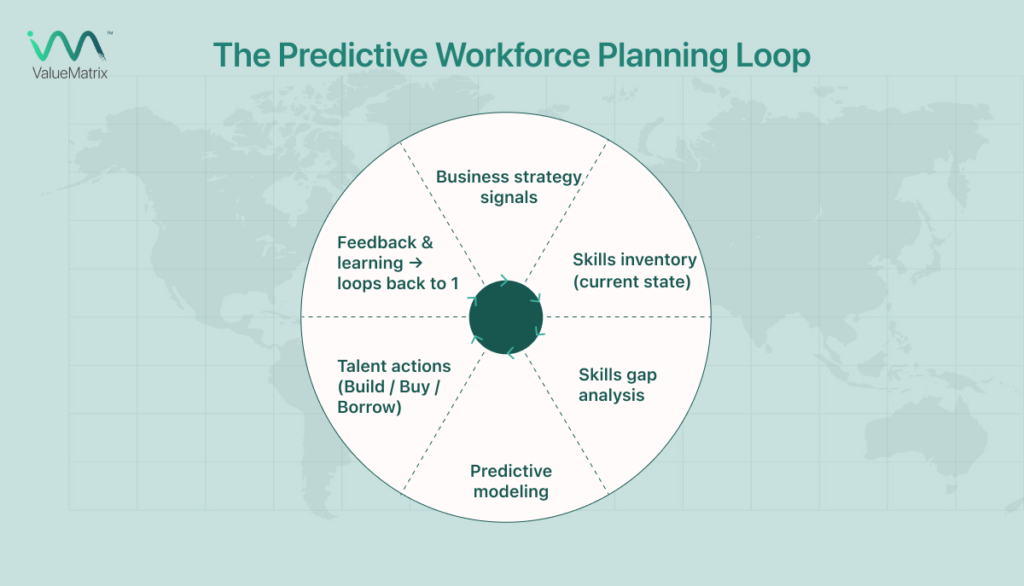
Step 1 — Translate Business Strategy into Capability Signals
Workforce planning should start with the business, not with HR.
Every strategic shift — a new product line, an expansion into new markets, a change in operating model — implies a change in the capabilities the organisation needs. The first step is to translate those strategic signals into a view of future skill demand. Perfect accuracy is not necessary for this, but direction clarity is.
A corporation investing in AI-enabled products, for instance, is growing need for skills in data science, model deployment, quick engineering, and responsible AI in addition to recruiting additional engineers. Without making that translation explicit, workforce plans tend to lag behind strategy.
Step 2 — Build a Usable View of Current Skills
Most organisations do not actually know what skills they have — they know what roles they have.
Moving beyond job titles to a skills-based perspective of the workforce is necessary for predictive planning. This entails developing a dynamic skills inventory using information from learning activities, project histories, performance statistics, resumes, and manager input.
Creating an ideal or comprehensive taxonomy is not the aim. The goal is to create a model that can be updated on a regular basis when skills change and is sufficient to enable decision-making.
Step 3 — Perform Skills Gap Analysis
With future demand and current supply visible, skills gap analysis becomes possible.
This involves comparing:
- Supply: the levels of competence and abilities currently found in the workforce, and
- Demand: the levels of competence and abilities that will be needed in the future.
Typically, gaps have three forms:
- Quantity gaps: insufficient individuals with a particular expertise.
- Proficiency gaps: occur when a skill is present but not at the necessary level.
- Timing gaps: abilities can be acquired, but not fast enough.
Knowing what kind of gap there is is important since each one requires a different approach.
| Gap Type | What It Means | Best Response |
| Quantity | Not enough people with the skill | Hire / Borrow |
| Proficiency | Skill exists but at low level | Upskill |
| Timing | Skill can be built but not fast enough | Mix of hire + upskill |
Step 4 — Apply Predictive Analytics to Forecast Change
Prediction comes into play at this point.
Organizations can estimate how skills supply and demand are likely to change by using past workforce data, attrition patterns, learning velocity, and external labor market trends. This includes estimating:
- Attrition risk in scarce-skill roles,
- Time required to build skills internally,
- Hiring lead times and market availability,
- The impact of different strategic scenarios.
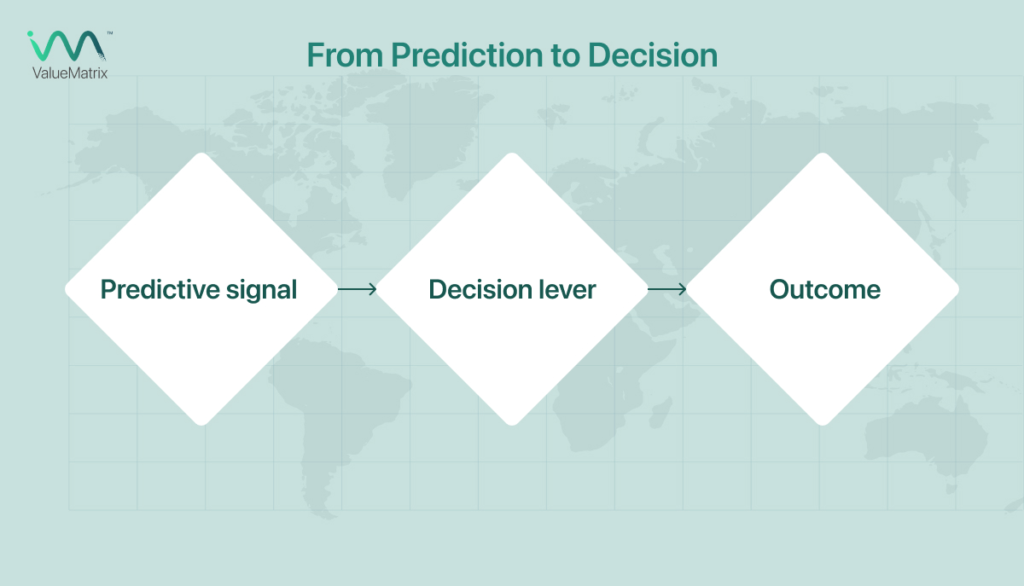
Instead of a single forecast, the output is a collection of predictive insights that show where the organization is most vulnerable and where prompt action would be most beneficial.
Step 5 — Translate Predictions into Talent Decisions
Predictions are only significant if they influence choices.
Three types comprise the majority of actions:
- Build: make investments in retraining and upskilling.
- Buy: hire externally to fill urgent or scarce gaps.
- Borrow: for short-term needs, use temporary workers, partners, or contractors.
Instead of relying on reactive hiring when gaps become uncomfortable, predictive planning enables organizations to make more thoughtful and early decisions about these possibilities.
Step 6 — Close the Loop and Learn
Lastly, predictive workforce planning needs to be iterative.
Over time, forecasts should be examined, results monitored, and models improved. Time-to-skill, internal fill rates, and prediction accuracy are examples of metrics that help make sure the system advances rather than stagnates.
When combined, these actions transform workforce planning from a static process into a dynamic system that changes in tandem with businesses and the labor market.
AI’s Role in Skill Gap Forecasting
The idea that AI will solve labor planning is appealing. In actuality, AI is an enabler rather than the strategy. When used effectively, it improves predictive workforce planning by interpreting complicated, rapidly evolving data on a scale that is beyond the capabilities of humans. When misused, it turns into yet another opaque system that generates figures that are untrustworthy.
The most useful role AI plays is in making skills visible and comparable.
By its very nature, skills data is complicated. It appears in a variety of documents, including job descriptions, internal profiles, project histories, learning systems, and resumes. These documents are frequently outdated and written in a variety of formats and languages. By extracting and standardizing this data, artificial intelligence (AI) methods like natural language processing transform unstructured text into a consistent skills view that can be analyzed.
AI can assist in spotting patterns that are challenging to find by hand once skills become apparent. It can reveal which abilities are frequently acquired together, which ones likely to occur together, and how personnel usually progress from one competence to another over time. This is especially helpful for figuring out “adjacent skills,” or the abilities that, given what someone already knows, are the simplest to develop next.
AI can also be used to link external signals with internal data. It may identify which skills are growing more in-demand, which are becoming more commoditized, and where talent competition is getting more intense by analyzing labor market trends, job advertisements, and industry activity. Organizations can differentiate between a short-term shortfall and a structural change with the use of this environment.
However, there are clear limits.
| AI Helps With | Humans Are Responsible For |
| Skill extraction from text | Strategic priorities |
| Pattern detection | Trade-off decisions |
| Forecasting probabilities | Risk tolerance |
| Trend monitoring | Ethical judgment |
| Scenario modeling | Final decisions |
AI cannot decide which skills matter strategically. It cannot assess trade-offs between speed, cost, risk, and culture on its own, nor can it comprehend business priorities. Those decisions remain human and organisational.
The best systems view AI as an analytical partner that broadens the scope of what can be observed, improves forecasts, and speeds up the development of insights, but humans are still in charge of interpretation and action. In that sense, AI does not replace workforce planning. It makes predictive workforce planning possible at the level of complexity that modern organisations now face.
What Data You Need — Realistic and Actionable
While perfect data is not necessary for predictive workforce planning, the correct data is. The difference matters. Many organisations delay action because they believe their information is too incomplete or too fragmented to support meaningful forecasting. In practice, most already have enough signal to start — if they focus on what actually informs decisions.
At a minimum, three categories of data are needed.
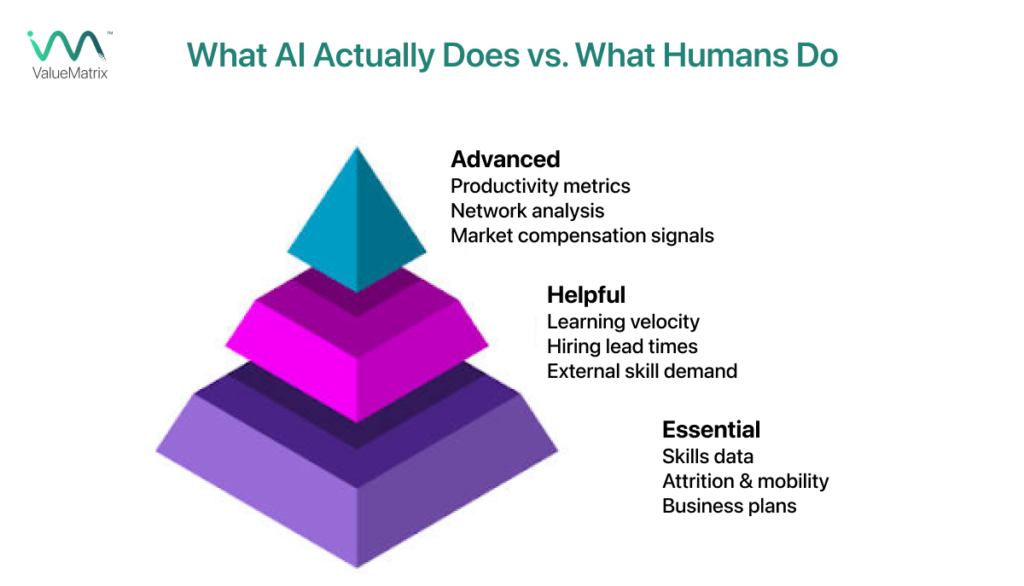
The first is internal workforce data. This includes skills information (from profiles, resumes, project histories, and learning systems), performance signals, role histories, and attrition patterns. When combined, these paint a picture of existing capabilities and its evolution over time. Understanding aggregate patterns—where abilities are concentrated, where they are unstable, and how quickly they evolve—rather than creating a comprehensive profile of each individual is the aim.
The second is business and operational data. Strategy documents, product roadmaps, pipeline forecasts, geographic expansion plans, and transformation initiatives all contain implicit signals about future capability needs. Making those signals explicit is what allows workforce planning to connect meaningfully to business direction rather than operating as a parallel process.
The third is external labor market data. Hiring trends, skill demand shifts, and market availability provide context for what is realistically “buyable” versus what must be built internally. This helps organisations avoid overestimating how quickly scarce skills can be acquired from the market.
What matters as much as data presence is data quality and interpretation. Job titles rarely reflect actual skills. Self-reported profiles tend to lag behind reality. Performance ratings may be biased or inconsistent. None of this makes predictive planning impossible — but it does mean that outputs should be treated as directional, not absolute.
The objective is not precision; it is early signal. Even imperfect data can reveal where risks are forming and where opportunities to intervene exist. Over time, as the system is used and refined, both data quality and forecast reliability improve — not because the data becomes flawless, but because the organisation becomes better at learning from it.
Case Studies That Illustrate Predictive Workforce Planning in Action
Organizations in a variety of industries are already utilizing predictive workforce planning as a practical discipline to foresee and address skill and talent shifts. Here are actual, documented instances of workforce strategy applications of skills-based planning and predictive analytics.
IBM: Forecasting Turnover and Skill Requirements using Predictive Analytics
Through the analysis of trends in skills, performance data, tenure, and other workforce indicators, IBM’s HR team has implemented predictive analytics to identify which employees are most likely to quit the organization. This approach reportedly achieved up to 95% accuracy in identifying attrition risk, enabling targeted retention interventions that significantly reduced turnover-related costs and training expenses.
IBM’s model illustrates an important point: predictive workforce planning isn’t about guessing the future — it’s about surfacing signals that allow you to act earlier and more deliberately. In this case, the insight did not simply highlight attrition risk — it provided the organisation with the ability to plan talent investments and mobility strategies before key contributors exited.
Predicting Upcoming Skill Gaps at JM Family Enterprises
JM Family Enterprises, a financial services and automotive company, used TalentNeuron’s predictive workforce analytics to pinpoint areas where new skill gaps were developing and to match expenditures in upskilling with business objectives. The business was better prepared for technical developments in areas like digital transformation and competitive differentiation thanks to this analytical approach.
The way this example links business and market signals to personnel strategy is what makes it helpful for workforce planners. The organization proactively determined which talents were rising upward and where internal capabilities development could have the biggest impact, rather than responding to shortages as they emerged.
Adoption of Skills-Based Planning by Major Employers
In major organizations where traditional role-based planning proven inadequate, a shift toward skills-based methods is highlighted by workforce planning research that goes beyond specific business instances. By prioritizing skills above traditional credentials, companies such as IBM, Walmart, and Boeing have participated in initiatives like the Rework America Alliance to boost internal mobility and talent pipelines.
These examples demonstrate a broader change in workforce strategy: organizations that place a higher priority on skill signals than job titles are better able to adjust to evolving labor markets, technological breakthroughs, and internal transformation goals.
Practical Challenges — and How to Overcome Them
Predictive workforce planning has drawbacks despite its advantages. Organizations who try to implement it quickly discover that structural, organizational, and cultural barriers are more important than technological ones. A system that quietly becomes simply another dashboard that isn’t used or one that influences real decisions can be determined by early knowledge of these problems.
1. Fragmented and inconsistent data
HRIS, learning platforms, performance tools, project management software, and external labor market sources are some of the systems that typically house workforce data. Integration is challenging because these systems were hardly ever intended to communicate with one another.
How to deal with it: Start small. Focus on a limited set of high-impact data first (skills, attrition, and business plans for one critical function). Prove value before expanding the model. Perfection is not required to generate useful early signals.
2. Low trust in analytics
Leaders are frequently hesitant to use predictive models, particularly when the results seem hazy or vague. Decision-makers are unlikely to apply insights if they are unaware of how they are produced.
How to deal with it: Give transparency precedence over intricacy. Leaders tend to value simple models that they understand more than complex ones that they don’t trust. Predictions should not be viewed as automated instructions but rather as guiding guidance.
3. Cultural resistance to skills-based thinking
Many organizations are built around roles, job titles, and hierarchies. Moving toward skills and capabilities may be daunting or confusing, especially for managers whose authority is derived from established structures.
How to deal with it: Present skills-based planning as a means of fostering development and mobility rather than as a means of overthrowing current systems. Demonstrate how it enables people to perceive opportunities rather than just risks for the future.
4. Planning without ownership
Predictive planning fails when it belongs to no one. The system loses momentum if HR controls the data but the business makes the decisions.
How to deal with it: Instead of being a stand-alone HR project, make predictive workforce planning a joint duty of strategy teams, business executives, and HR.
When used in this manner, predictive workforce planning becomes more than simply a tool—it becomes a regular, reliable input into how organizations consider capability, growth, and risk.
| Risk | What It Looks Like | What Helps |
| Data fragmentation | Conflicting numbers | Integrate gradually |
| Low trust | Leaders ignore outputs | Explain models |
| Cultural resistance | Managers push back | Frame as opportunity |
| No ownership | No one updates system | Assign governance |
How This Fits Into a Broader Workforce Strategy
The best results from predictive workforce planning come from collaboration. On its own, it can highlight risks and opportunities, but its full worth emerges when it is incorporated into an organization’s present strategy, talent, and transformational approach.
For example, predictive planning becomes more effective when combined with more extensive techniques for strategic workforce design, where managers actively rethink labor organization instead of just allocating jobs. (Strategic Workforce Planning with AI)
Additionally, it becomes more comprehensive when combined with strong analytics procedures that assist organizations in transitioning from descriptive reporting to insight focused on making decisions. Predictive models typically remain theoretical rather than practical without such analytical underpinning. (From Data to Decisions: Predictive Analytics in HR Talent Management)
Lastly, rather than sticking to a single static plan, predictive workforce planning functions best when organizations are able to model and investigate potential futures. Before selections are finalized, it is simpler to test various hypotheses and comprehend second-order impacts using strategies like digital workforce modeling. (Digital Twin Strategies for Workforce Planning & Culture)
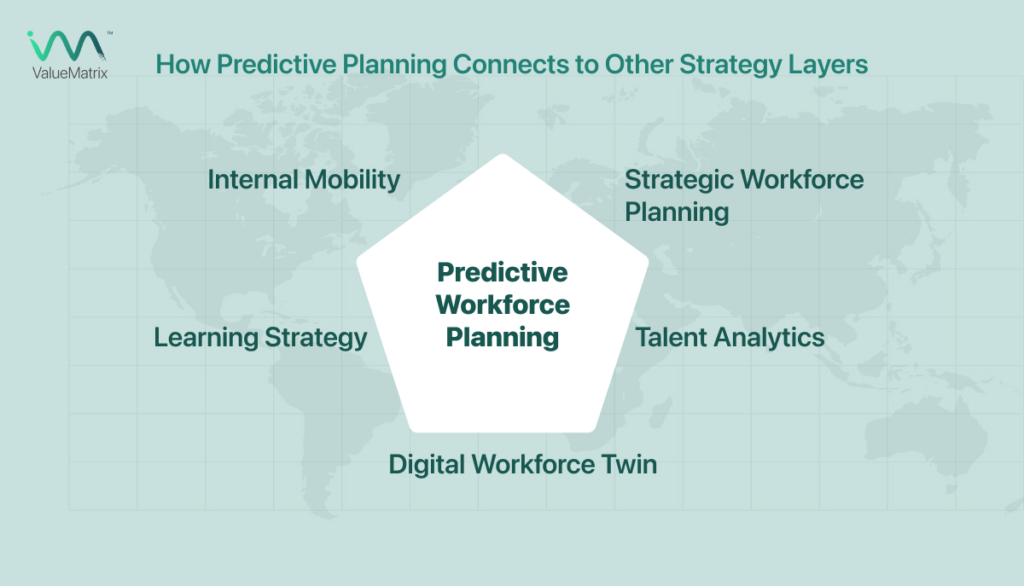
When combined, these methods transform labor planning from a sporadic endeavor into an ongoing strategic discipline that changes with the company, adjusts to outside changes, and helps management face uncertainty with more assurance.
Conclusion
Nowadays, most organizations are concerned with whether they are ready for change rather than whether it will occur.
Skills will keep changing. There will be more and more new roles. The value of some qualities will increase while that of others will decrease. Planning based only on historical structures is no longer adequate in such setting.
A path forward is provided by predictive workforce planning, which makes uncertainty visible and controllable rather than eradicating it. By integrating predictive analytics, skills data, and business strategy, organizations can more accurately invest in their workforce, choose answers more thoughtfully, and spot potential shortages earlier.
This has nothing to do with making precise predictions about the future. The key is to move from surprise to readiness.
The ability to grow without constant disruption, adjust without perpetual crises, and develop capabilities ahead of demand rather than in response to it are all made possible when organizations approach workforce planning as a living system rather than a static report.
This change is no longer discretionary; rather, it is fundamental in a world where an organization’s ability to adapt and change rapidly determines its competitive edge.
FAQs
Predictive workforce planning makes it possible to foresee future talent and skill requirements before they become serious problems. Instead of reacting to shortages after they occur, organizations use data, trends, and scenario modeling to forecast where gaps are likely to occur and make plans for them beforehand.
Headcount and historical trends—that is, the number of employees needed and the number that are expected to leave—are the main factors taken into account in traditional workforce planning. Predictive workforce planning adds a forward-looking component by concentrating on the skills that will be needed, how demand is changing, and how internal and external factors will affect talent availability over time.
No. Predictive workforce planning can begin with relatively simple models employing current data, like as attrition trends, hiring lead times, and skill inventories, even though AI can increase accuracy and scale. The transition from reactive to anticipatory thinking is the main change, not a technological one.
The goal of predictive models is to provide guidance, not to be entirely accurate. They are valuable because they draw attention to hazards, patterns, and expected outcomes before leaders have a chance to take action. Forecast reliability usually rises with improved data quality and improved models.
Current skill information, attrition and mobility trends, business and strategy goals, learning activities, and external labor market trends are among the most valuable data. Organizations only need enough signal to recognize new dangers and possibilities; they don’t need all the data to get started.
Businesses can take action sooner by determining where and when gaps are likely to occur. Instead of fumbling after gaps start to affect performance, this enables companies to invest in targeted upskilling, hire ahead of demand, create better internal mobility paths, or proactively deploy temporary talent.