

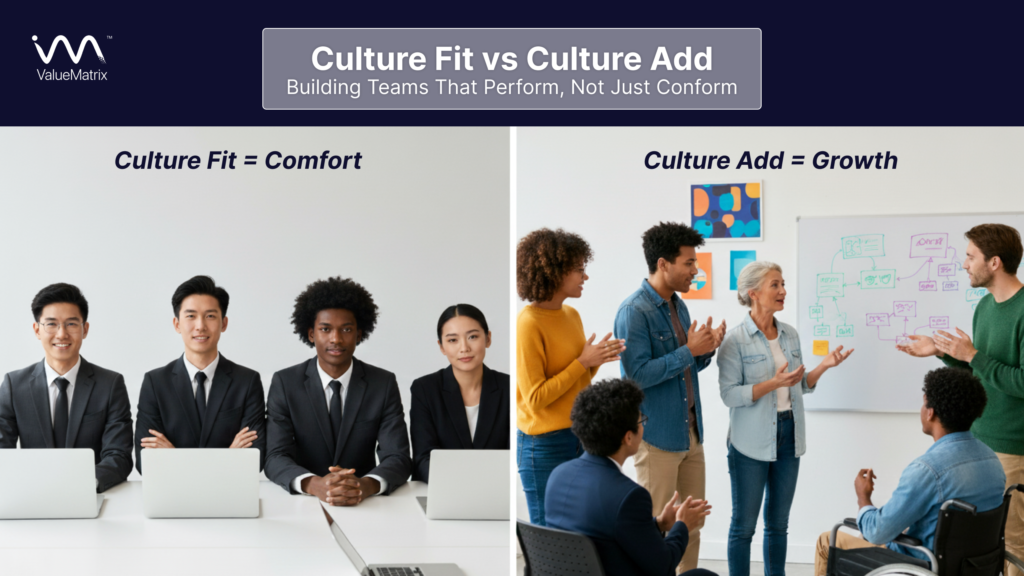
Here’s a scenario: you’re facing the final decision between two candidates. One is a culture fit, and the other is a culture add. The former feels immediately comfortable. They have the same university background, a similar communication style, and an easy rapport in the interview. The latter candidate challenges your thinking. They bring different perspectives and make you reconsider your long-held assumptions.
Whom do you hire? This culture fit vs culture add drama is commonly found across boardrooms and hiring committees of companies. Here, the choice you make can shape not just your team’s composition but your company’s future as well.
For years, the term “culture fit” has dominated the hiring process. Today, it is even more at the centre stage. Companies are now realizing they often hired people with similar traits. This “sameness” hiring process masked the main objective of hiring for quality. There’s enough evidence available in the industry that culture-fit hiring provides short-term comfort but restricts long-term success.
There’s, however, another approach to hiring, called the “culture add.” It is a more sophisticated approach that aligns with your company’s values and, at the same time, actively adds a broader perspective that strengthens your organizational capabilities.
As a CHRO, the challenge in front of you is not about choosing between these approaches. Rather, it is about creating a framework that captures the pros of both and avoids the underlying subtle affinity bias. The framework isn’t about good intentions or compliance but about building a competitive advantage through improved hiring. It is about innovation, performance, and consistent growth of your organization.
What We Really Mean by Culture Fit, Culture Add, and Affinity Bias
Culture Fit: The Traditional Approach
Over the years, culture fit hiring has focused on employing people who aligned with your company’s existing values. These values could range from communication styles to working methods. When applied correctly, the culture fit hiring approach creates a team full of cohesion and shared purpose. As a company, you see instant impact. The team onboarding is smooth, there are a few interpersonal conflicts, and members gel together from day one.
Then what’s the problem with hiring for culture fit? Here’s how:
Culture fit can become problematic when it’s used for personality matching over value alignment. UC Berkeley and Stanford research shows that the “culture fit” concept actually has two different components. The first one is the value congruence. It means how much the person aligns with the organizational values. The other is the perceptual congruence. It maps the ability of the hire in terms of reading and adapting to the cultural norms. A majority of hiring managers mix these elements. They simply label “fit” as a shorthand for “someone I would enjoy working with.”
Culture Add: The Evolution
The culture add hire approach is an entirely different way of hiring. The approach raises the question: “What will this person bring to the table?” rather than “Will this person fit in?” With the culture add approach, you recognize that the company’s culture is not static. It is a living ecosystem that will strategically evolve over time.
This doesn’t mean that you abandon value alignment. Culture add maintains focus on the base principles while looking for candidates with varied experiences. These new candidates have a different approach to solving problems and working with established processes. The result? You move from cultural preservation to cultural evolution.
Affinity Bias: The Hidden Influence
Affinity bias is nothing but an unconscious preference to work with people who remind us of ourselves. These people can have similar backgrounds, style of communication, or have a similar thought process to yours. When you are hiring, this can mean inclining towards candidates from familiar universities or those with a certain type of personality. It can also mean inclining towards people with similar cultural references or professional experiences.
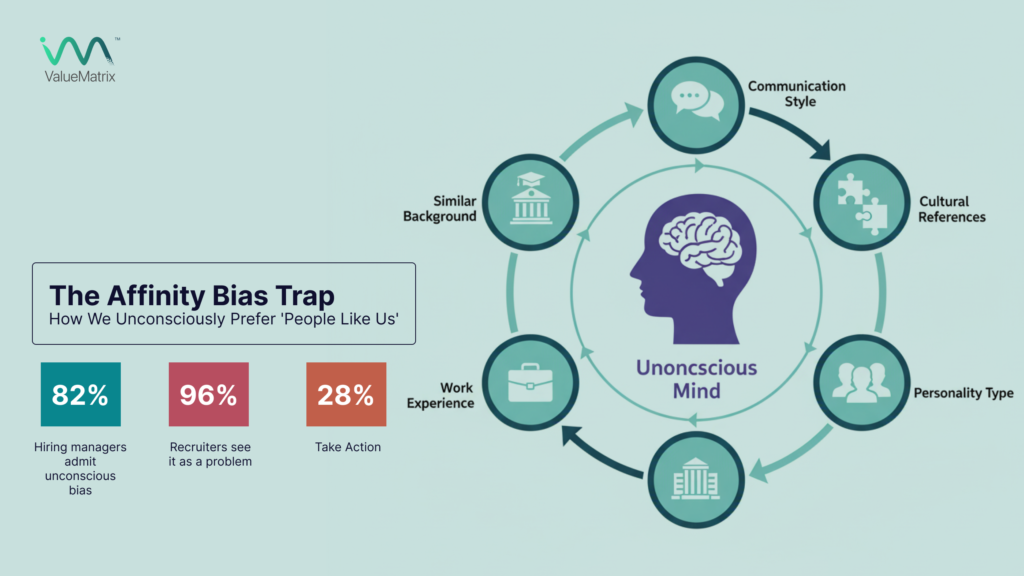
The numbers to support the data are sobering.82% of hiring managers say that they do have an unconscious bias that influences their decisions. Similarly,96% of recruiters also believe that it is a considerable problem. However, only28% companies take concrete action to eliminate this bias in their hiring process. This gap between awareness and action creates the perfect environment for affinity bias to creep in and flourish. All under the guise of “culture fit.”
Why Culture Fit Became a Double-Edged Sword
At the time of its emergence, culture fit wasn’t an inherently flawed hiring criterion. Early adopters used it to build teams that were cohesive with shared values and mission. It made practical sense for smaller companies to hire people who could work together. Each hire considerably affected the team dynamics and how the company operated.
The problems started to emerge when these companies became big. What began as a value alignment process gradually became a process of hiring for similarity. Managers thought “good culture fit” meant “someone like us” instead of “someone who shared our core principles.” This shift had consequences. Teams thought alike and approached problems in a similar fashion. This resulted in reinforcing existing blind spots.
This homogeneity comfort creates short-term efficiencies. Teams that have similar backgrounds can communicate easily, agree faster, and have fewer initial skirmishes. However, research consistently shows that this apparent efficiency becomes a costlier affair later. These homogeneous teams have lower creativity, poor problem-solving abilities, and don’t respond well to environmental changes such as market needs or customer demands.
The aforementioned Berkley research sheds light on why this happens. The study says that when teams share the same values, backgrounds, thinking, and working styles, they develop “perceptual congruence”. It is the ability to read and quickly react to corresponding cultural cues. It’s good for daily interactions. But it also creates echo chambers where assumptions are unchallenged and innovative thinking becomes a rare commodity.
Some of the most successful companies today agree that you need some friction between team members. It drives better outcomes. Team members need common values but must have different problem-solving approaches. It creates a “constructive conflict,” a disagreement that leads to improved solutions instead of personal grudges.
Why Culture Add Is the Next Evolution
Culture add represents hiring’s evolution from comfort-based decisions to performance-based ones. Companies that adopt this approach see massive improvements in their teams. They show marked signs of innovative thinking, problem-solving abilities, and market responsiveness.
The core principle at the heart of the culture add approach is that organizational strength is a result of shared purpose with varying capabilities. Companies build resilience and become more adaptable as team members bring varying degrees of experience and perspectives to achieve the same goals.
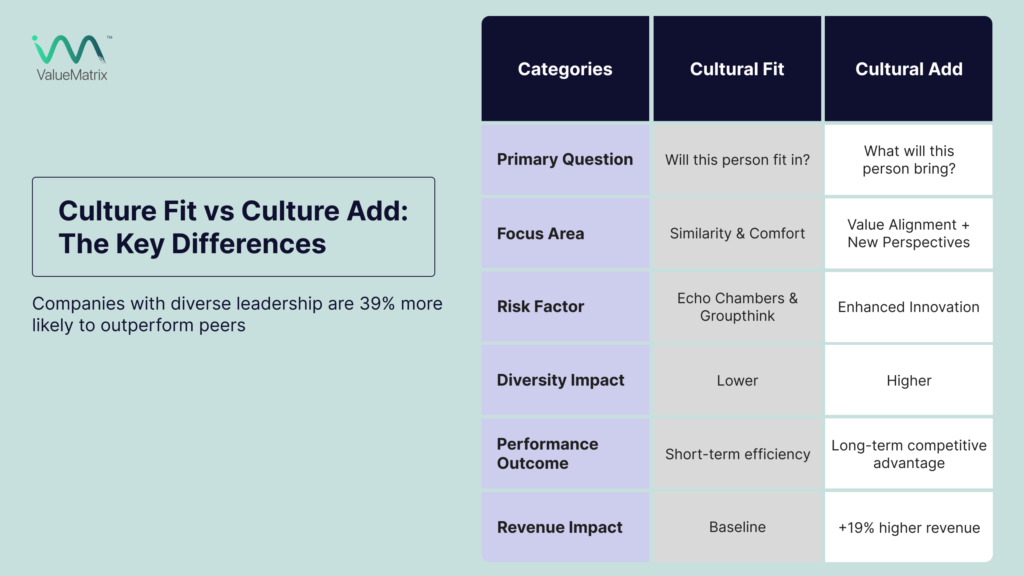
The numbers supporting this approach are quite persuasive.39% of companies show a higher possibility of financially outperforming their peers through their diverse leadership. Organizations that integrate culture add vs culture fit show19% higher revenue. These are not insignificant numbers. It shows a considerable competitive advantage.
Culture adds success because it addresses modern business realities. Organizations with just culture-fit hiring cannot really adapt to market challenges or evolving customer expectations. They struggle to anticipate these changes and cannot respond effectively.
However, culture add isn’t about hiring for differences’ sake. For a successful integration, you need to focus on value alignment. At the same time, you also need to redefine who contributes to your business’s success. Some of the most efficient culture add strategies spot specific gaps in their team’s abilities, experiences, and perspectives. And then they actively look for candidates to fill that gap.
The Affinity Bias Trap and How to Avoid It
Understanding Why It Happens
Affinity bias is a neurological-level brain function. Our brains quickly categorize people as “like me” or “not like me”. It’s a core survival mechanism. In today’s hiring context, this “survival mechanism” manifests itself in an unconscious preference for known patterns. These patterns could be similar educational backgrounds, place of birth, communication style, or even cultural references.
It doesn’t feel like a bias because it is below our conscious awareness. Hiring managers don’t deliberately think, “I prefer candidates from my alma mater.” Instead, they experience a sense of comfort or connection that they interpret as “good chemistry” or “strong culture fit”. This emotional response often overrides objective evaluation of skills and capabilities.
How Does It Work in Real Life?
You can see affinity bias appear throughout the process of hiring. It is subtle, but powerful. It can crop up during screening CVs. Managers may give higher preference to applicants from familiar universities or companies. They unconsciously make these quality indicators. Interviews are more formal with candidates who have references or similar experiences. The interaction may be longer and positive, but does not necessarily correlate with job performance.
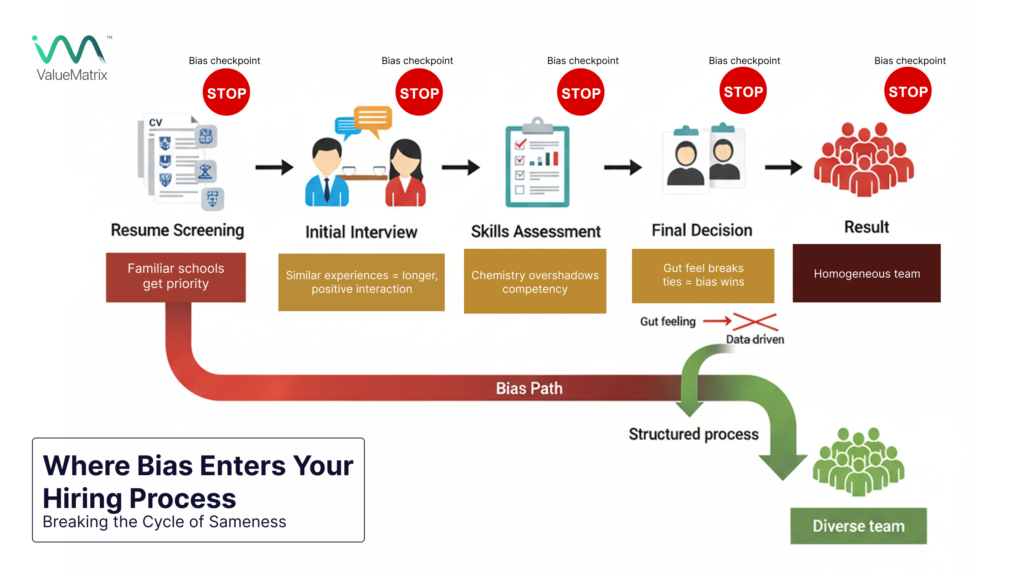
The bias can be particularly troublesome during the final hiring decisions. When you have candidates with almost equal qualifications, hiring managers often resort to “gut feel” or “culture fit” to break the tie. Research shows such decisions heavily favour applications that remind their hiring managers of their existing team members or of themselves.
Stop the Bias research reveals that candidates recognize these patterns.Age bias affects 64.4% of job seekers, while appearance-based bias impacts nearly 20%. When candidates can predict bias patterns, it indicates these biases are systemic rather than isolated incidents.
How to Prevent This Biasedness?
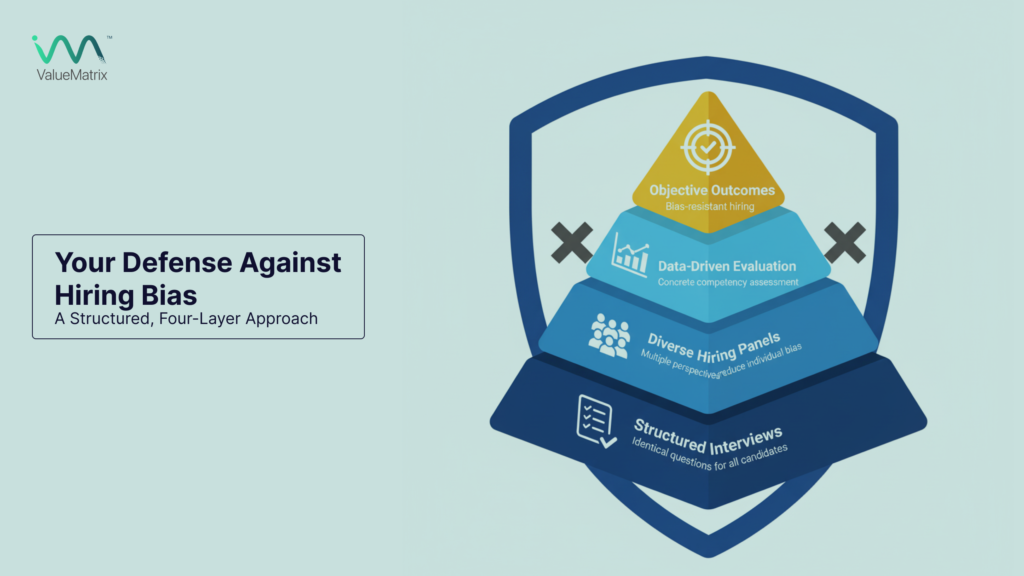
To overcome affinity bias, you need to bring in structural changes to your hiring process. Mere awareness training will not help. You need effective intervention on decision-making systems that should be human-driven but not gut-feeling-driven.
The first line of defence is conducting structured interviews. All candidates must answer identical questions related to the job so that the hiring manager cannot adjust interactions that favour certain applicants. Integrate behavioural interview techniques that focus on the candidate’s past performance in relevant situations. It will provide tangible evidence rather than a subjective impression.
Setting up a diverse hiring process can be the first step in reducing individual bias. According to studies, panels with demographic and cognitive diversity make better hiring decisions.
Having a concrete data evaluation creates accountability for decisions. When hiring managers try to justify choices based on certain competencies, they cannot rely on vague concepts like “chemistry” or fit. This doesn’t remove the human judgment, but rather channels it well towards relevant job factors.
Redefining Culture Fit for the Modern Organization
Some of the most sophisticated companies are not abandoning the culture fit approach completely. They are reimagining it to extract benefits and avoid limitations. This new approach distinguishes between your non-negotiable principles (cultural values) and flexible behaviours (cultural expressions).
Values Alignment vs. Style Matching
The modern culture fit approach aims to align with core company values instead of matching people with similar personalities or backgrounds. A tech company may need all of its employees to have a certain creative and innovative spark while being open to diverse approaches to achieve business goals.
This differentiation is crucial at the time of evaluation. The question then moves from “Do I enjoy talking with this person?” to “Does this person possess and has demonstrated our core values in their past experiences?”
A Harvard Business Review research shows that this new approach actually improves the diversity outcomes. When a company clearly lays out and consistently assesses against set values, it brings down demographic bias and maintains cultural coherence. Candidates from underrepresented communities often show strong commitment to company values in spite of different communication styles or cultural backgrounds.
Building Dynamic Culture
Progressive organizations recognize that culture should evolve strategically rather than remain static. They hire people who embody current values while bringing capabilities that support future organizational needs. This requires viewing culture as a growth engine rather than a preservation system.
The most successful implementations involve articulating both the present culture and the desired cultural evolution. Organizations might value collaboration today while seeking to enhance innovation capabilities for tomorrow. Culture add hiring identifies candidates who strengthen collaboration while introducing new approaches to creative problem-solving.
Comparison of Culture Fit versus Culture Add approaches showing Culture Add’s advantages in reducing bias risk, driving innovation, promoting diversity, and increasing revenue.
Building Systems That Make This Work
Making Culture Explicit
Successful implementation of culture add starts with clarity about what you want to preserve versus what you want to change. Companies must list down core values with the right articulation and give them to hiring managers.
This documentation often reveals assumptions that were never stated out loud. Teams discover they’ve been hiring for unstated preferences — communication styles, work approaches, or cultural backgrounds — that don’t actually correlate with performance. Making these implicit criteria explicit allows organizations to retain valuable elements while eliminating bias-prone factors.
Training Beyond Creating Awareness
A majority of bias trainings create awareness instead of bringing out a behavioural change. However, studies reveal that mere awareness does not eliminate its influence. Effective training programs combine awareness with proper decision-making tools that help hiring managers make unbiased evaluations.
The most impactful training programs use real hiring scenarios to practice new evaluation techniques. Managers can identify when they’re deciding on subjective impressions against objective evidence.
Redesigning Interview Processes
Culture add requires interview processes designed to reveal both value alignment and unique contributions. Companies with successful integration of this approach have a two-part evaluation framework. The first part focuses on stating core values, and the second part identifies distinctive perspectives or capabilities.
As a result, you see interview questions change from “Explain how you are a good fit for the company” to “Tell us how you handle situations that relate to our core values?” or “What approach would you take that may challenge our established thinking process?”
Leveraging Technology and Data
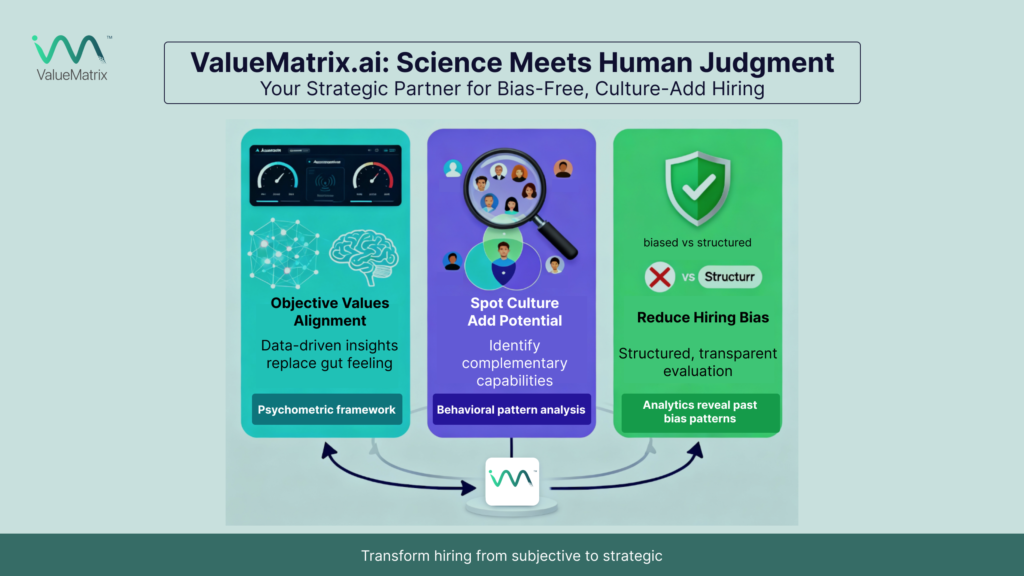
Modern hiring technology can reduce bias while improving decision quality.As a platform, ValueMatrix.ai uses a psychometric framework and behavioural analysis to examine how a candidate aligns with your values and culture in an objective manner. It supports human judgment with tangible data instead of just intuitive thinking.
These are key advantages of tech-based evaluations. Consistent and comprehensive. While human-led interviews vary based on the interviewer and candidate chemistry, a structured assessment allows you to evaluate all candidates identically. This process is much fairer and helps uncover capabilities that regular interviews may miss.
What Leading Companies Are Doing?
Forward-thinking organizations have adopted an integrated approach instead of choosing between culture fit vs culture add. These companies design their hiring pipeline in a way that aligns with their values while actively looking for diverse perspectives.
Some companies now have a dedicated “culture add” interview round. Here, candidates discuss how their approaches or backgrounds might help the team in the long run. Others set up separate meetings to see for value alignment and contribution to ensure both sets are factored in during the final decision.
Some of the best-in-class implementations track cultural diversity metrics along with demographic variety. These companies track whether their culture add hiring is really producing the expected results, such as better problem solving, improved innovation, or better market responsiveness.
Some companies also put money into post-hire integration systems. These systems help culture add employees to contribute efficiently while learning company norms. This avoids common integration hiccups as diverse hires cannot cope with the initial lack of cultural fluency or political capital.
How ValueMatrix.ai Can Help
If you want to balance culture fit vs culture add without the affinity bias, you need to have sophisticated tools that will trump the conventional hiring methods. It is here that ValueMatrix.ai can add value by blending scientific rigor with human judgment.
Objective Assessment of Values Alignment
ValueMatrix.ai uses a set psychometric framework that quantifies alignment between company culture and a candidate’s values. Instead of relying on the interviewer’s concept of “fit”, the platform gives data-driven insights on what motivates the candidate and how their working style actually “fits” the company’s needs.
When hiring managers examine culture fit based on their gut, they unconsciously rely more on interpersonal chemistry or background similarities than actual values. By using data-driven insights, the platform tries to address the fundamental problems with the conventional assessment of culture fit, i.e., subjectivity.
Identifying Culture Add Potential
Beyond aligning company values with candidates’ work strengths, Valuematrix.ai also analyses their personality traits, cognitive approaches, and behavioural patterns. It helps identify how a candidate might complement the existing team and strengthen organisational capacity.
This is crucial for companies looking to build high-performing teams. With ValueMatrix’s help, you can identify applicants who have similar core values to yours but with a unique problem-solving or leadership approach.
Reducing Bias Through Structured Analysis
Perhaps most importantly, ValueMatrix.ai helps you reduce bias in a structured manner. The evaluation is consistent and transparent. It eliminates the variability that allows affinity bias to creep into hiring decisions. The platform’s analytics can also identify bias in your previous hiring data. It can help you understand how past unconscious preferences limited your hiring potential.
Conclusion: Culture Is Not a Static Artifact. It’s a Living Strategy
Companies wishing to thrive in tomorrow’s competitive environment must not fall into the trap of “sameness” under the hood of culture fit. You need to strike a balance between your core company values and evolving corporate culture.
Culture fit vs culture add simply translates to short-term efficiency vs long-term competitive advantage. However, the real opportunity is integrating a system that offers both. Hiring process that maintains cultural coherence while building lasting workforce capabilities through varying approaches and perspectives.
Your culture isn’t something to protect from change. It’s a strategic asset to develop through thoughtful hiring decisions that honour your values while expanding your potential.
FAQs
Culture fit focuses on hiring people who align with existing values and working norms. On the other hand, culture add looks for people having similar values but new ideas or approaches that build on your existing team capabilities.
Simply relying on culture fit leads to a lot of sameness across the workforce. Your teams will work smoothly, but will not have that creative spark or adaptable attitude. Over time, it will create a comfort zone that will stifle innovation.
You need to ask the candidates questions that explore values alignment as well as work contribution. For example, “Tell me a situation where you challenged an established process and delivered a better result?” or “What’s your take on the workings of this team?”
A successful culture adds hires and increases diversity in thought without decreasing collaboration. You can see the change through metrics such as employee engagement, innovative output, or problem-solving mentality.
Yes. Tools like ValueMatrix.ai evaluate value alignment objectively while highlighting complementary traits a candidate could contribute. This blends consistency, fairness, and innovation for bias-resistant hiring outcomes
About Us
ValueMatrix is an AI-powered talent intelligence platform that helps companies hire better, faster, and without bias. We go beyond resumes to assess skills, behavioral traits, and cultural fit using advanced AI and proven psychological frameworks. Our platform delivers data-driven insights that improve hiring accuracy, reduce time-to-hire, and elevate candidate quality.
ValueMatrix AI enables hiring teams to make confident hiring decisions and build high-performing teams at scale.