
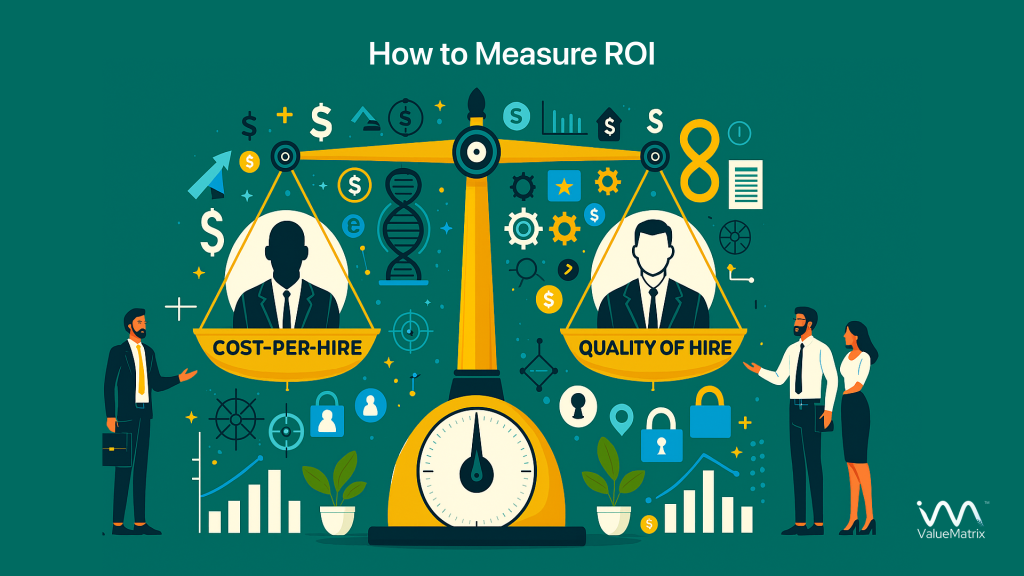
The great resignation might be making a comeback. A study by LinkedIn and Microsoft found that even more people want to quit their jobs today than they did in 2021. A survey of 31,000 individuals across 31 countries found that 46% of employees plan to leave their job in the year ahead – a higher percentage than the 40% reported in 2021. This report sets off alarm bells for HR around the world because a higher-than-usual employee attrition means your Cost-Per-Hire budget will increase while your Quality Of Hire takes a hit– two important metrics for HR.
Cost Per Hire and Quality of hire are two pillars of an effective recruitment strategy. Let’s parse both of these metrics separately.
Cost Per Hire
Cost Per Hire is the cost a company incurs while onboarding an employee. This cost includes the recruitment process, travel costs, administrative fees, salaries, bonuses, and benefits.
The Formula To Calculate Cost Per Hire

The Society of Human Resource Management (SHRM) and the American National Standards Institute (ANSI) made a standard formula in 2012, which is now largely followed by HR all over the world.
Cost per hire = Total recruitment costs (internal and external) / Total number of hires- Internal Costs include an in-house talent acquisition team, employee referral bonuses, a portion of hiring managers’ salaries, and learning and development costs for the recruiting team.
- External Costs include advertising costs, recruiting agency fees, job board fees, recruiter salaries, relocation expenses, travel expenses, recruitment technology, reference and background checks.
When you total both of these costs and divide them by the number of people you’ve onboarded, you get the amount it costs your company to fill one position.
The Cost Per Hire can also be calculated separately for different departments to get a more accurate picture of your spending pattern.
For example, Cost Per Hire for the marketing team might differ from Cost Per Hire for the technical team. CPH also tends to increase for higher positions; the average CPH for U.S. companies in 2025 is $4800, whereas it shoots up to $25,000 for executive positions.
The best thing about CPH is its flexibility; it can be applied in any way your company desires. You can break down your company’s CPH by diversity, ethnicity, or age group.
Why is it such an important metric?
Budgeting and Planning
CPH helps HR in allocating the proper Recruitment Budget. If applied deftly, it can provide valuable insights into your spending habits.
It can point out where you’re overspending, underspending, or misspending. For example, it can tell whether you should spend more on social media ads or on hiring a recruiting agency based on the performance-to-budget allocation ratio, or if you should spend more on hiring Product Managers and a little less on the technical backend. It can also help you achieve your diversity initiatives.
Helps you assess your HR’s performance
It’s a helpful indicator to assess whether your HR team is up to the task or not.
For example, if you’re overshooting your CPH budget and still, your company’s attrition rate is high, something has gone wrong there; your HR needs to pull their socks up.
But if your CPH is high and you’re still able to retain high-value employees for a long time, they’re doing their job just fine.
How to optimize Cost Per Hire for your company?

There is no one-size-fits-all number that can be universally applied to all businesses. It depends on your company’s goals, objectives, and budget. However, here are some best practices you can follow that’ll help you keep your costs down without compromising on the quality of your hires.
1. Utilising Social Media
Creating job postings on websites like Twitter and LinkedIn is one way to fish from a giant talent pool without blowing your budget. It is far more cost-effective than physical recruitment drives, where the travel and accommodation costs shoot up the CPH budget.
2. Employee referral program
You can incentivize your employees to refer you to qualified leads. It not only saves unnecessary expenditure but also expedites the hiring process. A qualified lead referral from an employee makes the HR job a lot easier.
3. Using AI
There are AI HR platforms available that can streamline your hiring funnel, remove human biases, and account for diversity, like Valuematrix.ai.
Limitations of Cost Per Hire
CPH has its uses, but it can’t be the sole metric you place all your bets on. CPH in itself doesn’t tell you anything. It helps you with budgeting, but beyond that, you’ll need other metrics to formulate a complete recruitment strategy.
This is where the Quality of Hire metric comes into play.
Quality Of Hire
The Quality of Hire metric helps you measure the value a new hire brings to your company. Quality of Hire contains two indicators:
- Pre-hire Indicators-Which include your assessment scores, work samples, and structured interviews.
- Post-hire metrics-Which include performance metrics, such as goal achievement, project impact, or manager ratings in performance reviews.
How To Measure the Quality of Hire Of Your Company?

This is where it gets tricky. QOH is notoriously difficult to measure, as it’s a very subjective metric. We all can have different notions of quality.
But still, there are markers on which you can gauge the QOH of your company-
- Culture Fit– Cultural alignment is a necessary metric for the long-term retention of new employees. Check how well they’ve integrated into the organisation by sending surveys to their managers. Also, keep in mind that you’re looking for an individual who believes in the vision of your organization, someone who is willing to contribute to its success. More often than not, people tend to look for a playmate they can “grab a drink with” after office hours in the name of cultural alignment.
- Retention– How long an employee stays with your company. A high flight rate might indicate some deep-seated problems in the onboarding process.
According to a survey byEngage HR, a high flight rate ends up costing an organisation 100- 150% of the departing employee’s salary.
So, high attrition is something you might want to look out for.
- Engagement is a very important metric to gauge the motivation of your new employees. This can be done via “catch-up” calls, surveys, and feedback forms. Another great marker to gauge the engagement of a new hire is their participation during team-building exercises like escape room challenges and off-site activities.
- Performance Metrics– You should have certain KPIs in place to measure an employee’s minimum acceptable productivity. For example, sales targets, number of project reports submitted, etc., 50% companies measure Quality of Hire through New Hire Performance Metrics. They are the most popular way of measuring the quality of hire.
The Most Common Quality Of Hire Formula:
Over the years, companies have adopted a standard formula using the scores from the metrics above.
The most common formula used by companies is the one below-
QOH=(Performance Score+Retention Score+Hiring Manager Satisfaction)/3
The score could be out of 5 (You could choose a different number).
- Performance Score is based on the number of tasks performed on time.
- Retention Score is based on the time the individual has spent with the organisation. If it’s over 12 months, score him 4; if it’s more than 2 years, he gets a perfect 5.
- Hiring Manager Satisfaction is based on the survey hiring managers receive at the end of the employee’s probation.
You then add up the metrics and divide them by 3, and you get a number that tells you the overall value of the employee.
How to optimize your Organization’s Quality of Hire?
Since it’s a qualitative metric, it’s best for the organizations to have a scorecard for the markers discussed above, like Retention, Culture fit, Engagement, and score the candidates accordingly, like the example above.
Organisations should use hiringAI platforms that use psychometric tests, psycholinguistics, and gamified assessments to remove all human biases from the hiring funnel and significantly cut down the onboarding time.
AI can make your Hiring Process more data-driven, objective, and predictive.
Cost Per Hire vs Quality Of Hire
While Cost Per Hire still remains the mainframe recruiting metric most companies rely on, Quality of Hire is steadily gaining ground. According to a recent Aptitude Research & Crosschq survey of 256 HR and TA leaders, 75% identify improving quality of hire as their top priority. But an effective recruiting strategy involves both metrics.
Here’s how both metrics affect each other.
- Poor QOH will surge your Cost Per Hire- If your QOH health is poor, i.e., Poor Retention, High Attrition Rate, Low Performance, it’ll not only put your company in an unending hiring cycle, further driving up your talent acquisition costs, but it could also affect the overall margins of your business. Zappos CEO Tony Hsieh revealed in an interview that bad hires cost him close to $100 million.
- High Cost Per Hire doesn’t necessarily mean better Quality of Hire- There are many stories about how overzealous HR went overboard trying to rope in a senior executive from a big conglomerate like Amazon, Google, etc., only to later find out that the person was not a good cultural fit for the company. HR sometimes tends to conflate spending more with quality, but more often than not, it’s a case of faulty leaks in the hiring pipeline, like misallocation of budget, not customizing your spending for every department, overspending on famous resumes, etc.
Homejoy, a US-based home cleaning startup, went on a talent acquisition overdrive, onboarding a Former Starbucks VP and Zynga CFO, and yet faced high attrition rates, resulting in poor customer service and ultimately closure in 2015.
- The Perfect Balance– Even though spending more doesn’t necessarily mean spending on quality, it is always a good practice to refer to your Industry average as a north-star metric. If you’re spending way below your industry average, you might be compromising on quality. The best practice remains optimizing Cost per Hire without compromising on the QOH.
How to get the most ROI out of Cost Per Hire and Quality Of Hire
Shifting to Skill-Based hiring- Skill-based hiring focuses more on the candidate’s competency in the job rather than their degrees or previous experiences. This approach pivots from the archaic resume-centric approach to task-based psychometrics and gamified assessments. Ocean Outdoor (via TestGorilla) shifted to skills-based hiring, reducing failed hires by 44% and saving 5 hours of interviews per position, and enhancing both cost efficiency and hire quality.
Encourage internal lateral movements within the organisation– Support employees who want to switch departments and experience your company from a different viewpoint. Provide them with the necessary training they will require to take on the new role. A current employee has many advantages over an outside hire-
- He is already a cultural fit(understands the company’s holistic vision),
- Highly engaged(hence the lateral move)
- He has already proved himself on the performance metric.
Organizations must also encourage upward mobility towards senior positions. As discussed, a current employee will be a lot more in tune with your company’s ethos. And also, a positive and affirming work culture will bring down your attrition rate and boost your employee retention, thus improving both metrics- CPH and QOH.
But it doesn’t end here- Positive career reinforcements within your organisation will also strengthen your social proof in your industry. And soon, you’ll be drawing top talent from your industry on mere word of mouth from your employees.
Hiring in the age of AI

Generative AI has completely disrupted the HR landscape, and results are already showing.
According to hirevue.com CHOP saved 1,695 recruiter hours ($667k annually) by eliminating manual phone screens. Holcim improved QoH by filtering out 60 % of poor-fit candidates.
Companies have already shifted to skill-based assessments leveraging AI.
How AI has impacted CPH and QOH
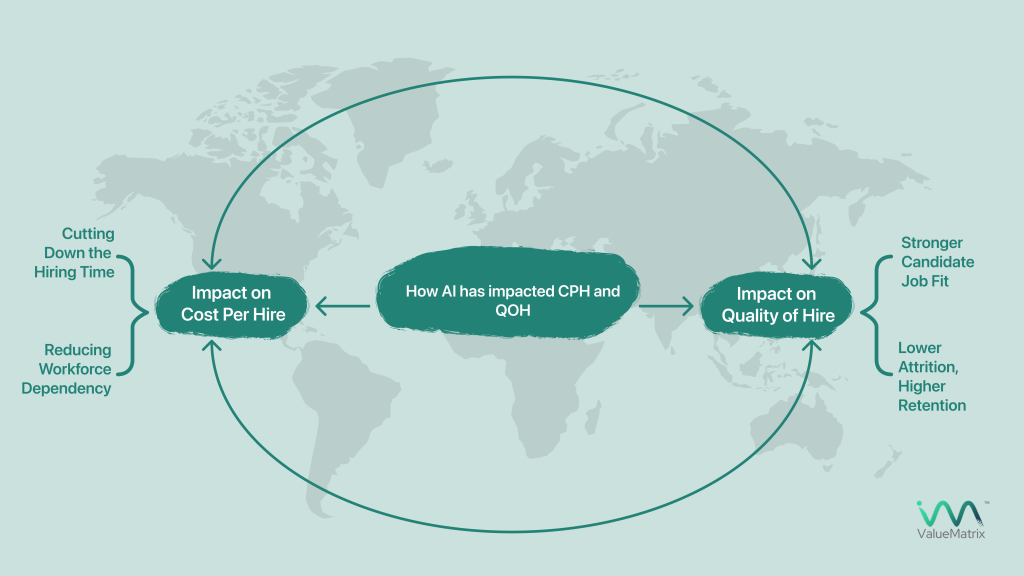
Impact on Cost Per Hire –
- Cutting Down The Hiring Time– According to this Aptahire report, AI has truncated the time-to-hire by 40-60% by analysing interviews, shortlisting candidates, and scheduling interviews in seconds instead of days. This has significantly brought down the overhead charges of companies. For example, if HR spends $200 a day, AI can cut down that time by 14 days, saving them $2800 a month.
- Reducing Workforce Dependency– AI has shown its impact in reducing workforce across verticals. Companies probably will not require a legion of HR to parse resumes and schedule interviews. AI will take over this role. Their role will most likely be collaborative shortly.
Impact On Quality Of Hire
- Stronger Candidate Job Fit– We have already discussed the shift from a resume-based approach to a skills-based approach, which focuses more on task-solving abilities rather than degrees. A report says that 8 out of 10 candidates suggested by AI are deemed suitable by human experts, which means AI-powered tools are already scoring 80% on the Job-fit metric.
- Lower Attrition, Higher Retention– With its predictive capabilities, AI does a much better job of finding employees who stick around for the long game. According to WifiTalents, 53 % of recruiters report that they have enhanced their retention, thanks to AI’s better overall matching capabilities.
Improved Meritocracy and Diversity- Companies like Unilever saw a 25 % boost in retention and 16 % increase in diversity using AI-powered hiring.
AI Is Here To Stay
Avature’s The State of the HR Landscape in 2025 found that 60 % of HR professionals now rank AI and automation as their top strategic priority, with 74 % already using or planning AI tools across HR functions like talent acquisition, workforce planning, and chatbots.
The era of HR professionals filing and compiling paperwork is passé now..
AI is here to stay, but so is the human element. We are heading towards a more synergetic recruiting environment where the human touch will remain without human error.
Global HR Industry Analyst, Josh Bersin, sums it perfectly-
“AI in recruiting is not about replacing people—it’s about making recruiting better, faster, and fairer. The goal is to improve the quality of hire while reducing cost and time.”
Global HR Industry Analyst, Josh Bersin
FAQs
1. What’s the most important element of a culture fit? An employee’s attitude or their skill?
While a balance between the two is optimal, any skill gap can be covered during the candidate’s training period or probation, but attitude misalignment is extremely hard to overcome. So, weightage should be given to the candidate’s attitude during assessment.
2. Can you predict QOH before making the hire?
Predictive assessments and structured interviews help estimate future performance, but true ROI often becomes measurable only post-onboarding, once actual value and retention are observed.
3. Should bootstrapped businesses/startups have internal recruiting teams or hire a recruiting agency? Which gives the highest ROI?
For bootstrapped businesses or startups, the highest ROI usually comes from lean, strategic use of recruiting agencies, not building an internal team too early, because internal teams are cost-intensive and can become a liability during an off-hiring cycle.
4. Should Quality of Hire vary by role type when calculating ROI?
Yes. A high QOH in a leadership or engineering role often yields higher ROI than an entry-level position.
About Us
ValueMatrix helps organizations build culturally cohesive teams with AI-powered recruitment and retention strategies. We educate corporate leaders on the importance of involving and encouraging all generations to adopt enterprise values and participate actively to achieve excellence.
Our AI-powered platform transforms talent acquisition with intelligent hiring techniques backed by established psychological frameworks. We partner with HR professionals to conduct unbiased and holistic assessments for aspiring candidates.