
A brief history of CHRO-CIO AI Strategy
CHRO and CIO have historically had very few touch points. Both positions had their own distinct roles to perform. One such touch point came around when cloud computing entered the corporate world in 2010, and every company started migrating its data to the cloud, including payroll, benefits, employee records, etc.
That was an important pivot in the history of the corporation, and it required collaborative efforts from the IT and HR departments to make it a success.
Other than a few watershed moments, both departments have had little to no communication between them.
The perception has always been that CHRO lacks the technical expertise, and a CIO is too solution-focused on backend problems, such as IT bottlenecks, to collaborate in any meaningful way.
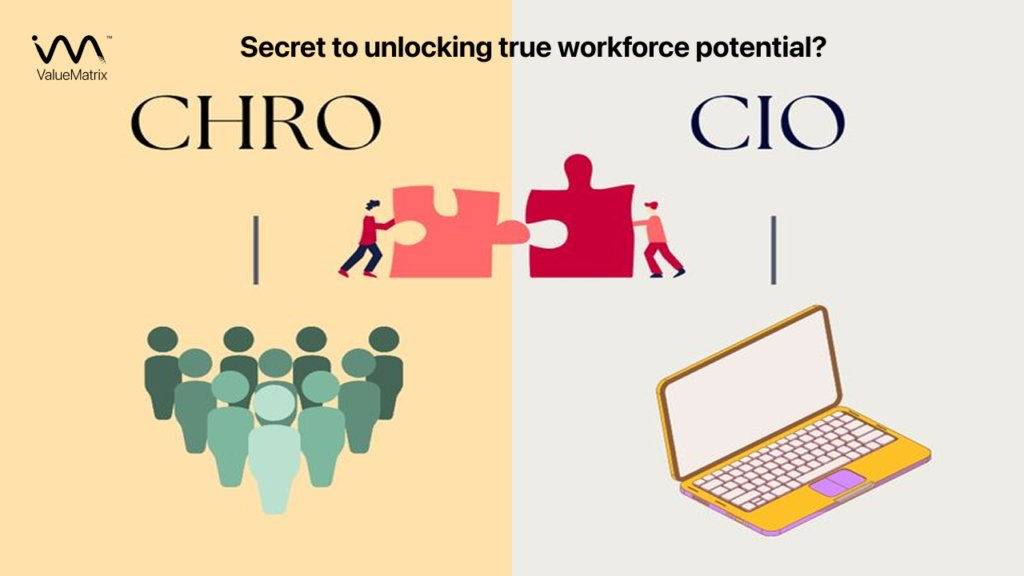
But these age-old practices need a massive overhaul, as the need of the hour is a comprehensive CHRO-CIO AI strategy.
Is a strategic CHRO-CIO partnership CHRO important in the age of Talent Intelligence?
What is talent intelligence, and why is it important?
Talent intelligence is the latest product in AI HR that uses AI and big data to scour the internet and scan millions of profiles. It then deconstructs those profiles into texts to churn out insights like skills, job history, career paths, etc.
It can also conduct labour market analysis. Let’s say your firm wants to open an office across Europe. Talent intelligence can tell you where you might want to locate your sales offices, R&D facility, and research center based on the availability of talent.
It can also sense the shift or pivot an industry might be going through and help you ascertain the skills you’ll be needing in your company. For example, the automobile industry is moving from petroleum to lithium batteries as its power source, so the automobile manufacturing companies will need fewer automotive engineers and more EV experts.
Talent intelligence can help you make that shift by identifying the cluster of skills or roles you’ll be requiring.
It can also help employees with internal job mobility by recommending vacant or soon-to-be-vacant opportunities and positions.
Why is a partnership between the two C-suites more important now than ever?
In the age of AI, particularly Agentic AI, companies are poised for a complete overhaul of their workplace structure, because Agentic AI will blur the boundaries between departments. This new change will force teams to band together as a lot of these departmental silos will dissolve.
What is Agentic AI?
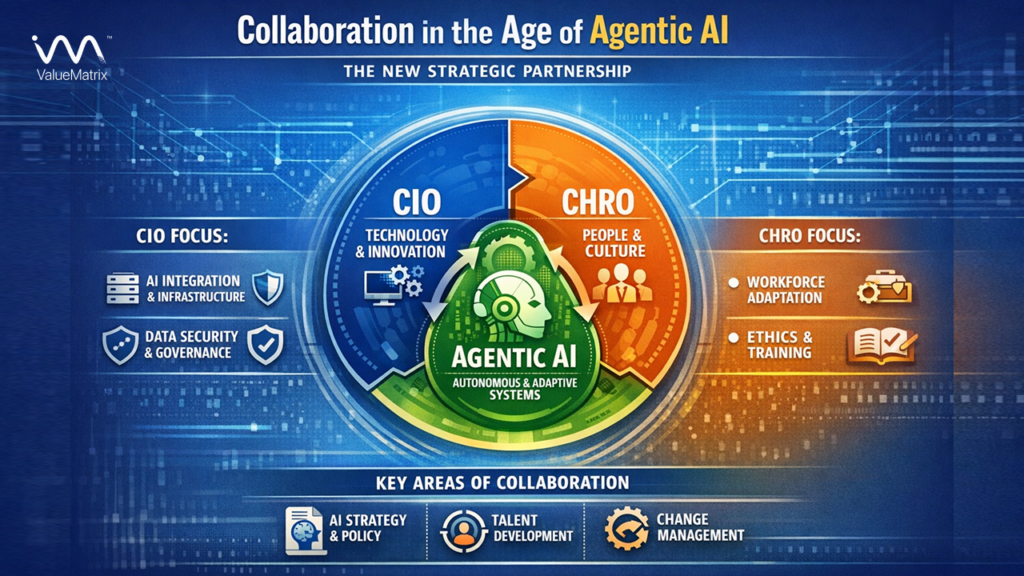
Agentic AI or generative AI is a system that can autonomously set goals and create multi-step plans to achieve those goals with little to no human intervention.
Agentic AI has the ability to iterate, reason, and adapt based on real-time feedback; it’s like a sentient employee. So once it is assigned tasks, it learns on the job and keeps getting better based on the inputs it receives.
Agentic AI coupled with Talent Intelligence is the kind of perfect storm that will change many industries forever, making the collaboration between IT and HR even more pivotal.
Why Talent Acquisition is the most high-impact area CIO and CHRO need to focus on.
Talent Acquisition
Talent acquisition is one domain that has seen an increasing interference of AI. You have Large Language Models that are able to screen thousands of resumes in seconds, Generative AI that can write your job descriptions, and Predictive analysis that can spot the “Best-fit” candidates for the job.
But these advances don’t make HR’s role irrelevant. HR is still the trusted barometer for culture fit for a company. We must remember that these AI models operate on the dataset of past hirings. And those past hirings were executed by the Human Resources.
HR policies of the past can be a repository of knowledge for the organization.
CHRO and CIO must sit together and can dig into past hiring data– like high attrition, culture misfits, performance failures, etc, and weed them out when implementing new AI technology.
Here are a few high-impact facets of talent acquisition that both parties need to focus on.
Skill-based hiring
The mass layoffs followed by post-COVID overstaffing exposed the flaws of pedigree-based hiring practices. A large number of those layoffs were due to skills mismatch, and ever since, we’ve seen companies make a hard turn from traditional hiring to skills-based hiring.
Skills-based hiring has many facets to it and requires a team effort from both the CHRO and the CIO. CHRO’s role is to sit with the team heads and discuss the skills they want to hire for.
For example, if you’re hiring a copywriter, your CHRO would need to loop in your creative director and discuss the copy skills that are hot in the market, like brand voice, ghostwriting sales funnels, etc.
Once CHRO gets a good understanding of the required skills, he, along with the creative director, can brainstorm time-sensitive assessments where a candidate is given a small brief about a decoy product and asked to write a 200-word mini-sales letter about that product..
When CHRO has a good idea of the ideal candidate, he relays those needs to CIO, who then designs analytics to poach copywriters with the desired skills, curates copywriting assessments based on the brief, and creates generative chatbots to help candidates in case of a query.
Skill-based hiring has become too complex to be solved by one vector; it requires various teams to band together and work in cohesion because the common goal remains the same: to scout and hire the best available talent in the market.
This sentiment is corroborated by Laura Coccaro, Chief Operating Officer at ICIMS.
“Bridging that gap and having that partnership, and really figuring out the way to find the strategic value in leveraging AI, for example, is a huge step in the right direction. And you can’t be doing that in isolation.”
Culture Fit
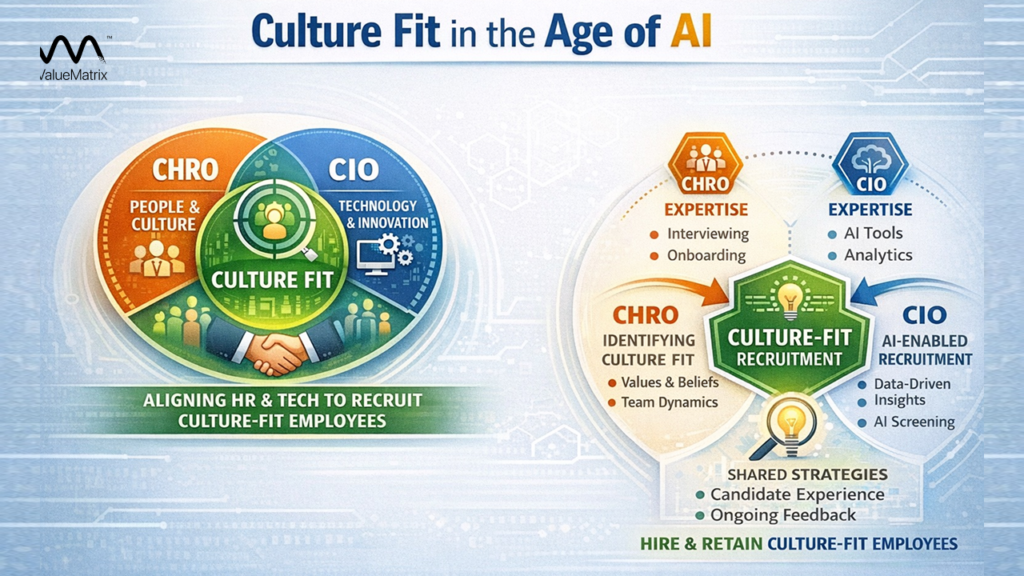
But as clear data showing a correlation between high attrition rates and bad culture fit emerged, recruiting officers started taking it a bit more seriously.
One pillar of talent acquisition that went through a complete transformation after AI was culture fit. It went from “pure vibes’ to a full-fledged science. In the past, it has been given a stepchild treatment; you’d rarely see a candidate with a good educational pedigree and experience be ruled out on the grounds of being culturally unfit.
Why is culture fit important?
Every company has some values, such as teamwork, fast-paced delivery, or creativity. The manner in which your employees carry out those values in their daily work defines your culture.
Company Culture also acts as a beacon to candidates who feel aligned with your values. It’s your company’s sales pitch to the like-minded people around the globe.
In times of crisis, it’s culture, and not fancy systems, that pulls a company through.
It’s the solid foundation on which a company is built. It’s basically the character your company is defined by. In a world where every company is racing towards AI automation, your company culture is your unique selling point.
Any company without a strong ethos or a clearly defined work culture is like a sand castle on a beach, washed away by the first big wave.
Yahoo’s hiring debacle is still etched in our minds. Yahoo went on a massive hiring spree under its CEO, Marissa Mayer, and brought in thousands of employees with wildly different sensibilities.
What followed was complete incoherence and misalignment among different departments, and as a result, Yahoo quickly started going downhill until its sale to Verizon Communications in 2017.
CHRO’s Role in directing and preserving the culture
A CHRO’s role historically has been stewarding the company’s culture through hiring.
He is the gateway to the company, the initial touch point. Every candidate is filtered through an HR round first.
How CHRO set the hiring criteria for the candidates?
HR sets the hiring standards, and a candidate is moved to the next round only when those standards are met. HR evaluates a candidate’s soft skills and draws an outline of his character through non-invasive questioning that feels like a conversation.
It is also an interlink between higher management and employees and is responsible for relaying the inputs of higher management to the concerned teams.
HR not only spells out the exact concerns of the management to the teams but also checks with the team if they’re facing any issues in their work, whether they’d require any support from up top.
This ensures a two-way dialogue between the employees and the management instead of a one-way, top-down order approach.
HR also plays a very important role during onboarding. It sets the context during a candidate’s onboarding. HR lays down the power structures, immediate supervisors, communication style, unwritten rules, defines clear roles, etc.
Then comes a performance review at the end of a candidate’s notice period. This is basically a performance recap by the HR department done in a semi-professional environment. This sets the tone for his entire tenure in the organization. The candidate is apprised of what he did well and where he could improve so that he understands what is expected of him.
By this time, the candidate is pretty well tuned to the inner workings of the organization and more or less has absorbed the company environment.
So, from the time a candidate is pre-selected to the time he is onboarded, HR plays a seminal role in a candidate’s complete assimilation into a company.
If you want a complete rundown of CHRO’s role in an organization, click here.
Where does the CIO come in?
Traditionally, CIO had little to do with a candidate’s assimilation into a company’s culture, but since AI has entered the hiring space, their role has increased exponentially as they understand the technology the best.
We have gamified assessments like “Balloon Game”, psychometric assessments based on behavioral science that can assess a candidate on the basis of characteristics like risk-taking ability, stress tolerance, and fairness. cooperation etc.
The best part about these assessments is that they are unhackable. They’re almost impossible to practice for because the candidate doesn’t exactly know what trait he is being judged for, and they happen in a time-bound environment, forcing the candidate to reveal his subconscious side.
Here’s where CIO and CHRO can come together.
CIO can help the CHRO in integrating these behavioural assessments into the hiring funnel.
CHRO decides which of the aforementioned traits are culturally aligned with the organization and chooses candidates that rank highly on those traits.
CIO comes in handy in scaling up and optimizing these assessments with the help of agentic AI. Embedding Agentic AI requires a lot of technical expertise; these cognitive tests detect subconscious ticks like speech, mouse-click pattern, eye movement, micro-expressions etc.,
and gives real-time feedback to the candidates on the dashboard.
All this requires serious planning and preparation. CHRO, along with CIO, decides what type of psychological models suit their organization the best, like BIG FIVE, HOGAN, etc.
CIO is also responsible for embedding generative chatbots to help candidates in real time with their queries.
Culture misalignment is one of the killers that you don’t realise until it’s too late.
Toxic Culture has cost the corporate world north of $2 billion in 5 years.
As Peter Drucker once famously said: “Good culture eats AI strategy for breakfast.”
Hence, it’s one of the most important metrics to leverage for both CHRO and CIO.
Bias Mitigation
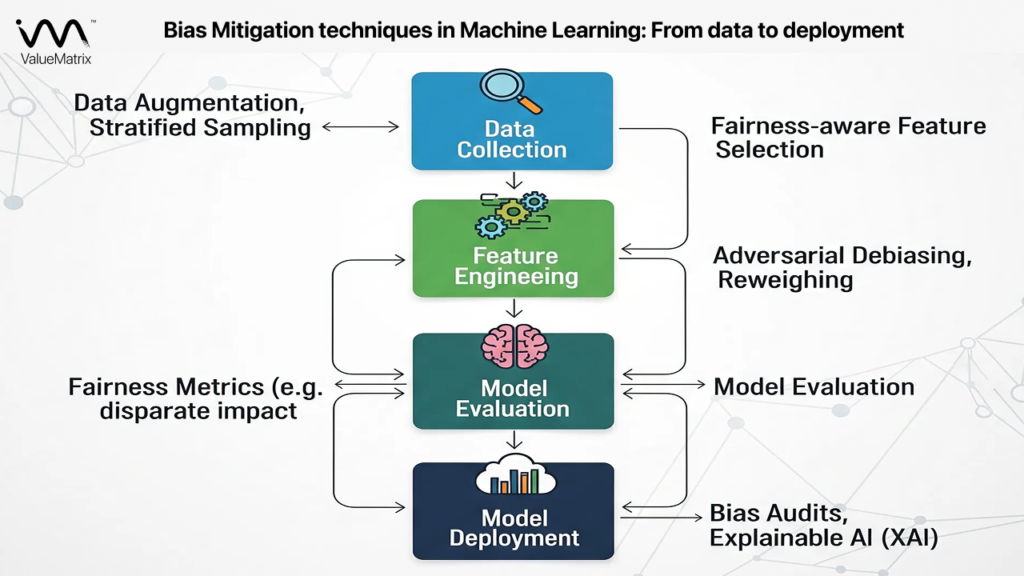
Every year, companies spend millions on anti-bias training for employees because companies with diverse workforces outperform homogenous teams.
That’s why it has become a top priority for companies to mitigate bias in recruiting.
DEI has been under attack under the Trump administration, but top firms haven’t given up on their diversity initiative.
CHROs have recently been put on the job to meet certain diversity standards. It has become more structured and serious; companies are spending significant time and effort to ensure a heterogeneous workforce.
Here are some of the ways CHROs are fighting bias in recruitment.
Redoing the job descriptions.
The choice of words in your job description can have a tremendous influence on the type of talent pool you attract. Your job description is the first interaction a candidate has with your company; that’s why CHROs are now focusing on inclusive words. Research has shown that using gendered words like “competitive” and “determined” can dissuade women from applying; hence efforts are being made to make the job descriptions more gender neutral by using words like “build” and “create”.
Anonymizing Data
Companies are using data scrubbing AI technology, which removes all the identifiers from a resume, like pincode, name, university, etc, so when an HR looks at a resume for the first time, they don’t come across any status marker which can trigger an unconscious bias in the interviewer, commonly known as ‘halo effect.’
Standardised Interviews
Research shows that unstructured interviews without any template or outline are poor predictors of a candidate’s success. Conversation-style interviews, which lack any defined questions, can seed strong bias in recruiters.
On the other hand, task-based interviews with set questions that gauge their skills are not more accurate in gauging their competence, but also weed out bias.
Iris Bohnet, director of the Women and Public Policy Program at the Harvard Kennedy School, suggests using an interview scorecard that grades candidates’ responses to each question on a predetermined scale.
That way, you have a data point to mark their performance as opposed to an organic conversation, which relies on the ‘feel-good’ factor.
Self Review
CHROs must be aware of their own biases. Humans are prone to several conscious/unconscious biases like affinity bias, confirmation bias, halo effect, horn effect etc.
CHROs must be cognizant of their irrational preferences in men and women. They must be aware of their likes and dislikes in candidates that are not relevant to their job performance. Only a fully aware HR director can keep his biases aside when interviewing a candidate.
The goal is to be a data point on the candidate and not be impressed or unimpressed by the person. In other words, a CHRO must exhibit complete disinterest in a candidate and only evaluate him based on his performance.
How can CIOs help in bias mitigation?
CIOs are in a unique position to help HR in bias mitigation because every conversation happens through technology these days, whether it is virtual synchronous/asynchronous interviews, gamified assessments, psychometric tests, etc., AI is the conduit being used in every interaction.
Here are some of the ways CIOs’ AI expertise, coupled with HR’s inputs, mitigate bias.
Biased Data Sets
The most common form of algorithmic bias comes from biased data that has been fed. So CIO, along with the CHRO must ensure that the systems are fed a diverse set of data.
CIO must take the CHRO’s help to identify previous skewed hiring patterns and rectify them.
For example, if a company’s last decade of data shows predominantly male hires, the algorithms will interpret male hiring to be essential for success and start weeding out women applicants. This happened in the case of Amazon.
Solving the ‘Black Box’ problem.
Many of the deep learning models tend to develop opacity problems. Which means that you feed an input and it gives an output, but the process in between remains a mystery. For example if a Machine Learning model evaluates a gamified test given by a candidate and scores it low, you can’t know the reasoning behind that score.
If HR and compliance teams cannot understand the rationale behind a candidate’s acceptance or rejection, they cannot– trace errors, diagnose embedded biases, or demonstrate that the AI tool adheres to legal fairness standards. Opacity transforms bias from a fixable error into an unmanageable systemic risk.
Regular hygiene checks.
CIO needs to conduct regular, independent audits to sanitize the AI tools of any bias. These models. These models should follow a list of fairness metrics, such as the ratio of female representation you want to achieve in the workforce. So that these models know what are your recruiting objectives in hiring.
Data scrubbing.
Data scrubbing or anonymized screening refers to AI tools erasing all status and societal identifiers like pincode, university, names, and gender from your resumes and only making visible your skills, samples, etc on your resume.
It helps the recruiters evade unconscious biases like the Halo or Horn effect, enabling them to focus on job-relevant skills and culture match.
Anonymized screening is more important during the initial stages because the bias is stronger. When you don’t have much data on a candidate, you rely on whatever is available to you to create a mental image. Our minds are most susceptible to bias in the absence of information, so surnames, skin colour or a pincode can trigger affinity bias, or a negative bias, also known as horn effect.
Conclusion
Saket Srivastava, chief information officer at Asana, believes that companies that are not focusing on the partnership between CHRO and CIO are missing out. He says that this partnership is “one of the most fundamental partnerships a company needs”.
And he is not the only one. John Bersin agrees with Srivastava and warns about a technology-first transformation; he believes that talent acquisition should happen in tandem. But the reality is far from this. The meeting of minds between these two entities hasn’t been in the way one would hope.
The iCIMS report suggests that when it comes to big firms, most CHROs and CIOs aren’t seeing eye-to-eye on talent acquisition.
This is a worrying sign since the success of talent acquisition relies on a strong partnership between the two. The biggest reason is their different perspectives on Talent Acquisition.
This chasm is deeper than you think. Only 27% CIOs believe that Talent Acquisition has a significant impact on business.
This statistic is quite telling; it reveals CIOs have a diminished view of HR’s work, and HR, on the other hand, believes that CIOs are novices in this space and should follow their lead.
If both can bridge the divide and make Talent Acquisition a joint venture, the opportunities are endless.
FAQs
According to the 2025 iCIMS study shared above, the top factors holding back the HR-IT partnership are:
Strategic disconnect between both sides.
Limited budgets and resources.
A lack of shared understanding around tech capabilities.
Resistance to change from HR.
CEO is the best suited for the role. He can help identify high-conflict zones, weed out the bottlenecks and find common ground between them. The dissemination of duties has to flow through the CEO, as he is the final authority.
Talent Acquisition has entered a new paradigm with Agentic AI, and data doesn’t seem to suggest that it’ll go back to the old normal. The convergence of the departments will only increase with maturing technology and not decrease, rendering siloed work not just inefficient but untenable.
About Us
ValueMatrix is an AI-powered talent intelligence platform that helps companies hire better, faster, and without bias. We go beyond resumes to assess skills, behavioral traits, and cultural fit using advanced AI and proven psychological frameworks. Our platform delivers data-driven insights that improve hiring accuracy, reduce time-to-hire, and elevate candidate quality.
ValueMatrix AI enables hiring teams to make confident hiring decisions and build high-performing teams at scale.