
Table of contents
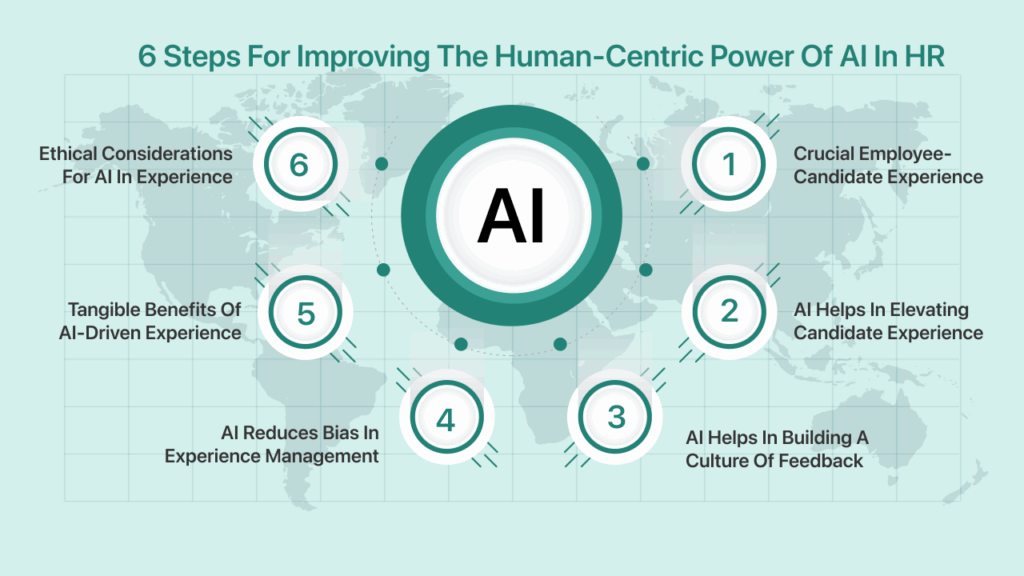
- 1. Why is Candidate & Employee Experience Crucial? 💖
- 2. How Does AI Enhance the Candidate Experience? 🚀
- 3. How Does AI Elevate the Employee Experience?
- 4. How Does AI Foster a Culture of Feedback and Voice? 👂
- 5. Does AI Reduce Bias in Experience Management? ⚖️
- 6. What are the Tangible Benefits of AI-Driven Experience? ✅
- 7. Case Study: Companies Excelling with AI in Experience 📊
- 8. What are the Ethical Considerations for AI in Experience? 🔒
- 9. How to Implement for a Better Experience? 🛠️
- FAQs
The talent ecosystem changes. A truly exceptional candidate and employee experience is no longer a luxury but a core competitive advantage. It is this change that is most visible with the flood of digital tools shaping every interaction point. For many leaders, the question remains: Can Artificial Intelligence, the often supposed coldly technical automated savior, actually improve the inherently human aspects of work?
Yes. AI’s actual power in the world of human resources does not lie in replacing human interaction but in eliminating the friction that allows for hyper-personalization and frees HR professionals to focus on the much more meaningful human connection with each other. This blog will explore in depth the different facets of modern HR technologies, particularly AI in candidate experience and Employee experience AI: how the automated frameworks put a person on a much faster, fairer, and personalized journey right from their first application through to ongoing career development within your organization.
1. Why is Candidate & Employee Experience Crucial? 💖
Offer the experience of candidates and employees within your organization in a candid atmosphere. In today’s fiercely sold-out talent arena, the experience that provides both candidates and employees would directly link to the values of your organization and the culture within it. Beyond basic engagement scores, it transcends all levels of business outcomes influenced by attracting, retaining, and finally leading to organizational success.
Beyond Engagement Scores
True engagement scores offer snapshots of both the candidate and employee experiences. They take into account every single interaction, from applying for a job to communication during hiring, onboarding, and growth opportunities throughout the career. In short, the entirety of what it means to be valued, to be heard, and to be supported in back-and-forth contact-holdings—that’s way more than a metric.
Impact on Talent Attraction and Retention
Phenomenal experiences draw the best talent into the fold. The channels that spread the reputation of a legitimately concerned employer are word-of-mouth, online reviews, and professional networks. Poor experience, on the other hand, significantly acts against attracting talented minds and discourages them from applying to the organization. Most of the time, organizations with good experience have lower attrition rates and thus are likely to save money typically used for new endeavors, recruiting, and training new hires.
The Link to Productivity and Business Results
Contented employees, who also seem fully engaged, always become very productive. People tend to increase motivation and commitment, as well as innovative spirit, when they feel valued and supported. Subsequently, this positive experience spills over to productivity, even showing returns like increased customer satisfaction, better service quality, and, soon, stronger financial viability. Hence, experience should not only matter in HR but also be a primary business strategy as well.
2. How Does AI Enhance the Candidate Experience? 🚀
An employee about to begin prospecting takes his first journey, fraught with the uncertainty and delays typical of this experience. AI now intervenes to transform an entire experience-the AI hiring experience-both in its ease of rapid query responses and increasing personalization of interaction. Right from the first touch point, candidates are made to feel informed and valued, even excited at the very prospect of the opportunity.
Automating Initial Screening and Communication
The most painful experience for candidates is known as the “application black hole.” AIs and virtual assistants are always at your service with instant assistance. They answer simple questions like job requirements, company culture, or the status of the application. This instant feedback soothes the candidate, free from anxiety, thus liberating recruitment teams from repetitive questions to spend more time on strategic issues.
- Statistic/Reference: 77% of job seekers who interacted with AI in searching for a job rated their experience positively, implying that it meets the expectation of speed and accessibility from the candidates.
Personalized Job Matching
The traditional job boards rely heavily on broad keyword matching, giving rise to a lot of irrelevant suggestions. In contrast, AI performs great personalized job matching: it contrasts a candidate’s skills and experience with specific role requirements, sometimes predicting the inferred career aspirations of that candidate. All of this ensures matching recommendations for positions that are good fits for candidates, adding a lot toward relevant and quality AI in the candidate experience.
Faster Scheduling and Feedback
Setting interview times may take painfully long through back and forth. AI scheduling tools can automate that process by coordinating calendars for all concerned, sending confirmations and reminders instantaneously. More glaringly, the AI ensures that all applicants, regardless of outcome, are given feedback on time, addressing a major pain in the hiring process.
Conclusion: AI tools are changing the AI hiring experiences by automating the first interactions through providing personalization in job search as well as rationalizing down logistics for hiring. Then, candidates think about how informed and respected they are, and how much the minimum added effort from recruiters frees their human efforts to focus on thoroughly engaging high-potentials.
3. How Does AI Elevate the Employee Experience?
Certainly, the promise of a great experience does not stop at hiring. Employee Experience AI indeed adds value to engagement, support, and growth throughout someone’s tenure in the organization. It empowers individuals and frees HR for strategic human capital initiatives. es.
Personalized Learning & Development
Such generic training programs are generally found to be ineffective in engaging employees. AI platforms, which are at the center of Employee experience AI, analyze individual performance, identify skill gaps, and career aspirations so that they can be developed into hyper-personalized learning paths comprising personalized course recommendations and micro-learning modules along with curated content-on-demand development opportunities that are relevant, interesting, and direct employee growth satisfaction.
Efficient HR Support & Self-Service
There is immense frustration in navigating pervasive HR policies or waiting for answers to inquiries about benefits, payroll, or requests regarding leave. Either way, such problems can easily be countered with AI chatbots and virtual HR assistants, which give out answers instantaneously, for example, 24/7. So the answer to that particular question would not be delayed. Administrative functions will be streamlined, and consequently, the HR teams will be less busy, ensuring that quick solutions to the problems of employees lead to enhanced satisfaction and productivity overall for these employees.
Proactive Internal Mobility & Growth
AI would be a game changer in inculcating a culture of internal growth. Proactively, it looks for internal “gig” opportunities, mentorship pairings, or suitable roles for promotion based on actual skills, project history, and expression of interest by employees. All of these proactive matching slashes outside hiring costs and puts out all the right signals for employee morale and retention by spelling out the career advancement paths within the business.
Conclusion: It automates the managerial burden of routine activity, personalizing the nature of support and opportunities for growth in day-to-day work. Employees would focus on such work with a sense of being valued by the tailor-made approach and clearly recognized pathways inside the organization for their careers.
4. How Does AI Foster a Culture of Feedback and Voice? 👂
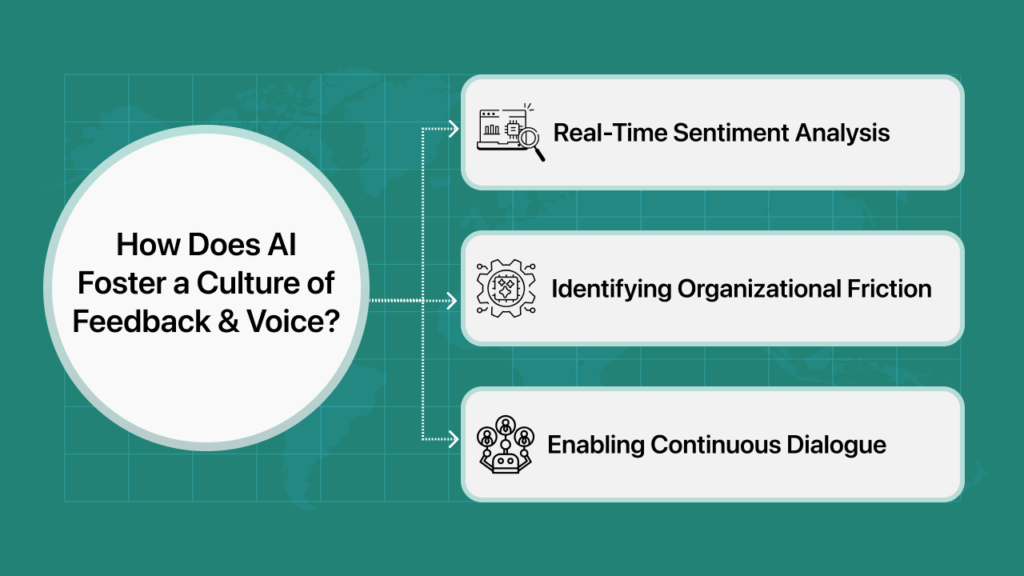
A truly positive workplace thrives on free communication and ongoing feedback. AI powers are moving beyond static annual surveys to create dynamic systems to ensure employee voices are not only heard but acted on in real time.
Real-Time Sentiment Analysis
Employee experience AI involves Natural Language Processing (NLP) to work with vast amounts of unstructured text data, drawn from pulse surveys, internal communication platforms, and feedback tools. Through this analysis, organizations are now able to assess employee sentiment in real-time, track trends in morale, and call out warning signs of potential burnout or dissatisfaction like never before.
Identifying Organizational Friction
Going beyond identifying individual sentiment toward collective arbitrary sentiment, AI can identify systemic problems for the organization. Through a matrix analysis of feedback with regard to certain processes, team structures, or stereotypes in management styles, friction points can be delineated. Identification followed up with targeted solutions helps leaders prevent these small issues from snowballing into major turnovers in talent.
Enabling Continuous Dialogue
AI indeed transitions feedback from being an annual event into making it part of an ongoing conversation. Through some points for intervention in the form of machine feedback and nudges prove to be more influential. Automated replies based on the responses they have received, the employees give quite certain feedback with the intention that this will create a greater sense of value, knowing their voices are being heard.
Conclusion: AI will turn feedback from a passive exercise into an active strategic weapon. It lets companies analyze sentiment and identify friction points in real time so that employees’ voices are prioritized in continuous improvement. Actions that then occur with speed and efficacy.
5. Does AI Reduce Bias in Experience Management? ⚖️
The ethical argument for AI in HR presents a strong case for the lessening of bias and provides candidates or employees with a fairer, more equitable experience. In fact, AI mostly levels the playing ground by focusing on objective data.
Objective Skill Evaluation
You can design AI hiring processes to operate in rounds, such that in early rounds of evaluation, relevant to skills alone. You can avoid any personal information that buzzwords activate in an unconscious setting. The idea in early rounds is on merit; hence, you can select candidates on these merits, which is not on race, gender, age, or any background.
Auditing for Inequity
AI for employee experience would analyze internal data on performance evaluation scores, promotions, and pay adjustments for the presence of any patterns that may indicate some form of bias or inequity-which human beings might never be able to detect. A neutral audit lends credibility to HR leaders. They address inequalities, reform policies, and provide equitable opportunities.
Fostering Diverse Talent Pools
AI, by helping to remove bias both in hiring and mobility within, definitely helps build diverse pools of talent. When organizations make decisions on objective skills and potential, they offer opportunities to various candidates and employees from minor groups, creating a richer, innovative, and equitable workforce.
Conclusion- AI is a powerful tool to fight bias in HR. With the help of AI, objectively based evaluation and auditing for inequity help to leave experience management fairly, thus creating an absolutely diverse and inclusive environment for all.
6. What are the Tangible Benefits of AI-Driven Experience? ✅
AI to enhance candidate experience and employee experience is not just about goodwill; it brings significant measurable returns on investments. Tangible benefits impact the business metrics and contribute to organizational success in the long run.
Higher Candidate Satisfaction
Candidates who had a positive AI hiring experience are apt to accept job offers without a great salary. In fact, such candidates can go on to be brand advocates for the company, actively referring other quality candidates. Such candidates leave a positive impression of a process that was personal and interactive.
Increased Employee Engagement & Productivity
Several AI components support employees, recognize achievements, and map growth paths. Yet, all these focus on one key activity: creating engaging employee experiences. AI supports employees, recognizes achievements, and maps growth paths. However, all these components work together to create an engaging employee experience. Employees associated with these three would be productive, innovative, and bound to the business. Companies can use this free time on the more valuable tasks.
Stronger Talent Brand & Retention
Companies with a reputation for incredible candidate and employee experiences develop a strong talent brand. This talent brand attracts better talent while minimizing voluntary turnover. Putting resources into employees’ experience AI that personalizes growth, and support creates a loyal employee responsibility on the company’s behalf.
Conclusion- The AI-influenced experience translates well from the aspects of attraction and conversion of top candidates to retention and engagement of high performers, thus showing measurable impacts at the talent-acquisition ground level, productivity, and, ultimately, the business as a whole.
7. Case Study: Companies Excelling with AI in Experience 📊
Such concrete examples help to illustrate how organizations worldwide have started to use AI to put forward great experiences.
Example 1: Streamlining Candidate Journey with AI Chatbots (e.g., Mastercard)
An example is Streamlining Candidate Journey with AI Chatbots (e.g., Mastercard).In their case, with enormous numbers of calls coming through the recruitment team, Mastercard, as a global technology company, needed to provide 24-hour candidate support.
To assist candidates with questions around the FAQs, application process, and other inquiries, Mastercard implemented an AI-powered chatbot, ‘MAI.’ This AI technology in candidate experience greatly relieves tired recruiters with instant answers and the streamlining of the initial journey. The very prompt responses significantly improved the candidate experience, and Mastercard is said to have reduced scheduling time for interviews by over 85% through AI-enabled automation.
Example 2: Personalizing Employee Growth with AI Learning Platforms (e.g., IBM)
IBM, a world leader in technology and innovation, has famously embedded Employee experience AI in its internal learning and development platforms. The AI tools analyze employees’ skills, career preferences, and organizational needs. So that they can prescribe personalized training modules, certifications, and internal project opportunities. The personalized experiences in up-skilling the huge workforce around the world are keeping people engaged. By making learning contextually relevant and easily accessible, IBM reports massive reductions in onboarding time. In some cases, by as much as 60%, alongside increases in continuous skill development across its workforce.
Conclusion: These case studies show that AI is not just a theoretical concept; it is practically catalyzing countless changes measurable in terms of candidate responsiveness and employee development, proving its worth in the overall experience.
8. What are the Ethical Considerations for AI in Experience? 🔒
While the advantages of AI regarding experience improvement are huge, it is worth noting that its implementation, especially in this context, comes with ethical obligations. Organizations must stick to a strong ethical role toward implementing AI candidate experience and Employee experience AI. Keeping in mind transparency, fairness, and data privacy.
Data Privacy and Security Compliance
AI systems thrive and produce excellent results based on a huge amount of personal data collected from candidates and employees. The protocols for data privacy must be well-activated, giving consideration to both regulatory and normative conscientiousness, such as GDPR, CCPA, etc. The other qualitative aspect is for organizations to maintain their transparency about what data was collected, how it was used, and whether it was protected, to help gain the workforce’s trust.
Ensuring Algorithmic Fairness and Transparency
Ensure you continuously check algorithms that you use in AI hiring experience and Employee experience for fairness and bias. There’s a risk that poorly designed or trained AI can mistakenly continue or even further the existing human biases. Organizations must work for algorithmic transparency, explaining how they make decisions and actively work to change any different outcomes.
Balancing Automation with Essential Human Interaction
Presently, AI automates mundane tasks. However, on the contrary, human beings will always remain indispensable in HR functions, no matter how sensitive they may be. Focus must be on sketching a seamless hybrid model. Wherein AI handles the efficiency part, relieving HR professionals and managers to provide empathy, personalized coaching, and the critical human connection when most relevant. Total automation in some reviews will create a not-so-personal experience.
Conclusion: The ethical implementation of AI cannot be compromised. For the purpose of building trust and ensuring AI serves humankind, the company must make data privacy a priority, undertake extensive auditing of fairness in algorithms, and reach a conscious equilibrium between the level of automation and human factor touch.
9. How to Implement for a Better Experience? 🛠️
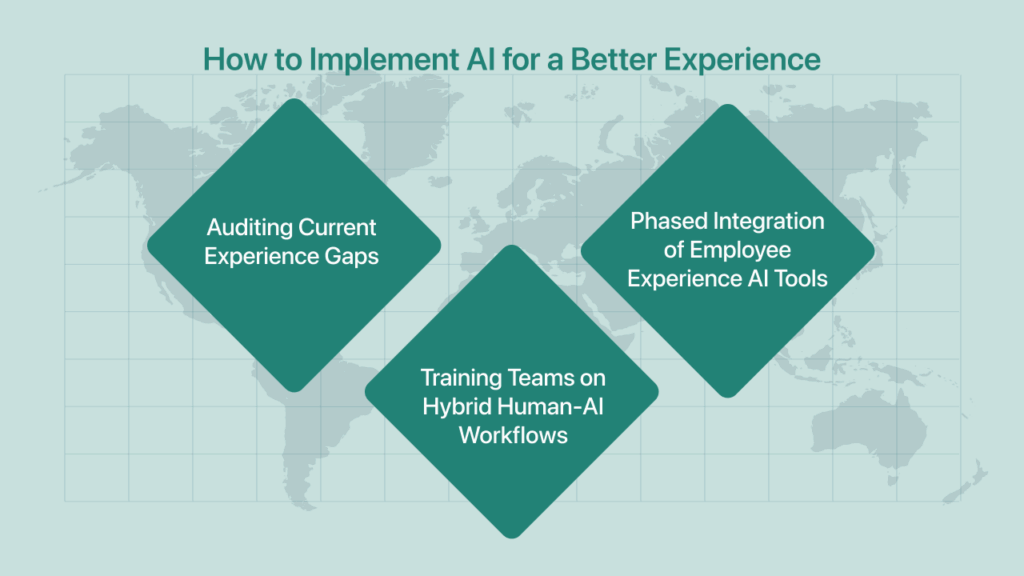
Fun fact: There is more to getting AI into any point of your talent lifecycle than simply buying software; it requires a phased, strategic approach with well-crafted change management. This should ensure that the technology targets real pain points while engaging smooth adoption by any critical human teams.
Auditing Current Experience Gaps
Before any technology purchasing, a company must carry out a robust and extremely data-driven audit of both candidate and employee journeys. And this is well beyond surface-level assessments. You need to put quantitative data together through metrics like time-to-hire, candidate drop-off rates at very specific funnel stages, and employee voluntary turnover. More importantly, though, qualitative information should emerge from targeted exit interviews, focus groups, and sentiment analysis of existing employee feedback systems.
With intervention, one can theoretically pinpoint the precise moments of greatest friction, like noting that “Candidates are dropping off during the interview scheduling phase,” or that “Managers cannot locate internal skills data to staff new projects.” This clear identification of experience gaps serves as a premise for which AI in candidate experience and Employee experience AI solutions will yield the highest return and drive the most immediate value.
Phased Integration of Employee Experience AI Tools
Most of the time, a ‘big bang’ launch of the new AI systems leaves chaos and resistance. A gradual integration approach works exceptionally well. Begins with safe, high-impact business areas where the automation is easy and benefits are clear-cut, such as deploying an AI chatbot for dealing with HR frequently asked questions or automating scheduling interviews for very high-volume roles. Pilot for small user groups, thereby doing extensive A/B testing of workflows. Leverage KPIs—such as time saved, or user satisfaction scores—from these pilots to iterate and refine the model and roll-out plan before scaling. This way will reduce disruption while giving teams time to adjust and will build up internal confidence in the technology.
Training Teams on Hybrid Human-AI Workflows
Successful Integration of AI is a change management initiative in itself, and training needs to be more than just teaching people how to use the new tools, but also how to redefine roles in working efficiently alongside as a change management initiative by training them. For the recruiters, this transformation is about focusing on the strategic talent advisory role rather than performing functions to more administrative activities like resume screening and scheduling arrangements.
This means that for SHRC staff, moving from repetitive answers to complicated empathetic forms of employee relations and strategic policy work becomes imperative. The leaders have to buy into this cultural change, making a clear definition of how AI empowers employees through the lessening of administrative burden and hence enriching jobs to be collaborative, a Hybrid Human-AI Workflow for them.
Conclusion: The effective implementation of AI is a strategic journey by the three pillars of evidence-based need assessment, controlled and iterative rollout, and dedicated change management. By focusing on these steps, organizations may guarantee that the successful adoption of AI will create a worthy force for building outstandingly human-centered experiences.
Conclusion
AI has just transformed the candidate experience and employee engagement in human resources. It helps in quickening processes, minimizing biases, and personalizing beyond imagination. Rather than dehumanizing the workplace, AI acts and becomes a very strong enabler. The very strategic implementation of AI makes it possible for every single touchpoint-from the first job application to a lifetime of growth in one’s career transformation. This is where efficiency and care come together as real talent feels valuable, using more human potential. Embracing AI is not a technological advancement but is in speed, fairness, and fulfillment in experience, driving broad individual well-being.
FAQs
The primary goal of AI in candidate experience is simplifying hiring activities, personalizing the process, and providing quicker, more consistent communication. This way, the applicants will have found the application and interview journeys much more positive and efficient, and top talent will be attracted and retained.
Employee Experience AI helps organizations personalize learning, automate HR support, and detect real-time employee sentiments. The result is a less engaged but more productive and retained employee with a work culture that is more conducive to supporting development.
The workforce is free from these mindless and menial tasks so that it can work upon strategic initiatives, complex problem-solving, and the parts of the human touch: empathy and connection which AI cannot do.
So freed from all these time-wasting and low-value activities, the workforce can work on strategic initiatives, complex problem-solving, and the so-called human touch. There’s empathy and connection that cannot be done by AI.
AI allows unbiasedness through the assessment of applicants’ abilities and merits without human interference. It very often anonymizes demographic aspects in the selection prerequisites. This means that human biases in evaluating candidates are minimized and making it a fairer and just evaluation process.
About Us
ValueMatrix is an AI-powered talent intelligence platform that helps companies hire better, faster, and without bias. We go beyond resumes to assess skills, behavioral traits, and cultural fit using advanced AI and proven psychological frameworks. Our platform delivers data-driven insights that improve hiring accuracy, reduce time-to-hire, and elevate candidate quality.
ValueMatrix AI enables hiring teams to make confident hiring decisions and build high-performing teams at scale.