
Table of contents
For over two decades, application tracking systems (ATS) have automated the process of resume screening. Now, with the arrival of AI, the comparison isn’t manual vs. ATS anymore; it’s traditional ATS vs. AI hiring. Organizations are increasingly adopting AI recruitment platforms to shift from an intuition-based process to an intelligent, data-driven function.
According to Technavio’s market report, ‘AI in recruitment’ market size is forecast to increase at a CAGR of 7.4% (by USD 287.2 million) between 2024 and 2029, primarily driven by the demand for automated recruitment processes. This article explores the advantages of AI-based systems over traditional ATS, the challenges organizations may face, and strategies for successful implementation.
Limitations Of Traditional ATS
ATS streamlines hiring workflows by collecting and shortlisting resumes, storing applications in a centralized database, and enabling recruiters to filter candidates based on predefined keywords and criteria. For HR teams, this was a significant leap in their efficiency. However, the limitations of ATS have become apparent with evolving hiring needs.
Keyword-dependent Screening
ATS filters resumes based on keyword match. This necessitates the candidates to fill their resumes with relevant keywords rather than focusing on their skills and strengths. The system may overlook or reject a profile if the keywords are missing, even when the candidate’s core skills match the job. For example, if the resume contains the words “customer success” instead of “client relations,” there is a risk of rejection because of a simple semantic mismatch.
Limited Understanding of Context and Relevance
In the reportHidden Workers: Untapped Talent, published by Harvard Business School and Accenture, 88% of employers believed that ‘qualified high-skills’ candidates are rejected because they do not match the exact criteria established by the job description. The system strictly follows instructions, but cannot view things in context. Most recruitment systems depend on ‘proxies’ such as a college degree or full-time experience. For example, if the job requirement is five years of experience in a given field, but the candidate has three years of full-time experience and another two years of related startup consulting experience, the profile may be rejected.
Poor Candidate Experience
The ATS-based application filing process can be long and tedious. The candidates are asked several details, which may or may not be relevant. They are made to navigate through a clunky interface, prompting some suitable candidates to leave the process midway. Moreover, automated application screening feels mechanical in the absence of any human interaction or timely feedback.
Not free from Manual Effort
The tracking system will filter out the unsuitable resumes, but manual intervention is needed in following up with the shortlisted candidates, scheduling the interviews, and taking the process forward. It doesn’t provide any cognitive assistance to the hiring team.
Lack of Predictive Intelligence
ATS platforms screen candidates who have applied for the job, but do not search for candidates, identify talent, or recommend profiles. It doesn’t support the hiring team with predictive analytics on a candidate’s likely performance, fitment into the team, and longevity in the organization.
These limitations do not make ATS redundant, but integrating them with AI-powered systems will expand their utility.
How AI-Driven Hiring Works
AI-driven recruitment uses artificial intelligence to perform various functions in the recruitment process. Unlike ATS that rigidly follows an instructions-based path, AI systems can understand context, recognize patterns, learn from feedback, and continuously improve. This is made possible through advanced technologies such as natural language processing (NLP) and machine learning (ML).
- NLP enables AI systems to go beyond keyword matching and read unstructured text such as resumes, cover letters, and interview transcripts.
- ML allows the system to analyze hundreds of past hiring decisions and subsequent employee performance. The algorithms learn to identify the characteristics of a successful candidate and continuously refine their models to make more accurate predictions.
Key Features Of AI-Driven Hiring Platforms
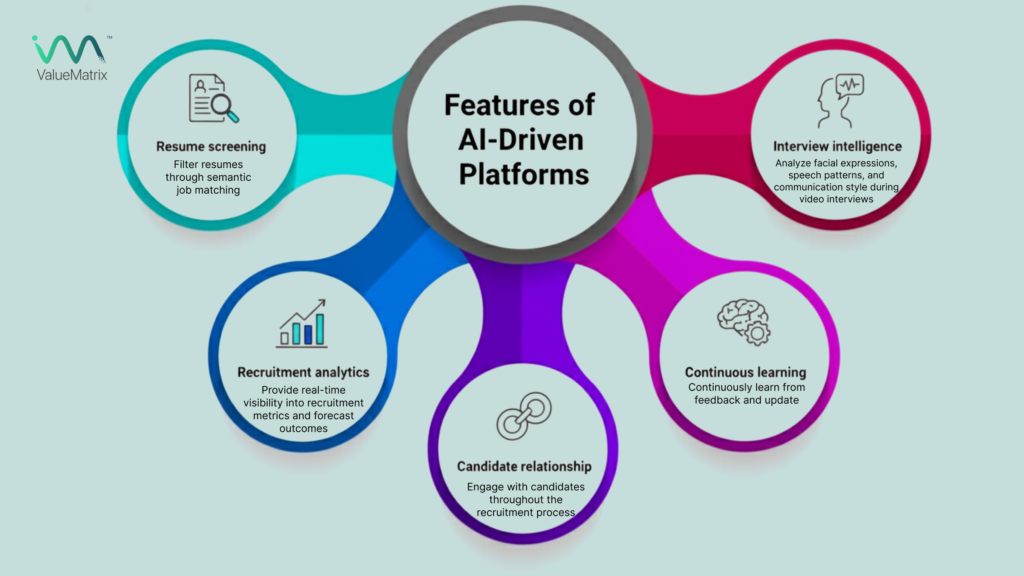
AI hiring systems are more than a solution to ATS’s drawbacks. According to SHRM’s 2025 Talent Trends Survey, 43% of organizations now leverage AI in HR processes, up from 26% in 2024, because it goes beyond resume filtering. The survey has found that 66% use it to write job descriptions, 44% to screen resumes, and around 30% to automate candidate searches and communicate with applicants.
Resume Screening
AI screening tools assess the relevance of experience, identify skills from similar industries, recognize non-traditional career paths, and evaluate the quality of accomplishments, while being quick at it. They filter resumes through a semantic job match rather than a keyword match. For instance, they understand that ‘Python programming’ and ‘software development in Python’ reflect similar capabilities, or that experience with ‘customer retention strategies’ is relevant for a ‘client success manager’ role.
Skill-based Assessment
The intelligent hiring platforms can make the filtering system more efficient by administering an initial skill-based test to evaluate the candidates before shortlisting them for the subsequent rounds. They provide automated scores based on the candidate’s performance. This skills-first approach ensures that deserving candidates do not miss opportunities due to missing keywords.
Interview Intelligence
The computer vision technology in AI models can analyze facial expressions, speech patterns, word choice, and communication style of the candidates during video interviews to help assess their soft skills. There may be ethical and privacy-related issues with this feature, but companies may want to use it with a robust governance system in place.
Recruitment Analytics
AI provides real-time visibility into recruitment metrics and also forecasts outcomes. Indicators, such as time-to-hire, cost-per-hire, quality of hire, diversity, and sources, provide transparency in the hiring drive and insights for future recruitment. More importantly, they offer predictive insights, which candidates are most likely to accept an offer, succeed in the role, or stay with the company long-term. These predictions help recruiters plug gaps in their hiring processes.
Candidate Relationship Management
One of the biggest complaints from candidates across industries is a lack of communication from the HR team. This is addressed by AI-powered chatbots, which engage with candidates throughout the recruitment process by answering questions, providing application status updates, scheduling interviews, and collecting preliminary information.
Continuous Learning and Optimization
One of the most interesting features of AI is its ability to learn from feedback and update itself. For instance, using data on the hired and rejected candidates and the performance of the new hires, the system predicts more suitable candidates in the future. The platform becomes increasingly tailored to your unique culture, values, and success profiles.
ATS vs AI Hiring: Key Differences
The fundamental difference between the two systems is automation vs. intelligence. While ATS focuses on automating the candidate shortlisting process, AI is based on adaptive intelligence.
| Aspects | Traditional ATS | AI-driven system |
| Technology | Rule-based software programed for keyword matching | Uses NLP, ML, and predictive analytics to learn and adapt continuously |
| Screening intelligence | Rigid filtering based on keywords might overlook qualified candidates | Evaluates semantic relevance, related experiences, and transferable skills |
| Automation | Automates resume screening and templated emails | Automates various tasks in the workflow, such as sending personalized communication and scheduling interviews |
| Analytics & insights | Provides insights into basic information, such as time-to-fill | Delivers analytical data on the quality of hire, retention outlook, and future growth trajectory |
| Learning & improvement | Static system that requires manual updates | Learns continuously from hiring outcomes and adapts to the organization’s values and culture |
| Bias mitigation | Can be programed to hide specific biases, but cannot detect patterns | Identifies hiring biases based on language and flags them |
| Decision support | Organizes hiring data for manual human review | Assesses skills, makes recommendations, and predicts the candidate’s future performance |
Benefits Of AI-Driven Hiring
Companies are increasingly investing in AI hiring systems to save time and costs, improve processing speed, and enhance the candidate experience.
Time and Cost Savings
AI platforms can screen resumes within minutes, drastically reducing time-to-hire and freeing the HR personnel to focus on employee engagement and development. Companies can also cut hiring costs by automating repetitive tasks and improving hiring accuracy. The recruitment team’s productivity improves as routine and mechanical tasks are delegated to AI.
Improved Quality of Hire
As per LinkedIn’s 2025 Future of Recruiting report, 61% of talent acquisition professionals surveyed believe AI can improve the way they measure quality of hire. Data-driven matching based on skills, relevant experience, cultural alignment, and growth potential identifies more suitable candidates than intuition-based hiring. Tests, work samples, and behavioral assessments enable skill-based evaluation.
Enhanced Candidate Experience
AI platforms provide faster response times and personalized communication with the candidates. Transparent processes ensure end-to-end visibility and build trust among the prospective hires.
Better Diversity Outcomes
The company’s DEI (diversity, equity, and inclusion) policy can be better implemented by feeding the AI system with the requirements. It ensures equitable screening processes, identifies language biases, and prioritizes demonstrated abilities over traditional credentials.
Challenges Involved In AI-Driven Hiring
AI-driven hiring is transformative, but organizations must navigate challenges and ethical considerations, such as algorithmic bias, data privacy, and technology integration.
Algorithmic Bias and Ethics
AI systems learn from the past hiring biases in the company and perpetuate them in future hiring. For instance, if a company has a legacy of hiring from a few selected universities, regions, or one gender, AI systems might give preference to candidates from those backgrounds and genders. Moreover, the video analysis feature that assesses a person’s personality through tone, communication, and facial expressions might disadvantage certain groups, such as neurodivergent people and non-native speakers. Organizations need to audit their platforms regularly to avoid such biases.
Data Privacy and Security
One major problem with AI-driven hiring is data privacy. The system collects extensive data from candidates via resumes, assessment results, video interviews, and social media profiles. The candidates may not be fully aware of its collection, retention, and usage. There is a high risk of a data breach in cyberattacks. Robust security measures and vendor due diligence will ensure proper protection of data.
Implementation Challenges
AI hiring platforms must integrate seamlessly with existing HRIS, ATS, payroll, and other HR technology systems. Poor integration will undermine the efficiency of the systems. Moreover, the performance of AI algorithms depends on legacy data. Organizations with limited historical hiring data or inconsistent data formats will need to clean and standardize the data before being integrated into the system.
Choosing the right AI hiring platform is imperative to mitigate challenges and make the process efficient. ValueMatrix emphasizes human-AI integration to leverage AI power while ensuring ethical and responsible talent assessment. In addition to predictive and advanced analytics, the platform offers gamified assessments and science-backed personality insights. It helps you manage your talent pool and generate customized reports while ensuring an optimized candidate experience.
Making The Shift From ATS To AI
Transitioning from a traditional ATS to an AI-driven hiring platform is a strategic first step that requires careful planning, stakeholder alignment, and systematic execution. Organizations that approach this transformation methodically can minimize disruption and realize ROI faster.
Assessment and Planning
Begin the process with a comprehensive audit of your existing recruitment process. Identify the drawbacks in your ATS capabilities, measure metrics such as time-to-hire, cost-per-hire, and quality of hire. Conduct a gap analysis.
Define goals for your AI-based hiring initiative. Is the objective to reduce time-to-hire, improve customer experience, ease the burden on the HR/ hiring team, or a combination of reasons? By analyzing your requirements, you can choose the most suitable AI system.
Do a comprehensive ROI analysis with projected costs and expected benefits over 3-5 years. Under costs include software licensing, implementation and integration expenses, training costs, and ongoing maintenance. Benefits can include saved time, reduced cost-per-hire, and improved retention.
Technology Selection
In addition to full-hiring lifecycle platforms, AI hiring technology is available as specialized solutions, such as resume screening, interview scheduling, and skills assessment. Decide if you want a comprehensive platform or just a part of it. Research vendors, look for peer references, and seek product demos. Shortlist the vendors that align with your requirements and budget.
Evaluate the capabilities of the shortlisted vendors through case studies and customer references. Test the system’s integration compatibility with your in-house systems, including your current ATS, HRIS, assessment tools, and communication platforms.
Review the vendor’s data security measures, compliance certifications, privacy policies, and contractual terms. Get clarity on issues such as storage, accessibility, and retention of candidate data.
Pilot Program and Testing
Test the platform with a pilot program in a few teams that have hiring challenges. Define the success metrics, including reduction in candidate screening time and faster time-to-fill.
Gather feedback from all the stakeholders – hiring managers, recruiters, and candidates – to know what worked well and what needs improvement.
Audit for bias during the pilot by analyzing whether selected candidates represent diverse backgrounds and rejections overrepresent specific demographic groups.
Training and Change Management
Develop training programs tailored for different roles and groups. Train the recruiters in operating the system and interpreting AI recommendations. Hiring managers need to know how to evaluate candidates shortlisted by AI.
Make efforts to allay fears about job displacement by selecting AI champions from within the teams. These champions can mentor their peers, troubleshoot issues, analyze the systems, and bring in changes.
Governance Framework and Bias Audit
Create a cross-functional AI hiring governance committee with representatives from HR, legal, IT, and leadership. This committee will frame the AI hiring policies, address ethical concerns, and ensure ongoing compliance. Schedule quarterly bias audits to address any adverse impact of the AI platforms.
Expansion and Optimization
When the pilot proves successful, expand the platform to other departments and use cases in the company. Prioritize areas where pilot insights suggest high-value impact. As AI systems are evolving rapidly, conduct periodic assessments of your systems to check whether they are relevant or warrant an update.
AI has disrupted the HR functions just like it has in various other areas. Traditional ATS is no longer sufficient to meet the dynamic hiring scenario. Companies are moving towards intelligence-based automation rather than depending on keyword-based shortlists andintuition-based hiring. However, while integrating an AI hiring system, organizations need to ensure fairness and transparency in the recruitment process. They need to balance the use of AI with human judgment. Regular audits and continuous improvement in the systems will ensure optimal usage of AI platforms.
FAQs
AI cannot completely replace human recruiters, but it will enable them to work more efficiently by automating repetitive, mechanical tasks. This will free up the recruiters’ bandwidth to focus on human-centric activities such as building relationships with the candidates, negotiating offers, and providing empathetic candidate experiences.
Consider AI-driven hiring if your company has frequent hiring requirements, receives a high volume of applications, has long recruitment cycles, and/ or requires frequent expansion of your HR team. AI will also be helpful if your company is expanding rapidly or struggling to retain talent and meet diversity goals.
AI performs well in assessing skills such as communication, problem-solving, and structured thinking based on the writing tests, video interviews, and situation-based assessments. However, it cannot completely replicate humans in assessing traits such as empathy, leadership, and adaptability.
AI tools collect extensive data from resumes and social media profiles. During video interviews, they may collect sensitive biometric information of the candidates, making it vulnerable to a data breach. Suck risks can be avoided by having a robust data security system, conducting regular audits, and retaining data for limited periods.
About Us
ValueMatrix is an AI-powered talent intelligence platform that helps companies hire better, faster, and without bias. We go beyond resumes to assess skills, behavioral traits, and cultural fit using advanced AI and proven psychological frameworks. Our platform delivers data-driven insights that improve hiring accuracy, reduce time-to-hire, and elevate candidate quality.
ValueMatrix AI enables hiring teams to make confident hiring decisions and build high-performing teams at scale.