
Table of contents
What does workforce readiness look like in 2026?
As we know, a lot has changed in the last few years. From AI automation, remote work, to skill-based hiring, we have witnessed a complete overhaul of the workforce.
Most of this change has been precipitated by AI. 2025 was really the year of a big tilt towards AI innovation. AI upskilling for the workforce was the centre of focus for most companies. We had AI agents called ‘Digital Colleagues’ that carried out transactional tasks for humans, such as customer support, data entry, and resume screening.
We had AI models like Predictive analytics and Sentiment analytics make huge leaps in Human Resources that helped humans summarize long texts into a condensed format.
How has ‘Job Readiness’ been redefined by AI?
AI’s exponential growth has stirred a ‘never-before-seen’ crisis. The skills are getting obsolete faster than anyone anticipated. The shelf life of every skill you learn has been reduced from years to months. Consider this reality check: 39% of key job skills in the U.S. are expected to change by 2030, and 59% of workers will require upskilling or reskilling by 2030.
Erik Brynjolfsson, Stanford Economist, calls it “The fastest, broadest change” that he’s seen in the workplace.
This means the employees will have to constantly upgrade their skills in order to stay competent. The employees need to adapt fast and cultivate a learning mindset.
The days when getting a job or a degree was the end of your learning curve are behind us. AI demands that the current workforce be students for life.
Upskilling for AI is not a ‘nice to have’ anymore; it’s the baseline.
When conglomerates like Amazon and IBM integrated AI into their workforce, it was viewed as futuristic, but not anymore. Every company will be adopting more or less the same AI platforms and tools in 2026.
A McKinsey & Company survey reveals that at least 88% of companies are using at least one AI function in their business. Which means roughly 280 million companies employ AI tools worldwide. AI adoption is not a ‘wow’ factor anymore.
So the differentiator will not be the technology but the people and their work culture.
Why is AI unlike past tech waves?
AI is very different to all the technologies that came before, like cloud computing and Saas. One major difference has been its rate of acceptance. ChatGPT crossed 100 million users in just two months, and over 250 million companies have incorporated some form of AI in their functioning.
No technology was ever embraced with open arms like this. Cloud computing had to face a lot of resistance owing to privacy concerns; in fact, some banks still don’t use any cloud services to store any information and use their own data centres.
One big reason for its astounding success has been its pervasiveness in every field. The beauty of AI is that its outreach is not restricted by domains or departments. Almost every aspect of your business, whether it is marketing or finance, can be augmented by AI.
Another interesting layer that separates AI from previous waves is its decision-making capability.
Take Human Resources, for instance, HR was the first one to embrace AI. It was mainly used for its time-saving prowess initially because it could screen thousands of resumes, but later its usage evolved to making hiring decisions using Predictive and Sentiment analytics.
How has AI Upskilling transformed the human capital landscape?
Traditional skill-acquiring structures are collapsing
The burgeoning expanse of AI has caught most of us flat-footed.
An HR executive wasn’t working with bias detection software 5 years ago, nor was a content writer detecting the use of LLMs in his subordinates’ work. The pace has been blinding for most.
Even the universities and college programs have not been equipped to prepare students for this new fast fast-paced reality. According to a World Economic Forum report, AI will create 78 million jobs that do not exist yet.
These jobs will render your previous experience useless, as everybody would be starting afresh. The companies will need to introduce ‘on-the-job’ mini-courses and training for employees, as taking a sabbatical to learn a new tool or skill will not be feasible due to the accelerated rate at which new skills are flooding the workplace.
Skill-Based hiring a new norm
Skill-based hiring has taken the HR world by storm. Most companies have moved to skill-based hiring as opposed to pedigree or experience-based hiring.
The majority of recruiters aren’t seduced by high-value degrees anymore. Most companies face a unique set of problems, and they want to know if the candidate is adept at solving those problems. That is why candidates are given mini projects; for example, a coder will be asked to build a feature or fix a bug. Similarly, a copywriter will be asked to write a sales letter for a product highlighting its USP.
The companies are looking for the practical applicability of your talent as opposed to judging you by a piece of paper.
Experience is another aspect of hiring that is heading towards obscurity. As we’re moving towards this completely new paradigm, most jobs of the future will have no bearing on your past experience. These jobs will not rely on your past expertise in using specific tools or software; what they will rely on is your decision-making, learning agility and problem-solving.
Ryan Ronslansky, LinkedIn Ceo, puts it neatly:
“Skills-first hiring will create a much more efficient, equitable labor market, which then creates better opportunities for all.”
AI Upskilling will give rise to Cross-Functional roles
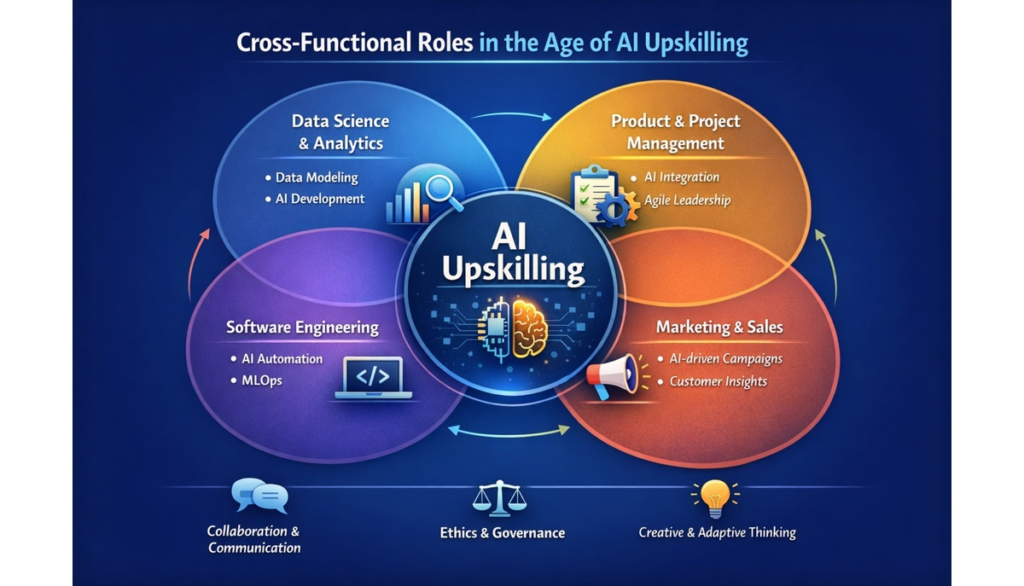
Experts are predicting that the workplace will become a melting pot of different expertise overlapping with each other. AI upskilling has already started to force people out of their role-based silos and work in synthesis, which means knowing a little bit about every role or department. You’ll not be expected to know a whole lot, but have a basic understanding of how things work in departments adjacent to you.
We’re already seeing CHROs and CIOs working closely together to architect hiring strategies for the future, a collaboration we had rarely seen before. CHROs are working with Predictive analytics models, and CIOs are learning about the nuances of human interaction that go into hiring. We have product managers and marketing specialists working together to achieve greater results.
But why this shift towards synthesis?
True innovation happens when technology, design, manufacturing and marketing come together to make a product successful. And furthermore, a holistic approach to the product works better than a siloed approach, especially in today’s landscape. A marketer who understands the engineering behind the product well will have a more effective sales strategy. Similarly it might help the HR team to learn about the skills the company requires to build their products.
True innovation happens at intersection, not in isolation.
McKinsey’s research proves this theory, cross-functional AI teams deliver 30–50% faster project rollouts and twice the ROI compared to siloed teams.
Rise of AI-powered Diversity.
Diversity has grown beyond tokenism in the age of AI. Tapping into diverse talent pools is among the top 5 most impactful business practices to increase talent. 83% percent of surveyed employers have implemented diversity, equity and inclusion measures, an increase from 67% in 2023. This trend is especially strong among larger organizations, with the adoption rate going over 95% in companies with more than 50,000 employees.
The AI has been able to scrub hiring bias of the past by introducing discrimination-free algorithms in the screening process. Most organizations now use software that removes any status-signalling identifiers like surname, address and university. Generative AI can help companies write bias-free, gender neutral job descriptions; it also uses inclusive words that signal ethnic and racial minorities that they’re welcome.
These predictive models also understand that everyone has different cognitive propensities and abilities. That’s why every employee doesn’t undergo the same modules. Employees are suggested learning modules based on their skill-gaps and everybody follows their own unique path.
Why are companies pushing DEI in the age of AI?
Diverse groups perform better on almost every important metric than a homogenous group.
This McKinsey survey found that diverse teams are more creative and effective at problem-solving and as a result, more profitable.
Diversity is a profit-making endeavour for the companies, and also a great reputation booster for the organizations. A diverse organization is viewed more favourably by the Genz, which constitutes 25% of the workforce.
Read this blog for an in-depth analysis of how to hire for diverse teams.
What are some of the barriers to workforce upskilling in the age of AI?
The workforce transformation is not frictionless; there are a few hurdles that stand in the way: Some are structural, others psychological. Let’s look at some of the challenges workforce upskilling faces in the AI age.
Skill gap
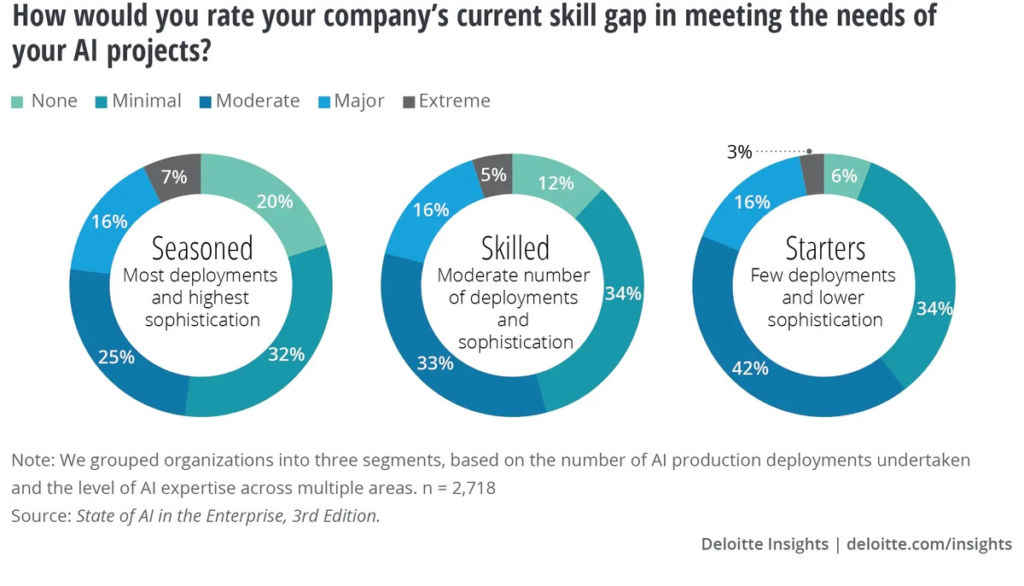
WEF puts the skill gap as the single biggest barrier to business transition. It is the topmost focus of the companies. 85% employers plan to prioritise upskilling their workforce.
Most employers believe that skill availability among employees is the toughest hurdle for them.
The reason behind this increasing skill gap is not declining skills among the workforce but the burgeoning speed at which AI is advancing. Many employers fear that AI progress might outpace the skills of their workforce.
The employees will always have to play catch-up. New tools are announcing their presence every week, and technologies are getting obsolete at an unprecedented rate. No one had heard of Sentiment Analytics in the hiring space just two years ago; now, every HR manager is wrangling with it. So, not just AI literacy, but continuous AI education is the need of the hour, and even non-technical roles aren’t off the hook.
Sundar Pichai, CEO, Google, echoes the exact sentiment in one of his interviews:
“One of the biggest risks with AI is that society doesn’t skill people fast enough to use it productively.”
Lack of clear career pathways.
One of the underdiscussed, yet potent barriers to workforce upskilling is ambiguity around job roles. We see a glut of AI courses, bootcamps, masterminds on sites like LinkedIn after every big AI development.
A lot of online experts come out of the woodwork to sell courses that claim to make you job-ready for the next big change. As a result, people feel inundated and don’t know where to look, as the linear carrier path that used to be the norm is fading into obscurity.
Employees are often confused about which courses are foundational, which are role-specific and which ones are completely irrelevant. As a result, a big challenge the workforce faces is figuring out which certifications will give them the highest ROI, i.e., skills that will stay relevant the longest.
As the rapid growth of AI demands continuous upskilling, the shelf life of acquired skills is proportionally shrinking. Thereby, there is no time to waste on irrelevant training. This survey shows that 43% of employees found the training they did to be ineffective.
In this skill-based economy, it is very important to have a proper gauge on the high-value skills to stay employable in the age of AI.
This skill dread amongst employees is further compounded by the disconnect between traditional learning routes like schools, universities and the job market. It has been nearly impossible for regular university courses to keep up with market demands; that’s why the majority of the workforce feels they’re fending for themselves with no one to look out for them.
Organizational and cultural resistance to change
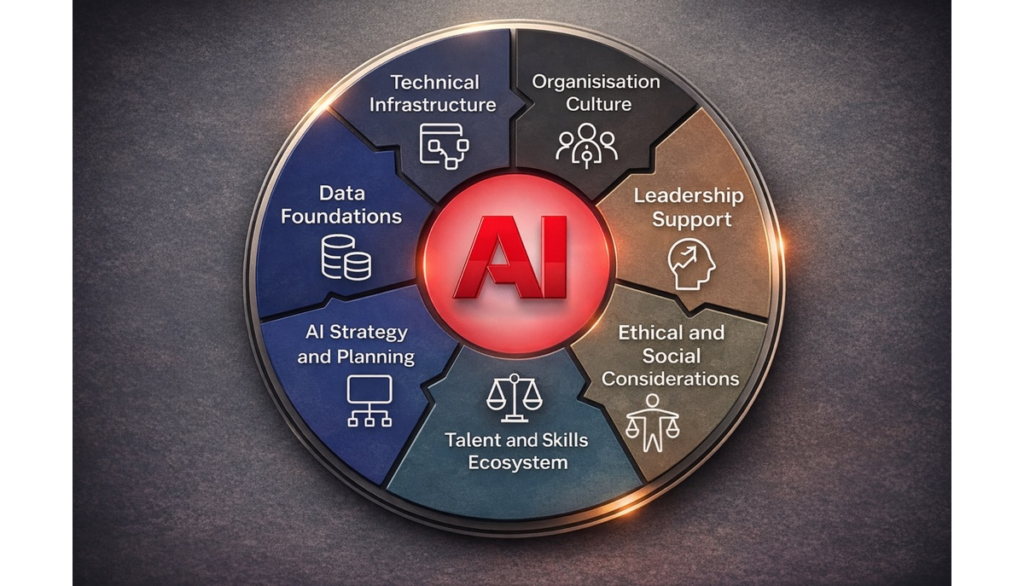
Beyond skills and structural issues, one thing that hinders complete AI absorption amongst the workforce is cultural resistance. Some employees feel threatened by AI; they might think they’ll get displaced by AI so it’s better to resist its ingress as much as possible.
Others are status quoists, who like the inertia that has got them thus far and may want to keep it that way. Some firms have been successful for far too long before the AI revolution, so their employees are bound to underestimate its arrival. Some who are old school, who have seen many technologies come and go, may think AI is just fancy ‘bells and whistles’ with little impact on productivity.
Besides resistance at the employees level, organizations also sometimes drag their feet when it comes to change. Either they fail to see the larger picture, or they believe that AI is misaligned with their future goals. Let’s take Kodak’s example. Kodak invented the first digital camera in 1975, and remained a pioneer in the colour photography space. But in the era of editing software, data and emerging intelligence, Kodak clung to its chemical-film legacy. As a result, Kodak filed for bankruptcy in 2012.
How to overcome it?
Human friction can’t be solved by introducing new software. This kind of resistance requires executive-level intervention. CHRO and CIO are the best C-suites to tackle this problem.
They are the arbiters of culture in any organization and any organizational change has to flow through them. CHRO, along with CIO, should introduce customised AI initiation mini-courses and training modules, matching the proficiency level of the employee to familiarize him with the basic AI tools and platforms.
Here’s a blog detailing how CHRO and CIO are the key to scaling the Talent Intelligence.
The CHRO must also share success stories of AI assimilation with their workforce. One such shining example is Walmart’s culture-first AI approach in 2024-2025. CEO Doug McMillon jumpstarted a campaign which implored every associate to use AI every day for at least a few minutes. He introduced user-friendly training modules to reduce the friction among his employees.
His exposure theory approach worked. Walmart’s new AI-powered helpdesk cut query handling time in half and AI tools helped reduce the time it takes for a product to move from a supplier to a Walmart store from 24-26 weeks to 6-8 weeks.
Conclusion
AI adoption has moved from “nice to have” to “need to have” for most businesses. It has become a staple in recruiting, customer service and backend operations. AI automation isn’t about adopting new tools at work, but a continuous commitment to a learning mindset, with the understanding that what you learn today will decay in a couple of months or sooner.
This requires an attitude shift as this is a hard turn from the ‘4-year degree-40-yearjob’ model. But surprisingly, the employees have welcomed this change with alacrity. 76% of the GenZ and 59% of the millennials show a favourable attitude towards job upskilling.
Employees hungry to learn is a good sign for the companies, but there’s a catch: an increasing number of them don’t want to go through the hassle of self-learning and want their companies to take charge of their learning curve.
A Research.com study reveals that 28% of employees prefer on-the-job training over figuring out relevant courses to take for themselves. Food for thought for the organizations all around the world.
FAQs
Most of the upskilling is bound to happen in the tech world, as any AI innovation hits the IT industry first and then creates ripple effects in other sectors.
So the platforms most critical to AI upskilling are: Computer vision, Generative AI
Machine learning, Natural language processing and Robotic process automation.
Employees can avoid burnout by being time-specific and skill-specific. They need to be very specific about the skills they want to update so they don’t waste time learning skills irrelevant to their job. They should also break down their training into smaller chunks, preferably 2 or 3-day modules for easier digestion.
Yes, on-the-job upskilling/reskilling programs have been known to improve retention in organizations. A recent LinkedIn survey says that 94% would stay at a company longer if it invested in their learning.
It’s hard to predict the future, especially with AI. But the jobs that were vulnerable to AI are already getting replaced. If your job requires continuous updating of skills, it means the future seeks a collaboration with AI instead of the replacement of human capital.
About Us
ValueMatrix is an AI-powered talent intelligence platform that helps companies hire better, faster, and without bias. We go beyond resumes to assess skills, behavioral traits, and cultural fit using advanced AI and proven psychological frameworks. Our platform delivers data-driven insights that improve hiring accuracy, reduce time-to-hire, and elevate candidate quality.
ValueMatrix AI enables hiring teams to make confident hiring decisions and build high-performing teams at scale.