
Executive Summary:
• Introduction
• The Data Revolution: Is Data the Future of Recruitment?
• What is the Technical Architecture for AI’s Data-Driven Recruitment?
• What’s the Secret behind AI-Powered Methods in Recruiting?
• How to Measure Success? ROI and KPIs Framework for AI Hiring
• Case Studies and Application: How AI-Powered Data-Driven Talent Acquisition is Changing the Recruitment World?
• How to Strategize for AI-Powered Data-Driven Recruitment?
• Are CHROs Prepared for the Dark Side of Data-Driven Hiring?
• What are the Action Steps for CHROs to Implement Data-Driven AI recruitment?
• What’s the Future like with AI-Driven Recruitment?
• Conclusion
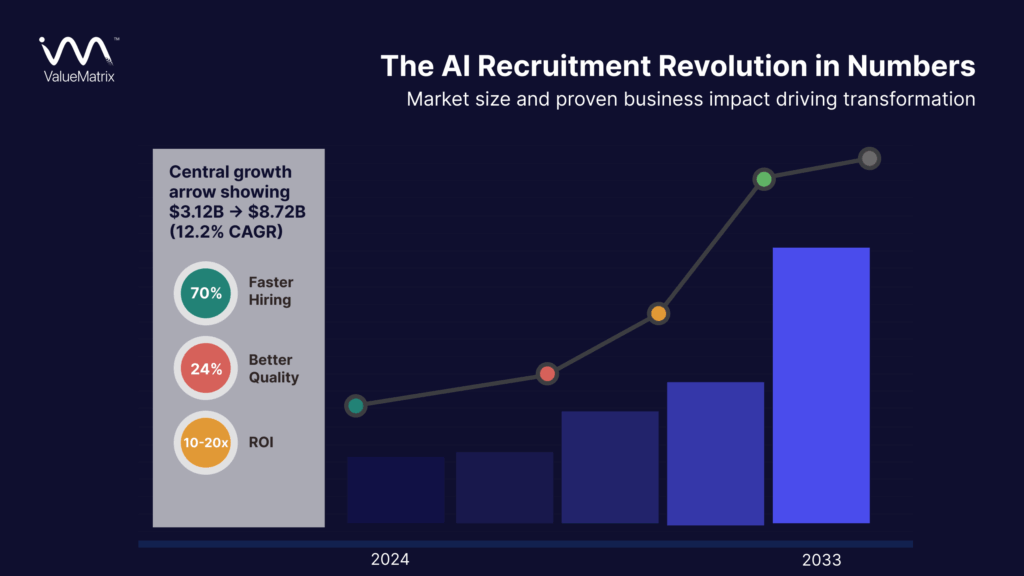
Imagine a world where your next great hire isn’t identified by a resume or instincts, but by a data-driven assessment. That world is here. The job market is in a historical transition phase. While traditional recruiting practices still rely heavily on subjective indicators and institutional reputation as predictors of potential, forward-looking businesses are taking a completely different tack. The Talent Intelligence Software Market will rise from $3.12 billion in 2024 to $8.72 billion in 2033, with a whopping 12.2% compound annual growth rate. This is not another tech trend; this is the most radical shift in recruiting since the digital recruiting platform became a reality.
For Chief Human Resources Officers, this revolution is both an opportunity and an imperative. Firms that adopt AI-based talent evaluation have witnessed their hiring speeds increase by70% while their hire quality goes up by 24%. More importantly,85% of businesses now affirm that people analytics as well as people data are core HR strategy essentials, imperatives supported by CHROs. The warning is unmistakable: the businesses that become masters in AI-based talent intelligence will have significant competitive edges in discovering, assessing, and acquiring the best available talent.
Stakes are higher than ever. Wrong hiring decisions are projected to cost businesses anywherefrom $17,000 to $240,000 per misfit hire, as businesses that use sophisticated AI tests gain10 to 20 times return on investment per good hire. This dramatic boost in hiring efficiency is due to the fact that AI can peer through superficial qualifications to dive into deeper competencies, culture fit, and performance potential that more traditional methods are completely incapable of discovering.
The Data Revolution: Is Data the Future of Recruitment?
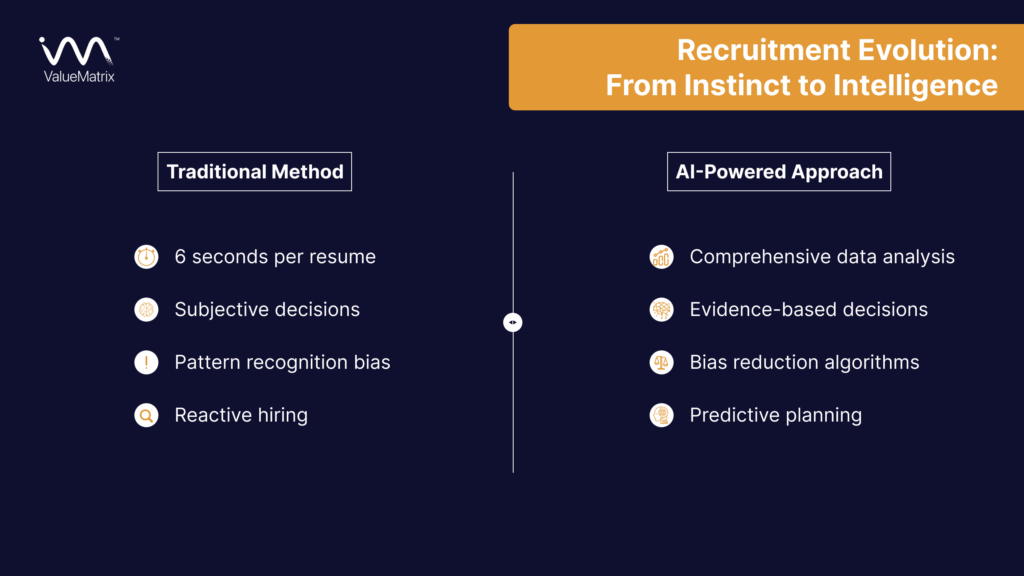
Traditional recruitment operates on fundamentally flawed assumptions. A hiring manager spends only aboutsix seconds looking at each resume on average. This short time forces them to use mental shortcuts and quick pattern recognition. This process overrides any chance for a real, comprehensive evaluation. While these decisions might seem efficient, they consistently hurt people who don’t tick the usual boxes of “fit” candidates. What this does is automatically privilege candidates who emerge from conventional patterns while potentially overlooking superior talent from untraditional sources. What this retains is a decision-making process based on familiarity that serves to enforce organizational homogeneity.
The data-driven approach is a whole paradigm change. Instead of using intuition, you can now use intelligent systems that analyse huge amounts of data. These systems find the real patterns that predict job success.
This approach helps companies move from simply reacting to hiring needs to proactively planning for them. It allows you to predict how well a candidate will perform with incredible accuracy while expanding access to previously overlooked talent pools.
Market adoption reflects this very revolution.73% of companies now automate recruitment to some extent, with best-in-class companies talking about dramatic increases in efficiency as well as outcome effectiveness. The companies that are embracing this revolution are not simply automating the past; they are reframing good talent acquisition in this era of voluminous information as well as sophisticated analytical power.
Talent intelligence AI systems are the end product of this development. These systems retrospectively review workforce data holistically to forecast candidate success and maximize hiring choice in multiple directions. Whereas most conventional tracking systems for applicants exist mainly to manage workflow, AI talent systems employ machine learning algorithms to assess candidate promise in light of historically proven success criteria. The end product is decision-making in hiring based on evidence instead of supposition, on data instead of prejudice, and on predictive models instead of reactive assessment.
What is the Technical Architecture for AI’s Data-Driven Recruitment?
The foundation of AI-enabled talent intelligence is predictive analytics that transform historical hiring data into predictive patterns. Machine learning models analyse patterns in successful as well as failed hires to identify traits that are predictive of superior performance, extended tenure, and cultural fit. Such models utilize sophisticated algorithms such as regression analysis, decision trees, and neural networks to analyze candidates against multi-faceted success parameters.
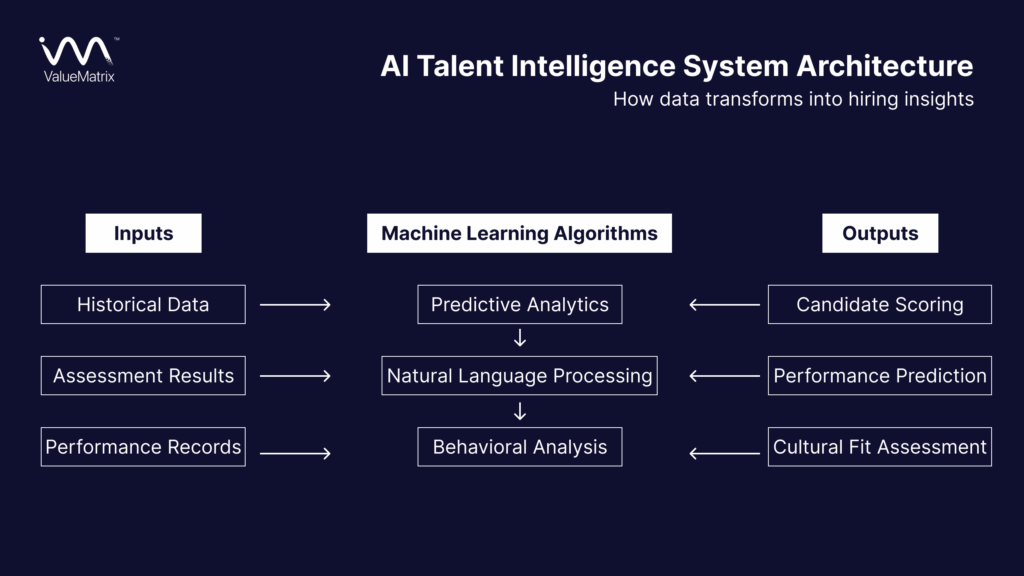
The power of this strategy is reflected in outcome measurement. Companies using comprehensive AI assessments boast10 to 20 times ROI per hire, not just for efficiency gain, but for dramatic hire error reduction. These systems do not just sift through data more rapidly, they uncover patterns between candidate characteristics and job success that are repeatedly missed by human evaluators.
Next-generation measurement technologies go well beyond resume parsing to offer extensive candidate measurement. Using Natural Language Processing, these intelligent tools can analyze everything from video interviews to cover letters. They look for subtle clues in communication patterns to assess soft skills, how well someone communicates, and if they are a good fit for the role. AI cognitive measurement tools use neuroscience-based games to quantify problem-solving ability, risk tolerance, and decision-making approach while avoiding education or professional credentials.
Behavioural analytics provide another level of sophistication, forecasting cultural fit and performance based on personality trait analysis. These tests go beyond survey-based preferences to assess true behavioural patterns, giving insight into how candidates will respond under pressure, work in teams, and conform to organisational culture. Skills-based assessment frameworks are competency demonstration rather than credential checking, to enable companies to spot talent based on capability as much as institutional connection.
Advancements in AI talent intelligence tools represent the demands and needs of the evolving recruitment market. Such systems are continually studying external labour market data to inform competitive positioning, pay benchmarking, and talent pool segmentation. AI-enabled salary analysis helps to optimise accurate offers, while predictive models identify skill gaps before they become critical organisational constraints. Such broad market insight renders reactive hiring proactive in nature as far as talent strategy is concerned.
What’s the Secret behind AI-Powered Methods in Recruiting?
For your company to be data-driven in recruitment, sophisticated integration of varied sources of information is essential. State-of-the-art analytics suites cross-reference information from tracking systems, assessment systems, social profiles, and performance management systems to build candidate profiles that are extensive. This multi-source approach provides unprecedented visibility into candidate potential while identifying success factors that single-data-source systems consistently overlook.
Data quality assurance is important in this regard. Organizations will be compelled to enact robust data cleansing, validation, and standardization procedures to drive analytical accuracy. Poor-quality information doesn’t just reduce the efficiency of systems; biases are introduced that can invalidate the very intent of fair, merit-based assessment.
Predictive modelling methodologies seek to forecast candidate success through statistical analysis of trends in prior performance. Predictive models will forecast job performance as well as retention probability while identifying candidates best positioned to achieve long-term success in specific organisational contexts. Attrition risk analysis allows for proactive retention programmes, while performance correlation studies link recruiting judgments to objective business outcomes.
Systematically designed assessment protocols guarantee uniform application of evaluation criteria to all candidates. Standardised protocols decrease subjective interpretation while retaining human discretion in ultimate decision-making. Algorithms for mitigating bias actively foster fairness as well as diversity enhancement through data-based processes that detect and adjust for systematic discrimination. Mechanisms for ongoing calibration improve model accuracy in light of outcomes in hiring, as well as feedback loops that give rise to systems that improve automatically over time.
How to Measure Success? ROI and KPIs Framework for AI Hiring
If you want proof that AI talent intelligence delivers value, efficiency metrics tell the story fastest. Application completion rate improves by as much as85 %. That’s not just speed; it’s a major productivity boost and a real lead in competing for talent. The savings are just as impressive. Cost-per-hire often drops by30 to 40 %, while the quality of hires actually goes up to95% according to hiring managers. Recruiters can also handle far more candidates per hour without cutting corners on evaluation. And let’s not forget the day-to-day workload. Administrative tasks shrink by nearly half. That spares your HR teams from focusing on the work that really drives strategy and impact.
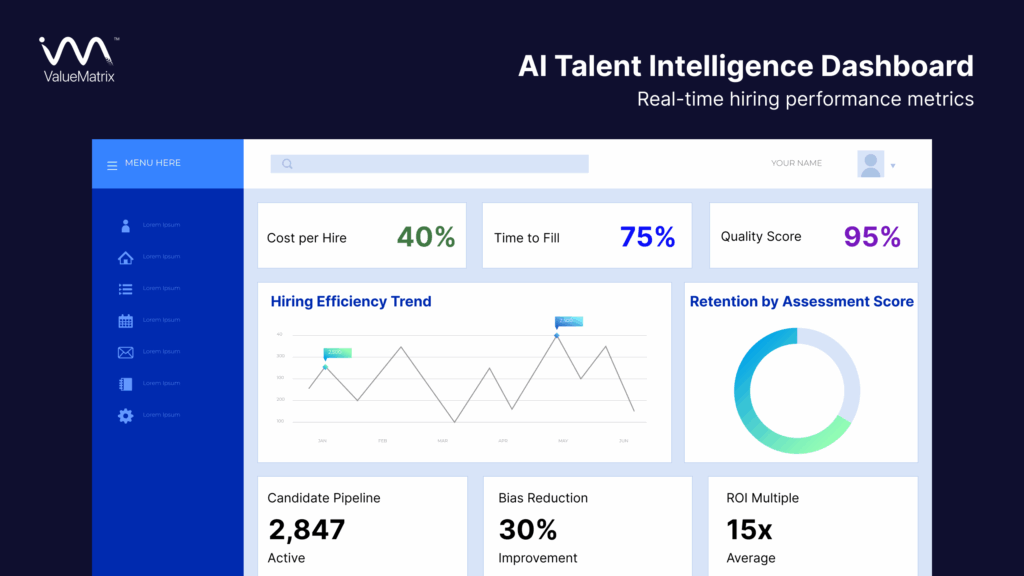
Quality and impact metrics show the deeper value of data-driven hiring. With AI in place, predictive accuracy improves fast. You see it in better submission-to-offer ratios and higher interview success rates. Retention tells another part of the story.Tracking at 90, 180, and 365 days often shows stronger retention for AI-assisted hires compared to conventional methods.
Then there’s performance.Studies connect new hire success ratings and productivity back to the exact assessment criteria used in hiring. That feedback loop lets you keep polishing your assessments and make them even more accurate over time.
Strategic value metrics emphasize the long-term gains you get from stronger talent acquisition. The impact shows up in hard numbers like higher revenue per hire, faster project delivery, and innovation outcomes that prove how remarkable talent compounds in value over time. You’ll also see changes in your discourse. Approaches driven by AI make it easier to engage passive candidates and prepare for future hiring needs with more confidence. And then there’s your market position. Stronger acquisition capabilities and a stronger employer brand give you a clear upper hand over competitors fighting for the same talent.
Case Studies and Application: How AI-Powered Data-Driven Talent Acquisition is Changing the Recruitment World?
Unilever’s journey is one of the strongest examples of what AI-driven talent intelligence can really accomplish. By partnering with different AI services, the company moved away from traditional screening and brought in neuroscience-based assessments and AI-reviewed video interviews. The impact was impressive. Recruitment time dropped by 75%. The company saved over £1 million. And it welcomed the most diverse hiring class in its history. What made the system powerful was its fairness. It measured cognitive skills and behavioural patterns but never touched demographic data. That meant every candidate was judged on merit and nothing else.
IBM’s example shows how AI in hiring has evolved from unintentionally spreading bias to actively reducing it. Early on, the company saw how conventional models could reinforce existing discrimination. Instead of ignoring the issue, they reconstructed their approach. Using fairness-aware machine learning, IBM designed algorithms that deliberately cancel out bias. The results spoke for themselves. Hiring bias dropped by 30%, while the quality of hiring improved. Even more impressive, the system uncovered candidates with non-traditional backgrounds who went on to deliver remarkable performance. It proved that fairer hiring can also mean smarter hiring.
AI talent intelligence isn’t limited to one industry: it’s proving its value across the board. In healthcare, organizations use it to predict seasonal staffing needs and improve nurse retention with advanced analytics. Manufacturers take a different approach. They focus on skills-based judgements for technical roles and use AI to predict safety performance before making hiring decisions. In financial services, compliance is everything. Firms introduce risk assessment into their hiring process, ensuring regulatory standards are met while still improving how they bring in talent.
How to Strategize for AI-Powered Data-Driven Recruitment?
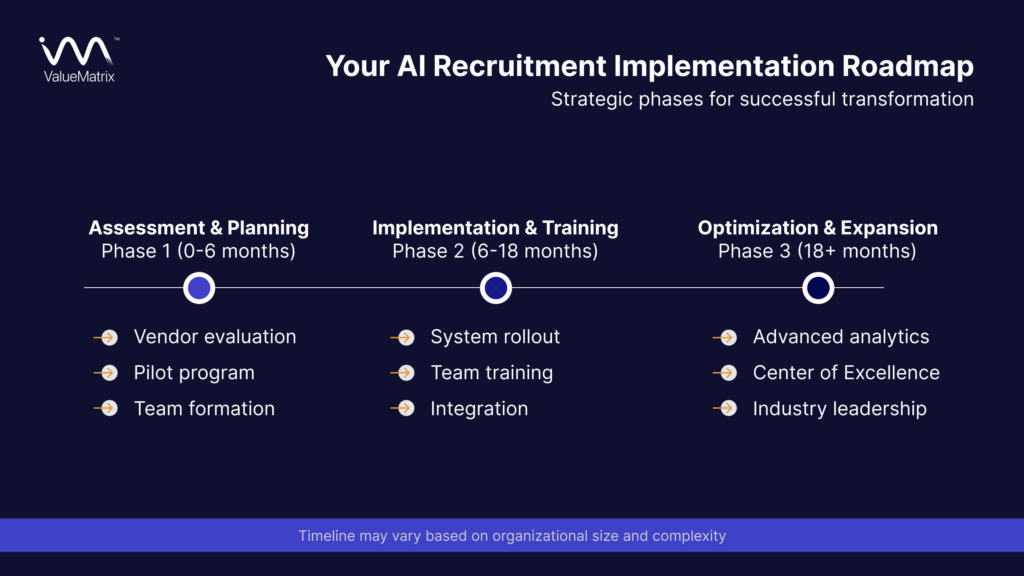
Choosing the right technology and its distribution demands careful assessment of platform capabilities, unification requirements, and organizational readiness. The vendor landscape is crowded. So how do you decide?
- Look at scalability.
- Check how well the system integrates.
- Evaluate how advanced the AI really is and how strong the vendor’s support team will be when you need them most.
- A phased rollout is usually the safest way.
- Start small with pilot programs. Expand gradually.
- Track success with the right measurement framework from day one.
Integration is where many AI projects hit their toughest roadblock. You need to connect new platforms with your existing HRIS, ATS, and performance management systems. That’s no small task. The truth is, this technical complexity can make or break your implementation. Success often depends on two things: a) choosing the right vendor and b) having the internal technical muscle to back it. That’s why integration planning can’t be a reconsideration. You’ll also need solid change management in place. With both, your teams can fold the new platform into daily workflows without disruption.
When it comes to AI talent intelligence, change management may be the single biggest factor in whether you succeed or slip. It’s not just about plugging in new technology. It’s about shifting your culture from hiring on gut instinct to making decisions backed by evidence. That kind of change needs buy-in at every level. Hiring managers, executives, and even legal teams all have to be aligned. Without that, adoption slows down.
Your HR teams will also need support. Training and development should focus on building data literacy, while showing clear value to anyone who’s still sceptical about AI. And then there’s governance. Strong oversight committees and clear ethical AI guidelines help keep the system answerable, without shutting down innovation.
Are CHROs Prepared for the Dark Side of Data-Driven Hiring?
Introducing AI talent intelligence isn’t without its challenges. Data quality, algorithm transparency, and integration all demand close attention. Many HR systems are disorganized, which creates the need for standardization. That alone can make implementation more complicated than expected.
Transparency is another big factor. For legal compliance and for candidate trust, you need AI that can explain its decisions. If you can’t explain how the system reached an outcome, the risks grow quickly.
And then there’s integration. Legacy systems rarely play nicely with new platforms. Getting it right requires strong vendor management and a careful technical plan outline to keep workflows seamless.
Ethics and compliance sit at the foundation of AI in hiring. You can’t fail to notice bias detection, privacy safeguards, or regulatory requirements if you want your system to be trusted. That means building in continuous auditing and fairness checks. These steps help catch and prevent discriminatory patterns before they ever take place.
Privacy is just as crucial. You’ll need clear candidate consent, strong data security, and processes that handle cross-border data transfers responsibly. And the compliance scene is only getting complex with NYC’s AI laws, the EU’s AI Act, and industry-specific rules; organizations need to stay informed and adapt quickly.
To regulate the risks of AI in hiring, you need a strategy that goes beyond quick fixes. The most competent organizations build proactive plans that deal with these challenges directly. For ethical management:
- Start with regular algorithm audits.
- Pair audits with varied development teams and continuous monitoring to reduce the chance of bias creeping into your system.
- Focus on privacy as a built-in privacy approach not only ensures compliance but also allows analytics to deliver real value.
- To safeguard the legal side, have simultaneous reviews and regulatory tracking that help you adapt quickly as new compliance requirements come up.
What are the Action Steps for CHROs to implement data-driven AI recruitment?
What’s the Future like with AI-driven recruitment?
The next wave of AI is set to make hiring even smarter. Emerging technologies are pushing talent assets into new territory. Advances in natural language processing will allow systems to interpret candidates more accurately, beyond just keywords. Add emotional intelligence evaluation as an important component, and you get a much deeper, more human-centred view of every applicant. Blockchain integration promises secure credential verification and candidate data management. Immersive assessment technologies using VR and AR will enable job simulations that evaluate skills in realistic contexts.
In conclusion, real success with AI in hiring takes more than just adding new tools. It requires a full dedication to transformation, not a surface-level acceptance. That means investing in the right technology framework. It also means putting strong administrative frameworks in place and building a culture that holds data-driven, evidence-based decisions. The payoff makes the effort worth it. You gain access to talent you couldn’t reach before. Also boost organizational performance. You lower legal risks. And you strengthen your reputation as an employer of choice.
The future of recruitment will belong to the organizations that learn how to blend human judgment with the power of AI. This isn’t about replacing people in the process. It’s about giving them better information, reducing bias, and making it easier to spot exceptional talent, no matter someone’s background or traditional qualifications. For CHROs, this shift is more than a tech upgrade. It’s a chance to position HR as a true strategic driver of business success, while embracing the core principle of merit-based hiring. The real question is simple: how quickly will forward-thinking organizations accept and hold this change and start unlocking its transformative potential?
About Us
ValueMatrix is an AI-powered talent intelligence platform that helps companies hire better, faster, and without bias. We go beyond resumes to assess skills, behavioral traits, and cultural fit using advanced AI and proven psychological frameworks. Our platform delivers data-driven insights that improve hiring accuracy, reduce time-to-hire, and elevate candidate quality.
ValueMatrix AI enables hiring teams to make confident hiring decisions and build high-performing teams at scale.