
Key Takeaways:
- AI Talent Assessment evaluates candidates holistically by combining skills, cognitive ability, behavior, personality, and organizational fit into a single evidence-based profile, rather than relying on one test score or interview impression.
- Traditional assessment methods struggle with consistency and predictive accuracy because they depend heavily on interviewer judgment, which varies from person to person and day to day.
- AI candidate matching compares a candidate’s demonstrated skills and traits against actual role requirements, which widens the qualified talent pool beyond keyword-based resume screening.
- Explainable AI is what makes automated hiring decisions defensible and trustworthy, since it documents the specific, job-relevant factors behind every score rather than producing an unexplained result.
- AI can improve diversity and consistency in hiring, but only when organizations actively audit for bias and validate their models against real performance data on an ongoing basis.
- The most effective AI Talent Assessment programs treat AI as an evidence layer that strengthens human judgment, not a replacement for it, keeping people in control of final hiring decisions.
Introduction
Hiring has always been an exercise in prediction. A resume, a panel interview, a gut instinct, and then a bet on how someone will perform two years from now. That bet has historically been made with thin evidence. AI Talent Assessment is changing the shape of that evidence, replacing fragments of information with a connected, evidence-based view of who a candidate is and how they will perform.
At ValueMatrix, we don’t think of this as a recruitment automation story. We think of it as a Talent Intelligence story, one where skills, behavior, cognition, personality, and organizational fit are analyzed together, explained transparently, and connected to real business outcomes like retention, performance, and workforce planning. Whether an organization calls this AI-powered talent assessment, an AI talent assessment platform, or simply talent assessment software with AI built in, the underlying shift is the same: candidate evaluation is becoming a data discipline, not a gut-feel exercise.
This blog breaks down what AI talent assessment actually is, why the traditional model of talent assessment in recruitment is running out of road, how AI candidate assessment and AI candidate matching work in practice, and how organizations can implement AI hiring assessment responsibly and effectively.
What Is AI Talent Assessment?
AI Talent Assessment uses machine learning and data science to evaluate candidates across skills, cognitive ability, behavior, personality, and job fit simultaneously, producing a holistic, evidence-based prediction of on-the-job success rather than a single test score or subjective impression.
Traditional assessment tools were built to measure one dimension at a time: a coding test measured coding ability, a personality questionnaire measured traits, a structured interview measured communication. An AI talent assessment platform or, more broadly, talent assessment software with AI at its core, integrates these signals into a single analytical layer. Instead of a recruiter manually reconciling five disconnected scorecards, the system correlates patterns across all of them, flagging, for instance, when strong technical skills are paired with behavioral indicators of poor collaboration, or when a candidate’s cognitive profile suggests they will thrive in ambiguity even if their resume looks nontraditional.
This is the foundation of what the industry increasingly calls Talent Intelligence: not a single assessment, but a continuously learning system that connects candidate data to workforce outcomes. The World Economic Forum’s Future of Jobs Report 2025 projects that AI will create 170 million new roles while displacing 92 million by 2030, which means the pool of “qualified” candidates is shifting faster than static assessment methods can track. AI Talent Assessment exists to keep evaluation current with a labor market that no longer holds still.
Why Are Organizations Adopting AI Talent Assessment?
Organizations are adopting AI Talent Assessment because hiring pressure has outpaced human bandwidth: recruiters face higher volumes, tighter quality-of-hire expectations, and growing scrutiny on fairness; and AI is the only practical way to evaluate candidates consistently at scale.
Interest in AI in talent assessment isn’t limited to large enterprises with dedicated data science teams. Mid-sized organizations are adopting AI recruitment assessment tools for the same reason — the cost of a bad hire has grown, and the volume of applicants per role has grown with it.
Three forces are driving adoption simultaneously. First, quality of hire has become the metric that matters most, and it’s proving hard to pin down with traditional tools. LinkedIn’s Future of Recruiting 2025 report found that 89% of talent acquisition professionals agree it will become increasingly important to measure quality of hire, yet only 25% feel highly confident their organization can do so effectively. That confidence gap is precisely what structured, data-driven assessment is designed to close.
Second, AI adoption inside HR functions has moved from experimentation to infrastructure. SHRM’s 2024 Talent Trends: Artificial Intelligence in HR report found that 43% of organizations now use AI in HR tasks, up from 26% the prior year, with recruiting consistently cited as the leading use case.
Third, leadership sees talent decisions as a strategic risk, not just an operational task. A survey of 750 executives by the IBM Institute for Business Value found that 87% of business leaders believe placing the right people in the right roles is essential to realizing the full value of an AI-enabled future. Assessment is no longer a gatekeeping function — it’s viewed as the mechanism that determines whether workforce strategy succeeds at all.
Traditional Talent Assessment vs AI Talent Assessment
Traditional assessment relies on isolated tools and human judgment applied inconsistently across candidates. AI Talent Assessment integrates multiple data streams into a single, standardized, explainable model that scores every candidate against the same criteria.
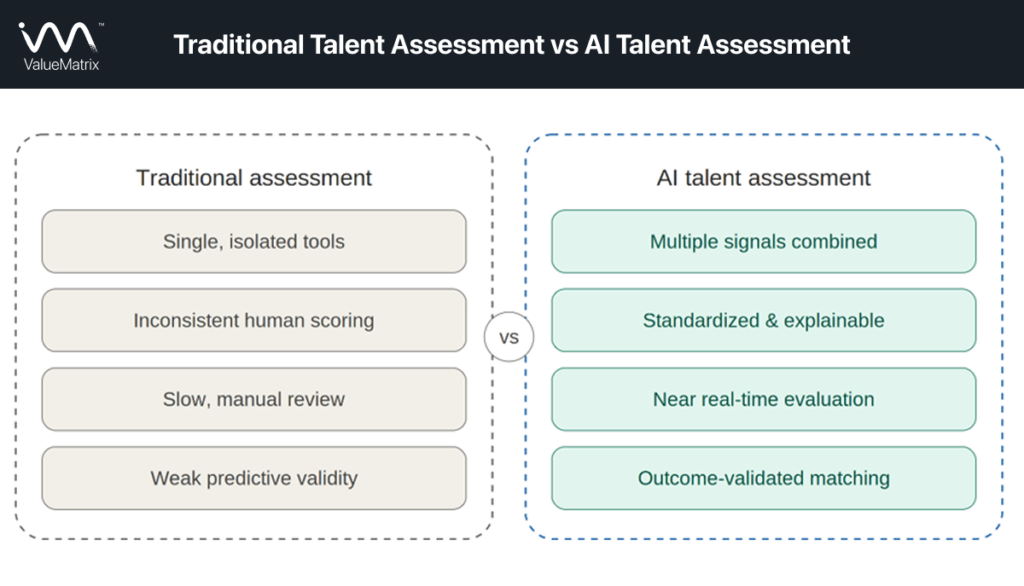
The practical differences show up at nearly every stage of the hiring funnel: how evidence is gathered, how consistently it’s applied, and how well it predicts what actually happens after someone is hired. This is where talent assessment in recruitment has changed the most: evaluation used to happen mostly at the interview stage, and now it happens continuously, from the first application through the final offer.
| Dimension | Traditional Talent Assessment | AI Talent Assessment |
|---|---|---|
| Data sources | Resume, interview notes, single-test scores | Skills tests, behavioral signals, cognitive data, structured interviews, performance history |
| Consistency | Varies by interviewer and panel | Standardized scoring criteria applied uniformly |
| Bias exposure | High: subject to interviewer fatigue, affinity bias, halo effect | Reduced when models are audited, though not eliminated |
| Speed | Days to weeks per candidate pool | Near real-time scoring at scale |
| Predictive validity | Limited: often correlates weakly with job performance | Strengthened through outcome-linked, validated models |
| Transparency | Implicit, rarely documented | Explainable AI provides a documented rationale per decision |
| Fit assessed | Mostly skills and experience | Skills, behavior, cognition, personality, and organizational fit combined |
Neither approach is “hands-off.” Traditional assessment still requires human interviewers; AI assessment still requires human oversight of models, audits, and final decisions. The difference is in the quality and structure of the evidence each approach produces before a human makes the call.
Types of AI-Powered Talent Assessments
AI Talent Assessment spans several distinct but connected categories: skills assessment, cognitive assessment, behavioral assessment, personality insights, organizational fit analysis, and candidate-job matching, each contributing a different layer of evidence to the final hiring decision.
Not all AI talent assessment tools cover every category. Some vendors specialize narrowly in skills testing; others build broader AI candidate assessment suites that combine several of these dimensions. Understanding what each category actually measures helps organizations avoid buying a narrow tool and expecting it to answer a broad question.
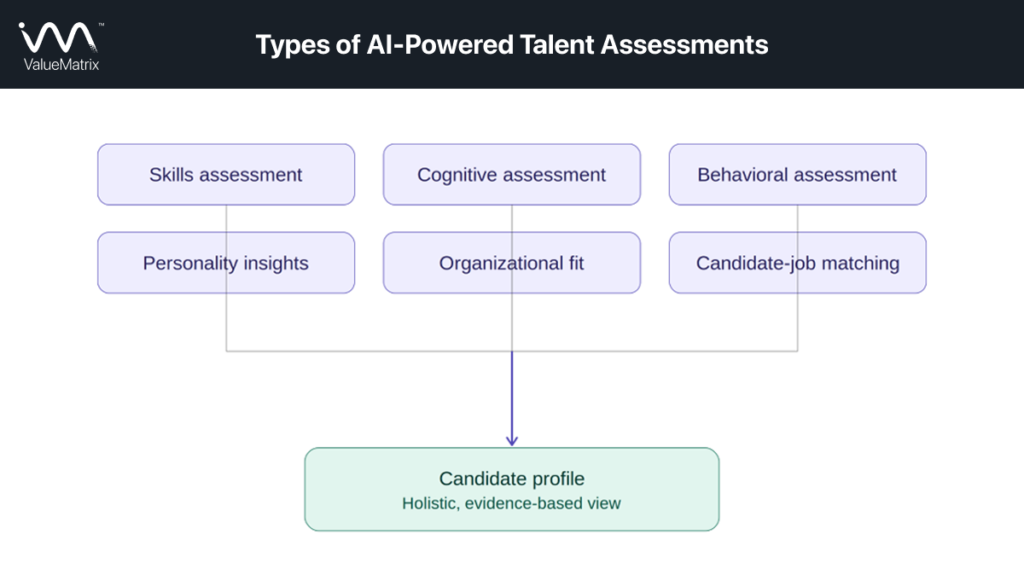
Skills assessment evaluates job-relevant technical or functional capability through simulations, coding challenges, or scenario-based tasks scored automatically against defined competency benchmarks.
Cognitive assessment measures problem-solving speed, reasoning, working memory, and learning agility — traits that correlate with adaptability in fast-changing roles, independent of prior experience.
Behavioral assessment analyzes how candidates act under realistic conditions — through gamified exercises, situational judgment tests, or structured interview response patterns — to predict workplace behaviors like collaboration, resilience, and initiative.
Personality insights use validated psychometric models to describe stable traits (conscientiousness, openness, emotional stability) that shape long-term work style, without reducing a candidate to a single label.
Organizational fit analysis compares a candidate’s values, working style, and motivational drivers against a team’s or company’s actual culture — not an idealized culture statement, but observed norms.
Candidate-job matching synthesizes all of the above into a single compatibility score against the specific requirements of the specific role, rather than a generic “good candidate” rating.
Used in isolation, each of these tools tells a partial story. Used together under a Talent Intelligence framework, they form a composite picture that is far closer to how a thoughtful hiring manager would evaluate someone, if that hiring manager had unlimited time and zero fatigue.
A common point of confusion is treating “skills assessment” and “talent assessment” as interchangeable. They aren’t, and the distinction matters for how an organization should design its evaluation process.
| Dimension | Skills Assessment | AI Talent Assessment |
|---|---|---|
| What it measures | A specific technical or functional capability | Skills plus behavior, cognition, personality, and organizational fit |
| Question it answers | “Can this person do the task?” | “Will this person succeed in this role, on this team, in this organization?” |
| Typical format | Coding tests, simulations, task-based exercises | Multi-signal model combining several assessment types |
| Predictive scope | Short-term task performance | Longer-term performance, retention, and team fit |
| Use case | Screening for a defined technical competency | Holistic hiring decisions and workforce planning |
Skills assessment is a necessary input into AI Talent Assessment, not a substitute for it. A candidate can pass every technical test and still be a poor fit for a role that demands ambiguity tolerance, cross-functional collaboration, or a particular pace of decision-making — factors a coding test was never designed to capture.
How AI Improves Candidate Evaluation
AI improves candidate evaluation by standardizing criteria across every candidate, surfacing behavioral and cognitive signals invisible to a resume, and applying consistent scoring at a scale and speed no human panel can match — all while creating an auditable record of why a decision was made.
The core improvement is consistency. Two candidates evaluated by two different interviewers, on two different days, with two different moods in the room, historically received different scrutiny even when equally qualified. AI models apply the same weighted criteria to every applicant, which reduces the variance that creeps in through human inconsistency — a variance that isn’t malicious, just unavoidable in manual processes.
The second improvement is depth without added time. A well-built candidate-matching model can weigh skills data, behavioral responses, and role requirements simultaneously, producing a ranked shortlist in minutes rather than days. Gartner’s research has associated AI-based skills inference with improved internal mobility match rates, helping organizations find qualified candidates from populations they weren’t previously considering — a benefit traditional resume screening structurally can’t deliver, because it filters on keywords rather than demonstrated capability.
The third, and most differentiating, improvement is explainability. A defensible AI Talent Assessment system doesn’t just output a score — it documents which factors drove that score, in language a hiring manager, a candidate, or an auditor can understand. This is the difference between “the algorithm said no” and “the candidate scored below threshold on structured problem-solving criteria relevant to this specific role, here’s the evidence.” That documentation is what makes AI-assisted decisions defensible under increasing regulatory scrutiny — and what makes them trustworthy to the people they affect.
AI Talent Assessment and Candidate Matching
AI candidate matching goes beyond keyword-based resume screening by modeling the actual requirements of a role against a candidate’s demonstrated skills, behavioral tendencies, and cognitive profile — producing a fit score grounded in job-relevant evidence rather than surface-level resume overlap.
Most legacy applicant tracking systems match candidates to jobs the way a search engine matches text to a query: by counting overlapping words. This approach systematically under-ranks strong candidates who describe their experience differently than a job description is worded, and over-ranks candidates who have simply mirrored the posting’s language.
AI-powered matching works differently. It builds a structured profile of what a role actually requires — not just listed qualifications, but the skills, behaviors, and working conditions associated with people who have succeeded in similar roles — and compares that profile against a candidate’s assessed capabilities rather than their vocabulary choices. Research compiled around structured, AI-supported interview formats has found meaningfully higher assessment consistency compared to unstructured interviews, reinforcing that matching quality improves when the inputs themselves are standardized before the matching algorithm ever runs.
Done well, this benefits candidates as much as employers. People from nontraditional backgrounds — career changers, self-taught professionals, candidates without a pedigree degree — are evaluated on what they can actually do, rather than filtered out before a human ever sees their profile. That is the practical mechanism through which AI Talent Assessment can widen a talent pool instead of narrowing it, provided the underlying models are built and audited responsibly.
This same matching infrastructure is what makes predictive hiring possible. Rather than asking “does this candidate look qualified on paper,” predictive models ask “based on the assessed traits of people who have succeeded in similar roles at this organization, how likely is this candidate to succeed here.” That question can only be answered when skills, behavioral, and cognitive data are structured consistently enough to compare across candidates and connect back to real performance outcomes over time. It’s a meaningfully different exercise than screening — screening filters people out, predictive matching ranks people in, based on evidence tied to what success has actually looked like.
Benefits of AI Talent Assessment
Organizations implementing AI Talent Assessment report faster hiring cycles, more consistent evaluation criteria, improved diversity outcomes, and stronger long-term predictive accuracy for performance and retention — turning hiring from a cost center into a strategic capability.
The benefits compound across four areas:
Speed and efficiency. Automating structured evaluation frees recruiters from manual screening so they can spend time on judgment-intensive work — final interviews, offer negotiation, and candidate relationship-building.
Consistency and fairness. Among HR professionals whose organizations use AI to support recruiting, interviewing, or hiring, nearly one in three report that the diversity of their organization’s hires has improved due to AI use, according to SHRM’s 2024 research — a meaningful signal that structured, criteria-based evaluation can reduce some forms of inconsistent human judgment when implemented with proper oversight.
Better long-term decisions. By connecting assessment data to eventual performance and retention outcomes, organizations can validate — and continuously refine — which criteria actually predict success in a given role, rather than relying on assumptions carried over from job descriptions written years earlier.
Strategic workforce planning. The same data infrastructure that powers candidate assessment can inform internal mobility, succession planning, and skills-gap analysis, turning what used to be a point-in-time hiring decision into an ongoing organizational asset.
None of these benefits are automatic — a poorly implemented AI hiring assessment can create new problems as easily as it solves old ones. Deloitte’s 2025 Global Human Capital Trends report, based on input from nearly 10,000 business and HR leaders across 93 countries, found that only 6% of workers believe their organization is making great progress in realizing value from AI — a reminder that the technology creates potential, not guaranteed results, and that implementation quality is what separates the two.
Challenges and Ethical Considerations
AI Talent Assessment introduces real risks — algorithmic bias inherited from historical data, candidate trust deficits, regulatory exposure, and over-reliance on automated scores — that require active governance rather than passive faith in the technology.
The most cited concern is bias amplification: a model trained on historical hiring data will reproduce historical patterns unless it is specifically audited and corrected for that risk. This isn’t a hypothetical — it’s the reason regulators in multiple jurisdictions now require bias audits for automated employment decision tools. SHRM’s research found that among organizations using AI to support HR-related activities, two in five have concerns about the security and privacy of data used by AI tools, and a lack of resources to properly audit or correct AI algorithms was cited by 41% of organizations as a reason they haven’t adopted AI for HR — indicating the industry itself recognizes this as unresolved, not solved.
Candidate trust is a second challenge. Many applicants remain uneasy being evaluated by systems they don’t understand, which is precisely why explainability isn’t a “nice-to-have” feature — it’s the mechanism that makes automated evaluation acceptable to the people subject to it.
Regulatory exposure is growing as well. Jurisdictions including the EU (through the AI Act) and several U.S. states now impose specific obligations — bias audits, disclosure requirements, candidate notice — on automated hiring tools, and this regulatory landscape is still evolving.
Finally, there’s the risk of over-automation: treating a model’s score as a verdict rather than an input. SHRM’s research notes that three in four HR professionals agree AI will increase — not decrease — the importance of human judgment in the workplace over the next five years. The organizations that get this right treat AI as an evidence layer that informs a human decision-maker, not a replacement for one.
Best Practices for AI Talent Assessment
Effective implementation requires validated assessment models, mandatory bias auditing, transparent candidate communication, human oversight at final decision points, and continuous outcome tracking to confirm that assessments actually predict on-the-job success.
Following AI talent assessment best practices isn’t just a compliance exercise — it’s what determines whether a program delivers lasting value or gets quietly abandoned after a rocky first year. A responsible AI Talent Assessment program is built on a few non-negotiable practices:
- Validate before you deploy. Every assessment component — skills tests, behavioral models, matching algorithms — should be validated against actual job performance data specific to your organization, not just vendor-supplied benchmarks.
- Audit for bias on a recurring schedule, not just at launch. Models drift as candidate populations and job requirements change.
- Keep humans in the loop at decision points that matter. Use AI to structure and surface evidence; reserve final hiring calls for accountable human decision-makers.
- Communicate transparently with candidates about what is being assessed and how, including a path to request explanation or contest a decision — both an ethical baseline and, increasingly, a legal requirement.
- Track downstream outcomes. Connect assessment scores to actual retention, performance, and promotion data so the model keeps improving rather than calcifying around its original assumptions.
- Combine assessment types deliberately. Skills tests alone measure capability; add behavioral and cognitive assessment to understand how that capability shows up on the job.
Organizations that treat these as ongoing operational discipline — not a one-time compliance checklist — are the ones seeing sustained gains in hiring quality rather than a short-lived efficiency bump followed by trust erosion.
Future Trends in AI-Powered Talent Assessment
The next phase of AI Talent Assessment centers on predictive hiring models tied to real performance outcomes, assessment criteria that account for AI-era skills, mandatory explainability under emerging regulation, and a shift from one-time hiring evaluation toward continuous, organization-wide talent intelligence.
Looking ahead, several shifts stand out. First, assessment and workforce planning are converging: Gartner predicts that by 2027, 75% of hiring processes will include certifications and tests for workplace AI proficiency, signaling that assessment criteria themselves are being rewritten around new categories of skill rather than the static requirements listed in older job descriptions.
Second, predictive hiring is maturing from a marketing term into a measurable discipline. Rather than assessing candidates against generic competency frameworks, leading platforms are increasingly validating their models against an organization’s own performance, retention, and promotion data — closing the loop between “who we hired” and “how they actually performed.” This shift matters because a model that predicts culture fit or skill match in the abstract is far less useful than one calibrated against what success actually looks like inside a specific company.
Third, explainability is moving from a differentiator to a baseline requirement. As AI Act-style regulation spreads and candidates grow more aware of automated evaluation, “black box” scoring will become a legal and reputational liability rather than a convenience. Organizations that can show their work — which criteria drove a decision, and why those criteria are job-relevant — will have a durable advantage over those that can’t.
Fourth, assessment data is increasingly feeding internal mobility and succession planning, not just external hiring. The same behavioral, cognitive, and skills signals gathered during recruitment can inform who’s ready for a stretch assignment, who’s a flight risk, and where the organization’s skills gaps actually sit. That reframes Talent Intelligence as a continuous organizational capability rather than a point-in-time hiring event; assessment becomes infrastructure, not a gate candidates pass through once.
Finally, expect assessment models themselves to diversify. Rather than a single composite “fit score,” organizations will increasingly want disaggregated views — separate, comparable readings on skills, behavior, cognition, and organizational fit — so hiring teams can weigh trade-offs deliberately instead of trusting a single blended number they can’t fully interrogate.
How ValueMatrix Uses AI-Powered Talent Intelligence
ValueMatrix combines skills, behavioral, cognitive, and organizational-fit assessment into a single explainable Talent Intelligence model, giving hiring teams a transparent, validated, bias-audited view of candidate potential rather than a disconnected set of test scores.
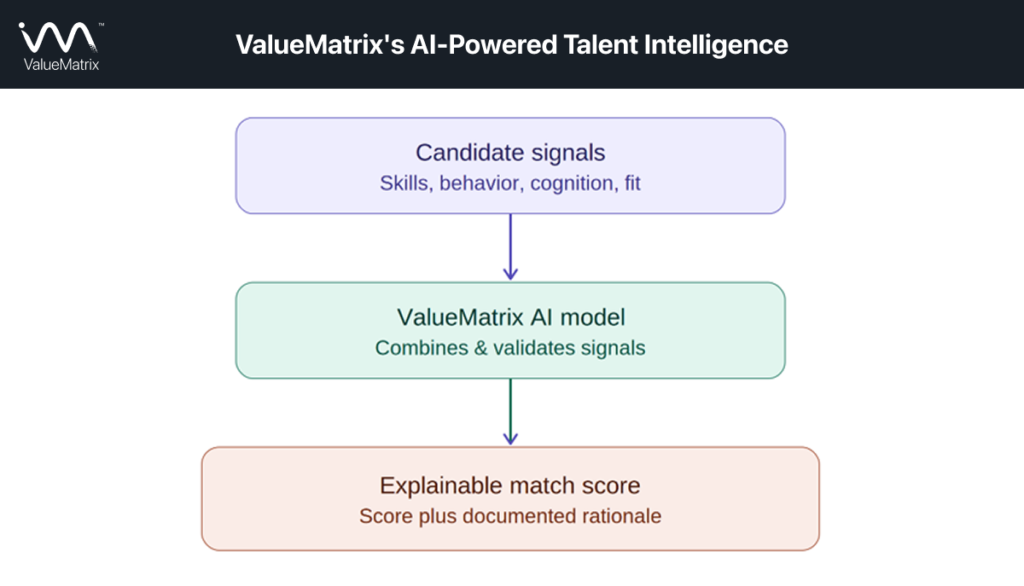
Our approach starts from a simple premise: a hiring decision is only as good as the evidence behind it, and evidence scattered across five disconnected tools is weaker than evidence brought together under one coherent model. ValueMatrix’s Talent Intelligence platform assesses candidates across skills, behavior, cognition, personality, and organizational fit, then produces a candidate-job match score with a documented, explainable rationale behind it; built for hiring teams who need to defend their decisions, not just make them quickly.
We treat bias auditing and model validation as ongoing operational work, not a one-time certification, and we design our assessment reporting so both recruiters and candidates can understand exactly what was measured and why it mattered for the specific role in question. The goal isn’t to replace human judgment in hiring — it’s to give the humans making that judgment the clearest, fairest, most complete picture of a candidate that data can responsibly provide.
Conclusion
Hiring decisions used to rest on fragments: a resume, an hour-long interview, a hunch. AI talent assessment replaces those fragments with a connected view of who a candidate actually is: their skills, their behavior under pressure, how they think, and how well they’d fit a specific team and role.
The organizations getting the most value from this shift aren’t the ones that automated the most steps. They’re the ones treating AI as an evidence layer that sharpens human judgment, not a substitute for it; validating models against real outcomes, auditing for bias on a recurring basis, and giving candidates a transparent account of how they were evaluated.
The combination of skills, behavior, cognition, personality, and organizational fit, assessed together and explained clearly is what separates AI talent assessment from a faster version of the same old process. It’s a different kind of hiring decision altogether: one built on evidence rather than instinct and designed to get more accurate the longer it’s used.
FAQs
1. What is AI talent assessment?
AI talent assessment uses machine learning to evaluate candidates across skills, cognition, behavior, personality, and job fit at once. Rather than relying on a single test score or interview impression, it combines multiple data signals into one holistic, evidence-based prediction of how a candidate will actually perform on the job.
2. How is AI talent assessment different from a regular skills test?
A skills test measures one narrow capability, like coding or writing. AI talent assessment goes further, combining skills data with behavioral, cognitive, and organizational-fit signals to predict long-term success, not just whether someone can complete a specific task. It answers “will they succeed here,” not just “can they do this.”
3. Does AI talent assessment reduce hiring bias?
It can, when built and audited responsibly. Standardized criteria applied consistently to every candidate reduce the variance that comes from interviewer fatigue or unconscious preference. However, bias reduction isn’t automatic: models trained on historical hiring data can inherit past patterns unless actively audited and corrected on an ongoing basis.
4. What is explainable AI in hiring, and why does it matter?
Explainable AI documents the specific factors behind a candidate’s score, in language a hiring manager, candidate, or auditor can understand. Instead of an opaque “algorithm said no,” it shows exactly which job-relevant criteria drove the outcome, making decisions defensible under scrutiny and trustworthy to the people they affect.
5. Can AI predict which candidates will succeed long-term?
Predictive hiring models get closer to this by validating assessment scores against an organization’s actual performance, retention, and promotion data over time. Rather than relying on generic competency frameworks, they calibrate against what success has actually looked like inside a specific company, improving accuracy the longer they’re used.
6. Is AI candidate matching just resume keyword matching?
No, that’s the older, more limited approach. AI candidate matching builds a structured profile of what a role genuinely requires and compares it against a candidate’s demonstrated skills, behaviors, and cognitive traits, rather than counting overlapping words between a resume and a job posting.
7. What are the risks of using AI in hiring assessments?
The main risks are algorithmic bias inherited from historical data, candidate distrust of opaque scoring, growing regulatory exposure around automated employment decisions, and over-reliance on AI scores as final verdicts rather than inputs. Responsible programs address each of these through auditing, transparency, and continued human oversight.
8. Should AI replace human recruiters and hiring managers?
No. AI is best used as an evidence layer that informs human decision-makers, not a replacement for them. Most HR professionals agree that as AI handles more structured evaluation, human judgment becomes more important for interpreting culture fit, nuance, and long-term potential.
9. What should organizations look for in an AI talent assessment platform?
Look for validated models tied to real job-performance data, regular bias audits, transparent and explainable scoring, human oversight at final decision points, and the ability to combine skills, behavioral, and cognitive assessment rather than relying on a single narrow test.
10. How does ValueMatrix approach AI-powered talent assessment?
ValueMatrix combines skills, behavioral, cognitive, and organizational-fit assessment into one explainable Talent Intelligence model. It’s designed around ongoing bias auditing and transparent reporting, giving hiring teams a clear, validated view of candidate potential, so decisions can be defended, not just made quickly.