
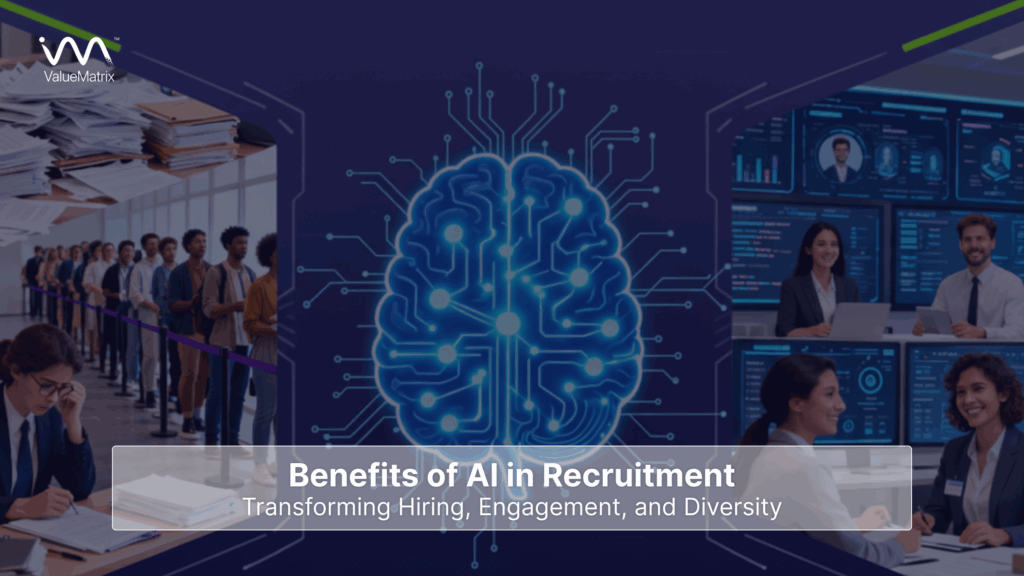
Imagine that you advertise a vacancy and within weeks, there are hundreds of resumes in your inbox. You begin to sift, but the stack just builds. Weeks go by, and when you are about to shortlist, the best-qualified candidates are gone and have taken offers elsewhere. You insist on diversity, but unconscious bias works its subtle influence on decisions you never intended. Candidates, fed up with endless forms and delayed responses, drift away to rivals who are quicker.
If that story sounds familiar, you are not alone. It is the recruitment crisis of today that most organizations are encountering. But there is a silver lining: AI is filling the picture, not to simplify the process, but to rethink how to hire, engage, and create inclusive teams.
The current state of recruitment numbers paints a stark picture.Recruiters spend up to 23 hours per hire on screening and interviews alone. Meanwhile,88% of applications flooding your inbox are unqualified.The global average time-to-hire has stretched to 44 days, while top talent receives multiple offers within days.
AI addresses these challenges systematically through automation and data-driven insights. Organizations implementing AI recruitment tools see remarkable results:75% reduction in screening costs, time-to-hire dropping from 44 days to just 11 days, and 48% improvement in diversity representation. These aren’t incremental gains. They represent fundamental shifts in how successful companies attract and retain talent.

What Role Does AI Play in Modern Recruitment?
AI completely disrupts the way you find and assess talent. The technology does away with time-wasting activities that rob your recruiters of productivity. Resume filtering is done in an instant rather than days. Sourcing candidates goes far beyond conventional avenues to uncover your secret talent pools you never thought of.
Machine learning algorithms analyse candidates across multiple dimensions. Skills and experience represent just the starting point. These systems evaluate cultural alignment, collaboration potential, and growth trajectory. They learn from your successful hires to improve future recommendations continuously.
The accuracy improvements are remarkable. AI systems process applications consistently without fatigue or mood variations affecting decisions. They apply identical evaluation criteria to every candidate. This consistency eliminates the variability that plagues human screening processes.

Traditional keyword matching becomes obsolete with advanced AI. These systems understand context better and identify transferable skills. They see promise in candidates whose resumes do not ideally match job postings but whose abilities are a fit for job descriptions.
This enables your recruiters to focus on high-value tasks. It changes recruiting from administrative work to strategic talent advisory. The outcome is improved candidate experiences and improved recruitment results for your organisation.
How Does AI Accelerate the Hiring Process?
In a conversation with ValueMatrix, Jayesh Menon, a global HR leader predicts:
AI will drastically accelerate hiring speed, leaving interviewers no time for coffee breaks between candidates. Beyond rapid onboarding, AI will analyze data from recruiters, managers, and interviewers to identify optimal team mixes that drive long-term hire quality. This data-driven paradigm shift will redefine organizational recruitment strategies.
Speed makes or breaks your company’s talent acquisition game in the competitive recruitment market. Top candidates receive multiple offers quickly. Your ability to identify and engage them first often determines hiring success. AI provides the acceleration you need to win this race consistently.
Manual candidate screening disappears as a bottleneck. AI algorithms process thousands of applications simultaneously. They rank candidates based on fit and potential rather than simple keyword matches. What previously took your team days now happens in minutes.
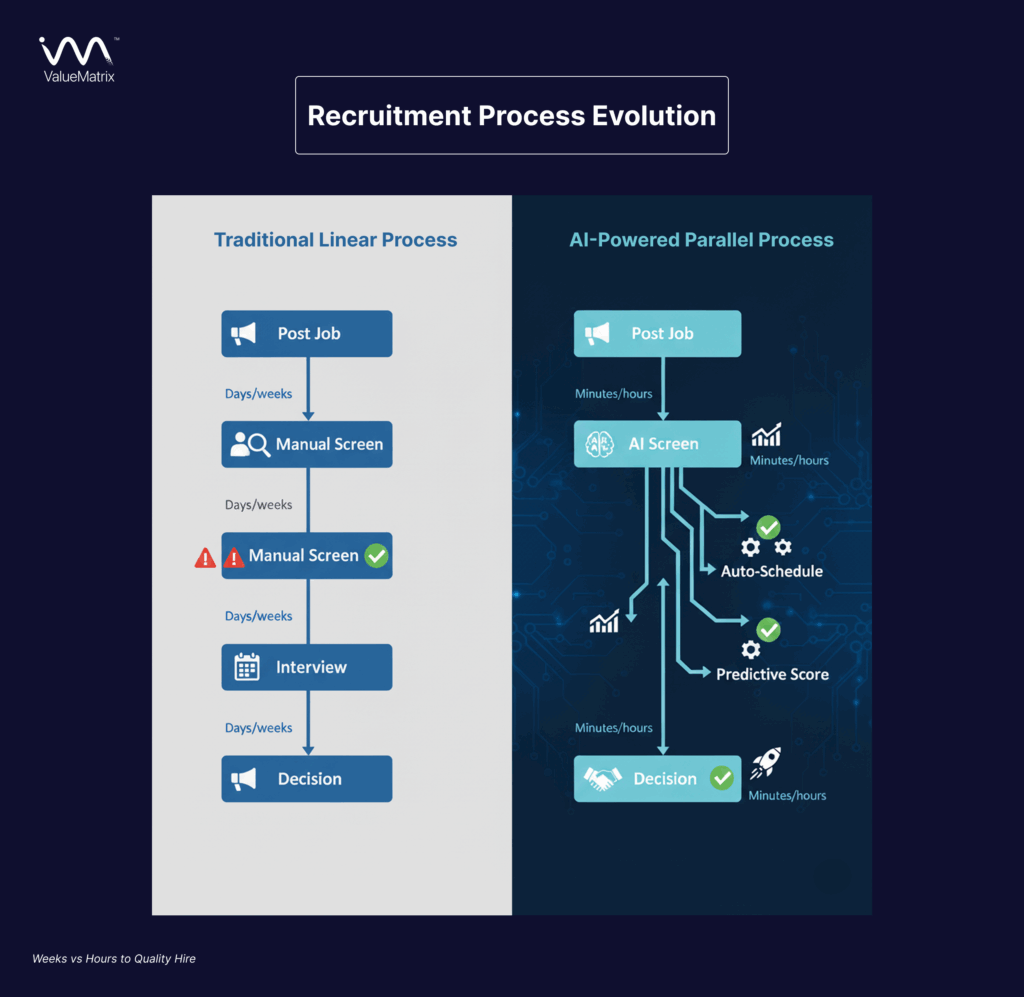
Interview scheduling becomes automated and intelligent. AI chatbots coordinate availability between candidates and hiring teams seamlessly. They handle scheduling requests and send automated reminder communications. This eliminates back-and-forth emails and keeps your hiring process going.
Predictive candidate scoring accelerates decision-making dramatically. Instead of squander hours bickering over candidate fit, you have data-backed confidence scores. These insights help you prioritize interviews and make faster offers to top candidates.
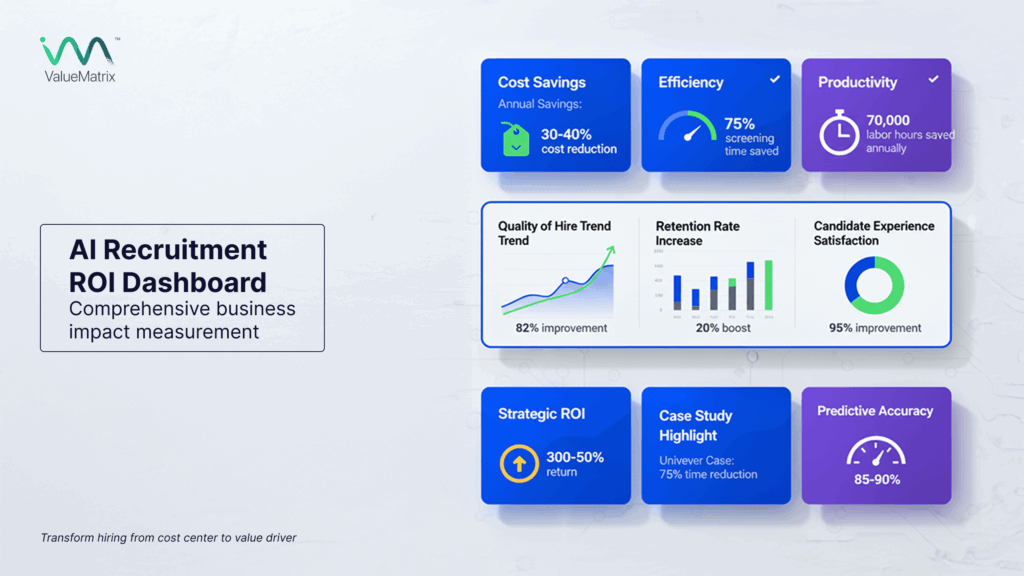
Real-world results demonstrate this acceleration impact. Companies using AI recruitment tools typically seea 30-50% reduction in time-to-fill positions within 60 days of implementation.Unilever reduced its recruitment time by 75% while saving 70,000 labour hours annually.
Your hiring managers benefit from this acceleration, too. They receive a ready-made, pre-qualified pool of candidates instead of wading through the jungle of unfiltered applicants. Their time in interviews becomes more productive when every candidate meets a baseline level of requirements. This efficiency creates positive experiences that attract additional quality candidates to your organization.
Can AI Improve Candidate Engagement?
Candidate experience is a major differentiator for talent attraction. Your employer brand is built from the way candidates experience your recruitment process. AI enables you to create consistently positive interactions to develop your employer brand.
Chatbots with artificial intelligence provide immediate answers 24/7. Candidates do not need to wait days for straightforward questions on job roles or company culture. This immediate availability addresses communication gaps that frustrate potential hires. Remember,65% of candidates report insufficient communication during recruitment processes.
Personalized communication becomes scalable through AI. Instead of generic email blasts, candidates receive tailored messages based on their interests and application stage. This personalization makes each candidate feel valued rather than processed through a mass system.
Interactive assessments replace boring application forms. Gamified evaluations reveal cognitive skills while engaging candidates actively. This approach creates positive impressions of your organization’s innovation and candidate focus.
Career websites employing chatbots see remarkable engagement boosts:95% more leads, 13% more clicks on job requisitions, and 40% more completed applications. These improvements translate directly to stronger talent pipelines.
Your employer branding benefits from AI-enhanced candidate experience. Organizations investing in recruitment technology demonstrate innovation and efficiency. Candidates share positive experiences that attract additional quality applicants naturally.
Response time becomes consistent regardless of application volume. Whether it be 100 applications or 1000 applications, respective candidates are given due diligence and on-time updates. This consistency not only builds trust but also shows the candidate respect in time as part of your hiring process.
How Does AI Promote Diversity in Hiring?
Diversity initiatives often struggle because unconscious bias influences human decisions despite good intentions. Research shows48% of HR managers admit biases affect their hiring decisions. AI systems can focus on objective qualifications while minimizing demographic influences on candidate evaluation.
Skills and performance data become the primary evaluation criteria. When designed well, AI software can avoid the characteristics that so often contribute to unfairness. Rather than being drawn to superficial impressions, it zeroes in on what’s important: the candidate’s abilities and potential to perform well in the position.
One of the smartest features? Blind screening. Names, photos, and demographic indicators can be hidden while focusing on capabilities and experience. This approach creates more equitable initial screening processes.
Structured assessments ensure every candidate faces identical evaluation criteria. Human interviews vary based on the interviewer’s mood and personal preferences. AI maintains consistent standards across all candidate interactions systematically.
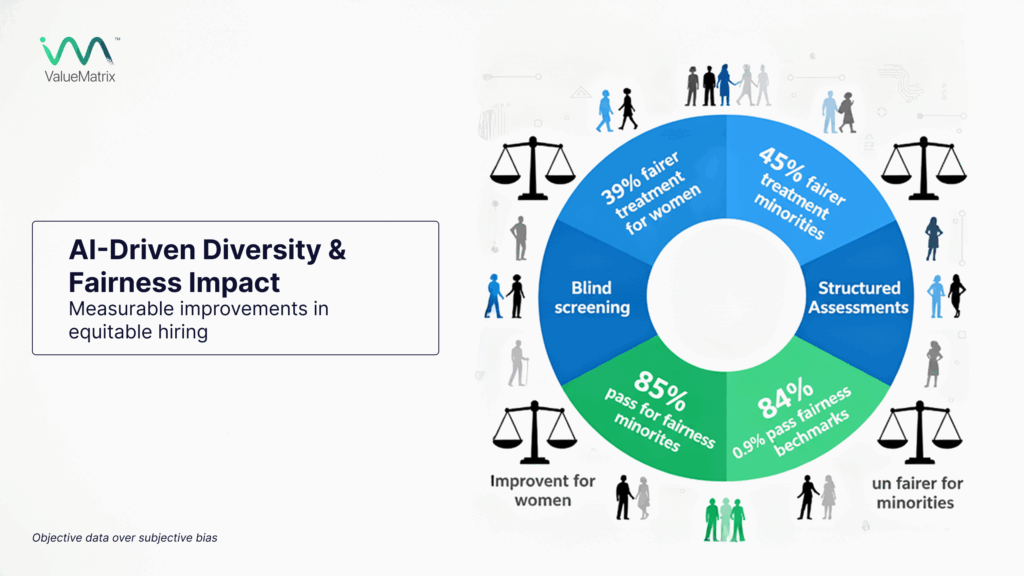
The diversity improvements are measurable. New research showsAI systems deliver up to 39% fairer treatment for women and 45% fairer treatment for racial minority candidates compared to human decision-making. Organizations report more balanced candidate pipelines that better reflect available talent pools.
But success needs constant surveillance. AI systems can reproduce past biases in training data if not well-crafted and periodically audited. You need to create constant surveillance to ensure your AI systems foster instead of impeding diversity aims efficiently.
What Impact Does AI Have on Recruitment Metrics?
Data-informed insights revolutionize how you report and improve recruitment performance. AI delivers in-depth analytics unavailable through manual tracking. These metrics foster strategic decisions rather than knee-jerk guessing of your recruitment efficacy.
Time-to-hire becomes exactly quantifiable across various positions and recruiters. You can spot hold-ups and streamline processes using hard numbers instead of gut feel. There’s a usual75% time-to-hire reduction for businesses implementing full AI solutions.
Cost-per-hire decreases significantly through process efficiency. Organizations reporta 30-40% reduction in direct hiring costs. These savings result from reduced manual labour, faster processes, and improved hiring accuracy that reduces costly turnover.
Candidate quality metrics improve measurably with AI assistance. Hiring managers report82% better quality hires when using AI recruitment tools. This improvement translates directly to better team performance and reduced early turnover costs.
Predictive analytics assist you in recognizing patterns before they affect your recruitment. You can anticipate seasonal recruitment requirements, forecast a shortage of skills, and make strategic allocation of resources across various recruitment avenues.
Retention rates are better with AI-aided recruitment. There is20% employee retention, and it is also found that candidates are 18% likely to accept job offers.
Your hiring teams become more productive and strategic. Recruiters handle more requisitions per person while improving candidate quality. This represents fundamental capability enhancement rather than simple efficiency gains.
Recruitment ROI becomes clearly quantifiable. Instead of viewing hiring as a cost centre, you can demonstrate strategic value creation through better quality hires, reduced turnover, and improved team performance that directly impacts business outcomes.
How Can AI Ensure Fairness in Recruitment?
AI recruitment needs to be designed intentionally and monitored for its duration. Algorithms must be aimed at relevant job parameters without indulging in parameters likely to discriminate. It needs technical and ethical diligence from your company.
Objective criteria eliminate subjective intuitions in initial filtering. AI systems analyse skills, experience, and potential using consistent standards. They do not have bad days or personal biases affecting candidate consideration disparagement. But they can have systemic biases ingrained in their programming.
Continuous monitoring is a must as it finds and fixes biased patterns before they influence hiring decisions. Regular algorithmic audits guarantee your AI systems perform equally well for various candidate groups. This prevention upfront blocks discrimination problems from evolving over time.
Open decision-making creates trust with candidates and internal stakeholders. When recruitment decisions are challenged, it’s possible to justify the objective measures and fair process employed in assessing candidates. This open decision-making assists in legal compliance and ethical hiring practices.
New study unveils AI systems actually do better than humans on fairness measures, averaging0.94 to human-guided hiring’s 0.67. Even better: 85% of AI models audited pass industry fairness benchmarks.
However, New rules demand preventive compliance activities. New York City’s Local Law 144 prescribes bias audits of AI recruitment software. The EU AI Act imposes further requirements on algorithmic non-biased decision-making. You should keep abreast of changing legal requirements.
Your AI vendors should provide built-in fairness mechanisms. Systems should include:
- Bias detection
- Diverse training data
- Regular algorithmic reviews.
These features should be standard rather than optional add-ons in your procurement decisions.
Documentation becomes crucial for legal protection. Maintain records of your AI system’s:
- Design principles
- Training data sources,
- Regular audit results
This documentation demonstrates your commitment to fair hiring practices if challenged.
Training your team on ethical AI use ensures responsible implementation. Recruiters and hiring managers need to understand both AI capabilities and limitations clearly. They should know when human judgment should override AI recommendations appropriately.
Why Choose Valuematrix for AI-Driven Recruitment?
Valuematrix.ai offers a comprehensive platform addressing the complete talent lifecycle rather than just individual recruitment tasks.Our approach combines predictive analytics, deep learning, and bias mitigation into an integrated solution for modern hiring challenges.
Methodology backed by empirical psychological research sets us apart from simple resume parsing tools. We evaluate personality-organization fit using established psychological frameworks, psycholinguistics, and computational psychometrics. This approach ensures you’re building cohesive teams rather than just filling individual positions.
Our platform goes beyond traditional hiring by focusing on holistic candidate evaluation. Unlike conventional methods, Valuematrix assesses cultural and team alignment before your organization’s first interaction with candidates. This saves valuable time and resources while improving hiring outcomes.
The science behind their platform includes personality analysis, organization culture assessment, team dynamics evaluation, and cognitive gamification. These components work together to reveal candidate potential that traditional screening methods often miss completely.
Conclusion
Your organization is standing at a pivotal moment right now. The future of your talent acquisition is in front of you. The evidence is clear: AI-driven recruitment gives you truly transformational results. You get a faster time-to-hire and better diversity representation. Most importantly, you secure higher-quality candidates.
These are not minor improvements. This is a fundamental shift in how successful companies approach finding talent. Embracing AI now gives your organization a massive competitive edge. You’ll consistently attract and retain the best people in the market.
This transformation is about more than just efficiency. AI enables true strategic workforce planning and data-driven decision-making that was simply impossible before. Your HR team evolves from administrative support to a genuine strategic business partner.
Success depends on thoughtful planning and ethical oversight. The most effective approach balances technological efficiency with human judgment and relationship building. AI must never be in the driving seat; it needs to be your strategic co-pilot.
We at Valuematrix provide you with a proven platform for this transformation. Our comprehensive approach addresses the complete talent lifecycle while maintaining focus on fairness, quality, and organizational culture alignment. Start your transformation today and position your organization as an employer of choice in tomorrow’s competitive talent marketplace. Explore Valuematrix.ai’s AI recruitment solutions to accelerate your journey toward smarter, faster, and more inclusive hiring.
About Us
ValueMatrix is an AI-powered talent intelligence platform that helps companies hire better, faster, and without bias. We go beyond resumes to assess skills, behavioral traits, and cultural fit using advanced AI and proven psychological frameworks. Our platform delivers data-driven insights that improve hiring accuracy, reduce time-to-hire, and elevate candidate quality.
ValueMatrix AI enables hiring teams to make confident hiring decisions and build high-performing teams at scale.