
In this post:
- Find out how AI is revolutionizing the workplace with new opportunities and setbacks.
- AI’s impact on workplaces, culture, and employee motivation.
- How AI in the Workplace Elevates Productivity and the Hiring Process.
- How HR tools like ValueMatrix AI find the right talent and reduce bias.
- Checklist for Using AI Wisely and Adapting to Job Changes.
- Why the use of human AI and ethical AI matters.
- Explore ways to upskill and prepare workers for the impact of AI-driven changes.
- How to develop a fair and ethical workplace with AI.
AI in the Workplace: How Do We Embrace a Human-Focused Future Workplace
AI in the workplace is transforming the way businesses operate, including the latest methods for monitoring progress. While some people worry about jobs being replaced, we need to understand the best way to manage these changes. The goal is to build a bright, human-focused future of work that benefits everyone.
Most tasks performed each day become more agile. The performance method leverages a substantial amount of data to support informed business decisions by automating redundant tasks through AI. It enables them to be proactive in identifying how to overcome the differences between good and bad decisions, assessing the implications, and filtering through opportunities.
AI’s Impact on the Future of Work
However, AI in the workplace raises several challenging questions about the future of work. Will it boost productivity and engender innovation, or will it replace jobs and take away the essence of humanity?
These questions become more intense because AI is already changing how teams work together, communicate, and generate value. It’s more about sharing and utilizing intelligence with humans than about creating intelligent robots.
Hence, the question for business leaders, HR managers, and policymakers is how AI in the workplace will affect their organizations. It proves to be not only a huge opportunity but also a significant challenge, particularly in terms of talent management and employee loyalty.
Changes that can soon promise a better, more stable, and sustainable future are on the horizon. No one can deny that AI-based modifications are inevitable.
AI will enhance how we work, resulting in faster and more intelligent work.
Boosting Human Potential and Customer Satisfaction
Imagine a corporation with diverse operations that runs smoothly, operates more intelligently and increases profits through the use of AI. AI in the workplace doesn’t just automate; it frees up top talent. It handles repetitive tasks, allowing employees to focus on creative ideas, strategy, and stronger client relationships – a significant shift in how we utilize human skills.
When we discuss customer service, AI can provide immediate responses to the most frequently asked, mundane questions via online chat during nighttime hours. It doesn’t replace any team members but eases their workload by handling the basic backlog of questions.
Meanwhile, the team member deals with more complex issues, handles complaints, or calms down a hyperactive client. They can also build loyalty by connecting and conducting personalized conversations, a feature limited only to humans.
According to a report, nearly a decade ago, in 2013, workers reported an increase in productivity while using generative AI, which rose by a slight margin, to around 14%. First-time employees experienced a hike of up to 35%. Most see AI in the workplace enhancing their performance sooner, rather than later.
Beyond Customer Service
No longer is AI in the workplace solely limited to customer services; it can also conduct analytical tasks. AI can analyze market trends, forecast customer behavior, and optimize complex company operations.
These predictive analytics can help businesses make faster and more informed decisions. For example, it aids in social listening by analyzing sentiments from social media and economic indicators, and thereby suggesting market planning.
Talent Management: Key Role of AI in Helping Hire a Perfect Team
Hiring the right people has always been a challenging, time-consuming task. Old recruiting methods often fall short due to slow processes, unconscious bias, and difficulty in finding the right cultural fit.
AI can bring such a fundamental change to the workplace through performance measurements that are effective and data-driven.
HowValueMatrix.AIUses AI to Deliver Fairer and Faster Hiring
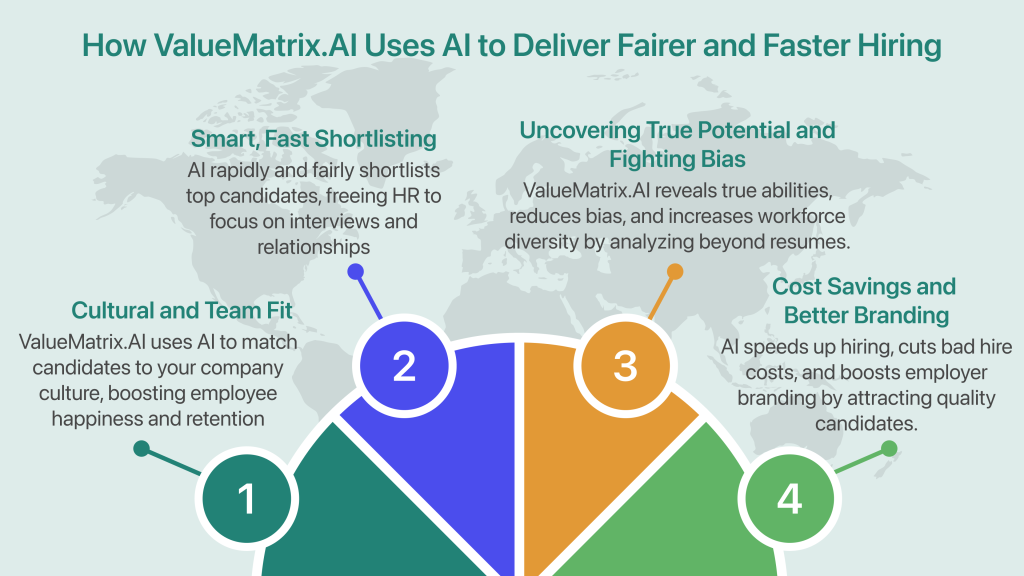
ValueMatrix.AI spearheads recruitment through its advanced AI intervention and predictive methodologies. It evaluates candidates beyond their resumes, focusing on areas such as personality, problem-solving capabilities, and collaborative style, to match them with the culture. It helps you hire people who align with your organization’s values and enhance team dynamics to become valuable, long-term assets.
So, ValueMatrix underlines the whole point of smart hiring:
- Cultural and Team Fit: ValueMatrix.AI checks if a candidate’s personality and work style align with your company’s culture and existing team dynamics. AI assesses the candidate’s communication patterns and work preferences. The benefits are what every organization wants: happier employees with lower turnover and stronger team bonding.
- Smart, Fast Shortlisting: Though applications come in significant numbers, HR is often overloaded. Now, speedy shortlists are required. AI sorts through thousands of applications fairly quickly and consistently, whereas humans take much longer to complete this process. It identifies suitable candidates and enables HR to focus on worthwhile tasks, such as interviewing and building relationships with candidates.
- Uncovering True Potential and Fighting Bias: While resumes can appear very attractive, ValueMatrix.AI helps companies look beyond them. It employs robust analysis to showcase a candidate’s real abilities and hidden potential. AI reduces bias by minimizing human involvement in the initial screening stage. It widens the diversity of backgrounds and cultures within your new workforce.
- Cost Savings and Better Branding: A quicker and more effective hiring process translates into significant savings through reduced bad hire costs and a transparent, fair process. AI in the workplace can enhance your brand’s perception as an innovative company. An employer using AI in the workplace will experience suitable candidates looking to join their company.
For the ultimate good, AI is an excellent ally in acquiring and retaining top talent. It thereby hastens the evolution of future workplaces, which will be more effective and increasingly fair, meritocratic, and equitable.
Your Team & AI: Making It Work Together (Human-AI Collaboration)
When we talk about AI integration, there is a human angle: How will employees perceive their relationship with the AI systems? Will they feel enhanced and empowered, or will they be overshadowed or possibly even threatened by it? The emotional impact of AI on the world of work deserves very sensitive handling; winning the hearts and minds of employees is everything.
Streamlined AI Integration
Studies show that excessive reliance on automation can lead to “automation complacency,” where users overlook system failures and cease questioning AI’s output. It means we must design workflows and train people to keep their critical thinking sharp, so they don’t unquestioningly accept AI results.
However, AI in the workplace also empowers us. Imagine AI as a tireless assistant handling tedious data work. It frees your team to focus on what humans do best: creativity, intuition, emotional intelligence, empathy, and strategic thinking. 2017 research demonstrates that when utilized effectively, AI can enhance human decision-making and boost productivity.
The secret, hence, lies in teamwork. You will be reaping maximum gains when you design AI that complements your team’s strengths. This cooperation between human beings and AI entails not just technology, but also the creation of a better and more humane working environment, wherein AI is a major partner in a prosperous future of work.
Leading the Way: How to Shape Your Future of Work and Define Workplace Excellence
Success in human-AI integration will significantly impact your organization’s prospects, as AI continues to advance. It goes beyond implementing a new tool; it is indeed crucial as a strategic objective to intelligently incorporate AI as an integrated team member, thus augmenting the potential of your human workforce. It is also a prerequisite for an AI-literate workplace.
Such activities will be necessary for creating AI in the workplace tools that are human-centered, easy to implement, transparent, and genuinely empower people to enhance their decision-making abilities. The World Economic Forum (2020) envisaged that the future of work will be a blend of human strengths and machine capabilities.
Indeed, one of the areas where AI will undoubtedly make a significant impact is in development.
In other words, continuous learning is focused on today, not tomorrow, making it extremely important in an AI-centric world. Hence, as a CHRO, it is beneficial to invest in upskilling and reskilling employees so that they can learn to work effectively with AI.
It will lead to:
- Decreased Turnover: Employees who believe their skills are growing and that the company is investing in their future are more likely to become engaged and resist leaving.
- Enhanced Talent Acquisition: Workforce planning with AI positions your business as a leader in innovative work models, thereby attracting top talent.
- The Creation of New Solutions: An AI-literate workforce identifies new efficiencies and solutions.
- Elevated Resilience: A technology-savvy workforce ready to adapt to change.
In the future of work, continuous learning will be the key to unlocking the full potential of human resources.
Simple Rules for People-First AI in the Workplace
Follow this simple set of rules by which AI can help employees and thus improve workplaces:
- Clear and Transparent Communication: How AI works should be very clear to the human teams working with it. In the long run, transparency builds trust.
- Human Control: People should be able to overrule AI decisions at every point. AI shall never supplant human judgment; it is to support human judgment.
- Equality First, Be Less Biased: Collaborate AI with diverse teams. Additionally, conduct regular audits of AI systems to prevent bias and ensure accuracy.
- Build for Assistance, Not Replacement: Do not create joblessness for your people; instead, work to elevate their AI-using abilities.
- Incorporate Ethical Principles: AI tools must align with the company’s values and adhere to relevant legal frameworks and regulations.
These principles offer the promise that AI in the workplace will empower employees while also creating a more effective and better future workplace.
How to Prepare: Respond to Workplace Changes Due to AI Automation
The effects of AI on the work environment and changes in job demand require proactive plans for workforce development by HR leaders. One shouldn’t wait for roles to disappear. Investing continuously in reskilling and up-skilling will be a lifeline for business survival.
The pace is picking up. It means your organization needs to make simple, personalized, and accessible learning paths.
Train your people specifically for AI literacy and industry certifications or micro-credentials. Equip your people with the essential human-centric traits—creative, emotional intelligence, critical thinking, and collaboration—that AI can never match.
While going with the first approach, the challenge can be addressed by:
- Develop Strategic Partnerships: Forge strategic partnerships with educational institutions and industry partners to anticipate skills requirements, formulate relevant training programs, and create talent intelligence pipelines.
- Instilling Unique Human Skills: Reinforce and strengthen human capabilities in systematic, clear communication, ethical reasoning, ambiguity resolution, empathy, and leadership, as with AI, these capabilities will yield better payoffs.
- Creating and Redesigning Jobs Proactively: Browse through the new roles that emerge due to AI, such as AI ethicists, and reconsider existing roles to leverage AI and enhance human capacities.
The idea is to turn the threat of AI to jobs into a big opportunity. The strategic workforce initiatives will prepare organizations to equip people to adapt, thrive, and contribute effectively in the new world of work.
Building a Better Workplace Policy with AI
The future of work is both fascinating and challenging, as AI brings significant benefits for productivity and new ideas, yet also raises concerns about job displacement and algorithmic bias.
To a great extent, navigating such risks means striking a balance between the critical nature that AI in the workplace can serve and realistically managing the challenges it poses. It’s striking a balance between technology and humanity.
Understanding how AI will shape the lives of people—specifically their roles, skills, and welfare—and finding innovative ways for humans to collaborate with AI will unlock the full potential of this technology.
It humanizes workplaces even more, but most importantly, it makes them empathetic. All in all, work changes will provide the best indication of how well we are adapting and being ethically responsible in managing this futuristic technology.
What’s Next? Tomorrow’s AI in the Workplace Impact
AI in the workplace is going to have a lot more interesting surprises in store. Imagine training systems that utilize virtual reality, combined with AI, for complex tasks, or having intelligent, AI-designed learning systems generate personalized learning plans for each employee, thereby fostering professional growth. They’re real possibilities.
AI will learn and optimize itself, later managing entire supply chains or vast power grids. It will grow more independent and thus argue for the demand for Explainable AI (XAI).
Even as AI makes independent decisions, we understand why XAI is being used to maintain transparency. Discussions about AI’s impact on the economy’s well-being will become sharper, and so will its effects on entire economies.
What will be the future of talent management in an AI-driven world? People-centric design and advocacy for lifelong learning would enable us to maximize this tremendous capacity of AI.
Our shared vision should be a better, more sustainable, and equitable future of work for all. This partnership with AI in the workplace is necessary for widespread prosperity.
Key Takeaways: Together Build the Future of Work
A business, leader, or organization must create a human-centered and AI-driven workplace for a more effective workforce. For this, it is essential to foster a culture of continuous learning, form diverse AI teams that are ethically aware, and keep the field of ideas vibrant with ongoing conversations.
AI in the workplace seeks to harness human potential, power innovations, and create prosperity for all. Are you ready for that? LetValueMatrix AI make your hiring process smarter and AI-driven to build a future-ready team for your business.
About Us
ValueMatrix helps organizations build culturally cohesive teams with AI-powered recruitment and retention strategies. We educate corporate leaders on the importance of involving and encouraging all generations to adopt enterprise values and participate actively to achieve excellence.
Our AI-powered platform transforms talent acquisition with intelligent hiring techniques backed by established psychological frameworks. We partner with HR professionals to conduct unbiased and holistic assessments for aspiring candidates.
FAQs
1. What measures does AI take to eliminate bias in recruitment?
Typical measures for preventing bias in recruitment include employing structured interviews with standardized questions and skills-based assessments, as well as regularly training hiring teams on unconscious bias. Clear standards established beforehand will help ensure a fair and even process.
2. What are the ways to avoid unconscious bias in recruitment?
Reviewing resumes with the use of AI can remove all identifiable information; therefore, standardizing interview questions and scoring should be a must. Using AI in the workplace solutions, such asValueMatrix.AI, for objective comparison of candidate attributes and skill matching is also recommended.
3. How can recruitment bias be reduced with the help of AI?
AI could help by analyzing data about candidates’ skills and qualifications objectively and unbiasedly on a specific criterion. The AI in the workplace tool depersonalizes the initial screening process to provide a fair evaluation and help rectify human biases that are otherwise found in traditional recruitment methods, thereby identifying a wider pool of talent.