

Table of contents
- The New Era of AI-Human Collaboration
- References & Statistics: AI vs Human Leadership
- What Exactly is AI Decision Making in HR?
- Why Algorithms Win on Speed and Scale
- Where Does Human Leadership Still Reign Supreme?
- AI vs Human Decision Making: The Bias Battle
- The Core Challenge: Lack of Human Touch
- AI in Organizational Leadership: Redefining the Manager’s Role
- The Future Model: Human-AI Augmentation
- Ethical Imperatives: The Leader’s Final Responsibility
- FAQs
The New Era of AI-Human Collaboration
As CEOs and CHROs, you are navigating the single largest shift in corporate decision-making this century. The question is not if we use AI, but how we use it to lead. Integrating AI decision-making in HR and operations offers massive speed and scale. But this must be balanced with human wisdom. This blog cuts through the noise to show you where algorithms excel and where human leadership is non-negotiable. The goal is to build an executive approach that moves past the debate of AI vs human decision-making. It should focus on a winning partnership for the future of your organization.
References & Statistics: AI vs Human Leadership
| Category | Key Fact/Figure | Implication (Why it matters to CHROs/CEOs) | Source/Reference |
| Adoption Rate | Around 50% of the companies around the globe have thus far adopted AI for human resources as of 2024. | The adoption of artificial intelligence is mainstream; putting off its adoption is only going to cause you to be below par with your competitors. | Gartner / WeCP |
| Productivity Gains | 66% of organizations report marked productivity improvements from AI, mainly in decision-making and operational efficiency moves. | AI always guarantees a clear ROI: making processes much more efficient and getting better outcomes through data-driven results. | IBM / Unleash |
| Hiring Efficiency | AI-powered hiring tools can reduce time-to-hire by 50% and reduce recruitment costs by up to 30%. | Directly improve your HR metrics at the top of the funnel and identify bigger cost savings. | Hirebee.ai |
| Talent Acquisition | 70% of companies now use AI-powered tools to screen resumes, reducing time spent on initial filtering by 40–50%. | Automation serves as an adjunct to heavy tasks so that the recruiter can devote time to points of high value between times of real personal engagement. | IBM / WeCP |
| Bias Mitigation | AI-powered hiring tools are projected to reduce recruitment bias by 50% by 2025. | Being favorably regarded by a modern-day Standards Association might have a measurable effect on promoting a reasonable, objective, and legally compliant recruitment process. | Hirebee.ai |
| Employee Trust | 78% of employees expect transparency in AI-driven HR decisions; 70% will demand it by 2025. | Transparency (XAI) cannot be negotiated, as it is important for maintaining employee trust and engagement. | Hirebee.ai / WeCP |
| Privacy Concerns | 85% of employees express concerns about the handling of their personal data when AI is used in HR processes. | Very strong human-led ethical governance and data security protocols need to be absolutely honored. | Deloitte / WeCP |
| Augmentation Value | Three-quarters of HR professionals agree that advancements in AI will heighten the value of human judgment over the next five years. | That affirms the strategic model of augmentation, which would enhance the quality of human strategic oversight through AI. | SHRM |
What Exactly is AI Decision Making in HR?
AI decision-making is basically applying today’s most powerful software to analyze massive amounts of data from the company, spot trends, and make recommendations, or even take the best actions themselves. In the HR space, this means taking important decisions-from hiring to retaining-an area that until now has been dominantly slow and subjective for human processing-into a fast-paced, data-driven world. This tremendous change offers the HR function the opportunity to transform from a mere administrative cost center into a hub of strategic intelligence.
It is important to remember that AI handles the transactional work, freeing up your expensive human talent for the strategic work. Your CHRO’s role is changing from a chief administrator to a chief strategist who interprets machine insights for the C-Suite.
The Shift from Intuition to Algorithm
Traditional HR often relied on a recruiter’s judgment or a manager’s “gut feeling.” AI replaces this with a mathematical model that scores people and situations based on objective data. This removes many common personal biases.
Key Areas Where AI Rules the Data
AI has revolutionised several once voluminous activities: screening thousands of applicants, predicting which employees are more likely to quit in another six-month period (turnover risk), and performing worldwide analysis of employee survey data in real-time.
How AI Changes the HR Role
Your HR leaders no longer waste time on scheduling or sorting. They now focus on interpreting the AI’s insights to guide big-picture people strategy, such as fixing systemic retention problems identified by the algorithm.
The modern scene set up by AI will no longer permit HR to sit and twiddle its thumbs; instead, it must turn data-centric. Ensure that your teams have been adequately trained to utilise all of this data toward the improvement of business results in your capacity as a leader.
Why Algorithms Win on Speed and Scale
Algorithms actually win most decisively in speed and scale-the two variables have become increasingly critical in determining a competitive business. No human team, regardless of its size, could process the kind of data with the speed and consistency of a well-designed AI. For executive leaders, this means shorter hiring cycles, proactive risk management, increased operational efficiency, and more. It is an essential element of effective AI in organizational leadership.
It’s not just about cost-cutting; it’s about slashing the latency of strategic decisions. In fact, AI gives you the possibility to create instant reactions to the changes in data, providing your company with a very important head start in fast-moving markets.
Handling Massive Data Sets Quickly
AI can crunch millions of data points-from competitor salaries to internal performance metrics-in seconds. That gives your executives real-time intelligence for important financial and people-related decisions.
Ensuring Consistent, Unbiased Scoring
A machine doesn’t have a bad day. Everyone has been subject to AI’s same set of rules, producing levels of consistency and fairness that humans just can’t maintain over time and at scale.
Predicting Future Talent Needs
Predictive analytics are features of AI that predict what competencies or skills will be necessary for your organization in two to three years, as determined by your business strategy. This allows those skills to be prebuilt internally or to source that talent even now.
The engine for competitiveness for your business is the speed and scale of AI, using the most current and comprehensive data available at all times for your talent pipeline and workforce planning.
Where Does Human Leadership Still Reign Supreme?
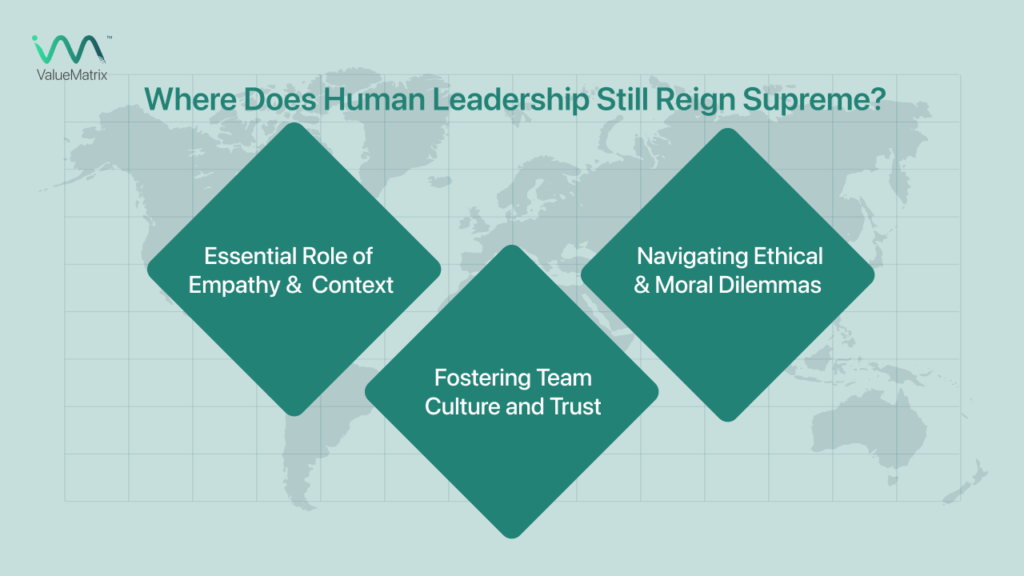
Not when algorithms handle data, but when it comes to the soul of the organization-the culture, values, and trust-it is the duty of humans to manage. These are decisions where empathy, moral judgment, and personal context are considered a few of the non-negotiables under human leadership; you cannot outsource these to any machine.
Among these leaders reside the wisdom and ethical framework responsible for the validation and guidance of AI with respect to data. The data can reveal what is occurring, but the human leader can authoritatively sustain axiology with respect to that.
The Essential Role of Empathy and Context
AI may give a red flag about something like low-performing, but it takes real human leadership to come in and talk to the team, understand that they have issues with leadership, and provide the support and coaching they need to get them into the right alignment.
Navigating Ethical and Moral Dilemmas
When an AI justifies the closure of a site purely on profit, the human leader will weigh the ethical concern regarding the consequences of such closure to employees who have served the company loyally and the community. One thing is for certain: Such an AI will not have a moral compass.
Fostering Team Culture and Trust
It really is about personal engagement, mutual vision, and mentoring that builds culture. Your leaders must certainly be the ones to motivate and mediate personal clashes and to establish the trust in which a high-performing organization operates.
This gives meaning to human leadership-the value and culture around which your organization revolves. By reserving these critical areas for human judgment, you ensure your business remains purpose-driven and trusted.
AI vs Human Decision Making: The Bias Battle
Bias issues usually dominate discussions of AI versus human decision-making and more often become the central point of the conversation. AI promises to take out human bias, which AI sort of manages concerning unconscious biases, such as preferring a candidate from a particular school. AI learns through historical data, and if such data was biased against an organization’s history of inequities in hiring, then the AI just ends up automating and amplifying that bias.
As CHROs and CEOs, you should understand that AI replicates your past decisions; the critical human role is actively auditing AI for bias and correcting it continuously to create fair outcomes genuinely.
How Algorithms Can Inherit Human Bias
If a hiring AI is trained on data where 90% of past successful engineers were male, it might unconsciously penalize female applicants, even if they are equally qualified. This is a risk that human leaders must manage.
The Human Power to Audit and Correct
You must require regular testing of the results produced by the AI by your human resources and information technology teams to check for systemic bias. Where results are not welcome, it becomes the non-negotiable duty of the human team to intervene, investigate the data inputs, and restructure the algorithm for fairness.
Achieving Fairer Outcomes Together
The most successful model is one where AI flags potential bias, and a human team then applies judgment and company values to fix it. This partnership ensures both objective data and ethical practice are achieved.
Mitigating algorithmic bias is a core ethical and legal responsibility for executive leadership, demanding ongoing audit and corrective action from your human teams.
The Core Challenge: Lack of Human Touch
Relying too heavily on AI decision-making in HR has put a critical risk to the human resource management capability, and that is of alienation. When an employee receives news of changes to his or her career, salary, or performance from a faceless machine, it feels like that employee has been devalued, processed, and, in many cases, has lost faith in the company. At the end, there is a loss of loyalty from the employees when you only have the machine dishing out decisions.
An AI should be appointed to handle data and everyday tasks, while humans will be responsible for interacting personally and handling high-stakes conversations. That technology should the betterment of human relationships, and not the replacement of them.
The Value of Personalization in Human Resource Management
Employees are often confronted with multifaceted issues such as medical conditions of a family member or conflict. In this case, an employee needs that human employee in HR who listens and offers individualised assistance- a service that cannot be emulated by AI.
When Decisions Need Emotional Intelligence
Not all numbers merit the issues when talking about the progress, difficult feedback, or team reorganizations. It is such conditions that otherwise indicate emotional intelligence in managing morale from the whole team and the sensitivities of each individual’s qualities of human leadership.
Building Trust in a Machine-Driven World
One of the many factors that builds trust is transparency. On the other hand, human leaders in your organization should be able to explain to employees why AI made such a recommendation and vouch for the fairness of the process. Hiding behind the algorithm is the fastest way to destroy employee trust.
In every aspect of competition, the human element is something that has to be safeguarded because it enables your highly efficient AI processes not to destroy the culture and engagement that propel your business ahead by accident.
AI in Organizational Leadership: Redefining the Manager’s Role
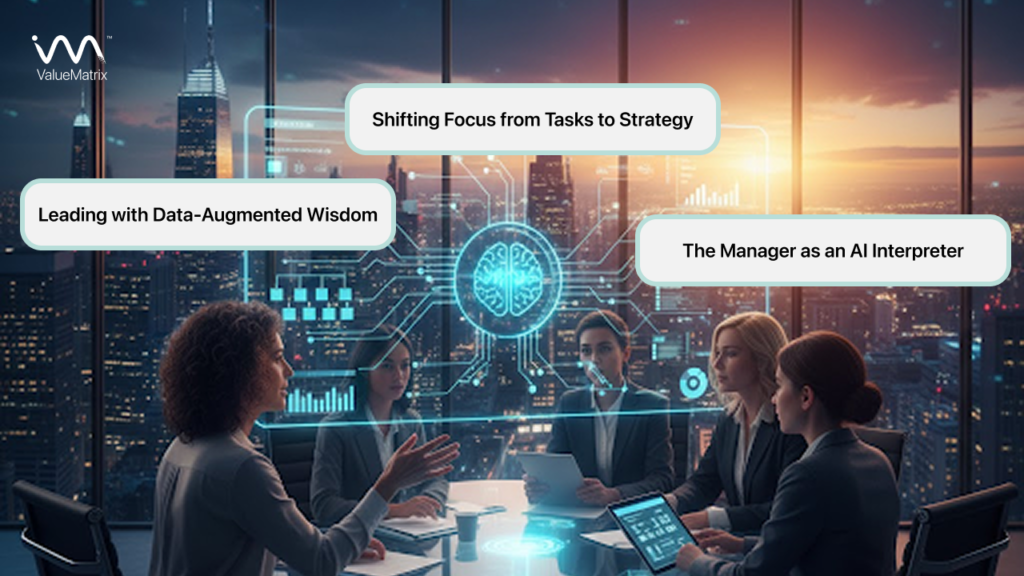
Probably the highest opportunity brought about by AI in organisational leadership really is to elevate the quality of managers. When AI takes care of low-level monitoring and reporting, the more high-value functions of managers evolve into coaching, strategic thinking, and the development of people.
Your managers need to change from reacting to issues to proactively interpreting insights and charting long-term direction. This requires investment in AI literacy and strategic thinking skills. The future manager is therefore human plus machine.
Shifting Focus from Tasks to Strategy
Tasks that managers used to have to spend time chasing metrics on or scheduling reviews are now under the responsibility of AI. This allows managers to focus on what is really high-value work: developing future leaders, improving customer relationships, and driving innovation.
The Manager as an AI Interpreter
This sales methodology has a conversion rate that is lower than 15%. The manager must learn that information and communicate it clearly to the sales team within the purview of actionable coaching.
Leading with Data-Augmented Wisdom
Data is the reality provided by AI. Wisdom is the combination of the human leader’s context and experience. What these two will put together will entail far better decisions than either could achieve by themselves.
Allowed to have power over the process with an AI system, the managers energise themselves into managing the people, creating emancipated possibilities of the true strategic leader.
The Future Model: Human-AI Augmentation
The focus should not be on the battle between AI vs human decision-making; rather, Human-AI Augmentation. Doing what machines do best-scaling, data processing, and fast calculations- while the humans apply those things least, the big three of ethics, empathy, and strategy. This model hardly obviates the worker; it instead augments your workers and makes them smart, fast, and strategic.
Executive strategy must thus be about designing those seamless workflows where data flows effortlessly from AI to human for ultimate judgment and then back in ensuring the smoothest process integrity beyond reproach.
The Goal: Not Replacement, But Partnership
AI doesn’t eliminate the worker; it elevates him/her. The blending of human intelligence with machine-powered assistance is the essence of success.
Designing Seamless Human-AI Workflows
This will be clear, well-defined hand-offs that are integrated and deliberate, where AI performs a first screening of the best 10 percent of its candidates, then hands over to the human recruiter for interviewing, culture-fit evaluation, and negotiation of the offer.
New Skills for the AI-Powered Leader
AI literacy must become a part of your leaders’29’ understanding tools and question data; they must put even greater emphasis on emotional intelligence, the one skill the machine will never learn.
Augmentation is the strategy that gives you the best of both worlds: the efficiency of technology and the wisdom of human experience.
Ethical Imperatives: The Leader’s Final Responsibility
Fairness, privacy, and transparency stand as the trinity that, for good or ill, rests with you as the final arbiter of ethical governance. With increased AI usage in HR decision making, you too become evermore responsible for ethical governance. Turning your head away from ethical implications may not just be an act of immoral choice; it exposes your firm to considerable legal and reputational jeopardy.
Your leadership must construct a framework clearly defining when AI can use employee data, ensuring human intervention in all high-stakes decisions. Therefore, trust would form the backbone of an AI culture.
Ensuring Transparency and Explainability (XAI)
Should your employees know how an AI determines their hiring or earning potential? Well, if yes, we should XAI embrace and must stipulate simple and clear explanations for all significant outputs on algorithmic decisions.
Protecting Employee Privacy and Data
The policies need to elaborate on what employee data AI can access and how it goes ahead to ensure protection. There should never be a feeling of AI being some sort of invasive surveillance system. Protecting the privacy of employee data is non-negotiable.
Establishing Clear Human Oversight Rules
Any high-impact decisions like firing or promotion must go through a human leader based on the AI recommendation. This puts a check on uncontrolled AI decision-making, causing damage that cannot be undone.
The executive owns the highest level of ethical responsibility. In thus raising the bar for AI intervention, she paves the road for a sustainable, trusted, and future-ready structure.
Conclusion: The Smart Path Forward
So, the leadership shall not be encased by any of the two large options, algorithms or people, It shall be curbed as a blend of the two. This, of course, is the obligatory strategic mandate. There remains no expectation of success, as far as human leadership is concerned. In those domains of culture, empathy, and ethics without the unified strength and objectivity supplied through AI decision-making in HR. Those who lead such integration will not only create efficiencies in their organizations, but they will also build the trustworthy, data-augmented organizations that will thrive well beyond the next ten years.
Statistics: The Hard Facts of AI in HR
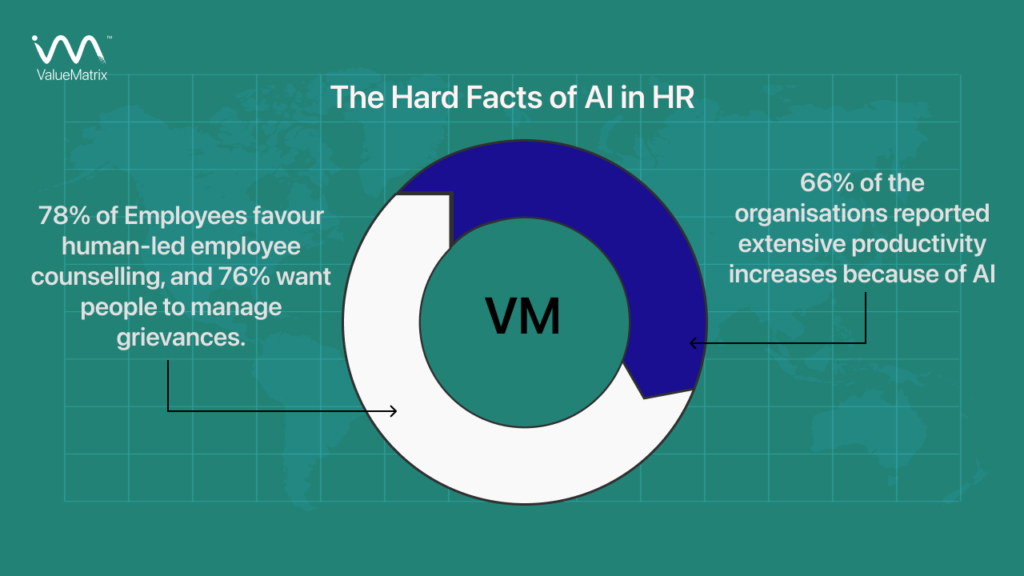
- AI for Productivity: Around 66% of the organisations reported extensive productivity increases because of AI, primarily in the areas of operational efficiency and decision-making.
- The Human Preference: Nonetheless, most employees prefer the involvement of humans in sensitive matters even when AI is efficient, since 78% of them favour human-led employee counselling and 76% want people to manage grievances.
Case Studies: Real-World AI-Human Balance
1: Unilever’s AI-Powered Recruitment
- Company Challenge: The global consumer goods company Unilever needed to modernize its four-month-long recruitment process, which was handling over 1.8 million applications every year.
- The Fix: Unilever adopted an AI system for preliminary screening and used gamified assessments for an objective measurement of candidates’ skills and fit. The final selection step consisted of a human-judged video interview.
- The Result: The time to hire went down from four months to two weeks on average. This saved a lot of time, and the AI screening process turned out to have less bias than the traditional resume review process, with the final hire done via human judgment.
- Source URL:https://www.aihr.com/leading-hr/ai-in-talent-management/
2: IBM’s Watson for Career Coaching
- Company Challenge: IBM had to give personalized career development and upskilling advice to its huge global employee base without overworking human managers.
- The Fix: Therefore, IBM has launched Watson Career Coach- an AI tool that would analyze an employee’s skill set, job history, and preferences against future skill requirements the company may have. The AI then recommends personalized learning courses and possible job moves to alternative internal positions.
- The Result: The AI recommended objective and data-driven career paths, which human managers then used as the starting point for some strategic coaching. This approach further empowers human managers in mentoring and guiding their teams.
- Source URL:https://www.aihr.com/leading-hr/ai-in-talent-management/
FAQs
Algorithmic bias is what the training data enforces upon the AI when it learns and perpetuates unreasonable past human behaviour. This puts the leaders at stake because of the legal risk and loss of employee trust via unfair data-driven decisions.
No, AI takes over all repetitive tasks, but human leadership sets strategy, culture, conflict resolution, and empathy-the basic human functions of a business.
It is the principal possibility where the human leader takes the last decision, but this decision drastically improves due to a manifold amount of data, insights, and predictions coming from the AI system. It thus creates human intelligence sharper because of the machine.
The use of AI in analyzing employee data reveals which employees are close to leaving. Thus serving as an early warning system for managers, further making preventive control through coaching, support, or incentives against costly turnover easier for them.
AI fluency, augmented with emotional intelligence, is perhaps the most critical factor for effective modern leadership.
About Us
ValueMatrix is an AI-powered talent intelligence platform that helps companies hire better, faster, and without bias. We go beyond resumes to assess skills, behavioral traits, and cultural fit using advanced AI and proven psychological frameworks. Our platform delivers data-driven insights that improve hiring accuracy, reduce time-to-hire, and elevate candidate quality.
ValueMatrix AI enables hiring teams to make confident hiring decisions and build high-performing teams at scale.