

Key Takeaways
- An AI talent management strategy combines talent management practices with AI technologies.
- AI helps improve hiring efficiency, employee experience, and workforce planning.
- Unlike traditional systems, AI-driven strategies are based on real-time data and predictive analytics.
- Building an AI-based system requires a systematic approach suited to your requirements.
- ValueMatrix supports organizations in implementing robust and unbiased AI talent systems.
Table of Content
- What Is An AI-Driven Talent Management Strategy?
- How Is AI-driven Talent Management Strategy Different From A Traditional Approach?
- Why Do Organizations Need AI in Talent Management?
- What Is the Role Of AI In Talent Management Strategy?
- How to Build an AI-Driven Talent Management Strategy?
- What Are The Best Practices In AI Implementation?
- What Are Some Real-World Use Cases Of AI In Talent Management Strategy?
- FAQs
Talent management strategy is a long-term plan to hire, engage, and retain talent. Organizations have followed a traditional approach for years, but now it’s time to adopt an AI-driven talent management strategy. But are the companies adapting to the AI approach? According to Deloitte’s 2026 Gen Z and Millennial Survey, one-third of the Millennial (31%) and Gen Z (30%) workforce feel that their organizations are slower than they are in adapting to AI across operations. The systems, training, and tools are lagging in providing employees with the necessary AI support, the survey has found. This post tells you why it’s time for organizations to integrate their talent management with AI and how they can implement it for maximum benefits.
What Is An AI-Driven Talent Management Strategy?
An AI-driven talent management strategy (TMS) combines talent management practices with AI technologies. It enables skill-based planning to align workforce capabilities with business objectives. AI capabilities such as machine learning, automation, and predictive intelligence transform a reactive talent management system into a predictive strategy.
AI-based TMS involves skill gap forecasting and intelligent recruitment; employee engagement with personalized learning, upskilling, and career development; continuous performance management and real-time feedback; talent analytics and data-driven decision-making; and
HR automation, operational efficiency, and AI governance. These features are explained in detail further in this post.
How Is AI-driven Talent Management Strategy Different From A Traditional Approach?
Unlike traditional TMS methods, AI-driven strategies are based on predictive analytics, personalization, and continuous adaptation to dynamic requirements. The following table summarizes the fundamental differences between traditional and AI approaches to TMS.
| Traditional Talent Management Strategy | AI-driven Talent Management Strategy |
| Largely dependent on human intuition. The decisions are reactive and based on historical data and managerial experience. | Predictive analytics, real-time data, and machine learning enable evidence-based decision making. |
| The approaches are usually short-term to fulfill immediate workforce needs. | Focuses on long-term workforce readiness through skill requirements and talent gap forecasts. |
| The recruitment process is mainly manual, with human-led screening and evaluation. | Automates candidate sourcing, screening, and shortlisting, improving speed and efficiency. |
| Learning and development are standardized and implemented uniformly across employees. | Learning and development are personalized based on individual career goals, experience, and skill gaps. |
| Performance management is conducted through annual or periodic reviews, based on static reports. | Performance management is a continuous process with real-time feedback and productivity insights. |
| HR tasks require manual effort and time. Workforce planning is relatively static. | Automation of repetitive HR functions allows teams to focus on human-centric tasks. |
| Static and less adaptable to market dynamics and business changes. | An agile and adaptive approach enables organizations to respond to changing demands. |
Why Do Organizations Need AI In Talent Management?
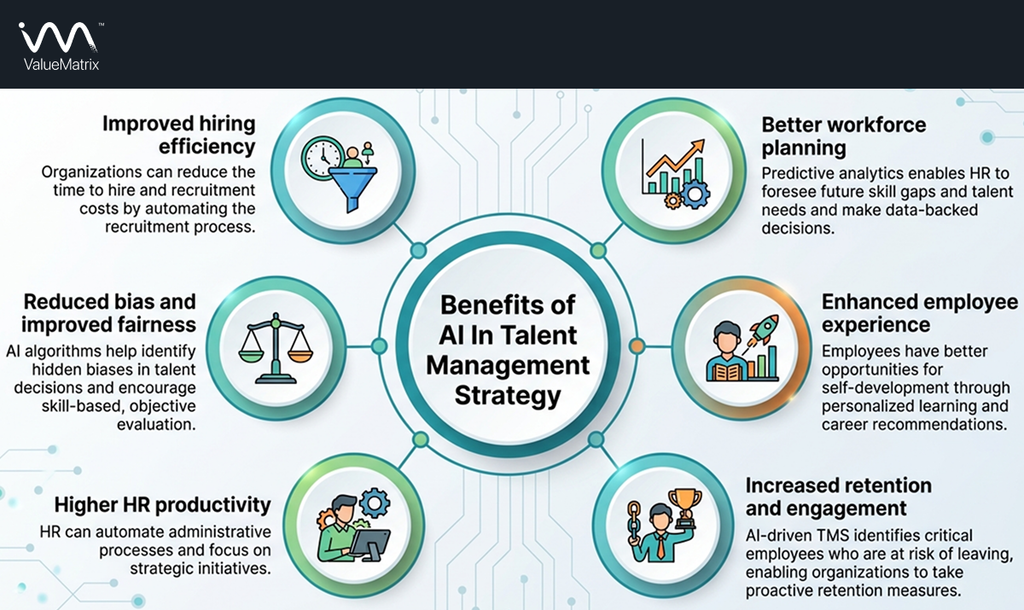
Organizations need data-driven insights to make competitive decisions. AI makes talent management more efficient and accurate by providing HR with historical and real-time employee data. Here are the various ways organizations can benefit.
Improved hiring efficiency
Organizations can automate a major part of the recruitment process, including parsing resumes, screening and shortlisting candidates, and scheduling interviews. This reduces time-to-hire cycles and recruitment costs. Moreover, AI uses uniform criteria to screen all the resumes, thereby enhancing the candidate-job matching accuracy.
Better workforce planning
Predictive analytics enables HR to foresee future skill gaps and talent needs and make data-backed decisions. Succession planning can be more accurate with AI-driven learning and development.
Enhanced employee experience
Employees have improved opportunities for self-development through personalized learning and career recommendations. Real-time feedback enables them to improve their skills to reach goals. Even at the recruitment stage, candidates can look forward to prompt AI updates on the status of their applications.
Increased retention and engagement
AI-driven TMS focuses on enhanced workforce engagement and retention. It identifies critical employees who are at risk of leaving, enabling organizations to take proactive retention measures. It also keeps employees engaged through personalized skill development programs.
Continuous learning and upskilling
Organizations can nurture a culture of continuous learning through AI. The tools recommend relevant training based on skills and goals. Organizations can quickly reskill their employees to meet dynamic business needs.
Higher HR productivity
HR can automate repetitive tasks and administrative processes. It reduces their manual workload, allowing them to focus on strategic initiatives.
Reduced bias and improved fairness
AI algorithms standardize recruitment and evaluation processes, implemented uniformly across employees, irrespective of their personal background. It helps identify hidden biases in talent decisions and encourages skill-based, objective evaluation.
What Is the Role Of AI In Talent Management Strategy?
As workforce expectations evolve, the role of AI is increasingly expanding to various HR functions in organizations. It now extends to the entire employee lifecycle, from recruitment to learning & development and succession planning. Let’s see how organizations can implement AI in various HR functions.
Recruitment and candidate relationship
AI tools are being used to screen applications and shortlist the relevant ones without human intervention. They filter resumes through semantic job matches, match candidates’ past experiences with the job description, and evaluate the quality of accomplishments. They also communicate with candidates to gather initial information and schedule interviews.
Learning and development
The 2026 Deloitte survey found that 79% of Gen Z and Millennial employees use AI to identify learning and development opportunities. AI designs individual learning paths based on skill gaps, learning patterns, and career aspirations of employees. It helps them gain the skills necessary for their future development. AI also provides managers with visibility into individual skills and their capabilities.
Career pathing and internal mobility
According to the Deloitte survey, the Millennial and Gen Z populations are also using AI for career advice and to cope with work stress. AI systems use machine learning, natural language processing, and predictive analytics to evaluate employee performance. Data-driven analytics enable continuous tracking of performance on parameters such as productivity, project success, communication, collaboration, and skill development. Algorithms analyze data in real time to flag performance gaps, enabling employees to work on them.
Compensation and rewards management
AI supports a performance-based rewards strategy by providing insights into individual contributions to the project. It identifies compensation gaps and inequities by analyzing compensation trends. This ensures fairness and transparency in rewards and recognition systems.
Succession planning
Business expansion and employee succession, especially at the leadership level, can get smoother with AI. It facilitates real-time feedback and immersive practice environments to enhance leadership development experiences. Personalization helps executives identify their strengths while working on their skill gaps. Predictive analytics equips them with real-time feedback on training.
Strategic workforce agility
Tony Guadagni, director, Research in the Gartner HR practice, says, “As new jobs are created, one in five employees will need to be redeployed by 2030. Organizations must leverage their recruiting teams to be more proactive in getting employees with critical skills and capabilities into the right roles.” He observes that recruiters must proactively focus on internal mobility, and to do that, they need ‘up-to-date’ data on employees’ skills to fit them in the right place.
AI supports recruiting teams with historical and real-time employee data, enabling organizations to restructure their workforce. AI helps build agile teams with better adaptability to changing business needs.
How To Build An AI-Driven Talent Management Strategy?
Building an AI-driven TMS needs a systematic approach. Organizations must assess if their current systems are built to integrate AI technologies. They must convince HR teams and employees to embrace the transformation and train them in the necessary skills. But before all this, companies should define the objectives of AI integration.
Define business and workforce objectives
Plan long-term. Align workforce requirements with organizational goals and identify the challenges and gaps. Prioritize strategic talent needs over short-term fixes. Determine measurable outcomes, standards, and metrics.
Assess current talent management processes
An audit of the organization’s existing HR systems and workflows helps identify challenges and bottlenecks. It also provides visibility into manual processes that can be automated using AI. Analyze the quality of the current workforce data, as the quality of AI results depends on that of the datasets.
Build a strong data foundation
Centralize workforce data across the organization. Ensure the data is accurate, unbiased, and consistent. Update the database with the latest information. According to the 2025 McKinsey report, ‘Superagency in the workplace: Empowering people to unlock AI’s full potential’, a major concern among employees (43%) about AI implementation is their personal privacy. Establish a framework for data security and privacy, and reframe the data governance policy to cover AI usage.
Identify high-impact AI use cases
Prioritize the areas where AI will bring about measurable improvements in talent management. Recruitment, workforce planning, learning, and retention are a few such areas to begin with. While you start with scalable, business-critical areas, do not settle for quick wins; the focus should be on the long term.
Choose the right AI technologies
Evaluate various platforms and compare them with your AI requirements. In addition to being compatible with the existing HR systems, the platform should be scalable. Research about the vendor’s reliability, support, and security standards. ValueMatrix’s AI platform meets these requirements and more. It is customizable to your organization’s needs, while its predictive analytics equip you with insights to make informed decisions.
Integrate AI into talent processes
Embed AI into the HR tasks that you want to automate, such as resume screening, performance management, and succession planning. Begin by automating low-end and repetitive tasks before moving to roles that have a major impact on employees. Focus on the user interface, as employees are more likely to accept the changes if the technology is accessible and easy to use.
Train HR teams and managers
Build organizational trust in the AI systems by conducting training sessions across the hierarchy. Begin by training the HR and management teams and help them see the benefits of a data-driven workforce management system. Make sure the knowledge percolates to the junior-level workforce for better acceptability.
What Are The Best Practices In AI Implementation?
The success of AI implementation depends on technological adoption and workforce acceptance. Technological adoption is possible through good data quality, an agile AI platform, and integration of the tools into the existing HR system. Workforce acceptance can be achieved through a governance policy that ensures data privacy and promises transparency.
Ethical AI governance is the backbone of the system
According to the McKinsey survey, only 39% of C-suite leaders use third-party benchmarks to evaluate their AI systems, with ethical metrics even further down their priority list. But this perspective needs to change. An AI governance policy is necessary to reduce legal and reputational risks and also to build trust among the workforce. Establish policies that reflect fairness and accountability in workforce decisions. Ensure regular audits of AI models to keep them free of bias and discrimination that could impact hiring decisions and performance evaluations. As AI systems involve the collection of large amounts of data, organizations must adhere to data privacy regulations.
Prioritize employee trust and transparency
Employees are likely to be sceptical about AI transformation, and they expect reassurances from their organization. Companies must communicate in multiple ways about how the transformation can benefit the workforce.
Swagatam Basu, senior director analyst in the Gartner HR practice, says, “Employees with a positive outlook toward AI are 3.4 times more likely to be highly productive. The most effective drivers of positive AI adoption are employee confidence in their current and future roles, and transparent, ongoing communication about how AI will be used and its impact on jobs.”
Balance automation with human judgment
AI tools support managers and HR with data insights and analytics, but they cannot replace human decision-making. Human involvement is necessary in hiring, performance evaluation, and promotions. Teams should avoid the temptation to rely excessively on automated systems but combine AI insights with contextual and emotional intelligence.
Continuously monitor and optimize AI systems
Regularly track AI performance metrics to understand the business impact of the systems. The models must be agile enough to adapt to the changing needs of the workforce. Also, organizations must promptly close any loopholes that surface during periodic audits to ensure their systems operate within the parameters of the governance policy.
What Are Some Real-World Use Cases Of AI In Talent Management Strategy?
IBM: AI integration with the virtual agent
The existing HR system: IBM introduced its internal virtual agent, AskHR, in 2016 to automate several HR tasks. In six years, it could automate 80 HR functions and handle over two million employee queries annually.
The need for upgrade: The organization planned to move to a ‘unified, intelligent’ system with a personalized approach towards employees. It wanted a system that would streamline workflows, provide instant and accurate support, and free the HR team to shift to higher-value tasks.
The integration of agentic and gen AI: In 2025, IBM integrated its Watsonx Orchestrate to enhance AskHR’s AI capabilities. The integration resulted in a two-tier support model with AI answering routine queries about leaves, pay slips, etc., and human HR handling more complex matters.
The result: IBM says, AskHR has evolved from a virtual agent to a ‘fully functional digital agent’. Large language models (LLMs) enable the agent to dissect the employee prompt and route it to the relevant HR domain (payslips, benefits, leaves) and provide an AI-generated response.
AI integration has also made it easier for managers to transfer employees and prepare organizational structures, with 99% managers adopting AskHR.
Siemens: An example of successful AI integration
The objective: Siemens had multiple objectives spread across various HR tasks. It wanted an AI system to:
- Analyze resumes, match candidates, and reduce hiring bias.
- Reduce HR’s workload while enhancing employee experience in answering routine HR queries.
- Mitigate employee turnover and role mismatch while improving engagement.
The solution: The company adopted human capital management software enhanced with AI to automate various stages of recruitment. A chatbot was deployed to answer employees’ routine HR queries. Siemens started utilizing predictive analytics to identify employee turnover patterns.
The RoI: Siemens witnessed a 30% reduction in time-to-hire and an 18% increase in candidate diversity. AI-generated risk scores and personalized interventions reduced voluntary employee turnover by 12%.
AI makes talent management more structured and data-driven. It enables organizations to make informed decisions at various stages of the employee lifecycle, right from recruitment and training to career development, engagement, retention, and succession planning. However, these benefits can be reaped if the objectives are clear and implementation is well-planned. A transparent AI policy will build trust among the stakeholders, leading to a smooth integration.
FAQs
- How does AI improve talent management?
AI improves talent management by automating repetitive HR tasks, providing data-driven insights, and predictive analytics to make more informed decisions. Its real-time inputs enable organizations to take quicker actions.
- What are the key components of an AI-driven talent management strategy?
Organizations can utilize AI in various talent-related tasks, including recruitment, learning and development, succession planning, performance evaluations, and employee engagement.
- What challenges do organizations face when implementing AI in talent management?
Organizations may face employee resistance due to a lack of trust and fears over data privacy. Moreover, poor data quality and historical bias can negatively influence the AI results and mislead the stakeholders. Legal compliance is one more important factor for organizations to address when implementing AI.
- What role does AI play in recruitment?
AI tools automate basic tasks such as resume screening and shortlisting. They also support the hiring team with skill matching, interview scheduling, and candidate analysis to speed up the hiring process.
- Can AI help reduce employee attrition?
AI can help companies reduce attrition through employee engagement and predictive analysis. It can design personalized learning and development programs based on individual career goals, helping employees grow within the company. Moreover, predictive analytics identify high-risk employees based on their performance data and engagement patterns, enabling companies to take preventive measures.
- What are the benefits of AI in employee learning and development?
AI supports employees with skill gap analysis and personalized learning recommendations. Based on the changing business needs and personal career goals, it guides them in continuous upskilling.
- How does AI support workforce planning?
AI helps in predicting future hiring needs by analyzing workforce trends. It enables organizations to create data-driven workforce strategies.
- How can organizations ensure ethical implementation of AI in TMS?
Organizations can ensure ethical implementation of AI by establishing a comprehensive governance policy and continuous monitoring and course correction. They must maintain transparency, protect employee privacy, and involve human oversight.
- What type of companies benefit from AI-driven TMS?
Companies with a huge employee base and large-scale hiring needs can benefit from AI systems. Organizations with skill-intensive workforces, such as technology, retail, healthcare, and manufacturing, can see significant benefits.
- What is predictive analytics in talent management?
Predictive analytics uses historical and real-time workforce data to forecast employee attrition, workforce needs, future skill gap analysis, and technological advancements.