
Table of Contents
- Executive Summary
- Introduction: Addressing AI Recruitment Bias
- The AI Advantage in HR: Eliminating Bias in Hiring with AI 🤖
- What AI and Cognitive Assessments Measure 🧠
- Role of Valuemetrix in Transforming Cognitive Skill Assessments ✨
- Benefits Delivered by Valuemetrix’s AI-Driven Assessments ✅
- What is the importance of good data? 📊
- What are the real gains in the real world and business impact? 📈
- Case Study 1: How did a tech company discover a smart new way for recruiting? 💻
- Case Study 2: How did a financial firm change perceptions of diversity? 💰
- How AI and Human Expertise Complement Each Other 🤝
- How does a better experience lead to a better brand: The candidate journey? ✨
- What is the cost of non-adoption of AI? 📉
- What are the ethical considerations and the rules of the road? ⚖️
- What is the future of AI in recruitment? 🔮
- What is the role of leadership in championing the change? 👑
- How can we measure success: Key metrics for AI in hiring? ✅
- What is the impact and regulatory landscape? 🏛️
- How can we adopt AI in a step-by-step manner? 👣
- Conclusion: A Call for AI Hiring Bias Reduction 📢
- FAQs ❓
Summary
Hiring can be arduous due to hidden biases, which may limit a company’s ability to find top talent and hinder the development of new ideas.
This article elucidates a smart way to fix this problem: to use AI-powered tools to counteract and mitigate AI-recruitment bias. Platforms such as Valuematrix.ai enable organizations to make evidence- and data-based hiring decisions rather than emotion-based ones. This translates into actual wins, such as hiring people fast, spotting better employees, and building more diverse teams.
The future of talent acquisition partners human skill with smart technology, which ensures that the hiring process is fair, fast, and highly effective.
Introduction: Addressing AI Recruitment Bias
Bias in hiring has historically been a significant challenge for businesses, often leading to homogenized teams that struggle to recognize great talent and novel ideas. These hidden biases, which serve as mental shortcuts, often favor individuals who are similar to us. For leaders, combating unconscious bias in recruitment is not just the right thing to do—it’s a critical business imperative. In today’s competitive landscape, failing to attract talent from all backgrounds is a major business risk. The key to solving this is by using technology that nips AI recruitment bias in the bud.
The AI Advantage in HR: Eliminating Bias in Hiring with AI 🤖
Hiring with smart software goes far beyond a simple technological upgrade; it’s a strategic business move. AI tools introduce an unprecedented level of equality and analytical scrutiny into the hiring process, which gut feelings have traditionally driven. By analyzing a vast number of factors related to a person’s skills and potential, AI ensures that the best person for the job is chosen, irrespective of personal likeness.
Fact-Based Decisions: AI systems search for information that a person would not detect, such as problem-solving styles; thus, removing the need to rely on gut feelings but giving a clear, measurable reason for every hire.
Faster and Scalable: AI systems can scan thousands of job applications in just minutes for the big players in the market. Consequently, the human resources division can spend its precious time on more important jobs like connecting with candidates for the final decision. It has been researched that these tools can cut the time for closure of a hire by almost 50%.
What AI and Cognitive Assessments Measure 🧠
Present-day AI assessments are not limited by old jobs; they are purely ability-measured. The shift from what they have done to what they can do is paramount in fostering teams fit for the future. These tools measure key skills that predict the success of these individuals in the long run:
Problem-Solving Skills: They measure how naturally a candidate thinks logically and resolves new and unusual problems. This is a valuable skill for coping with today’s business challenges, which often require flexibility.
Learning Ability: Since assessments can change based on answers, they help to assess the speed at which the candidate can learn and adapt. This is one of the main indicators of someone who would do well in a dynamic world.
Behavioral Insights: AI will refine your understanding of how a candidate makes decisions and collaborates, revealing information that can be helpful regarding teamwork, leadership, and pressure handling.
Role of Valuemetrix in Transforming Cognitive Skill Assessments ✨
Valuematrix.ai is a pioneer in this area for a reason. It is a fully-fledged AI platform designed to provide organizations with a comprehensive view of candidates, extending beyond mere skill tests, which forms the basis for an unbiased and fair review.
- Comprehensive Candidate Profiling: The platform integrates multiple sources of information, combining resume analysis with behavioral insights and cognitive assessments. It also extends its analysis to subtle, technical indicators to build a rich and complete profile that goes well beyond a typical candidate’s resume.
- Advanced Behavioral Analytics: Valuematrix.ai uses cutting-edge analytics to understand a candidate’s behavioral traits, helping recruiters find the perfect fit for a role and a team.
- Fun and Games: The game-based assessments of Valuematrix.ai largely work toward making the whole hiring journey entertaining and just. The candidates will be less anxious, and the system will obtain pinpoint data regarding their competencies, providing a win-win scenario.
- Person-Job Matching: The platform is rooted in advanced technologies for matching personal attributes of individuals to the requirements of an open position and team, thereby optimally forecasting a good fit in the long run and ultimately driving down the costs of attrition.
Benefits Delivered by Valuemetrix’s AI-Driven Assessments ✅
The value of AI in hiring translates into tangible metrics that matter to business leaders. Companies that implement these advanced tools immediately see a demonstrable effect on their bottom line.
- Dramatic Time Reduction: Automating the initial steps of the hiring process gives companies a significant edge in finding the best candidates before their competitors can, effectively halving the time-to-hire.
- Improved Quality of Hire: When hires are based on a resonance with core competencies, they perform better.This leads to improved work output, increased employee tenure, and a much more robust talent pool for the future.
- Enhanced Candidate Experience: The application process becomes more engaging, efficient, and transparent for applicants, which in turn enhances your organization’s brand image.
- Cost Savings Through Efficiency: A streamlined hiring process results in reduced administrative work and significant cost savings. According to a recent study, organizations using AI tools can expect a 30% cost reduction in their hiring.
What is the importance of good data? 📊
The success of every AI application hinges on the quality of data relevant to that application. This way: bad ingredients make bad cuisine. Ditto with AI. When the data set used to train the AI contains old biases, the AI will be able to internalize these same biases.
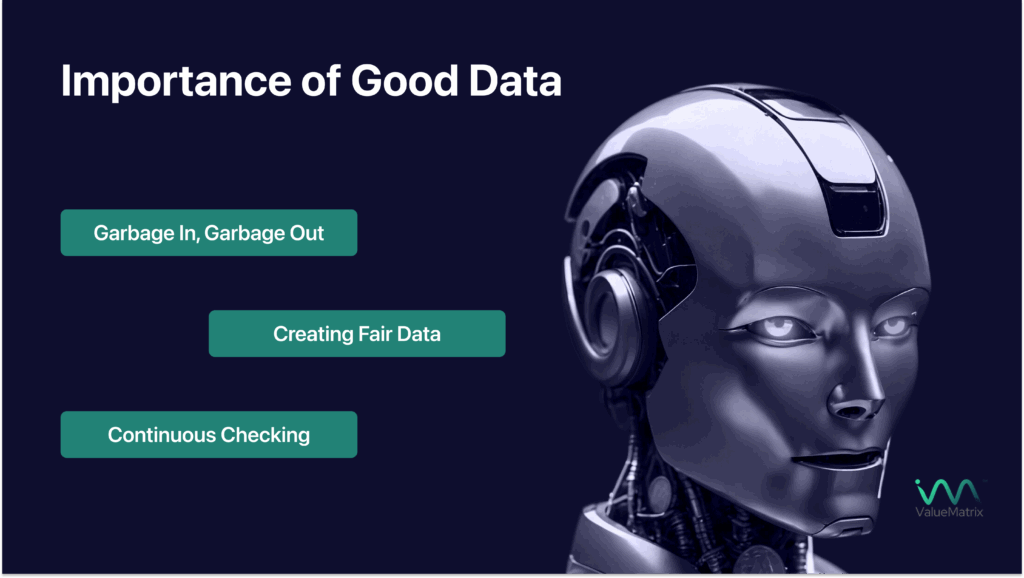
- Garbage In, Garbage Out: This is one of the most well-known sayings in the IT world. In other words, when you give wrong input to AI, you get a false output. Companies should have a diverse, clean dataset at the entry point to eliminate bias.
- Creating Fair Data: This means that you take data from many different cultures and experiences because that is an important step in ensuring fairness for the AI from the very beginning.
- Continuous Checking: Good data or not, AI should be monitored regularly. You must check from time to time the hiring results to ascertain that no new biases have arisen with the use of AI. This is a key activity in the AI approach to minimizing hiring bias.
What are the real gains in the real world and business impact? 📈
The value of hiring from the AI perspective is translated into numbers that matter for business leaders. Companies that implement such advanced tools immediately witness demonstrable effects on their bottom line.
- Lower Hiring Time: Automating the initial steps in hiring provides companies with the upper hand to find the best candidates first before their competitors can halve the time-to-hire.
- Better Quality of Hires: As a result, hires made based on the resonance with core competencies are going to work much better. Such an attitude leads to improved work output, increased tenure, and a far more robust talent pool for the future.
- Lower Cost: The process becomes more streamlined, resulting in reduced administrative work, thus yielding more savings in hiring costs. According to a recent study, organizations engaging in AI tools can expect a 30% cost reduction in their hiring.
Case Study 1: How did a tech company discover a smart new way for recruiting? 💻
Tech Company Discovers Smart New Way for Recruiting. An enormous tech corporation was incurring much cost for leaving employees. The high turnover rate had been due to blunders made in screening applicants using archaic methods. The smart AI platform identified applicants who had a style of thinking and problem-solving skills to be integrated into the required job. This change realized a 40% decline in attrition within the first year and increased productivity within teams by 25%.
Case Study 2: How did a financial firm change perceptions of diversity? 💰
Changing Perceptions of Diversity in a Financial Firm. A major financial services firm set on creating a diverse team found its efforts hampered by hidden biases in hiring. Those resumes and interviews usually contained people who came from certain backgrounds. Therefore, the company began to use an AI tool to hide candidates’ personal information and hire them based solely on skills and traits through game-based testing.
The company now has a greater range of diversity in its hires, whose performances surpass those previously hired through the old methods. A staggering story of how AI reduces hiring bias entails how unbiased evaluations can directly boost and even further organizational diversity goals. New recruitment bias research found thatAI systems are up to 45% fairer to racial minorities than human hiring.
How AI and Human Expertise Complement Each Other 🤝
AI does not replace human judgment; it empowers it. The most forward-thinking companies are establishing a new model where AI handles data and facts, leaving human experts to provide empathy, context, and make final decisions.
- AI as the Foundation: AI provides recruiters with clear insights, enabling them to conduct more meaningful and focused interviews that explore a candidate’s personality and cultural fit.
- Human Insight for Context: The human touch remains crucial for ensuring fairness, interpreting assessment results, and addressing ethical issues that may arise with new technology.
- Transparent Decision-Making: This is a closed loop where feedback on new hires can be fed back into the AI system, making it smarter over time.
- Continuous Improvement: The partnership between AI and human expertise creates a system that is always learning and adapting.
How does a better experience lead to a better brand: The candidate journey? ✨
A candidate’s experience in this highly competitive job market is of utmost importance. AI will play a role to an extent within this, where the overall application process becomes more engaging, efficient, and open to applicants, thereby improving the image of your organization.
- Quicker Applications: AI can already take care of the early stages of recruitment, update applicants within seconds, and perform cutbacks in the time applicants must wait.
- Personalized Aid: Smart chatbots address frequently asked questions and take candidates by the hand to provide a personal and instantaneous experience; recent research showed that 200% more applications can be attributed to AI tools assisting recruiters in personalizing job recommendations.
- Fun Assessments: The fun part isn’t only that game-based and interactive tests are more accurate; there’s also that they’re far more fun for candidates, which leads to lots more people finishing the application, as well as a much better feeling about your company.
What is the cost of non-adoption of AI? 📉
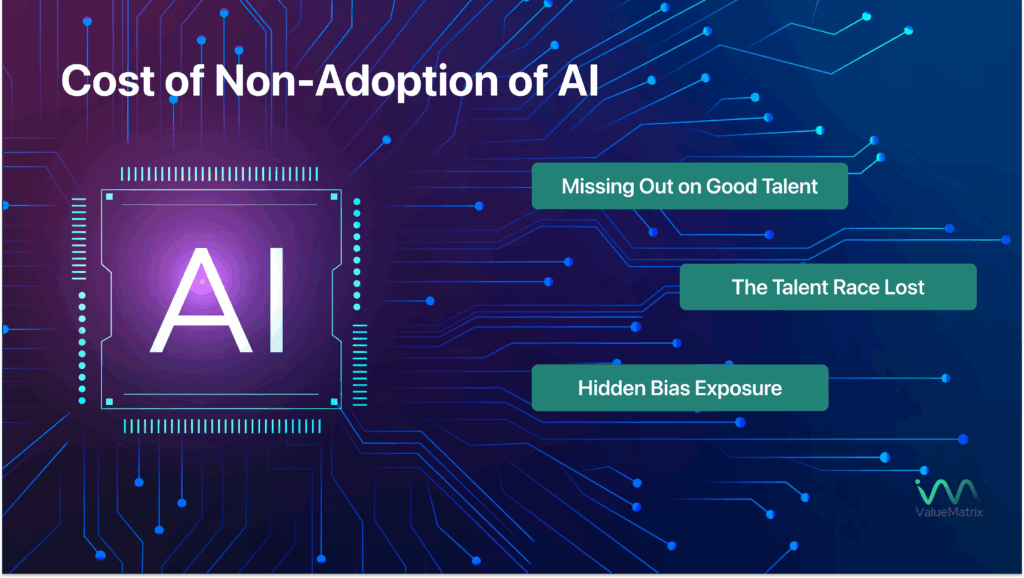
Most of the threats to companies that do not adopt AI as part of their hiring processes are serious. Doing nothing will not get you left in the same place: it will leave you behind.
- Missing Out on Good Talent: The absence of AI means that applicants can only be found and considered manually by recruiters. Thus, those potential candidates who might not have had a typical resume and who might have been very skilled would have never seen the light of your company. Those all will go to your competitors, who are indeed finding these people using AI.
- The Talent Race Lost: While in a fast-moving market, hiring late can result in losing one of the best candidates. AI processes allow for the hiring time to be cut short by weeks, and thus allow you an advantage.
- Hidden Bias Exposure: Without a proper, data-based approach, your company is likely to fall back on its old habits, bringing up legal issues and undermining diversity. This, in turn, damages your company’s name and makes it difficult in the long run to attract talent.
What are the ethical considerations and the rules of the road? ⚖️
In recognition of the fact that AI would play a significant role in HR, it would be imperative that one knows the rules and ethics on the matter. For proactive companies, it should only build confidence and legal conditioning regarding the use of AI.
- Clear Explanations: AI hiring decisions are not to be a “black box.” The tools must be self-explanatory to an HR person as to why the candidates are ranked in order. Openness is equally important because it will protect the organization from claims of bias, some of which have now become legal requirements in specific jurisdictions, such as the EU’s AI Act. A prominent example of the risks is the Amazon hiring algorithm bias, which showed how flawed training data could lead to biased outcomes.
- Data Protection and Privacy: The technique of collecting and utilizing the information should be per international standards, like those of the GDPR. The leaders must ensure that proper data protection policies are instituted for sensitive information protection and instill confidence in job seekers.
- Auditable Processes: AI recruitment systems must be tested on a biased basis. In other words, the software must use a range of different data sets to elicit and correct any unnecessary biased outcomes. Proficiency in these checks familiarizes the users with the term “responsible” or “ethical” AI use.
What is the future of AI in recruitment? 🔮
AI is not only the answer to today’s hiring needs, but it also opens up opportunities for the future talent of an organization. The upsurge of innovation, which is going to spread its wings next, would hover around forecasting and managing talent demands in advance through AI.
- Predictive Analytics: Talent requirements can be predicted by using AI on market trends, business goals, and current employee data to ascertain what skills would be needed within an organization in the next year or within two years. This makes the company very proactive in hiring the requisite skills.
- Conversational AI and Chatbots: These developments will become further advanced, making them much wiser and will handle even more of the early processes of hiring. They don’t just answer queries but guide candidates along personal experiences, really humanizing the experience, even as it automates.
- Internal Mobility: AI will enhance the internal talent discovery for new roles, thus making talent management much simpler, resulting in better retention and having a stronger internal talent pipeline.
What is the role of leadership in championing the change? 👑
Championing the Change. The success of a new technology, such as AI in hiring, is possible through strong hands-on leadership. A budget is a must for executives to lead a company toward this new way of working.
- Set the Vision: The leaders must have a clearer explanation as to why AI is being used. Besides efficiency, this is about building a better, fairer, and more innovative company.
- Lead by Example: When the leaders advocate the new system, the rest of the company falls into place. This must happen with the HR team.
- Encourage Transparency: Leaders must be as open about how the AI works and how it is being checked for bias. This would build confidence among the employees as well as the candidates.
How can we measure success: Key metrics for AI in hiring? ✅
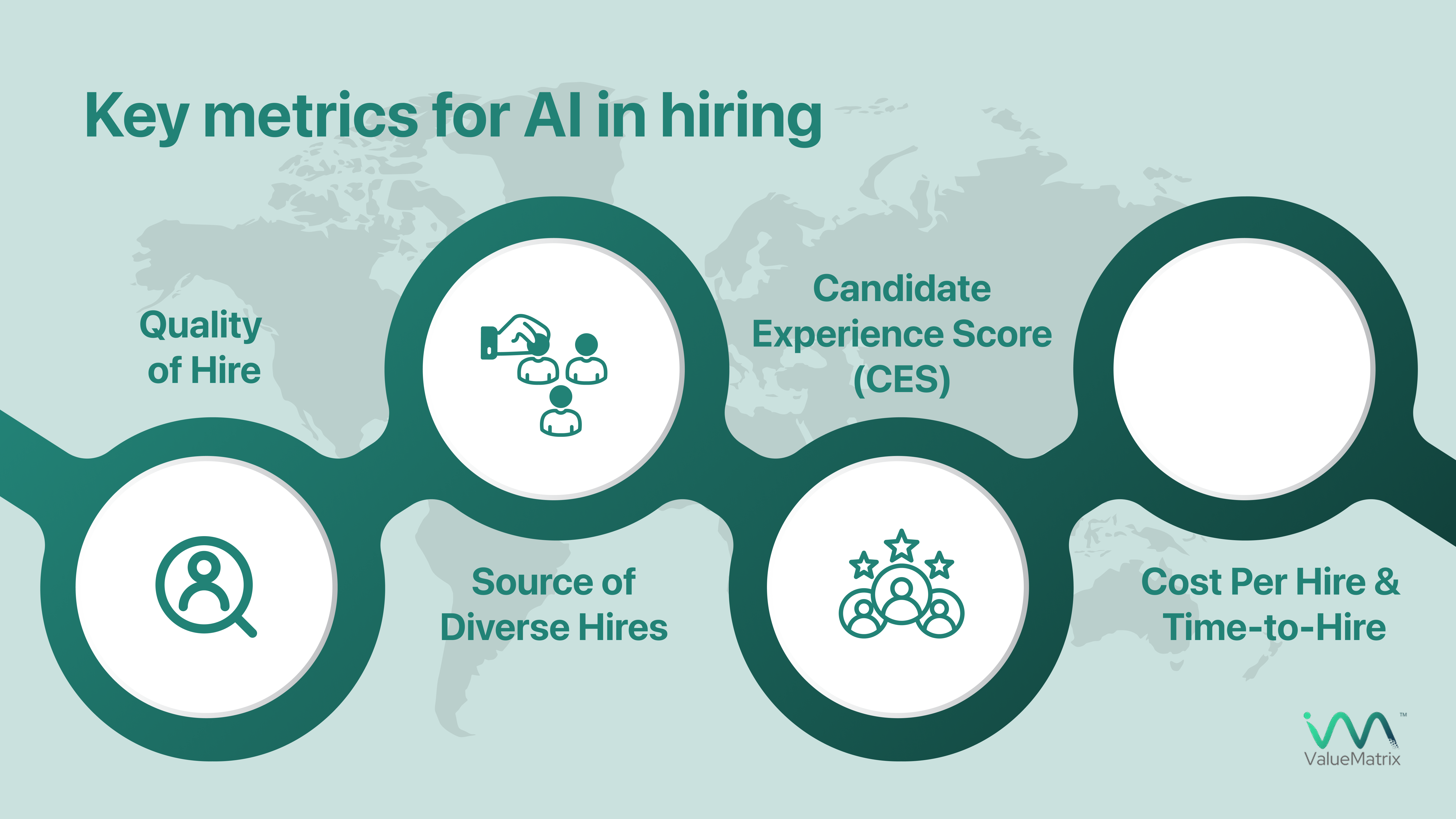
Key Metrics for AI in Hiring Show the value AI creates through identifying the right numbers, not only in terms of cost savings, but also those that measure effects on the long-term health of the company.
- Quality of Hire: It is the most critical metric. It can be measured through performance reviews of new hires and the level of enjoyment and retention within the company.
- Source of Diverse Hires: Identify and follow the channels that most brought about diverse candidates. This would increase with the help of AI over the years.
- Candidate Experience Score (CES): Surveys can be used to see how candidates feel about the new AI process. A good score shows that the technology is making the experience better, not worse.
- Cost Per Hire; Time-to-Hire: The most important but not only metrics; these are still relevant to showing the efficiency associated with the new process. Reduced cost and time to hire illustrate ROI clearly.
What is the impact and regulatory landscape? 🏛️
AI being in vogue for recruitment: different countries are pursuing their laws and regulations. It is extremely critical for the global players to be kept abreast with these regulations.
EU-Focused AI Act One of the most important Acts for the world, it specifically lays down rules for AI, with a serious focus on bias and transparency. All organizations must ensure that the AI used for hiring in the EU is explainable and unbiased.
US State-Level Laws In the US states where legislation has begun on AI for hiring, there are New York, Illinois, and others. Companies must therefore be ready to deal with a lot of diverse and different laws across states.
Global Standards Numerous organizations are currently engaged in setting up global standards for the ethical use of AI. The leaders should observe these and ensure their systems meet or exceed these standards.
How can we adopt AI in a step-by-step manner? 👣
A rational plan that steers through the particulars of adopting this technology is most suitable for any executive interested in utilizing it.
- Step 1: Try it out. Start with a pilot in one department or for one type of job. Data-gathering should be aimed at finding evidence that the AI tool reduces bias and improves hiring statistics.
- Step 2: Widen the scope. Full company rollout follows the successful pilot. Seamlessly integrate your AI tool with any HR systems in place to handle the entire talent management process.
- Step 3: Improve and adapt Monitor the platform, update the software as required based on feedback, and develop insights to feed into broader talent management issues, from performance appraisal to internal mobility.
Conclusion: A Call for AI Hiring Bias Reduction 📢
AI-powered assessments are a game-changer. They solve the long-standing problem of bias, uncover hidden talent, and deliver a clear, measurable return on investment. The future belongs to companies that adopt a strategic approach to unbiased hiring practices. The choice for leaders is clear: use a fact-based approach to eliminate bias in hiring with AI, or risk falling behind in the global talent race. Platforms like Valuematrix.ai are not just tools; they are strategic partners in building the diverse, high-performing teams needed to win in the future.
About Us
ValueMatrix is an AI-powered talent intelligence platform that helps companies hire better, faster, and without bias. We go beyond resumes to assess skills, behavioral traits, and cultural fit using advanced AI and proven psychological frameworks. Our platform delivers data-driven insights that improve hiring accuracy, reduce time-to-hire, and elevate candidate quality.
ValueMatrix AI enables hiring teams to make confident hiring decisions and build high-performing teams at scale.
FAQs❓
Q1. How will our organization be ready for bias in AI recruitment?
Answer: The primary step is to audit your existing hiring process for a particular level of bias and utilize AI tools like Valuematrix.ai to create a data-driven baseline for addressing these improvement areas.
Q2: How does AI help in eliminating bias in hiring?
Answer: AI systems can blind resumes and use structured, skills-based assessments to evaluate candidates. This approach removes human biases and ensures that hiring decisions are based on merit.
Q3. What would be the biggest advantage of AI hiring bias reduction within the firm’s boundaries?
Answer: Less bias will result in a wider talent pool and more qualified individuals; it subsequently yields innovation and productivity. Also, the organization is protected from legal and reputational risks.
Q4. How can we measure the success of Valuematrix.ai?
Answer: Monitor the time-to-hire and cost-per-hire metrics for new hires, together with their retention rates. You can also measure disparity numbers at various stages within the hiring funnel.
Q5. Will this method impact candidate experience?
Answer: No; to the contrary, it is usually improved because it makes the process faster and clearer. Game-based assessments and fast feedback loops can make the experience more interesting for applicants.
Q6. Does that mean that AI also possesses its own biases?
Answer: Yes, through the kind of data it is trained on, machines are capable of learning those biases. This is where the need for audits and ethical supervision comes in. Checks and balances are an important hallmark of responsible AI use.