

Key Takeaways
- AI in performance management automates performance reviews, sets employee goals, and provides customized feedback.
- Continuous feedback enables employees to make spontaneous course corrections instead of waiting for periodic reviews.
- The success of AI tools depends on their implementation. A carefully planned roadmap ensures positive results.
- A combination of AI insights and human oversight is the best way to go forward for organizations.
- ValueMatrix uses predictive analytics and The Big Five (OCEAN) model to identify performance patterns and support with data-backed recommendations.
Traditionally, performance management systems (PMS) have relied on historical data to review employees. However, in McKinsey’s The State of Organizations 2026 report, 38% of respondents considered a rigid PMS one of the top barriers to high performance. The report says, “Traditional systems that focus on past outcomes and fail to adapt to changing priorities hinder growth, limit skill development, and leave employees feeling constrained.” AI in performance management is designed to solve these problems with real-time insights and instant feedback. AI integration is especially relevant now as subjective assessments and static goals do not meet the Gen Z workforce’s expectations.
What Is AI In Performance Management And What Are Its Benefits?
AI in performance management is the use of artificial intelligence technologies to evaluate employees. AI systems use machine learning, natural language processing, and predictive analytics to collect and interpret data.
Data-driven analytics enable continuous tracking of performance on parameters such as productivity, project success, communication, collaboration, and skill development. Algorithms analyze the data in real time to flag performance gaps and recommend interventions to prevent escalation of issues.
Here are some of the key benefits of AI-powered performance management.
- The State of Organizations 2026 report found that the use of dynamic goals was higher (46%) in organizations with improving performance and lower (33%) in organizations with declining performance. Managers can set dynamic goals based on the real-time insights from AI systems.
- AI tools gather employee data from multiple sources, including managers, peers, and self-assessments, providing a holistic view of their performance.
- Gallup’s State of the Global Workforce 2025 report says that AI has the potential to improve employee engagement by providing ‘real-time, personalized manager advice grounded in the best management science’.
- Similarly, they can identify flight risk or underperforming workers and take timely measures to avoid any disruption to projects.
- Managers can prepare personalized growth plans for their team members, aligning them with individual strengths and career goals.
- Standardized evaluations, backed with data, make performance reviews more transparent by keeping them objective and mitigating personal bias.
For business leaders, AI-driven performance management is not simply a technology upgrade but a shift in their approach to identifying and nurturing talent. It provides them with diverse practical applications.
What Are The Practical Applications Of AI In Performance Management?
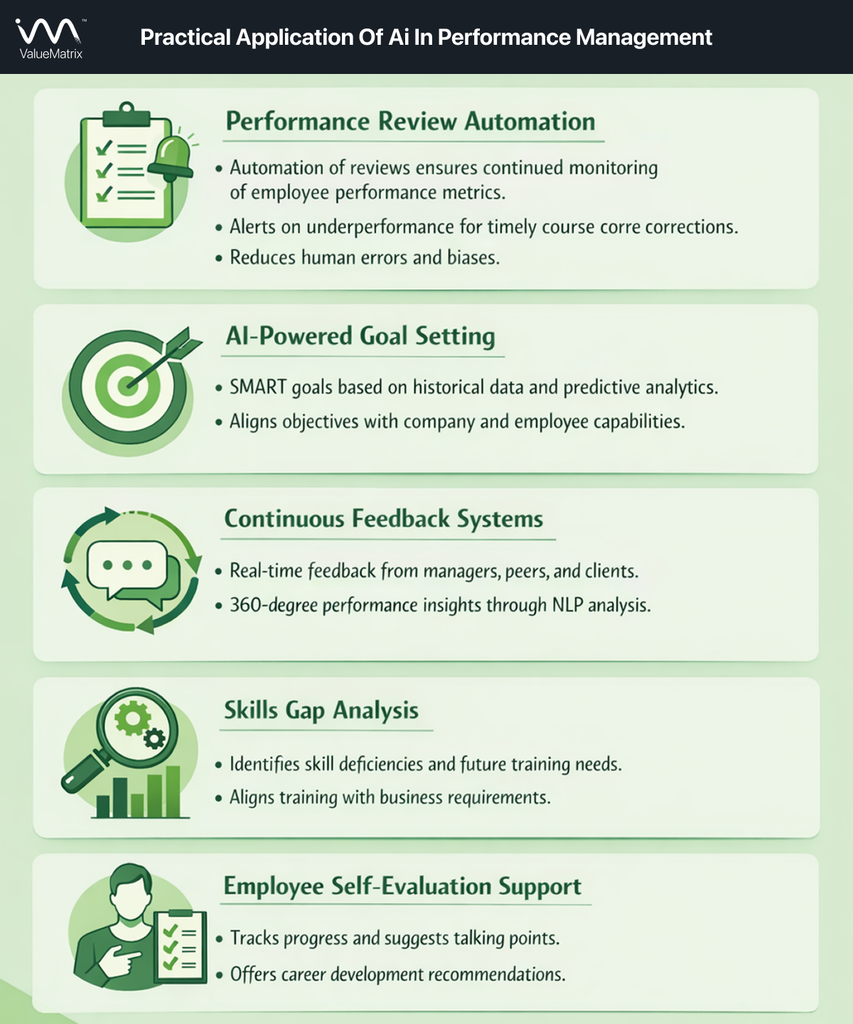
AI automates several aspects of performance review. Managers can set data-driven goals for their team members and assess them objectively. Constant feedback enables employees to analyze their skill gaps and grow continuously.
Performance review automation
AI collects information from multiple sources, such as CRM systems, project tools, and platforms. It schedules performance review meetings and sends alerts. By triggering pending reviews, it ensures their timely completion without manual reminders. Instead of preparing performance reports from scratch, managers can simply refine the AI-generated ones.
Employee goal setting
AI combines business goals, industry benchmarks, and historical data of the employee to set achievable individual goals. It keeps the goals dynamic to match market conditions, project requirements, and employee performance trends.
Continuous feedback systems
Real-time performance insights enable employees to work on the feedback in real time. AI collects feedback from multiple sources, including the manager, peers, and clients; NLP analysis provides feedback on intangible performance aspects, thereby giving employees a 360-degree view of their performance.
Skills gap analysis
Organizations can plan their recruitment and skill training by identifying the existing skill deficiencies and analyzing the future skill forecasts. They can align training with business needs and changing skill requirements, enabling internal mobility.
Employee self-evaluation support
AI platforms compile data from work platforms to track individual progress towards goals. They suggest talking points for evaluations and help prepare achievement summaries. By inputting performance data and aspirations, employees receive suggestions for their career development.
How To Implement AI In Performance Management?
Defining the use cases of AI in performance management is the first step in implementation, as the entire structure depends on the organization’s requirements. Here’s the step-by-step process of integrating AI systems into employee performance assessment.
Define clear objectives and use cases
Are you looking to improve accuracy in evaluations? Identify skill gaps? Predict performance trends or attrition? Or is it a combination of them? Organizations must identify the areas they want to integrate with AI. Well-defined objectives ensure you select the right solution and implement it strategically.
Audit the existing data
Audit the existing dataCreate a unified data inventory by mapping multiple sources, such as CRM systems, learning platforms, and feedback systems. Evaluate the quality of the existing data based on parameters such as completeness, accuracy, consistency, and currentness. Eliminate outdated, redundant, biased, and low-value data. Clean and integrate the data before feeding it into the AI system.
Choose the right AI-enabled HR platforms
Select an appropriate AI technology that integrates smoothly with existing HR systems, collaboration platforms, and learning management systems. ValueMatrix’s platform seamlessly integrates with the existing HR systems. In addition, it is easily scalable, easy to integrate, and ensures transparency.
Maintain human oversight in decision-making
AI insights should be seen as tools that support human decisions but not replace them. Managers must know how to use AI to make informed decisions and where their human judgment takes precedence. AI may not fully capture qualitative factors such as team dynamics, personal circumstances, and project complexity, which need human assessment.
Promote transparency and employee trust
AI for performance reviews, a sensitive process, may not be well-received by employees. Explain why AI is being used by emphasizing skill development, better feedback, and transparency. Assure them of data privacy by demonstrating the process and sources of data collection. Provide them access to their performance dashboard with a provision to question, challenge, or provide inputs. Build trust by uniformly implementing AI systems across teams and auditing them regularly.
Train managers and HR teams
Provide hands-on training to team managers and HR in AI tools. They need to know how the system works, what data it uses, and the limitations of its outcomes. Managers must learn to read dashboards, understand performance analytics, and combine AI-generated recommendations with their human observations and judgment. They should be able to identify biases and unfair recommendations and flag them for course correction.
AI In Performance Management: Challenges and Best Practices
| Challenges in using AI for performance management | Best practices to address them |
| Data privacy and security concerns: AI models are built on large volumes of personal and performance-related data. There is a high risk of data breach and non-compliance with privacy laws. | Implement strong data governance: Establish guidelines for data collection, retention, and deletion. Comply with privacy laws such as GDPR or local regulations. Restrict access to sensitive data and obtain employee consent before collecting information. Conduct regular audits to ensure data safety. |
| Algorithmic bias: AI systems may replicate historical biases in performance evaluation. This can prove disadvantageous for employees from backgrounds that faced bias in the past. | Train and audit AI models: Continuously train the AI models on inclusive datasets and assess bias in the outcomes. Set up a framework wherein managers/ HR review potentially biased outcomes. Conduct regular audits of the outcomes and retrain the models. |
| Lack of transparency in AI decisions: Managers and employees may not fully understand how the AI model generated specific feedback. This leaves room for a lack of accountability among managers and trust issues among employees. | Adopt explainable AI systems: Use interpretable models whose algorithms are understandable, instead of ‘black box’ models that are less transparent. The model must present insights on a user-friendly interface that shows performance drivers, trends, and contributing factors. |
| Overreliance on automation: Managers might excessively rely on AI recommendations. Complete reliance on algorithmic analysis without critical thinking and human judgment may result in inaccurate evaluations. | Combine AI with human judgment: Train managers to use AI as a support tool, but not to completely rely on it for performance evaluation. They need to combine AI insights with their critical thinking and human judgment skills to make balanced decisions. |
| Employee resistance and trust issues: Lack of transparency in the AI evaluation process, replication of historical biases, and overreliance on AI models will only increase employee mistrust in the process. | Promote transparency and communication: Involve employees early in the process and make them a part of the transition to AI-based performance evaluation. Provide them access to the interface to understand how the system works. Collect their feedback and consider it for implementation. |
| Integration with existing HR systems: Legacy HR platforms may lack the architecture to integrate AI systems, requiring substantial investments. Moreover, the existing data may be scattered across various systems, HRIS, LMS, and CMS, complicating data flow into the AI systems. | Invest in scalable and compatible models: AI tools with API and modular architecture integrate well with your existing HR systems. Prioritize interoperability and scalability while choosing a vendor. Phased implementation can minimize disruptions and confusion. |
ValueMatrix offers a transparent AI system that can be easily integrated with your existing HR technologies. Book a demo now to know how.
What Are Some Real Life Examples Of AI In Performance Management?
Cognizant: Taking performance management to new heights
Its existing performance management system (PMS): Cognizant’s PMS GoPerform focuses on employee work satisfaction and performance through features such as goal setting, performance reviews, and continuous manager feedback.
The need for enhancement: The company wanted to make the system more efficient by integrating AI and ML to improve “the value and effectiveness of manager feedback.” This would provide employees with more meaningful and actionable feedback.
The solution: Cognizant collaborated with Microsoft to develop a model that analyzes the effectiveness of each manager’s comment. It also enables real-time feedback on those comments.
The impact: At the beginning of the implementation, 81% of the manager feedback was flagged as useful; this rose to 96% in subsequent performance cycles with continuous AI-driven feedback to managers on the effectiveness of their comments.
A commercial bank: Decoding the performance of phone-based sales agents
The problem: A commercial bank’s phone-based sales agents had no scalable way to measure performance. Managers relied on manual auditing of calls and surface-level metrics, resulting in subjective, generic feedback. There was no way to understand why top agents outperformed others.
The solution: EY deployed machine learning and natural language processing (NLP) to analyze agent conversations at scale, extracting insights. These were combined with structured data from CRM platforms and performance records to identify behavioral patterns of successful sales agents. The findings were packaged into an interactive and up-to-date dashboard for agents and team leaders.
The impact: The bank could identify the key drivers of performance in a phone-based environment and offer targeted coaching to its agents. It also had the opportunity to automate a part of the workflow and mitigate leakages at each progression stage.
AI enables organizations to shift from periodic and subjective reviews to continuous, real-time, and data-driven feedback. Automated analytics, combined with human observations, help managers make confident decisions. However, it requires careful implementation with a strong governance policy that ensures data privacy and builds employee trust. Organizations must realize that AI analytics are only a part of a comprehensive performance review system where human oversight still plays a critical role.
FAQs
- How does AI provide continuous feedback to employees?
AI systems source feedback from multiple sources, including project tools, managers, peers, and clients. NLP identifies the recurring sentiment and issues to provide timely insights. The system regularly prompts managers to provide feedback at the end of a project or after meeting a significant milestone.
2. What types of data does AI use to evaluate employee performance?
AI performance tools typically analyze productivity metrics such as timely completion of projects, meeting deadlines, and the volume of work delivered. Quality metrics include the error rates, volume of rework, and customer satisfaction. The tools also consider feedback from various stakeholders, communication and coordination, employee engagement and behavior, and their learning curve.
3. Can AI reduce bias in performance reviews?
AI can help reduce bias as it uses measurable performance indicators rather than depending on subjective opinions. It standardizes the evaluation process and relies on large sets of data. Moreover, it can be programmed to identify bias by flagging anomalies such as consistently low ratings for a group of employees. However, the tools work best in collaboration with human oversight.
4. What role does AI play in goal setting?
AI analyzes historical performance, business outcomes, and market trends to set goals for employees. It aligns individual career goals with organizational priorities to make them more compatible.
5. How does AI support employee development and career growth?
AI supports employees with personalized goals based on their roles, performance, and skill levels. It identifies skill gaps by evaluating employee capabilities against project requirements. In addition to providing real-time feedback, it matches employees with mentors and learning and skill development programs.
6. Does AI replace managers in performance management?
AI is a support tool but not a replacement for human contribution. It equips managers with insights for informed and objective evaluation rather than subjective opinions. It lays the foundation for meaningful and effective feedback discussions.
7. What are the biggest risks of using AI in performance management?
Handling large volumes of data raises data privacy and security risks. AI models tend to reinforce the historical biases based on the data they are trained on. Incomplete or inconsistent data will lead to misleading insights, resulting in employee resistance and trust issues.
8. How can organizations ensure employee privacy when using AI performance tools?
Organizations should establish clear data governance policies on how employee data is collected, stored, and accessed. They should collect only the necessary information and obtain prior consent from employees. Companies must be transparent about the use of the data.
9. What should organizations look for when choosing an AI performance management platform?
Look for a platform that offers a full performance cycle, including goal setting, continuous feedback, and performance review. It must provide data analysis, predictive analytics, and automated recommendations. The AI tools must integrate with the existing HR systems. ValueMatrix comes with all these features and more. It has a user-friendly interface and allows for customization.
10. How does AI performance tracking handle remote or hybrid employees?
AI enables productivity tracking by monitoring work patterns such as task completion and output levels. It also analyzes behavioral and work trends through response times, communication frequency, and workflow patterns.