

Leadership development is witnessing dramatic AI disruptions. While workshops and seminars continue to dominate the landscape, they support AI-enabled digital training methods.
According to Future Markets Insights (FMI), organizations are increasingly investing in personalized virtual coaching and AI-enabled learning platforms for mid and senior-level managers. Integrating AI into leadership development programs is estimated to have increased learner engagement by over 30% and leadership bench strength by 20%.
In this dynamic scenario, companies do not want to lag behind, but they cannot act in haste. It’s imperative for them to dive deep into AI-based training models and understand what aligns well with their organization’s culture.
What’s Necessitating The Transformation Of Leadership Development
Overwhelming changes in the organizational landscape are necessitating leaders to upskill continuously. Remote and hybrid work models, AI disruption, and a new generation of workforce (Gen Z) with distinct expectations are reshaping leadership requirements.
According to the Harvard Business 2025 Global Leadership Development Study, 71% of learning professionals and functional heads surveyed felt the need for leaders to ‘improve their ability to function amid constant change and uncertainty’.
Although conventional leadership training methods are relevant today, they are inadequate in providing ongoing support and feedback. This is where AI leadership transformation becomes inevitable.
How AI Is Transforming Leadership Development
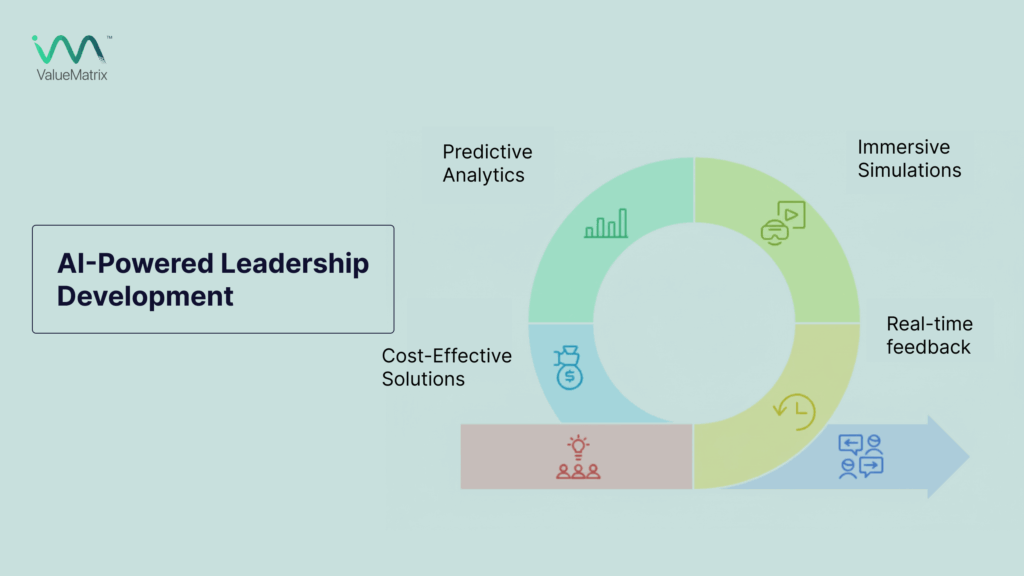
According to the Korn Ferry’s Workforce 2025 Global Insights Report, 71% of CEOs and 78% of senior executives agreed that AI will bolster their value over the next three years. By combining personalization, real-time feedback, immersive practice environments, and analytics, AI is creating effective and accessible leadership development experiences.
Personalized learning and development
Organizations can design individualized learning modules to suit a leader’s experience, skill gaps, learning style, goals, and competency level. AI algorithms make it happen by:
- analyzing the leader’s engagement with content
- presenting the content in different formats, such as videos, articles, and exercises, based on the learner’s interest
- scheduling sessions at a time when leaders are most receptive
Micro-learning and bite-sized development ensure that the modules fit into a leader’s busy schedule. Modular training can be designed into sizes that suit their workflow, ensuring continuous learning.
Real-time feedback and coaching
AI coaching tools for leaders provide real-time feedback while experiences are still fresh, thus helping them to learn from their actions.
- Natural language processing (NLP) analyzes emails, messages, and meeting transcripts to offer insights into a leader’s communication style and how others perceive it.
- Leaders can use AI coaching assistants to help them anticipate, rehearse, and respond to a challenging situation. After a meeting, AI gives inputs on their effectiveness and moments where they could have been more empathetic or clearer in their approach.
- Unlike human trainers, AI remains consistent and objective in its feedback even as leaders interact with different stakeholders. It can also draw behavioral patterns based on multiple interactions, such as a leader’s interaction style with a female employee vis-à-vis a male or their use of language under stress vis-à-vis normal circumstances.
Simulation and practical experiences
Role-plays and case studies have traditionally imparted practical leadership training. But AI-powered simulations leave them far behind in providing an immersive experience.
- Leaders can manage a crisis, face a difficult situation, or make strategic decisions in realistic situations simulated in a virtual world.
- AI bots enable leaders to repeatedly experiment in a specific area or situation until they are confident. They are capable of providing emotional reactions to leadership actions, thus preparing leaders to deal with real-life situations.
- A virtual board can probe a leader’s strategic decisions, preparing them to defend their decisions under a stressful situation. AI tracks the leader’s performance across multiple attempts to suggest techniques that best suit them.
Predictive analytics to identify leaders
Organizations can utilize predictive analytics to identify talent and make succession plans. Future leaders can be selected in a more informed and equitable environment, without pedigree, gender, demographic, or other biases.
- AI can help analyze a potential leader through data gathered from various sources, such as performance reviews, employee surveys, career paths, and past initiatives.
- These systems can bring out talented individuals who might have been otherwise overlooked due to unconscious bias or lack of visibility.
- On the other hand, systems can also identify the risk of a leader’s failure or flight through early warning signs, such as declining engagement and initiatives, and changing communication patterns.
Cost-effective solutions
The FMI survey found that virtual training, powered by AI systems, is reducing costs for organizations.
- Companies can measure their RoI by tracking how leadership learning activities are translating into better outcomes, such as improved team performance, retention rates, and bottom-line results.
- Smarter allocation of resources is possible through data analytics: more funds can be invested in interventions with the highest returns.
- Moreover, the low costs make leadership development affordable and accessible to individuals who cannot afford or are unwilling to invest in expensive executive programs at business schools.
- Organizations can extend learning opportunities to mid-level managers, instead of limiting them to the top brass, thus expanding their top talent pool.
In the Harvard Business 2025 Global Leadership Development Study, 49% said they expected better talent development outcomes from AI-based learning; 50% expected AI to enhance the scalability of their programs and initiatives. However, AI leadership training has its own set of challenges.
Key Challenges In AI-Based Leadership Development
AI-enabled personalized training and instant feedback are transformative. But organizations need to tread the path carefully as they face significant challenges. According to a 2024 study by IBM, business leaders identified privacy and security of data (43%), impact on workforce (32%), and ethical implications (30%) as the top three challenges in implementing AI in their organizations. These challenges also affect leadership training programs.
Resistance to change
Leaders may resist AI-based development due to skepticism about moving away from human-centric training methods. Additionally, the fear of being evaluated by machines, their weaknesses exposed by algorithms, and their own inability to adapt to new technology may lead them to resist change. Moreover, budget holders may question the need to invest in new training methodologies when the traditional ones are ‘just fine’.
Such resistance to change can be addressed by demonstrating through pilots, involving the parties concerned in design processes, and implementing AI systems from the top.
Inevitability of human touch
Individualized training is a boon for leaders, but AI-driven models cannot create a classroom environment where participants sit together, brainstorm, and exchange ideas. The room for human connection, discussing each other’s strengths and vulnerabilities and building relationships, is shrunk. The empathy, intuition, and contextual wisdom that leaders gain from experienced human coaches are missed in AI-led training programs. AI can provide information and practice opportunities, but emotional support in overcoming vulnerabilities and struggles is better provided by peers and human coaches.
Organizations should not view AI as a replacement for human touch, but blend them thoughtfully to design an optimal training model. Such a model integrates AI’s personalization, scalability, immediate feedback, and data analysis with humans’ empathy, contextual judgment, and motivation.
Data privacy and bias
AI leadership development programs collect extensive personal data through performance reviews, communication, behavioral patterns, and feedback. But in the absence of usage boundaries, doubts rise about data ownership, consent to use, and the period of retention. Moreover, the risk of bias is high if the historical data fed into the AI training systems reflects past preferences based on human prejudices.
A robust AI governance policy will mitigate these issues. Leadership programs must include sessions on AI ethics and bias-awareness. Regular bias testing mechanisms, diverse teams in program designing and auditing, and transparency in data collection and usage are some of the measures organizations should take as part of their AI leadership development.
Implementation gap
Investments made in state-of-the-art AI leadership training systems will not yield returns in the absence of a solid implementation plan. Technology implementation often outpaces change management, leaving leaders with tools they don’t fully understand or trust. The result is low adoption rates. Long-term sustainability is another issue, as the initial enthusiasm may wear out after the pilots.
Organizations need to create the conditions necessary for sustained engagement. AI adoption should be treated as a change initiative by investing in user training and support and integrating AI tools into existing workflows.
Implementing AI Leadership Development
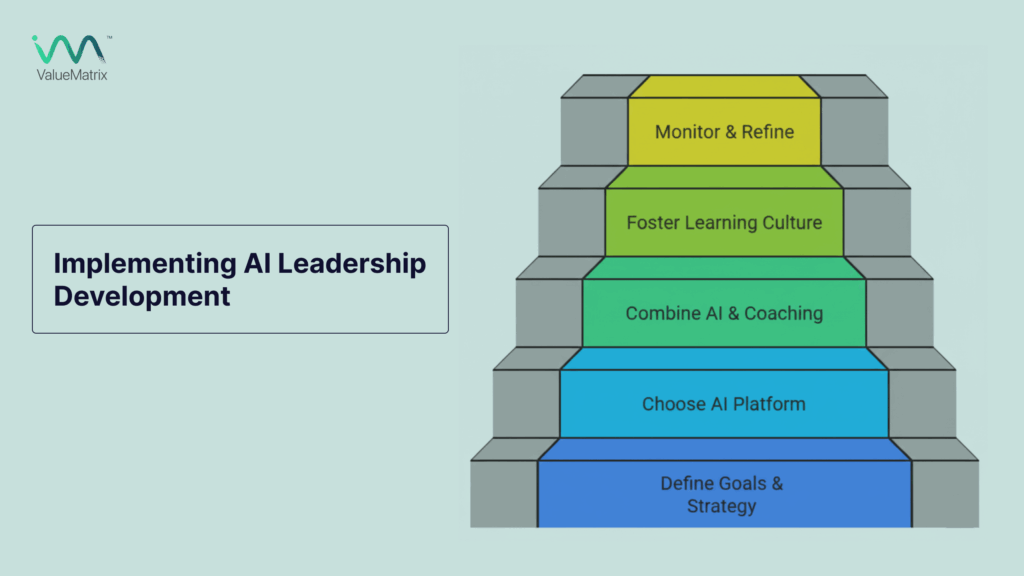
Organizations cannot rush through the implementation of AI-enabled leadership training out of FOMO. It should be a thought-out process with systematic integration. The program must complement the vision of the organization. It’s imperative to start with a robust strategy, choose the right platforms, and foster a culture of learning among the managers.
Start with clear goals and a strategy
Before selecting an AI program, organizations should have clarity on what they want to achieve with the program. Do they want to reduce leadership skill gaps in certain competencies, improve soft skills, or expand the leadership program across the organization? Set up goals and design a strategy while avoiding the temptation to go with the low-hanging fruit.
- If the company is going through an overall digital transformation, the leadership program should be integrated into it.
- The strategy should also address scope and sequencing. For example, start with a pilot for the senior leadership or with a limited scope before going for an enterprise-wide transformation.
- Define clear stages with incremental goals to give visibility into the program’s effectiveness while providing participants with a sense of achievement.
- Establish governance structures that define investment limits in the program, decision-making authority, and yardsticks for success measurement.
Choose the right AI platform
Weigh in the suitability of the technology to program goals instead of prioritizing vendor reputation or the glamor of the application.
- If personalized learning is a priority, evaluate algorithms’ capability to adapt content. If simulation-based practice matters, assess scenario realism.
- Test the user experience to ensure acceptance among the leaders. Even the most sophisticated technologies can fail in the absence of a seamless experience for the user. Evaluate its features, such as intuitiveness, mobile accessibility, and ease of navigation. Consider how platforms fit into leaders’ workflows.
- The new AI program must integrate into the existing HR systems, learning management platforms, performance management tools, and communication channels. Standalone systems that need separate attention will duplicate the processes.
This platform integrates easily with organizational systems, using data-based approaches to flag high-potential employees, assess leadership readiness, and personalize learning paths. Thus, advocating equitable and continuous leadership growth within modern enterprises.
Combine AI with human coaching
Do not see AI leadership programs as a replacement for human-led training. A well-designed training program will blend AI’s scalability and data capabilities with human coaches’ empathy, wisdom, and emotional connection.
- AI offers continuous micro-coaching, personalized content curation, practice simulations, and progress tracking, while human coaches provide periodic deep-dive sessions.
- Human coaches can review AI-generated insights about the leader’s recent development activities. This data-informed coaching enables more targeted, efficient conversations.
- Coaches can also assign AI-based exercises between sessions.
Foster a culture of continuous learning
AI-enabled continuous learning should become a part of organizational culture. Leaders must understand that ongoing learning is expected of them and set an example for employees down the ladder. When executives openly discuss their AI-based learning, share their experiences, and their decisions reflect the new learnings, that motivates others to follow in their footsteps.
Monitor, measure, and refine
Like any strategic initiative, AI-based training programs also need continuous evaluation. Measure the program’s effectiveness through individual progress, engagement, and business impact. Track indicators like platform usage rates, completion of learning modules, simulation practice frequency, and AI coaching engagement.
- Learning metrics provide insights into the adoption patterns – organizations will know if the program is being absorbed equitably by all the leaders, or if some are ahead of others.
- The metrics help measure whether the managers are actually enhancing their skills or simply consuming content. Analysis of pre- and post-training assessments will measure the growth in competency levels.
- Progress tracking should be visible to both leaders and their managers for accountability and feedback-based conversations.
- Keep refining the program to steer it towards the goals. It should be result-oriented and flexible enough to absorb user feedback and align with changing requirements.
AI systems are imperative for data-driven leadership development. If organizations select the right tools that align with the core objectives, AI can bring in the desired efficiencies. However, AI-based coaching is still in a nascent stage, with limited data on its effectiveness and drawbacks. A robust governance policy can help mitigate challenges such as data breaches, inherited biases, and ethical blind spots in the future of leadership training.
FAQs
Define the RoI metrics at the goal-setting stage itself. This can be done by combining quantitative outcomes (efficiency, cost, productivity) with qualitative gains (agility, innovation, and engagement). Note the difference in performance between leaders who underwent AI leadership training and those who haven’t. See if certain modules are yielding better performance results than the others.
AI-enabled training complements human coaching, but does not replace it. AI can provide data-based performance analysis, real-time feedback, and personalized training, but it cannot be a source of emotions, empathy, and support. Successful organizations use a hybrid “tech + touch” model.
AI practice bots help you practice by simulating a real-life environment. Through role-play, they enable you to rehearse for a difficult conversation or test decision-making approaches.
Leadership development will become continuous, with human and AI trainers working together. For example, a session may be taken by a human coach with the follow-up exercises and Q&As answered by AI. AI bots will provide an interactive and engaging learning experience. VR simulation will be extensively used for real-life scenarios. AI co-leaders will act as peers to challenge one another.
Leaders may dislike the idea of a machine scrutinizing and ‘judging’ them, or may worry about their data breach. Organizations must design strong data and AI governance policies to convince leaders about AI-based training. They should be transparent about the data being collected and set surveillance boundaries.
About Us
ValueMatrix is an AI-powered talent intelligence platform that helps companies hire better, faster, and without bias. We go beyond resumes to assess skills, behavioral traits, and cultural fit using advanced AI and proven psychological frameworks. Our platform delivers data-driven insights that improve hiring accuracy, reduce time-to-hire, and elevate candidate quality.
ValueMatrix AI enables hiring teams to make confident hiring decisions and build high-performing teams at scale.