
Key Takeaways:
- 89% of HR professionals using AI in recruiting report that it saves time or increases efficiency.
- 86.1% of recruiters say AI accelerates the hiring process
- 66% of organisations using AI or machine learning in recruitment say it has improved hiring efficiency
- 43% of organisations now use AI for various HR tasks, which is up from 26% in 2024
- 85% of employers say AI-supported hiring processes significantly reduce hiring time
With the world moving towards AI, workforce intelligence and AI in HR have now become the backbone of modern hiring and people management. HR teams today are dealing with hybrid workforces, rising employee expectations, and massive volumes of workforce data. Yet, many still rely on spreadsheets and manual processes that slow decision-making. It is here that AI in HR can be a game-changer.
According to SHRM Labs, 86.1% of recruiters who use AI say it has accelerated the hiring process. Moreover, 85% of employers agree that using AI saves time and also increases efficiency. In fact, the adoption of AI is on the rise, as 43% of companies started using AI for HR tasks, which is significantly more than the 26% in 2024. The real shift is simple: HR is moving from reactive administration to proactive strategy. Artificial intelligence in HR is not about replacing humans; it is about removing repetitive work so HR teams can focus on people, culture, and growth.
What is AI in HR?
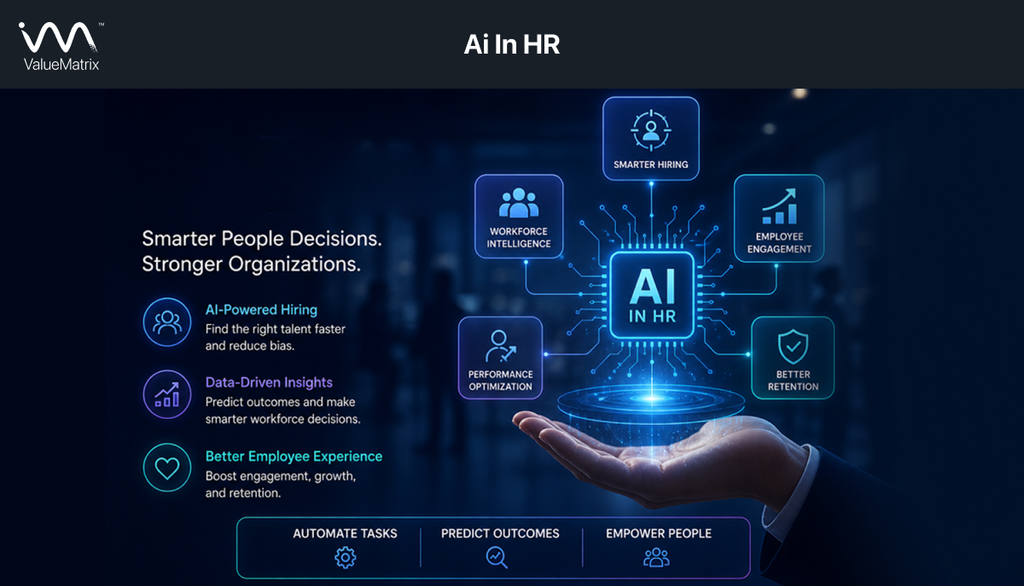
When it comes to the concept of AI in HR, it refers to the use of Artificial Intelligence technologies, mainly Machine Learning and predictive analytics. It is used to automate various aspects of hiring and workforce planning.
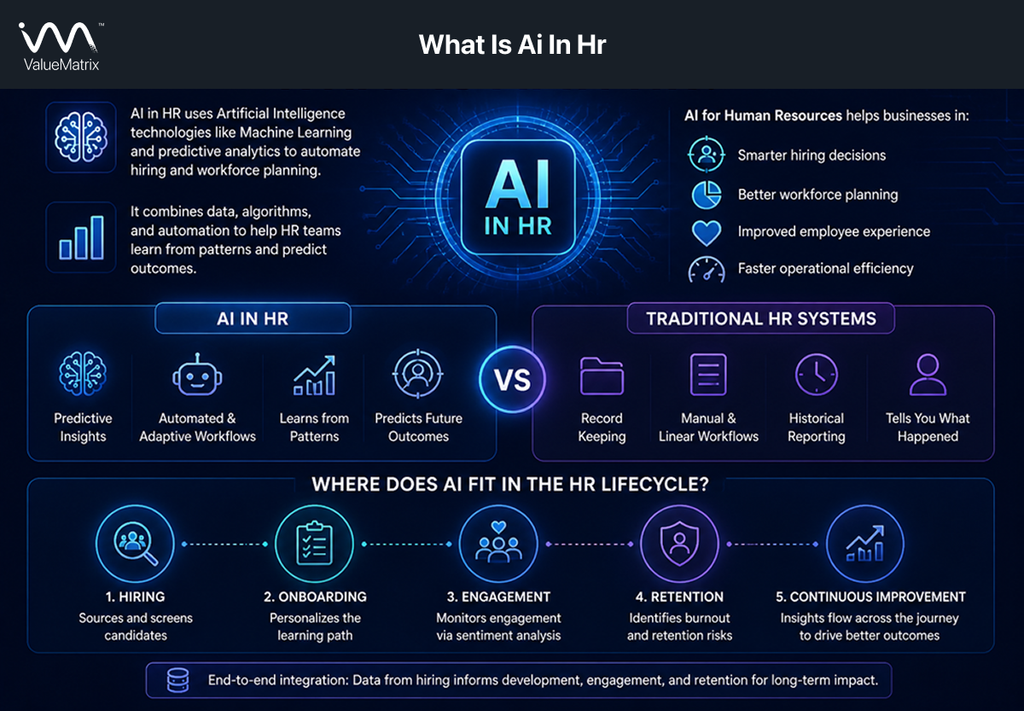
Artificial intelligence in HR combines aspects such as data, algorithms, and automation to change how HR teams work. Rather than relying solely on historical reports, HR AI systems learn from patterns and then predict outcomes.
AI for human resources helps businesses in:
- Smarter hiring decisions
- Better workforce planning
- Improved employee experience
- Faster operational efficiency
How Does AI in HR Differ From Traditional HR Systems?
Traditional HR systems are primarily record-keeping tools. They store data like names, salaries, and start dates, but they don’t “think.” In contrast, HR AI systems are dynamic. While a traditional system tells you who quit last month, AI in human resources tells you who might quit next month.
Traditional workflows are manual and linear; AI-driven workflows are automated and adaptive, learning from every interaction to improve accuracy over time.
Where Does AI Fit in the HR Lifecycle?
The influence of AI for HR spans the entire employee journey. In the hiring phase, it sources and screens candidates. During onboarding, it personalizes the learning path. For active employees, it monitors engagement through sentiment analysis.
Finally, during the retention phase, it identifies markers of burnout. This end-to-end integration ensures that data collected at the interview stage informs the employee’s development plan two years later.
Why AI in Human Resources Is No Longer Optional
AI in human resources is no longer optional because it has a direct impact on hiring efficiency, employee retention, and workforce productivity, key drivers of business performance in a competitive talent market.
Companies that are still taking time to adopt AI for HR can risk falling far behind.
Speed: Reducing Time-to-Hire and HR Workload
Hiring delays cost businesses both time and revenue. AI automates recruitment screening, scheduling, and candidate communication. According to SHRM, 85% of employers agree that AI-supported hiring saves employers time and increases efficiency.
In fact, according to the SHRM 2025 Recruiting Benchmarking Report, the average U.S. time-to-fill is 42 days, up 24% since 2021.
Here is how AI in HR helps:
- AI can screen a huge number of resumes in minutes
- Reduces recruiter workload significantly
- Improves hiring turnaround time
Accuracy: Better Hiring and Workforce Decisions
Manual hiring decisions often introduce bias and inconsistency. On the contrary, as per a CIPD report on Resourcing and talent planning, 66% of organisations using AI or machine learning in recruitment say it has improved hiring efficiency.
Here is how AI in HR helps:
- It matches candidates based on skills and data
- It aims to standardize evaluation criteria
- It also helps in reducing human error
Retention: Predicting Employee Behavior
Employee turnover is expensive. The U.S. Department of Labor explains that a single bad hire can cost up to 30% of an employee’s first-year earnings. AI helps reduce this risk by:
- Predicting attrition trends
- Identifying signals of disengagement
- Personalizing experiences for the employees
Scale: Managing Hybrid and Global Teams
As per the SHRM 2026 CHRO Priorities and Perspectives Report, 92% of CHROs anticipate AI will be further integrated into the workforce this year, and 87% forecast greater AI adoption within HR processes. AI enables:
- Real-time workforce analytics
- Global workforce tracking
- Better resource allocation
How Does AI in HR Actually Work?
AI in HR works by aggregating vast amounts of workforce data, cleaning it for consistency, and applying machine learning algorithms to identify patterns. These patterns are then converted into actionable recommendations that help HR leaders make more informed, objective decisions about their people. Here is exactly how AI in HR works:
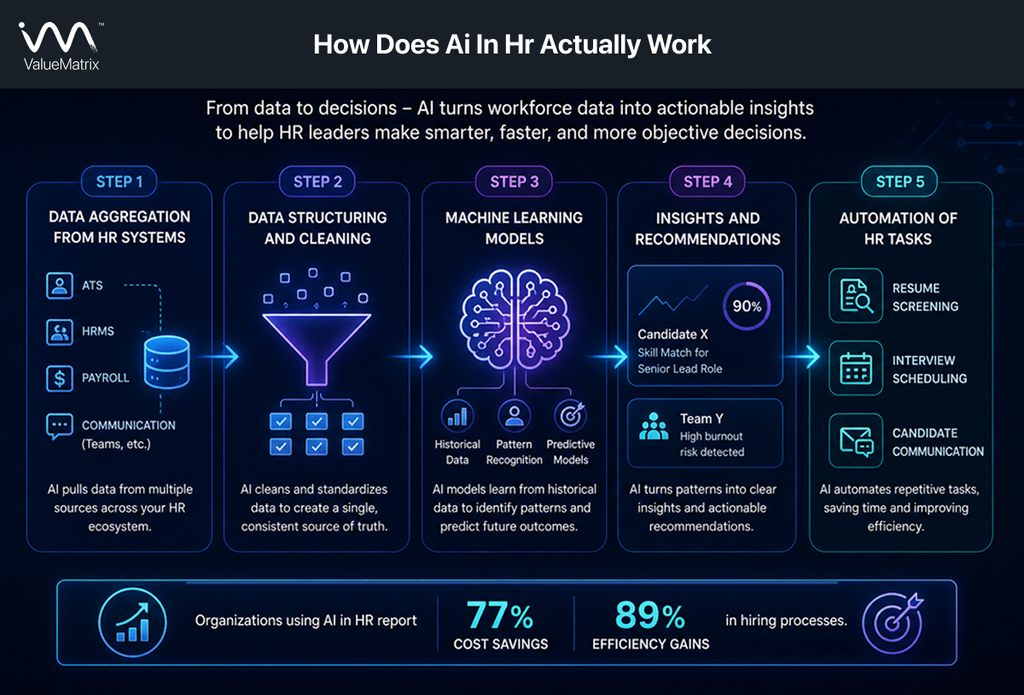
Step 1: Data Aggregation from HR Systems
The process starts when various data silos are connected. An HR AI platform pulls information from the Applicant Tracking System (ATS), the Human Resource Management System (HRMS), payroll records, or even internal communication tools like Teams.
Step 2: Data Structuring and Cleaning
Raw data can be quite messy. Different departments often use different formats for the same information. The AI thus helps “clean” this data, ensuring that “Software Engineer” and “SDE” are recognized as the same role and creating a “single source of truth” for the entire organization.
Step 3: Machine Learning Models
This is the main step of the operation. Machine learning models look at historical data, for example, the traits of your most successful sales reps, and build a predictive profile. This helps in talent analytics for hiring by identifying which future applicants share those same high-performance markers.
Step 4: Insights and Recommendations
The AI doesn’t just include a graph; it also aims to provide a suggestion. It might send a notification saying: “Candidate X has a 90% skill match for the Senior Lead role” or “Team Y is showing signs of high burnout risk.” These people analytics solutions help empower Human Resources teams to act proactively.
Step 5: Automation of HR Tasks
AI can significantly automate repetitive processes like resume screening, interview scheduling and candidate communication. In fact, Workable research shows that organizations using AI report up to 77.9% cost savings and 89.6% efficiency gains in hiring processes.
What are the Core Use Cases of AI for HR?
The core use cases of AI for HR include recruitment automation, employee engagement analysis, personalized learning and performance management. Each of these cases is designed to improve workforce efficiency and decision-making.
Recruitment and Talent Acquisition
Companies that use AI hiring tools report significant improvements in candidate quality and hiring speed. AI enhances hiring by:
- Automating candidate sourcing
- Matching skills in accordance with the profile requirements
- Ranking candidates objectively
Employee Engagement and Experience
AI tools analyze employee sentiment via:
- Surveys
- Feedback systems
- Communication patterns
This helps HR teams identify disengagement early.
Learning and Development
According to a long-standing LinkedIn Workforce Learning Report from 2019, 94% of employees say they would stay longer at companies that invest in learning. AI aims to personalise training by:
- Identifying skill gaps
- Recommending courses
- Tracking progress
Performance and Productivity Management
To improve the overall workforce productivity, AI-driven systems help to:
- Provide continuous feedback
- Tracking of important performance metrics
- Identify high-performing employees
What Matters When Choosing AI Tools for Human Resources?
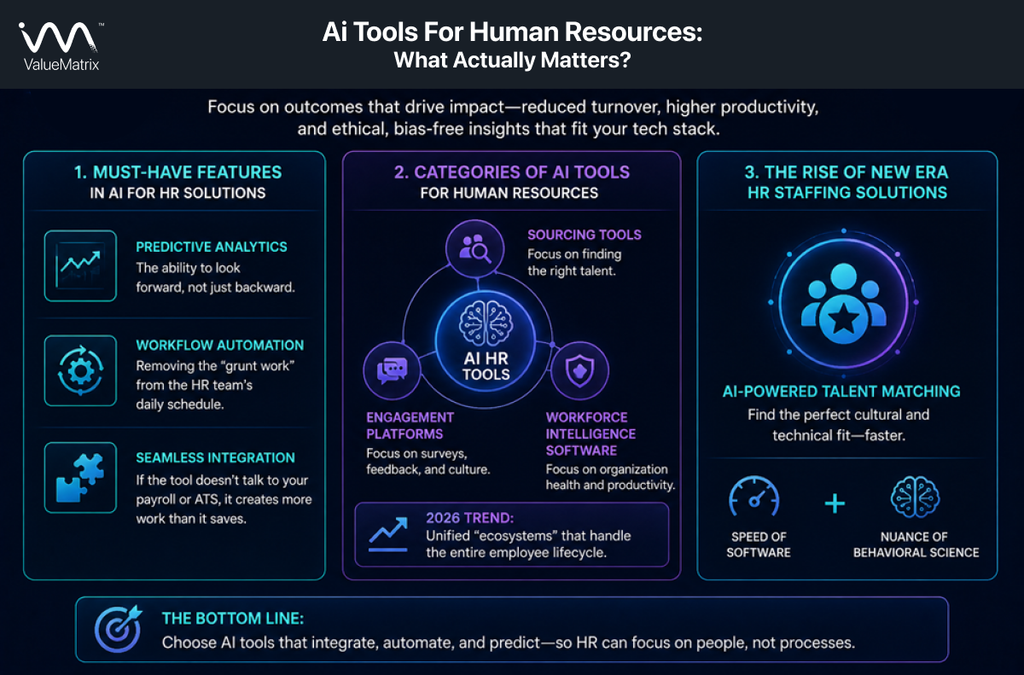
When selecting AI tools for human resources, the focus must be on outcomes like reduced turnover and improved productivity, rather than flashy features. The best tools are those that integrate seamlessly with your current tech stack and provide clear, ethical, and bias-free insights.
Must-Have Features in AI for HR Solutions
Any reputable workforce intelligence platform must offer:
- Predictive Analytics: The ability to look forward, not just backward.
- Workflow Automation: Removing the “grunt work” from the HR team’s daily schedule.
- Seamless Integration: If the tool doesn’t talk to your payroll or ATS, it creates more work than it saves.
Categories of AI Tools for Human Resources
The market is currently split into specialized tools and all-in-one platforms. Sourcing tools focus on finding talent; engagement platforms focus on surveys and feedback; and workforce intelligence software focuses on the organization’s overall health and productivity.
However, the trend in 2026 is toward unified “ecosystems” that handle the entire lifecycle.
The Rise of New Era HR Staffing Solutions
We are seeing a shift away from traditional “headhunter” agencies toward new-era HR staffing solutions. These are platforms that use AI-powered talent matching to find the perfect cultural and technical fit in a fraction of the time.
They combine the speed of software with the nuance of behavioral science.
Although hiring with the help of AI has many benefits, it also comes with risks. The EU AI Act classifies AI recruitment systems as high-risk. Nonetheless, the Act has rules in place that can help assess and mitigate risks. The AI Act has been effective since August 2025.
What are the Key Metrics to Measure AI in HR Success?
Measuring the success of AI in HR requires tracking specific KPIs such as Quality of Hire, Time-to-Hire, and Employee Retention. If these metrics do not show a positive trend after implementation, the AI is likely not being used to its full strategic potential. Here are the metrics:
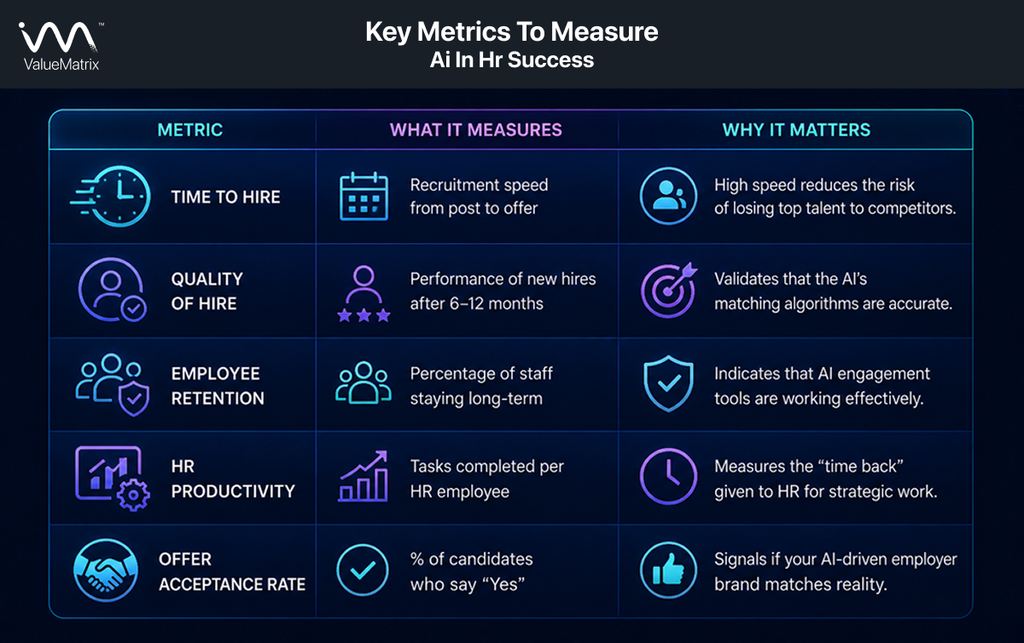
| Metric | What It Measures | Why It Matters |
| Time to Hire | Recruitment speed from post to offer | High speed reduces the risk of losing top talent to competitors. |
| Quality of Hire | Performance of new hires after 6–12 months | Validates that the AI’s matching algorithms are accurate. |
| Employee Retention | Percentage of staff staying long-term | Indicates that AI engagement tools are working effectively. |
| HR Productivity | Tasks completed per HR employee | Measures the “time back” given to HR for strategic work. |
| Offer Acceptance Rate | % of candidates who say “Yes” | Signals if your AI-driven employer brand matches reality. |
What are the Right Tools for Your Time?
Choosing the right AI for HR solution is less about chasing features and more about finding a system that actually solves your hiring and workforce challenges. Many organizations make the mistake of stacking multiple tools- ATS, analytics platforms and engagement software- only to end up with fragmented data and slower decisions.
Here’s what you should prioritize when evaluating tools:
- Integration-first approach: The platform has to effortlessly connect with your existing HRMS, ATS, and payroll systems in order to eliminate data silos.
- Ease of use: If your HR team struggles to use it, adoption will fail. Look for intuitive dashboards and simple workflows.
- Scalability: As your organization grows, your HR AI system should scale without requiring constant upgrades or replacements.
- Actionable insights, not just data: The tool should tell you what to do next, whether it’s identifying high-potential candidates or predicting attrition risks.
Platforms like to go a step further by combining data with behavioral science. Instead of just matching resumes to job descriptions, they focus on deeper insights such as:
- Culture-skill alignment
- Behavioral and cognitive patterns
- Data-driven predictive planning for hiring success
This is exactly where new-era HR staffing solutions stand apart. It helps to reduce complexity, unify decision-making, and help HR teams focus on what actually matters: building a stronger and more aligned team.
Summary
AI in HR is completely changing how organizations hire, manage, and retain talent. Whether it is faster hiring or predictive workforce planning, HR AI systems are known to enable smarter decisions even at scale. Companies that are actively adopting AI are seeing measurable improvements in efficiency, engagement, and productivity.
Conclusion
AI in HR is not simply a trend; it is a competitive advantage for a lot of businesses. Organizations that are accepting and incorporating artificial intelligence in HR are now able to make faster decisions, reduce hiring risks and build stronger teams.
The goal is simple: use data to support people, not replace them.
Ready to move from reactive HR to predictive workforce intelligence?
Frequently Asked Questions
What exactly is AI in HR, and how does it differ from traditional HR software?
AI in HR uses machine learning as well as data analytics to automate processes and predict outcomes. On the other hand, traditional HR software only stores and reports historical data. When AI is incorporated with HR, it enables proactive decision-making instead of reactive management.
Will artificial intelligence in HR eventually replace human HR managers?
No, AI is designed to support HR professionals, and not replace them. It automates repetitive tasks, allowing Human Resource teams to focus on strategy, employee engagement, and culture building.
How does AI for HR solutions improve the recruitment process?
AI can strategically improve and enhance recruitment by automating resume screening with the help of AI-powered screening filters to match candidates with roles and reduce bias. It can help to speed up the hiring process while improving candidate quality and decision accuracy.
Is AI in HR biased, or does it help reduce discrimination?
AI is great at reducing bias when designed correctly, while also focusing on skills and data rather than personal factors. However, when data quality is poor, it is still known to introduce bias, so careful implementation is required.
Can AI really help in predicting employee turnover?
Yes, AI uses different patterns such as engagement, performance, and behavior to predict attrition risk. This allows companies to take preventive actions before employees leave.
What are the first steps to implementing AI tools for human resources?
The process starts by understanding key HR challenges, selecting the right platform, integrating existing systems, and training Human Resource teams. It is a wise idea to start with a simple use case, like automating the hiring process, before scaling.
How do new era HR staffing solutions differ from traditional methods?
New era HR staffing solutions use AI, data, and automation to improve hiring accuracy as well as overall efficiency, while traditional methods rely heavily on manual processes and intuition.
Is employee data safe when using AI for human resources?
Most modern AI HR platforms are known to use advanced security protocols as well as compliance standards. However, organizations must ensure proper data governance and privacy policies.
What metrics should I track to see if my HR AI is working?
Track metrics like time-to-hire, quality of hire, employee retention, HR productivity, and candidate experience to measure the effectiveness of AI in HR systems.