
Corporate learning is evolving faster than ever. For decades, companies relied on predictable formulas: standardized training modules, annual workshops, and structured programs tied to rigid schedules. These approaches were safe and familiar, but they often struggled to produce lasting behavioral change or tangible business impact.
Today, the pace of business has far outgrown these legacy models. Technology is advancing rapidly, markets shift unpredictably, and organizational structures are constantly reshaped.
Table of contents
Upskilling can no longer be slow or occasional; continuous reskilling has become the new standard. Employees are expected to learn at the same speed at which the technology evolves, and traditional L&D frameworks simply weren’t designed for that kind of velocity.
The demand for new capabilities, right from advanced digital skills to generative AI fluency, has forced organizations to rethink the foundations of learning. AI has shifted from being a promising tool to an essential backbone of modern L&D. It’s quietly reshaping how companies identify skills, create learning content, and measure the impact of training investments.
AI’s edge isn’t just automation; it’s precision, adaptability, and timeliness. Traditional models treat everyone the same, but AI allows learning to adapt to each employee’s skills, career goals, learning style, and pace. This is more than a tech upgrade; it’s a strategic transformation. L&D is no longer just a support function; it’s becoming a core driver of business readiness.
The bottom line is simple – people learn differently, businesses evolve quickly, and traditional learning cannot keep up. AI bridges this gap by offering personalization, speed, and predictive insight that human teams alone cannot achieve.
The Three Pillars of AI-Driven Transformation in L&D
AI isn’t just an incremental improvement for corporate learning, but it’s a structural game-changer. Its impact is evident across three interconnected pillars: hyper-personalized learning pathways, intelligence-driven insights, and accelerated content creation with immersive delivery. Together, these pillars position L&D as a strategic engine for building capabilities, rather than simply a mechanism to deliver courses.
1. Hyper-Personalized Learning Pathways
One of AI’s clearest advantages is its ability to dismantle the old one-size-fits-all training model. Employees bring diverse experiences, learning speeds, knowledge gaps, and career ambitions. AI allows organizations to tailor learning journeys in real time, adapting to each individual’s needs.
Modern AI systems continuously analyze learner behavior as to how quickly content is absorbed, which formats engage best, where hesitation occurs, and which concepts prove challenging. The system then dynamically adjusts: difficult topics may be broken into smaller modules, reinforced with simulations, or revisited via simplified explanations. Employees showing mastery can accelerate, reducing redundancy and maintaining engagement.
AI also enables predictive skills-gap mapping. By comparing an employee’s current capabilities to role requirements, career goals, and the organization’s long-term plan, AI produces personalized skill road maps aligned with strategic objectives.
IBM’s Watson exemplifies this approach. By synthesizing thousands of data signals, from job roles and historical learning data to performance metrics and career transitions. Watson crafts intelligent, individualized paths. Employees see exactly where they stand, what they need next, and which micro-skills will accelerate their growth. The results are faster proficiency, higher completion rates, and improved engagement. Personalization, as Watson demonstrates, isn’t just a feature; it’s a competitive differentiator.
2. Insight Generation and Predictive Analytics
AI transforms learning into a data-rich ecosystem. Traditional L&D metrics like completion rates or satisfaction surveys often lacked depth. AI, however, links learning behavior to performance outcomes, offering actionable insights.
By aggregating engagement metrics, performance outputs, and operational results, organizations can see which programs truly drive business impact, which need redesign, and where employees may be struggling. AI also predicts future skill needs, enabling proactive workforce planning
For example, Schneider Electric leverages AI to monitor content usage and learning friction points, improving training efficiency by 60%. Instead of reactive course creation, AI enables a strategically programmed development engine. (aiexpert.network)
Unilever’s AI Onboarding assistant, Unabot, showcases a human-centered application. Using natural language processing, it guides new hires, answers questions instantly, clarifies policies, and reduces administrative bottlenecks. Employees ramp up faster with confidence, highlighting AI’s ability to augment human experience rather than replace it. (drpress.org), (slideshare.net)
Similarly, Amazon integrates AI in its fulfillment centers to guide employees through complex, high-velocity workflows. The AI detects performance friction in real time, whether in scanning, sorting, or routing, and provides contextual micro-instructions or visual aids. Personalized training modules follow, reducing errors and shortening learning curves, ensuring operational consistency across thousands of workers. (aboutamazon.com)
3. Intelligent Content Creation and Immersive Delivery
Learning content can become obsolete quickly in today’s fast-paced environment. AI addresses this by transforming content creation, updates, and delivery.
Generative AI drafts course outlines, assessments, case studies, translations, micro-learning snippets, and video scripts. Instructional designers can focus on narrative quality and learning experience rather than repetitive writing. AI virtual assistants guide employees through learning within their work context, bridging training and real-time performance seamlessly.
Immersive learning powered by VR and AR is where AI truly excels. It tracks decisions, evaluates sequences of actions, and produces detailed performance insights. Employees can practice high-stakes scenarios repeatedly, without real-world consequences.
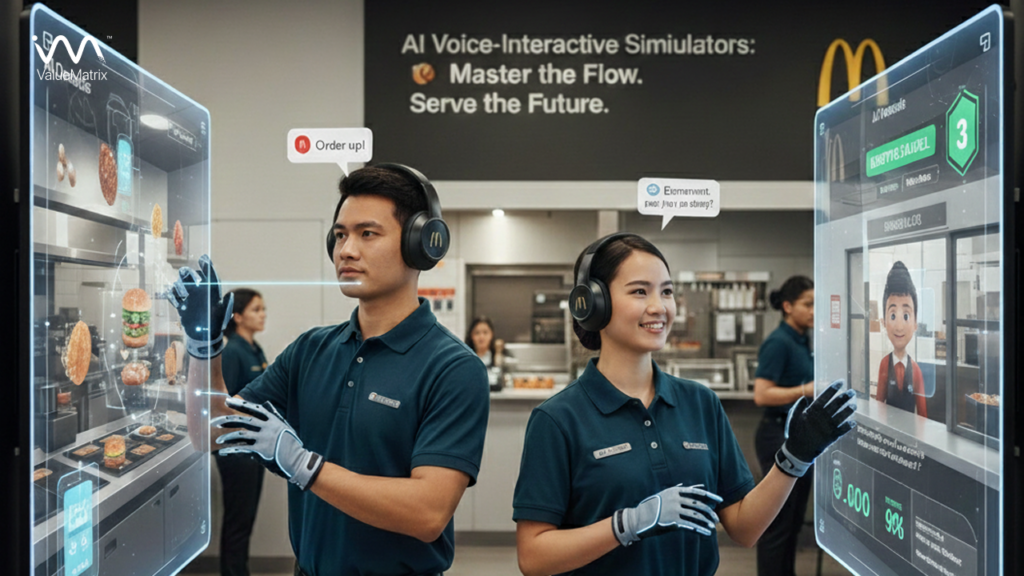
Walmart’s AI-driven VR training improved knowledge retention, assessment performance, and speed across over a million associates. (elearningindustry.com) McDonald’s uses AI voice-interactive simulators(applify.co), (theguardian.com) to replicate kitchen workflows and customer interactions, adapting difficulty based on performance. Combined with the examples from Unilever and Amazon, it’s clear that AI is no longer just a layer atop traditional training; it’s the engine driving personalized, immersive, and operationally integrated learning at scale.
Expanding Applications: How AI Is Reshaping the Learning Ecosystem
As AI matures in enterprise learning, its role goes far beyond automating administration or enhancing courses. It now influences every stage of the employee development life cycle, from onboarding and early support to career growth and long-term role transitions. This broader integration is transforming L&D from a training function into a continuous strategic asset for talent cultivation.
Coaching and Real-Time Performance Feedback
Traditionally, employees relied on sporadic manager check-ins or annual reviews to understand their performance. AI eliminates these delays, delivering immediate, objective insights. Today, AI platforms can analyze sales calls, leadership presentations, negotiation simulations, or customer interactions. They assess speech clarity, tone, pacing, confidence, and subtle behavioral cues often overlooked by humans.
This level of granular feedback gives employees a precise understanding of strengths and development areas, accelerating improvement. Managers, in turn, gain richer data for coaching conversations, ensuring that feedback is consistent, evidence-based, and aligned with organizational performance expectations.
Strategic Career Progress
High attrition rates and talent shortages have made career visibility a top employee expectation. AI-driven internal talent marketplaces now provide real-time guidance. By analyzing performance data, learning history, project contributions, and skill adjacency, AI recommends the roles employees are ready for next.
Instead of waiting for a manager’s guidance, employees see potential future paths and receive curated learning journeys to bridge skill gaps. This alignment of individual ambition with organizational strategy reduces recruitment costs, improves retention, and strengthens internal mobility pipelines, building a future-ready workforce.
Compliance and High-Risk Scenario Training
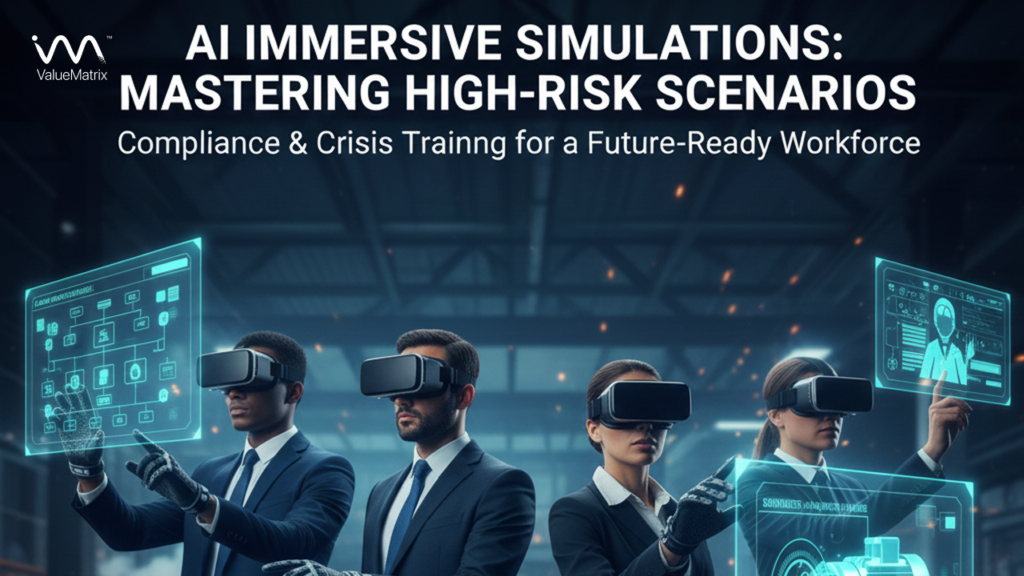
Compliance and high-risk training have historically been unpopular, often relying on static manuals and slides. AI transforms these programs by combining predictive intelligence with immersive simulations. Employees step into realistic, risk-free scenarios, handling equipment malfunctions, emergency situations, financial compliance challenges, or difficult customer interactions.
The AI tracks actions, scores performance objectively, and identifies effective versus risky decisions. Feedback is immediate, contextual, and memorable, far surpassing traditional compliance modules. Employees repeatedly practice skills critical for operational safety and regulatory adherence, ensuring behavioral change rather than passive content consumption.
Embedding Learning into Daily Work
AI tools increasingly integrate with workflows, communication platforms, and performance systems. Learning is no longer a separate activity but a natural extension of day-to-day work. Employees receive micro learning, guidance, or reinforcement in the flow of their tasks.
This constant, embedded learning produces a workforce that adapts instinctively, applies knowledge immediately, and remains aligned with evolving business priorities. Instead of reacting to skill gaps or performance challenges, organizations anticipate them in enabling a proactive, agile, and continuously upskilled workforce.
Real-World Illustrations
- Schneider Electric: Uses AI to optimize training investment, monitor engagement, and reduce learning friction—improving efficiency by 60%.
- Unilever (Unabot): Supports onboarding with instant answers and guidance, reducing administrative delays and accelerating confidence for new hires.
- Amazon Fulfillment Centers: AI guides employees through complex tasks with contextual micro-instructions, minimizing errors and shortening learning curves.
These examples demonstrate that AI’s role is no longer confined to making learning faster but extends to embedding development into the organizational ecosystem, aligning individual growth with business strategy.
Navigating the Challenges, Transparency Requirements, and Ethical Boundaries of AI in L&D
AI’s transformative potential in corporate learning comes with responsibilities and challenges that cannot be ignored. Its implementation affects not just technology, but trust, compliance, fairness, and ethics. Organizations that overlook these aspects risk undermining culture, eroding employee confidence, and facing legal pitfalls.
Data Quality, Bias, and Ethical Integrity
The foundation of AI lies in data. Systems trained on historical patterns like performance ratings, promotion histories, or training outcomes can inherit existing biases. Without careful oversight, AI may amplify these biases, leading to inequitable recommendations for learning pathways, skewed skill assessments, and unfair career development opportunities.
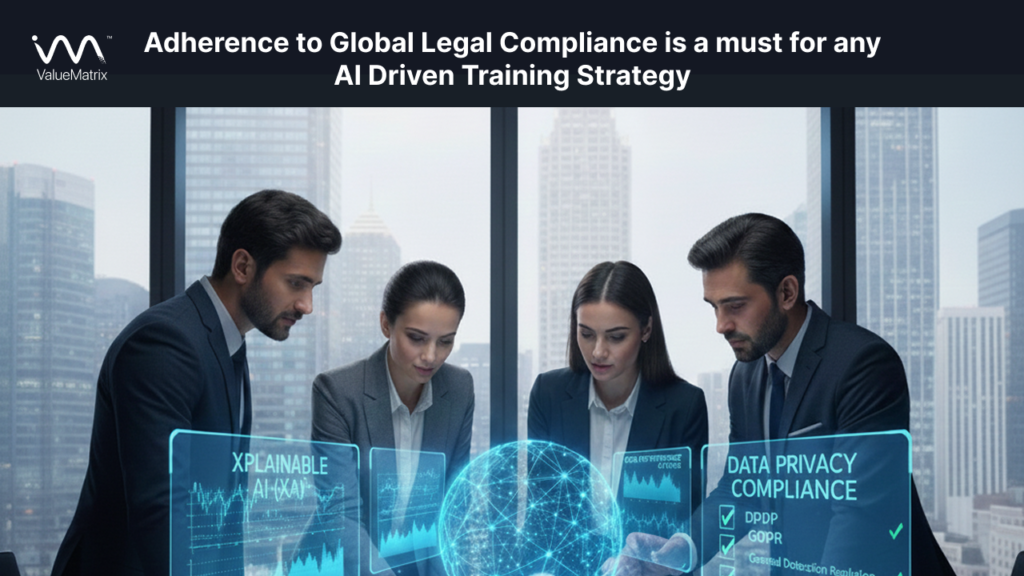
To mitigate these risks, organizations must implement strong data governance, periodic algorithm audits, and bias-mitigation protocols. Explainable AI (XAI) is equally critical. Employees need to understand why the AI suggested a specific course, assigned difficulty levels, or identified a skill gap. Transparency reduces the “black box” effect, builds trust, and ensures learners feel guided, not judged.
Regulatory Compliance and Privacy
AI-driven L&D platforms process highly sensitive information, including performance metrics, behavioral patterns, and learning histories. This invokes strict regulatory obligations:
- GDPR (Europe): Requires disclosure of data collection, purpose, retention, and access, with rights to correction and deletion.
- CCPA (USA): Ensures individuals know what data is collected and allows opt-outs of sharing.
- DPDP (India): Mandates explicit consent, lawful processing, purpose limitation, and secure storage. (Section 4 (1), Section 6 (1), Section 6 (4), Section 8 (5), Section 8 (7) of DPDP Act 2023
Global enterprises must design AI systems with region-specific compliance embedded, ensuring legal alignment without compromising learning effectiveness.
Integration with Legacy Systems
Many organizations operate on legacy LMS systems that struggle to handle the data density, real-time adaptiveness, and integration demands of AI tools. Simply layering AI on top can cause fragmentation, slowdowns, and underperformance. A phased adoption strategy is best: introduce modular AI tools, demonstrate measurable wins, and gradually scale to enterprise-wide transformation.
Human Perception and Acceptance
Employees often fear that AI could monitor, evaluate, or even replace them. L&D teams worry that generative AI might reduce their relevance. Addressing these perceptions requires clear communication: AI is a partner, not a replacement. It automates repetitive tasks, enabling humans to focus on judgment, creativity, empathy, and strategy; skills no machine can replicate.
Building Trust Through Ethical Practices
Organizations that prioritize transparency, fairness, and compliance cultivate trust while maximizing AI’s impact. Embedding ethical design principles alongside Explainable AI, data governance, and regulatory alignment ensures that AI-powered learning is equitable, respectful, and human-centric.
Strategic Takeaways
- AI systems must be transparent, auditable, and explainable to avoid “black box” distrust.
- Regulatory compliance is non-negotiable; global frameworks like GDPR, CCPA, and DPDP guide responsible AI use.
- Phased implementation ensures AI integrates effectively with existing systems.
- Clear communication and ethical practices position AI as a supportive augmentation, not a threat.
By addressing these challenges proactively, organizations can unlock the full potential of AI in L&D, transforming learning into a trusted, continuously improving, and strategically aligned capability.
Conclusion
Corporate learning stands at a pivotal crossroads. For years, L&D struggled with rigid course delivery, limited personalization, and an inability to demonstrate measurable business impact. AI has rewritten these constraints, evolving from a set of digital tools into a strategic capability that strengthens organizational resilience, accelerates transformation, and builds a workforce ready for continuous change.
The next decade will push this evolution further. AI-generated simulations will become more sophisticated and emotionally intelligent, adapting to learners’ stress, confusion, or overconfidence in real time. Affective computing will enable training environments that respond not just to actions but also to learners’ emotional states, bridging the gap between technical proficiency and human readiness.
At the enterprise level, cross-organizational skill mapping will allow companies to align internal talent with external industry trends, creating a dynamic workforce planning blueprint that updates continuously. Organizations will move from reacting to disruption to anticipating it, preparing teams for skills that haven’t yet become critical.
Yet technology alone cannot drive this future. Responsible AI adoption requires transparency, fairness, and regulatory alignment. Explainable AI, strong data governance, GDPR/CCPA/DPDP compliance, and ethical design principles must be embedded into the foundation of every learning ecosystem. These are not constraints; rather, they are trust-building mechanisms that empower employees rather than monitor them.
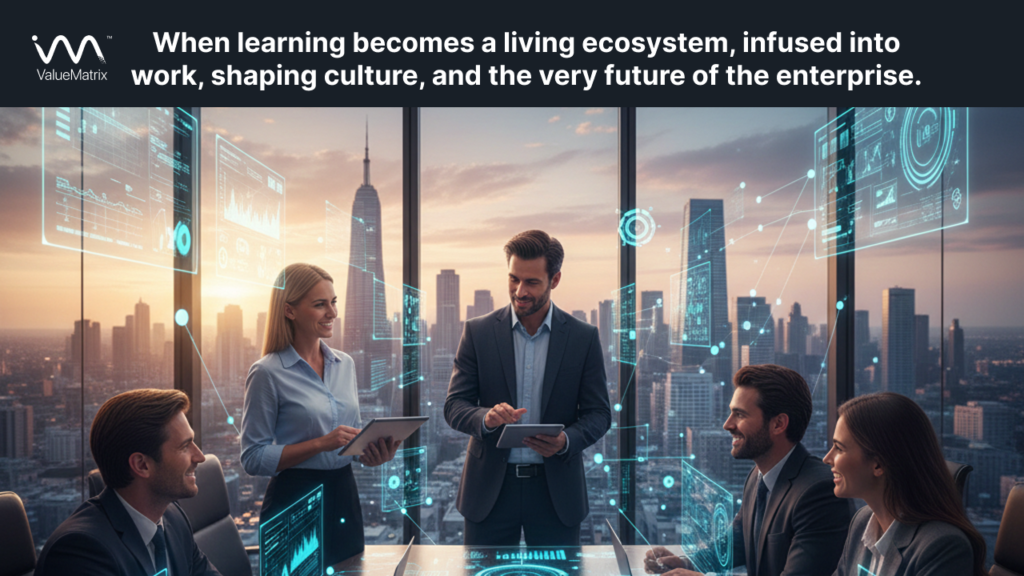
Ultimately, AI is transforming corporate learning for readiness, not just efficiency. In a world where strategy, technology, and markets shift without warning, organizations that integrate AI into daily learning workflows will thrive. Learning becomes a living ecosystem, infused into work, shaping skills, culture, and the very future of the enterprise.
FAQs
AI personalizes learning, adapting content, difficulty, and pace based on each employee’s needs. It continuously analyzes behavior, performance, and skill gaps, ensuring learning is effective, relevant, and time-efficient.
Yes. AI synthesizes performance data, project outcomes, assessments, and job-role expectations to pinpoint skill gaps, often more accurately than manual evaluation. Predictive models also anticipate future competency needs.
No. AI automates repetitive tasks like content creation or basic reporting, but cannot replace human judgment, pedagogy, or experiential design. L&D roles evolve toward coaching, learning architecture, curation, and AI governance.
Trust comes from transparency. Explainable AI allows employees to understand recommendations. Combined with data governance and regular bias audits, AI becomes more equitable and objective than human-only evaluations.
AI-driven L&D systems follow strict principles: clear disclosure of data collected, purpose limitation, secure storage, restricted access, right to correction/deletion, and explicit consent where required. Compliance is essential for responsible AI use.
AI connects learning to performance by analyzing engagement, skill acquisition, and operational results. It can identify which programs drive productivity, reduce errors, or enhance customer satisfaction, making L&D investments measurable and strategically aligned.
Absolutely. AI platforms track individual learning patterns regardless of location and deliver adaptive content, real-time feedback, and immersive experiences. This ensures remote or hybrid employees receive the same quality of tailored learning as on-site staff, fostering consistent skill development across the organization.
About Us
ValueMatrix is an AI-powered talent intelligence platform that helps companies hire better, faster, and without bias. We go beyond resumes to assess skills, behavioral traits, and cultural fit using advanced AI and proven psychological frameworks. Our platform delivers data-driven insights that improve hiring accuracy, reduce time-to-hire, and elevate candidate quality.
ValueMatrix AI enables hiring teams to make confident hiring decisions and build high-performing teams at scale.