
Table of contents
Amid the current hyper-competitive talent landscape, getting the right candidate is no longer about just a job posting and waiting for applicants — it’s about precision, speed, and strategy. With the digital shift, the need of the hour is quicker and smarter as well as effective AI talent prediction methods.
Research has indicated that AI-driven recruitment insights better equip businesses to identify untapped potential, decrease bias, and make wise decisions, thereby leading to a shift in hiring from reactive to a proactive strategic advantage.
This article discusses how AI can transform hiring end-to-end from screening and sourcing to talent forecasting and predictive retention. We’ll also touch upon risks and best practices, and explore how HR and talent acquisition can really benefit.
Talent Landscape: An Overview
The race for hiring effectively has heated up in recent times. While applicants anticipate quicker responses, transparency, and smoother transitions, innovative technologies, business models, and industries are growing at a faster pace as well. Besides, organizations are under pressure to hire inclusively.
Companies cannot afford to adopt slow and manual hiring, especially now, when a top candidate might be hired within days. With AI in workforce planning, they can automate the entire hiring process and become future‑oriented.
With the entry of online recruitment systems, companies are able to formulate active recruitment strategies and monitor their effectiveness. Data-driven analysis can predict future skill demand through industry data and market trends, thus helping organizations capitalize on the best talent in the market.
Machine learning can effectively screen candidates’ work experience, educational background as well as skill sets to achieve precise matching of positions with candidates.
How AI Transforms Hiring: From Reactive to Strategic
Talent Pool AI
An oft-asked question is what is talent pool AI? And the answer is it plays an important role in refining outcomes by screening through historical employee data to identify high performers’ traits so that a company can attract only top-notch candidates. AI in workforce planning helps to promote diversity in the hiring process by focusing on objective data, and thereby, eradicating unconscious bias.
By using AI to predict talent requirements like gauging upcoming turnover risks and skill gaps, one can easily shift from the crisis mode into planning mode. Transforming tasks like resume screening and scheduling interviews through digital can help the hiring manager’s team to formulate better strategies and further foster a conducive culture. This also allows the HR team to shape a company’s brand, and align recruitment with business goals.
An Assessment of Past and Current Hiring Methods
In the past, hiring was done in a pinch. Nowadays, companies are leaning toward AI-powered forecasting and skills data sets. This helps them spot hiring gaps quite in advance, thereby giving the teams time to build pipelines, foster passive candidates, and remain at the forefront of hiring.
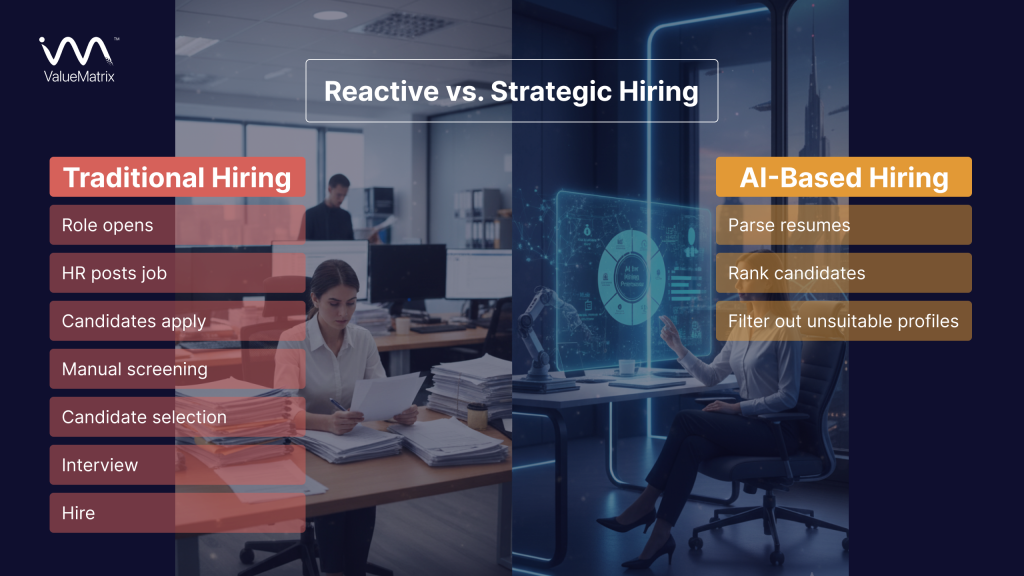
Let’s now break this down further to understand the difference between the traditional hiring model and what AI enables.
Different AI‑Driven Models: A Comparison
Traditional model (reactive)
- Role opens →
- HR posts a job →
- Candidates apply →
- Manual screening →
- Interviews →
- Hire
In the past, under the initial stages of the traditional recruitment process, there was often information irregularities between applicants and companies. While the candidate may not have complete understanding of the role, organizations sometimes found it difficult to convey the exact job description and their company culture. As a result, the invested time and communication costs increased for the relevant parties.
Also, earlier methods of manual resume screening were labor-intensive and time-consuming. It also led to screening inconsistencies at times as individuals were fatigued and thus impacted the result fairness and accuracy. Scheduling interviews was cumbersome to ensure optimal coordination among the recruiters and candidates keeping in mind their time and availability.
While the age-old model was inherently reactive, slow, and often influenced by unconscious bias or inefficiencies, AI models are constantly retrained by the feedback on hires, retention outcomes, or attrition. Such models also monitor labor trends, regional shifts, skills demand, and competitor hiring.
One of the most transformative capabilities is the shift from reactive hiring to predictive hiring with AI. Every hiring decision and its outcome, such as did the hire perform, did they stay, feeds back into the models. Over time, algorithms get smarter, boosting matching accuracy and reducing mistakes.
AI consumes lots of external data like job postings, compensation trends, skill demand, competitor moves, and macroeconomic indicators, among others. Machine learning-powered recruitment tools can enable skills‑based hiring, which means to focus on what candidates can do rather than degrees or previous titles. Therefore, companies can get access to a broader, more diverse talent pool and tap hidden potential.
Different AI‑Driven Models: A Comparison
Another interesting fact about machine learning is that it can predict the number of specialists or roles a business may need in the near term. With predictive analytics, organizations can also evaluate career moves, engagement signals, or historical patterns, thus easily recognizing staff or applicants that may be at a higher turnover risk. AI is also expected to help in skill gap mapping—wherein employees’ current skills versus future needs can be compared—and highlighting where additional investments or hiring are needed.
Optimization of the Talent Pool With AI
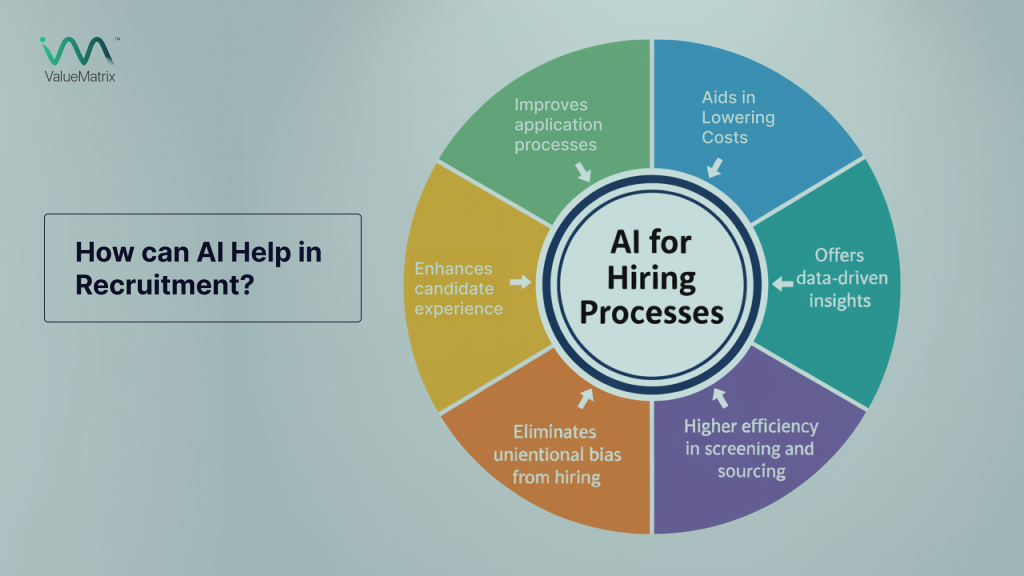
In recent years, technologies have advanced immensely and now we are seeing the rise of AI-powered tools across sectors and industries. In fact, companies are using such advanced technologies even to improve their recruitment process. Natural language processing or NLP, machine learning, and predictive analytics are aiding companies in reaching out to a higher number of candidates and thus filtering them effectively.
Resume screening and NLP
Through advanced digital tools, a large number of profiles can be reviewed in a short span of time, obtaining important criteria such as experience, skills, and education. NLP can comprehend context, synonyms, domain, and relevance, and thereby, offer richer matches vis-à-vis very rigid filters and basic keyword matches.
Cultural and value-fit analysis
Some AI tools can assess personality traits, motivational alignment, or values, and thereby, predict how an individual might align with a company’s culture.
Mitigating bias and fairness filters
By anonymizing demographic attributes and standardization evaluation criteria, some AI tools can help in reducing unconscious bias. However, AI models themselves can inherit bias, especially when models favor certain demographic profiles. For example, some research studies have indicated that several LLM-based models still favor male candidates in high-paying roles. Hence, it’s important to continuously audit models for fairness and disparate impact.
Another prime feature of AI and machine learning is that it can search candidate profiles across forums, open-source communities, or remote regions. Talent forecasting with AI also searches and engages passive talent before the roles are opened and indicates where such candidates drop off in the recruiting funnel, so as to enable recruiters to fix such bottlenecks.
AI talent prediction is helping to transform the experience for organizations and applicants at each stage of the hiring process. For example, faster responses through AI chatbots can enable candidates to make quick decisions. And such responsiveness enhances their overall satisfaction and experience.
One of the prime benefits of AI is its ability to reduce hiring time as it moves forward with only the most eligible and qualified candidates. As a result, businesses are able to improve their hiring quality. In fact, organizations using AI have managed to lower their screening costs considerably, thus reflecting its financial benefits.
By using predictive analytics for hiring, organizations can maintain their interaction with inactive candidates to ensure their interest in upcoming opportunities. This method lowers the need to start from zero every time the recruitment window opens.
AI talent prediction is also helping companies forecast future talent needs. In fact, companies such as IBM have attained 95% accuracy in predicting employee turnover, thereby addressing risks proactively. Google is supposedly using predictive models to identify skill gaps by evaluating certifications and project histories to ensure the workforce remains competitive.
Ability to Predict Talent Retention
Data-informed hiring can identify candidates who might succeed and provide tips to retain them. A company has to define the meaning of success for a particular role in terms of performance scores, tenure, promotion, or rapid productivity, thus creating the roadmap for predictive hiring models.
Data collection
Organizations need to review historical data, such as background, training, performance reviews, assessments, reasons for leaving, and interview feedback, for past and current employees.
Identify patterns and correlations
Analytics and machine learning can help in searching for features correlated with success; for example, increasing responsibilities, project types, and consistent upskilling.
Model training
Models can be trained through algorithms like logistic regression, decision trees, or neural networks to output a probability score for each candidate.
Scoring of candidates
Some of the machine learning models can be used during hiring to rank applicants and guide interviews and screening.
An oft-asked question is how does AI benefit HR and talent acquisition? To answer this, let’s recap what advantages AI unlocks:
- Proactive hiring — anticipating needs and not waiting for them to arise
- Skills foresight — detecting emerging competencies like AI, sustainability, web3
- Early identification of talent shortage — prior to gaps becoming urgent
- Time and cost savings — leaner, faster processes
- Higher quality hires and retention — better fit, longer tenure
- Explainability and transparency — use of explainable AI techniques to indicate which features influenced a candidate’s score
- Human + AI balance — AI to assist, not replace human oversight, is considered key by several hiring leaders
- Ethical and fairness audits — Continuously check for unintended bias or demographic disparities
- Fraud, deception, and AI misuse – Risk of generation of over-the-top polished resumes or false details; multilayered verification like live interviews, identity confirmation, and background checks for fraud detection
Future of AI in HR
The most valuable asset for organizations is their people, their workforce. Predictive hiring with AI is helping companies redefine how they manage this asset class. Though initially, machine learning and AI were introduced to automate hiring tasks, they have now evolved into intelligent systems that can project trends, evaluate workforce data, and aid in strategic decision-making.
As AI-powered recruitment tools are maturing, the role of HR is moving from administrative to one of strategic, concentrating on culture, leadership, and creativity. However, this shift also has a fair share of challenges. Data privacy, transparency, and ethical considerations are central to AI-based hiring adoption. The goal of AI must be to handle complex data and simultaneously allow HR leaders to enhance empathy and connection.
AI in workforce planning is likely to be one of collaboration, where machine learning enables individuals to make unbiased and future-focused decisions. A future where technology doesn’t delete the human element, but amplifies it and creates more efficient and individual-centred workplaces.
Digital transformation also has its pros and cons. Hence, companies must adhere to all of the regulations and ethical standards, and thereby prevent unwanted consequences. Adherence to such practices helps to increase applicants’ trust and be in line with legal and social expectations.
From GDPR to emerging state laws placing restrictions on automated hiring decisions, complying with regulations has become as essential as efficiency. These considerations are not barriers—they are stepping stones, and adherence to these requirements will only prove beneficial to a company’s hiring system.
AI recruitment trends are undergoing a major transformation from being a support to companies to rewriting the rules of talent acquisition and dissolving inefficiencies, as well as establishing a hiring process that is sharper and more precise than in the past. This evolution isn’t just for companies—it’s for candidates too. Amid this, job applicants will no longer need to endlessly wait for responses from age-old hiring systems and be victims of unconscious biases. AI is expected to work as their career strategist, classifying ideal roles, improving resumes in a couple of minutes, and even coaching candidates for interviews.
Conclusion
As demand complexity increases for hiring, AI can offer more than just efficiency. It aids in progressing hiring processes with every interaction by refining matching algorithms, enhancing screening criteria, and adjusting engagement tactics. AI-based hiring not only assists recruiters but also replaces the inefficiencies of traditional hiring with a faster and entirely data-driven recruitment ecosystem.
As AI reshapes the future of work, CHROs and business leaders are under tremendous pressure to hire the right talent quickly and strategically. In line with this, we’d like to add that ValueMatrix is a specialized AI hiring and talent intelligence partner that enables companies to navigate this shift with confidence. By merging proprietary AI talent data, deep market insights, and domain-specific hiring expertise, ValueMatrix helps organizations identify, evaluate, and hire high-impact professionals efficiently.
AI-powered hiring tools are already transforming HR processes by swiftly recognizing top talent, personalizing learning and development opportunities, and improving diversity and inclusion through unbiased screening. As the technologies mature, the role of HR personnel is shifting from administrative to strategic ones, focusing on culture, leadership, and creativity.
Yet, this transformation also brings new challenges. Data privacy, transparency, and ethical considerations need to be central to AI adoption. The goal is not to replace human judgment, but to augment it. The use of AI to handle data complexity must also simultaneously allow HR leaders to focus on empathy and connection.
The future of AI in HR is one of collaboration, where machines empower humans to make smarter, fairer, and more forward-thinking decisions. In this future, technology doesn’t remove the human element—it amplifies it, thus creating workplaces that are more efficient as well as human-centered.
Conclusion
As the demand for hiring grows more complex, AI offers more than efficiency—it delivers continuous improvement. By refining matching algorithms, enhancing screening criteria, and optimizing engagement tactics, AI enables hiring processes to evolve with every interaction. This leads to smarter, faster, and more accurate hiring over time. Companies that adopt AI-driven hiring not only gain access to the right talent but also build a resilient, future-ready workforce. In the race for top talent, AI isn’t just an advantage—it’s a game-changer.
As artificial intelligence reshapes the future of work, CHROs and business leaders are under increasing pressure to hire the right AI talent—not just quickly, but strategically. ValueMatrix is a specialized AI hiring and talent intelligence partner that helps organizations navigate this shift with confidence. By combining proprietary AI talent data, deep market insights, and domain-specific hiring expertise, ValueMatrix enables companies to identify, evaluate, and hire high-impact professionals efficiently.
FAQs
AI-based hiring is defined as the use of artificial intelligence technologies, natural language processing, machine learning, and predictive analytics to streamline and enhance the recruitment process. These include automation of candidate sourcing, screening resumes, evaluating skills, and predicting future performance or cultural fit.
Organizations looking to consider AI-based hiring can start small. First, they would need to identify the pain points in screening, sourcing, or retention. Thereafter, companies need to select AI tools that integrate with their existing HR systems. They also need to gauge its impact through metrics such as time-to-hire, quality-of-hire, and retention rates.
AI hiring is shifting from automation to prediction and personalization, wherein future systems can anticipate workforce needs based on market trends, offer real-time feedback loops to constantly improve hiring accuracy, and customize marketing for individual candidate profiles.
AI can analyze historical performance data, job-specific metrics, and behavior to identify traits associated with success in particular roles. Though no system is foolproof, predictive hiring models can considerably improve the odds of selecting candidates who might thrive and remain longer in an organization.
Companies need to audit algorithms regularly, use varied and representative training data, and have oversight across major hiring decisions. Organizations can also build trust by clearly communicating with candidates on how AI is used.
Some of the key concerns related to AI-based hiring are algorithmic bias, transparency, privacy (i.e., handling of personal data by complying with regulations such as GDPR), and over-reliance on AI, thus replacing human judgment.
On the contrary, no. AI is supposed to assist rather than replace recruiters. It handles data-heavy and repetitive tasks, thereby allowing recruiters to focus on strategies, culture alignment, and relationship-building, especially in areas where human intuition is irreplaceable.
About Us
ValueMatrix helps organizations build culturally cohesive teams with AI-powered recruitment and retention strategies. We educate corporate leaders on the need to involve and encourage all generations to adapt to enterprise values and participate actively to gain excellence.
Our AI-powered platform transforms talent acquisition with intelligent hiring techniques backed by established psychological frameworks. We partner with HR professionals to conduct unbiased and holistic assessments for aspiring candidates.