
Key Takeaways:
- Replacing an employee costs 50–200% of their annual salary
- 90% of employers are concerned about employee retention and consider learning opportunities as a key strategy
- Employees who get meaningful recognition are 45% less likely to leave over a period of two years
- 60% of large enterprises have implemented AI tools in HR functions
- Global employee engagement fell to 20% in 2025, compared to 23% in 2022
Every year, organizations pour millions into recruiting while watching their best people walk out the door. According to Gallup’s landmark research, the annual cost of voluntary turnover to U.S. businesses is approximately $1 trillion, while replacing a single employee can cost anywhere from one-half to two times their annual salary. At the same time, Gallup’s Employee Retention and Attraction Report 2025 found that 60% of employees considering a new role rank better work-life balance and well-being as their top priority when evaluating their next employer, as these were lacking at their previous organisation.
Traditional retention strategies like exit interviews, annual engagement surveys, and manager gut feelings almost always catch problems after disengagement has already taken root. By then, it is often too late. AI-driven talent retention strategies offer a fundamentally different approach. Instead of asking why someone left, AI helps HR leaders predict retention risks, identify who is likely to leave next, and determine what to do about it.
By combining workforce intelligence, data-driven predictive planning, predictive analytics, as well as behavioural insights, organisations can identify attrition risks earlier, personalise employee experiences, and make smarter, data-driven retention decisions. As workforces become more dynamic and distributed, AI-driven retention is rapidly becoming a strategic advantage rather than a competitive differentiator.
What Are AI-Driven Talent Retention Strategies?
AI-driven talent retention strategies essentially combine workforce intelligence, predictive analytics, as well as machine learning to help organisations understand employee behaviour, identify retention risks early, and personalise interventions before disengagement turns into employee turnover. Rather than reacting to resignations, HR teams can make proactive, data-informed decisions that improve workforce stability.
Retaining top talent is undoubtedly one of the core challenges that modern organisations face today. Traditional retention programmes tend to rely on annual surveys, performance reviews, and exit interviews. They often reveal problems only after employees have already disengaged. As employee expectations evolve and competition for skilled professionals intensifies, organisations need a smarter way to understand what keeps employees engaged.
The need for this shift has now become quite evident. According to the LinkedIn Workplace Learning Report 2024, about 90% of organisations are concerned about employee retention. Moreover, learning opportunities and career development ranked as their top retention strategies.
AI helps to address this challenge by continuously analysing workforce signals, including engagement levels, career progression, learning activity, manager interactions, and collaboration patterns. Rather than just reporting historical data, machine learning aims to identify the early indicators of disengagement, burnout, or flight risk. This enables HR teams to intervene before employees leave.
The impact of proactive retention is very significant. A 2024 Gallup and Workhuman research states that employees who are well-recognised are 45% less likely to leave their organisation over a two-year period.
This evolution has given rise to workforce intelligence, where employee data, behavioural analytics, and predictive modelling provide HR leaders with real-time visibility into workforce health. Essentially, retention analytics helps organisations to predict attrition, improve engagement, and make evidence-based talent decisions that strengthen long-term workforce performance.
How Do AI Talent Retention Strategies Compare with Traditional Retention Programs?
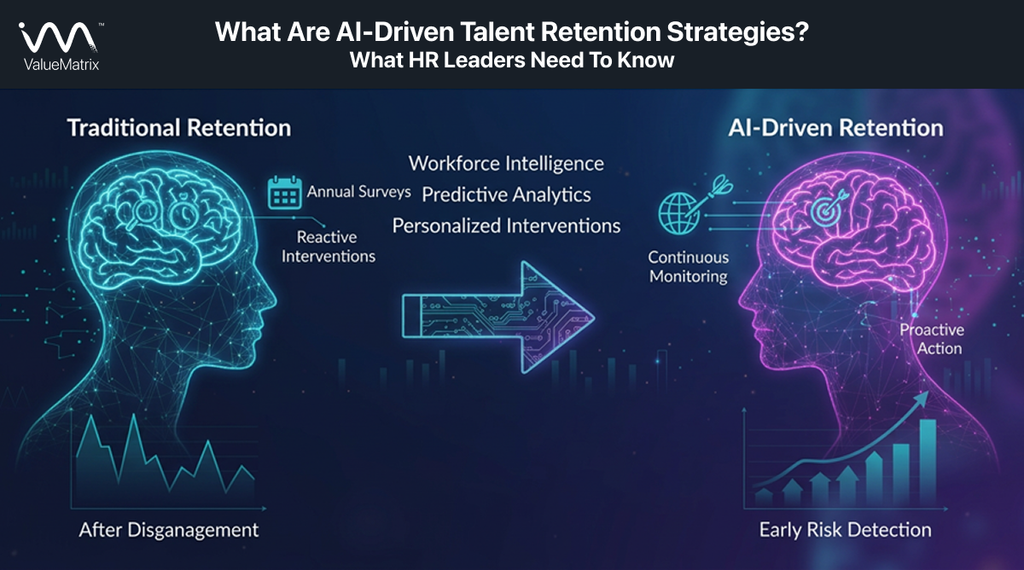
Traditional retention programmes rely on historical data to explain why employees left, whereas AI-driven talent retention strategies use predictive analytics to identify who may leave and why.
By analysing workforce behaviour, engagement, as well as career progression continuously, AI assists HR teams to intervene before disengagement becomes resignation. This proactive approach is increasingly critical, as Mercer’s 2024 Global Talent Trends report states that about 82% of employees tend to be at risk of burnout, which can be one of the strongest predictors of voluntary turnover. AI helps organisations detect these early warning signs and personalise interventions before valuable talent is lost.
Where Does AI Support Employee Retention?
AI supports employee retention metrics across the entire employee lifecycle by helping organisations make smarter, data-driven workforce decisions. It helps to improve employee engagement through continuous sentiment analysis and feedback monitoring. It also enables career development with personalised learning and internal mobility recommendations, strengthens performance management through real-time coaching insights, and enhances workforce planning by forecasting skills gaps and attrition risks.
Together, these capabilities help HR leaders create personalised employee experiences, reduce turnover, and build a more engaged, resilient, and future-ready workforce.
Why Are AI Talent Retention Strategies Becoming Essential?
AI-driven talent retention strategies are very important today as they help organisations understand employee behaviour, predict attrition risks, and take proactive action before valuable talent is lost. When workforce intelligence is combined with predictive analytics, HR leaders can significantly improve engagement, reduce turnover, and build a more resilient workforce.
Organisations that are unable to understand employee behaviour risk losing their best employees to competitors. Traditional retention initiatives are dependent on historical data, making it difficult to identify disengagement until it is too late. AI changes this by continuously analysing workforce data and delivering real-time insights that assist HR teams in making faster, more informed decisions.
What drives the cost imperative in retention?
High employee turnover can have an impact on more than recruitment budgets. A single resignation can result in productivity losses, project delays, disrupted collaboration, as well as the loss of valuable institutional knowledge. Organisations that take a proactive, data-driven approach to workforce management are better positioned to minimise these risks.
As per the Josh Bersin Company, organisations with advanced HR skills tend to be 2.5 times more profitable than those with less mature analytics practices. This fact highlights why AI-driven talent retention strategies have become a strategic investment. They are essential as they help HR leaders identify retention risks early and improve long-term workforce stability.
How does real-time visibility strengthen retention outcomes?
AI helps with continuous workforce listening by analysing employee feedback, engagement trends, and sentiment in real time, so companies no longer have to rely on annual surveys. HR leaders can now gain ongoing visibility into employee experience.
How does prediction change the retention game?
Machine learning models help businesses analyse behavioural patterns, performance trends, and workforce signals. This further helps to identify employees who may be at risk of leaving.
How does scale make AI retention a necessity?
Managing hybrid and globally distributed teams requires continuous workforce visibility. AI provides a unified view of employee engagement across locations. This, in turn, helps organisations make consistent talent decisions at scale.
How Do AI Talent Retention Strategies Actually Work?
AI retention systems work by collecting data from HRMS, performance platforms, and surveys. It structures and analyzes the data using machine learning. Then it generates flight-risk scores and tailored recommendations. It also automates retention workflows like stay interviews and personalized development plans.
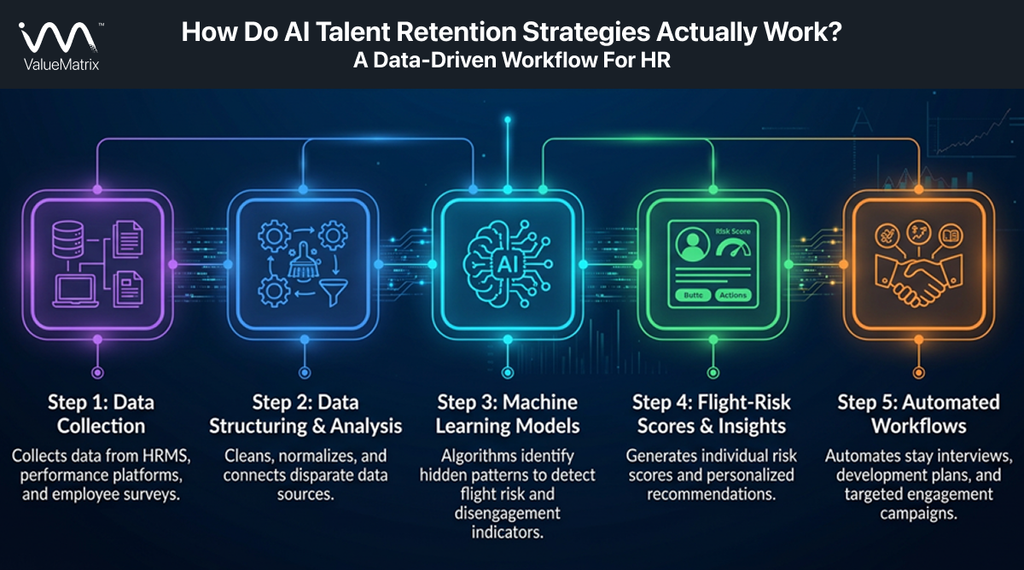
AI-powered retention systems are not magic. They follow a properly structured, data-driven workflow that aims to turn raw employee information into actionable retention insights.
Step 1: Data Collection Across Employee Systems
The process essentially starts with collecting data from across the employee technology stack. The data is often collected via HRMS platforms, performance management systems, engagement survey tools, or employee feedback channels.
Step 2: Data Structuring and Analysis
Raw data is not always usable. AI platforms help to clean, normalize, and structure the data. It also removes duplicates, standardizes formats, and connects disparate sources.
Step 3: Machine Learning Models
Structured data feeds machine learning algorithms. These algorithms identify patterns that are not visible to the human eye. These models detect correlations: employees who haven’t received a promotion in 24 months and whose manager has high team turnover are 3x more likely to leave, and generate risk scores for every individual in the organization.
Step 4: Retention Insights and Recommendations
The model outputs are not simple raw scores. They are, in fact, actionable insights for the HR team:
Here is an example:
“Sarah Chen, Senior Engineer, high flight risk.”
Recommended actions: “Compensation review, career conversation, stretch assignment.”
Step 5: Automated Retention Workflows
The top platforms believe in automated retention actions, triggering stay interview requests, enrolling at-risk employees in personalized learning programs, scheduling manager check-ins, or deploying targeted engagement campaigns.
Which Are the Core Applications of AI Talent Retention Strategies?
Core AI retention applications include employee engagement monitoring, personalized career development, internal mobility, succession planning and performance analytics. These applications deliver measurable retention outcomes across the talent lifecycle.
The real value of AI retention can be found in its practical applications throughout the employee lifecycle. When applied correctly, in fact, AI touches every stage of the talent journey. It tracks how people feel at work, how they grow, move, and perform.
How does AI improve employee engagement and experience?
AI-powered sentiment analysis tools scan pulse survey responses, feedback comments, and even communication tone to detect shifts in engagement in real time. Gallup’s State of the Global Workspace 2026 data shows that global employee engagement fell to 20% in 2025. This increases voluntary turnover.
AI-driven theme detection identifies engagement trends four to six weeks faster than manual analysis, giving organizations an important head start. Continuous AI-powered feedback loops are beneficial to organizations to move from annual engagement check-ins to always-on workforce listening.
How does AI transform learning and career development?
Career stagnation is one of the top drivers of high employee turnover. AI helps to personalize learning by analyzing an employee’s current skills, career aspirations and the organization’s future skill needs. It recommends courses, projects, and mentorship opportunities tailored to each individual.
How does AI strengthen talent management and retention strategies?
AI supercharges succession planning by identifying high-potential employees before a leadership gap can happen. It analyzes performance trends, readiness indicators, and career trajectories to build succession pipelines that are data-backed rather than driven by gut feeling.
How does AI enhance workforce performance and productivity?
AI-Powered performance analytics go beyond annual reviews. AI helps organisations to track goal progress in real time, identify productivity patterns, and flag when an employee’s output or collaboration drops below baseline, often an early indicator of disengagement. It also enables HR managers to intervene with coaching or support before performance issues end up in turnover decisions.
What Actually Matters When It Comes to AI Talent Retention Tools?
What matters most in retention tools is predictive accuracy, real-time sentiment monitoring, workforce dashboards with actionable insights, and the ability to unify fragmented employee data into a single intelligence layer.
Businesses need to know that not every retention platform will provide meaningful outcomes. As SHRM’s 2026 State of AI report found, about 60% of large enterprises use AI tools in several HR functions; the market is flooded with a lot of options. The challenge for HR leaders is separating genuine capability from hype.
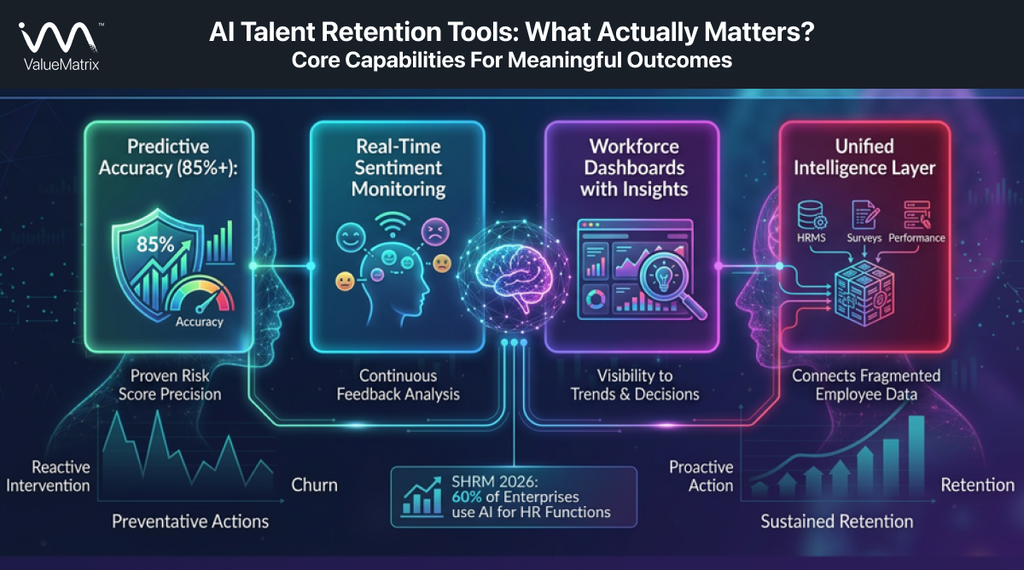
What are the must-have features in retention solutions?
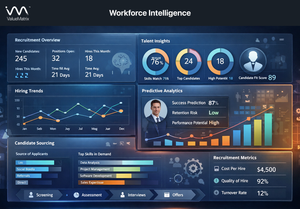
Businesses need to look for platforms that include predictive analytics with proven accuracy rates (85%+), attrition forecasting that identifies individual flight risk and team-level patterns. They also include sentiment monitoring across multiple channels (surveys, feedback, communications) and workforce dashboards that provide HR and managers with real-time visibility. The best tools will not just show data; they also go a step further and recommend actions and measure their impact.
What are the categories of talent retention technology?
The landscape includes employee engagement platforms (focused on surveys and listening), people analytics tools (focused on metrics and reporting), and workforce intelligence software (focused on predictive modeling and automated workflows). Each category has strengths, but the real impact essentially comes from tools that cross these boundaries.
Why are intelligent workforce platforms on the rise?
Unified intelligent workforce platforms combine employee data from across the organization, apply AI-powered analytics for retention insights, and deliver end-to-end workforce visibility. These platforms eliminate the fragmentation that plagues traditional HR tech stacks and give leaders a single source of truth for retention decisions.
What Are the Key Metrics to Measure Talent Retention Success?
The six metrics include retention rate, voluntary turnover, engagement score, internal mobility rate, and high-performer retention rate. They help to measure retention success and validate the ROI of AI-powered strategies.
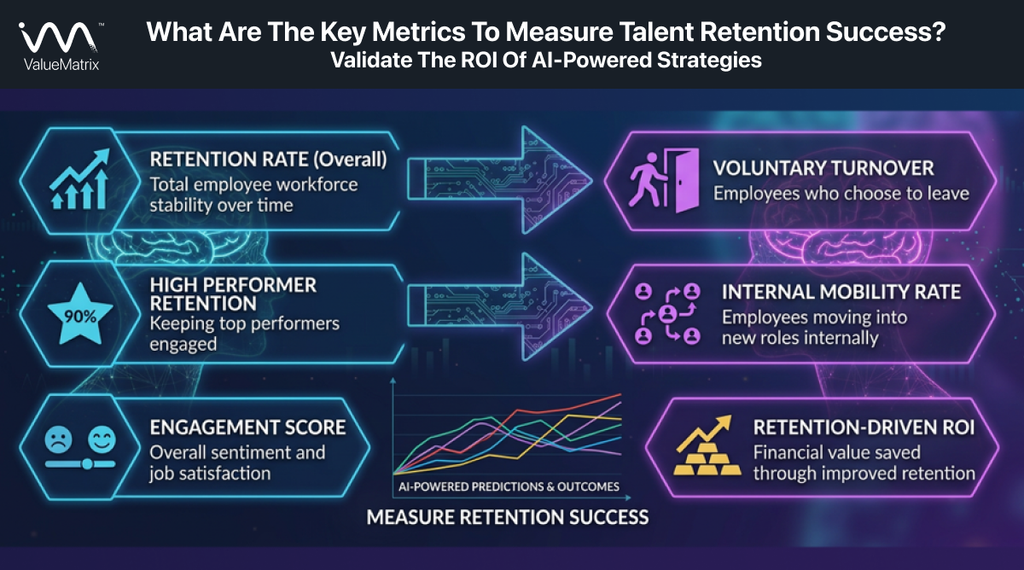
| Metric | What It Measures | Why It Matters |
| Employee Retention Rate | Workforce stability over a period | Direct measure of retention effectiveness |
| Voluntary Turnover Rate | Employees who leave by choice | Key indicator of attrition risk and engagement health |
| Employee Engagement Score | Sentiment, motivation, and commitment | Leading predictor of retention outcomes |
| Internal Mobility Rate | Employees moving into new roles internally | Reflects career growth opportunities and development culture |
| High Performer Retention Rate | Retention of top-performing talent | Protects business performance and competitive advantage |
How to Find the Right Talent Retention Platform for Your Team?
Organizations do not need multiple disconnected systems. They need one platform that provides a complete, unified view of employee engagement and retention. The fragmentation of HR tools, one system for surveys, another for performance, a third for learning, creates blind spots that prevent leaders from seeing the full picture of workforce health.
The ValueMatrix Way: ValueMatrix helps organizations understand employees beyond performance metrics. With the help of behavioral intelligence and predictive analytics, it enables smarter talent acquisition and retention strategies while improving workforce stability. Now, instead of guessing who is at risk, leaders get data-backed insights that drive real retention outcomes.
Summary
Talent retention strategies that are driven by AI can be detrimental as they help organizations move from reactive retention to proactive workforce management. These strategies combine predictive analytics, continuous listening, and automated workflows, and HR leaders can identify flight risk three to six months in advance. They can then implement targeted interventions and reduce voluntary turnover by up to 30%. Today, global engagement sits at just 20%, and replacement costs can even reach 200% of an employee’s salary. AI-powered hiring and retention are therefore no longer optional; it is a strategic necessity for every organization serious about keeping its best people.
Conclusion
The businesses that win the talent war are not necessarily the ones that hire the most aggressively. They will be the ones who retain the best talent. AI-driven talent retention strategies give HR leaders the tools to predict, understand, and prevent attrition before it happens. With workforce intelligence, real-time analytics, and personalized employee experiences, businesses can ultimately move from asking “why did the employee leave?” to knowing exactly “what will keep the employee engaged here?”
Ready to build a smarter talent retention strategy? Uncover how ValueMatrix helps organizations predict retention risks, improve engagement, and strengthen workforce performance with behavioral intelligence and predictive analytics.
Frequently Asked Questions
What is a talent retention strategy?
A talent retention strategy essentially is the collection of practices, programs, and policies an organization uses to keep its employees engaged and prevent voluntary turnover. It covers compensation, career development, recognition, manager effectiveness, and workplace culture.
How do AI talent retention strategies work?
AI retention strategies use machine learning models to analyze employee data, engagement scores, tenure, compensation, performance, and behavioral signals. This helps to predict which employees are at risk of leaving and recommend proactive interventions to keep them engaged.
Why are talent retention strategies important?
Turnover costs organizations 50–200% of an employee’s annual salary. With only 20% of the global workforce engaged and voluntary turnover costing U.S. businesses over $1 trillion annually, effective retention strategies are critical to financial performance and competitive advantage.
Can AI predict employee turnover?
AI can spot turnover risk signals but cannot predict with certainty. External factors like personal circumstances and market shifts remain unpredictable. Best used alongside manager judgment as one input in a broader retention approach.
What are the best HR strategies for talent retention?
The most effective strategies include continuous engagement monitoring, personalized career development, competitive compensation, manager training, internal mobility programs, and AI-powered predictive analytics that enable early intervention.
How do talent acquisition and retention strategies work together?
Acquisition and retention are indeed the two sides of the same coin. AI-powered platforms analyze retention data to inform hiring decisions, identifying which candidate profiles and sources produce the longest-tenured, highest-performing employees, creating a continuous AI-based talent intelligence loop.
What role does employee engagement play in retention?
Engagement is an important indicator of employee retention, as connected employees generally stay longer. However, it does not offer a guarantee. Factors like pay, growth, and personal circumstances also matter significantly. High engagement is a helpful signal, but it must be supported by broader retention efforts.
How can talent management and retention strategies reduce attrition?
By integrating AI-powered succession planning, internal mobility programs, personalized learning paths, and real-time performance analytics, organizations address the root causes of turnover, stagnation, lack of growth, and poor manager relationships before employees decide to leave.
Which metrics should HR leaders track for retention success?
Track employee retention rate, voluntary turnover rate, engagement score, internal mobility rate, and high-performer retention rate. These metrics provide a complete picture of workforce stability and retention effectiveness.
Why should organizations invest in AI-powered retention platforms?
Organizations invest in AI-powered retention platforms to better spot risks early and take action before people leave. They can also help HR teams make faster, more informed retention decisions.