

Key Takeaways
- AI makes psychometric assessment more accurate and efficient with data-driven insights.
- It can generate customized questions based on a candidate’s capabilities.
- Gamified tests evaluate features such as real-time reactions and risk tolerance.
- Organizations must have a strong governance policy to protect candidate data.
- ValueMatrix provides a comprehensive AI platform that is easy to integrate.
According to a BCG survey, 54% of the companies experimenting with AI in HR are using it for talent acquisition. AI implementation is going beyond resume screening and interview scheduling, with traditional assessment tests undergoing a tech makeover. An integral part of this makeover is AI-powered psychometric assessment tests. Cognitive and behavioral tests are being upgraded with ML and NLP features to make them data-driven and more accurate. This post covers AI impact on psychometric tests, its benefits and challenges, and best practices for organizations to follow.
What Is A Psychometric Assessment Test?
Psychometric assessment tests are psychological examinations to assess a candidate’s personality, behavior, cognitive abilities, and intelligence. These tests evaluate whether an individual’s mental abilities suit the requirements of the job profile. Verbal and diagrammatic reasoning, numerical reasoning, error identification, situational and logical ability tests are a part of psychometric assessment.
Organizations have been using these tests to assess candidates’ traits that cannot be evaluated in a written test or a face-to-face interview. For example, an organization receives thousands of applications from fresh graduates for a management trainee role. As the applicants are new out of university, they have little work experience and their resumes are not insightful. The organization uses psychometric tests to shortlist the most suitable candidates from the applicants.
Psychometric tests allow organizations to assess an individual’s emotional approach to work, willingness to follow rules, ability to take risks, and work in a team. Recruiters can also know whether the candidate is suitable for a client-facing role, teamwork, or an independent role where they can work without assistance. Moreover, companies use these tests as part of employee appraisal reviews and learning & development programs.
AI-Powered Psychometric Assessment
AI makes psychometric assessment more accurate and efficient with data-driven insights. The AI tools analyze results against predefined standards and compare candidates’ potential with existing high-performing employees, enabling recruiters to be more accurate in identifying the right candidates.
In the next section, let’s see how AI-driven assessments are better than traditional psychometric tests.
Why Are AI-driven Psychometric Tests Better Than Traditional Ones?
Traditional psychometric assessments test candidates’ behavior, personality traits, and suitability to the job. AI systems build on these foundations by including adaptive testing, predictive analytics, and role-specific recommendations.
| Aspect | Traditional psychometric tests | AI-supported tests |
| Candidate evaluation | Uses the individual test scores alone to evaluate the applicant. | Evaluates by combining the scores with job requirements, historical hiring data, and past models. |
| Predictive capability | Measures the scores to analyze the current traits but has limited scope for forecasting. | Uses machine learning to predict job success, learning ability, and growth potential. |
| Personalization | Same test pattern for all the candidates. | Enables customized testing based on experience, requirements, and skills. |
| Reporting | Produces standardized scores and rankings. | Generates comprehensive reports with scores, strengths, role fit, and behavioral insights. |
| Assessment speed | Often requires manual review or batch processing. | Evaluates the assessment instantly and prepares a comprehensive report. |
How Does AI Support Various Types Of Psychometric Tests?
Machine learning (ML) and natural language processing (NLP) enable AI systems to generate customized questions based on a candidate’s capabilities. AI tools support a comprehensive personality evaluation by analyzing not only the given test but also the individual’s past work history and their social media activities. Read to know how AI powers various types of psychometric tests.
Cognitive Ability Tests
Cognitive tests assess an individual’s mental capabilities. They measure problem-solving, reasoning, and learning abilities via numerical, verbal, logical, and spatial reasoning. But traditional cognitive tests use a static format for all candidates. This means all candidates receive the same set of questions or of the same level of difficulty, irrespective of their capabilities. AI addresses this by dynamically customizing the difficulty level based on the candidate’s ability.
For example, if an individual answers a question correctly, the difficulty level of the next question increases. If they fail to answer, AI makes the next question easier. This adaptive approach gives deeper insights into a candidate’s ability.
Personality Tests
These tests explore a candidate’s preferences and responses to a given situation. Some of the prominent personality tests include The Big Five (OCEAN) (Openness, Conscientiousness, Extraversion, Agreeableness, and Neuroticism) and DISC (Dominance, Influence, Steadiness, and Conscientiousness). AI systems make the assessment comprehensive by going beyond a standardized test. It enables broader evaluation covering social media posts and texts.
For example, research done by the University of East London (UEL) in 2026 found that machine learning can significantly improve DISC assessment. Most successful machine learning models tested by the researchers yielded 93% accuracy, showing that AI models can replicate traditional tests. Moreover, researchers found that the assessment can be equally effective with a shorter questionnaire (10 questions vis-a-vis 40). Researchers also say that machine learning categorizes individuals into overlapping behavioral types, instead of boxing them into a single personality type.
Research lead Dr Mohammad Hossein Amirhosseini, associate professor in Computer Science and Digital Technologies at UEL, says, “What our research shows is that machine learning can retain that simplicity while adding a deeper layer of insight, helping organizations understand behavioral patterns with greater accuracy and flexibility.”
Behavioral Tests
These tests assess a candidate’s interaction and reactions in a workplace. They evaluate an individual’s decision-making patterns, work preferences, leadership style, adaptability, and teamwork to predict workplace behavior. AI tools analyze not only verbal responses but also non-verbal cues such as facial expressions and eye movements. Gamified tests evaluate features such as real-time reactions and risk tolerance. NLP analyzes whether the textual responses reflect enthusiasm, openness, and emotional stability.
For example, AI-powered tests can generate simulated workplace scenarios and evaluate a candidate’s response in such scenarios. It helps the hiring team know how the individual would respond in situations such as tight deadlines, conflicts with team members, and leadership situations.
Specialized Workplace Assessments
They are a combination of tests, including emotional intelligence, situational judgement, and learning agility tests. Emotional intelligence tests evaluate an individual’s ability to identify, understand, and control their own emotions as well as others’. In situational judgement tests, candidates need to rate different scenarios as the least to best responses to a given situation. Learning agility evaluates the ability to unlearn old traits and acquire new skills necessary for the role.
AI systems generate hundreds of scenario-based tests without extensive contributions from subject matter experts. This reduces test generation time and enables recruiters to create situations even for novel concepts.
What Are The Benefits Of AI In Psychometric Tests?
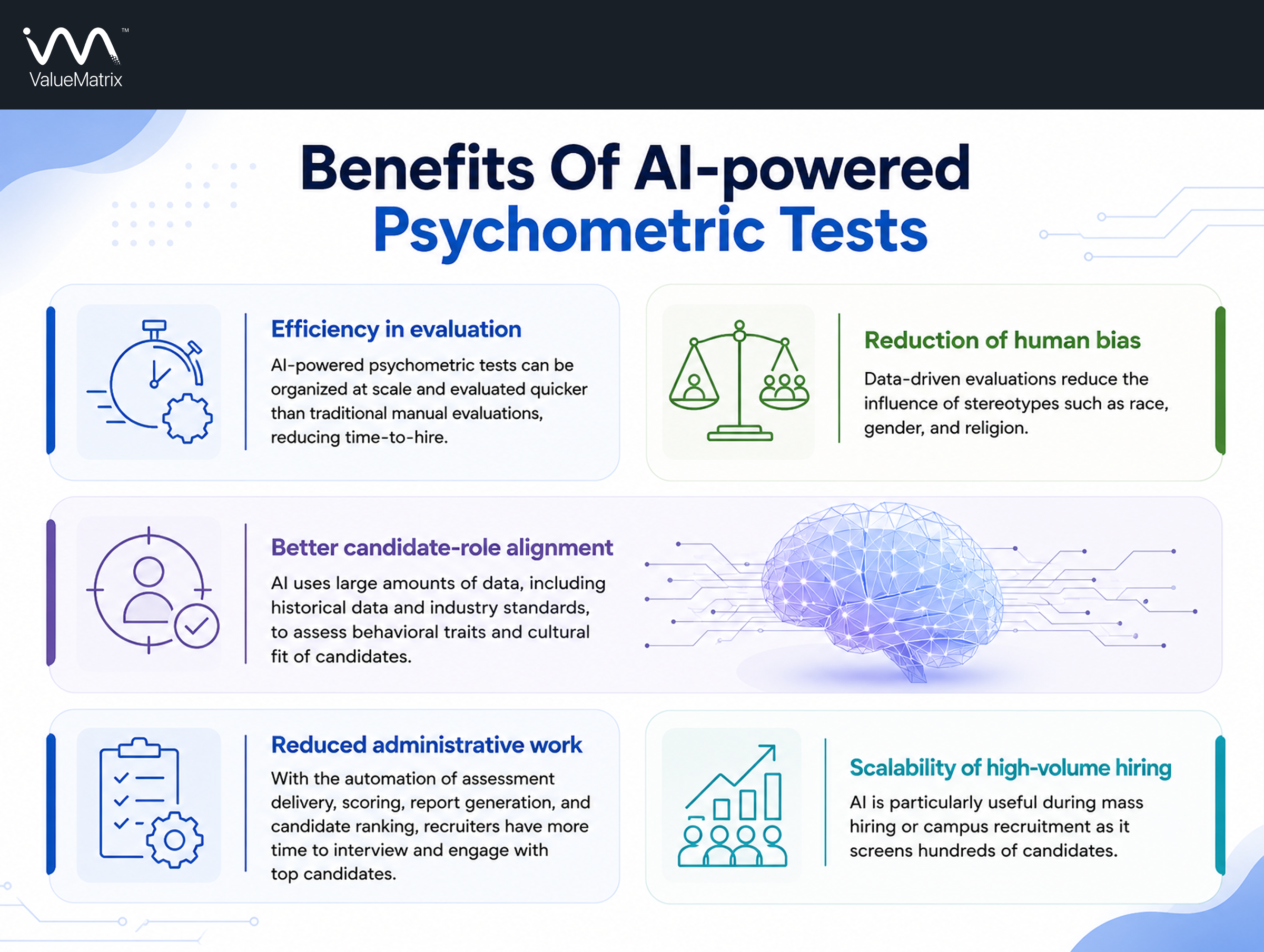
AI tools evaluate thousands of tests within minutes, cutting hiring time and costs. Automation of labor-intensive tasks speeds up the process, enabling companies to scale up hiring; recruiters can focus on human-sensitive tasks. Moreover, AI-standardized processes have the potential to eliminate biases.
Efficiency in evaluation
AI-powered psychometric tests can be organized at scale and evaluated quicker than traditional manual evaluations, reducing time-to-hire. Through AI evaluation, companies can reduce human intervention in the recruitment process, thereby achieving cost efficiencies. Instant feedback on candidates enables recruiters to make faster yet informed decisions.
Reduction of human bias
AI automates the testing and evaluation process. It uses the same standards to evaluate all the candidates, irrespective of their background. Data-driven evaluations reduce the influence of stereotypes such as race, gender, and religion. It considers multiple data points rather than fixating on a single trait to select or reject a candidate.
Better candidate-role alignment
AI uses large amounts of data to assess behavioral traits and cultural fit of candidates. It analyzes historical data and industry standards for better candidate-role alignment. Predictive analytics analyzes the long-term success of the candidate in the role and their growth.
Reduced administrative work
With the automation of assessment delivery, scoring, report generation, and candidate ranking, recruiters have more time to interview and engage with top candidates.
Scalability of high-volume hiring
AI is particularly useful during mass hiring or campus recruitment as it screens hundreds of candidates from a large applicant pool, while maintaining consistency and speed.
What Are The Challenges Of AI In Psychometric Testing?
AI-powered evaluation systems carry the risk of perpetuating historical hiring biases. Data privacy and security are major concerns, as collecting candidates’ personal information may lead to ethical issues; storing sensitive data of individuals in an access-controlled environment needs strict governance policies and involves costs.
Potential biases in algorithms
Though AI is widely believed to reduce biases, it may perpetuate existing discrimination if the historical data is biased. Moreover, algorithms may favor or discriminate against certain personality traits, thereby proving disadvantageous to some candidates.
Privacy concerns of candidates
AI collects a huge amount of candidate data from their video interviews, audio interactions, and social media to analyze their behavior. Tracking an individual’s facial expressions and hand movements during an interview and storing them is often considered intrusive. Moreover, candidates may not be comfortable with the idea of AI analyzing their social media activity.
Transparency issues
Should the candidates be told about the usage of their professional and personal information? Will they like the idea of companies storing their information for years, whether they get hired or not? These are some grey areas that companies need to contemplate while powering their psychometric tests with AI.
Data access and safety
Storing vast amounts of candidate data and securing its access is a major challenge for organizations. A breach can result in the leakage of sensitive information about their current and prospective employees. In fact, 73% of the companies surveyed in Deloitte’s State of AI in the Enterprise 2026 report see data privacy and security as the top AI risk.
Cost complexity
Implementing AI and integrating it with the existing HR systems involves significant investments in software and training. Smaller organizations may find it challenging.
What Are the Best Practices For Using AI In Psychometric Assessment?
Audit the AI systems regularly and update them with new data to maintain their accuracy. Ensure AI analysis is used in combination with human judgment and other types of assessment such as human interviews. Draft a governance policy that is strong on data privacy and security, and transparent about data usage.
- Use psychometric assessments that are based on scientific research and validated for reliability and accuracy. AI should be used to enhance their use but should not replace proven principles.
- Program the systems to identify role-specific personality traits and cognitive abilities. This will increase the accuracy of AI analysis.
- Recruiters should combine human judgment with AI insights. AI is only a support tool that complements traditional hiring methods such as interviews and work samples.
- Regularly monitor the outcomes to ensure accuracy and fairness of AI analysis and insights. Update the models with the latest data and features to maintain prediction accuracy.
- Take measures to protect candidate data through data security methods and access control. Make sure your data governance policy complies with the local privacy laws.
- Explain data collection and storage policies to candidates. Tell them what information is collected and how it is used to maintain transparency.
- Train recruiters and hiring managers to interpret AI-powered psychometric analysis by using the recommendations and understanding AI limitations. They need to know that their decisions cannot solely depend on AI insights.
AI-supported psychometric tests are here to stay. By combining scientifically validated tests with AI-driven analytics and deep insights, organizations can make more accurate hiring decisions and speed up their recruitment process. High-quality data helps in mitigating hiring bias. However, AI is not a replacement for sound human judgment. Hiring managers must be trained to make informed decisions using AI insights but also understand its limitations. A comprehensive governance policy will help organizations use AI to their benefit but ethically and within the legal framework.
FAQs
- What is an AI-powered psychometric assessment test?
AI-powered psychometric test is a recruitment tool that combines traditional psychometric assessment with AI tools to evaluate candidates’ cognitive abilities, personality traits, behavioral tendencies, emotional intelligence, and job fit. AI offers adaptive testing, automated scoring, predictive analytics, and detailed reporting for a comprehensive evaluation of candidates.
- How does AI improve psychometric testing?
AI improves psychometric testing by automating scoring, adapting questions to candidates’ abilities, analyzing response patterns, and providing deeper insights to recruiters. It also speeds up the process; if designed and implemented properly, it can reduce hiring biases.
- Are AI psychometric assessments accurate?
AI tests can be accurate if they are built on scientifically validated psychometric assessments, trained on high-quality data, and reviewed regularly. AI can be an improvement over traditional assessments, but its reliability depends on responsible implementation, ongoing validation, and human oversight.
- Can AI reduce bias in psychometric assessments?
Yes, AI can reduce hiring bias by standardizing recruitment criteria and minimizing the influence of human opinions. It can also monitor hiring patterns to identify biases across different demographic groups. However, if it is trained on biased or unrepresentative data, it tends to continue with existing biases. Regular audits and human oversight are necessary to identify AI biases and take corrective measures.
- What traits do AI psychometric tests measure?
AI psychometric tests measure a range of attributes, including cognitive abilities (such as logical reasoning and problem-solving), personality traits, emotional intelligence, communication style, decision-making, adaptability, resilience, leadership potential, teamwork, motivation, and cultural fit.
- How are AI psychometric tests used in recruitment?
Organizations use AI psychometric tests to evaluate candidates beyond their resumes and work experience. They provide deeper insights into an individual’s ability to work in teams, take risks and initiatives, and learn, among others.
- How can organizations choose the right AI psychometric assessment platform?
Organizations must choose a platform that can be easily integrated into the existing systems and is scalable. It should have features such as predictive analytics, adaptive testing, and customizable assessments. The platform should have robust bias monitoring mechanisms and strong security protocols.
- Can AI psychometric assessments support employee development?
Yes, AI psychometric assessments support employee development by providing detailed insights into their performance. They help organizations identify individual strengths, skill gaps, learning styles, leadership potential, and development needs, while customizing learning and development programs for employees.
- Are AI-based psychometric assessments suitable for all roles?
AI assessments can be used for a range of roles from entry-level to leadership hiring. However, the tests should be designed to suit the competency scope of each job. For example, cognitive ability tests may be more important for analytical positions, while personality, emotional intelligence, and situational judgment assessments may carry greater weight for customer-facing or managerial roles.
- Can AI psychometric tests replace interviews?
No. AI psychometric tests are designed to complement, not replace, interviews and other hiring methods. They must be combined with skill tests, interviews, and reference checks for a more accurate assessment of the candidates.