

Till now, recruiters have been relying on everything from their gut feeling to their experience while screening candidates. They have realised that this traditional approach has led to faulty outcomes.
Especially when a more data-based and stable form of recruitment process is available, which locks out human factors like biases, emotions, and personal preferences.
This robust form of recruitment is known as Talent Intelligence recruitment. It uses evidence-based data points to evaluate candidates, which are free from human flaws, and gives a more objective map of candidates’ hireability.
Here is the guide to talent -intelligence-based recruitment!
What are its key components?
1. Applicant Tracking System
ATS is the cornerstone of any hiring tech stack. ATS can automate tedious tasks like CV screening and interview scheduling. This leaves recruiters more time for the personal interviews, and they can really get to know them.
This helps them gauge them on important markers like cultural alignment, growth mindset, and emotional intelligence. ATS allows you to rank candidates on metrics such as skills, education, and even culture fit.
It can also track the performance of candidates Post-Hire. So, you can study the data and determine which factors are most predictive of success in your company and create a roadmap for future hiring.
2. Predictive Analytics
It is one of the main pillars of talent-intelligence-driven recruitment strategies. Predictive Analytics scans past hiring data, such as performance reviews, turnover records, and successful career trajectories, analyzes what worked and what didn’t, to forecast future hiring outcomes.
3. AI-Powered Screening
AI-Powered screening tools can parse thousands of resumes in seconds and look for critical information such as skills and experience. AI screening is particularly handy in gleaning information from a variety of resume layouts. Once the relevant data is mined, AI then maps it against the job description using keyword-matching to find job-fit candidates.
Why is Talent intelligence-based hiring important?
Here are some of the reasons why Talent intelligence-driven driving can be a game-changer for your company.
1. Improves Candidate Experience
Talent intelligence puts the hiring process on a fast track, which saves candidates’ precious time and makes the feedback loop faster and transparent for them.
The Talent intelligence-driven hiring approach is also objective. This means these tools are also fair and unbiased. So the candidates, as a result, have no nagging pressure to impress some recruiter or the fear of being judged based on their skin colour, accent, or where they come from.
2. Improves Cost Per Hire
ATS can parse resumes in seconds and filter out candidates who are not a match. This not only saves time but also cuts down the cost you would’ve accrued otherwise due to those unwanted resumes clogging up your system.
The candidates who are screened in are put through a faster hiring cycle through various psychometric evaluations and gamified assessments, which takes 10-12 minutes. A far cry from the old approach, where candidates had to undergo multiple, hour-long videos in each screening round.
3. Improves Quality Of Hire
Predictive analytics tools can extract the data from the past hiring drives and learn what worked and what didn’t. These tools then use this knowledge to accurately predict which set of behavioral traits has the best chance of succeeding at your company.
This predictive model gives you a strong blueprint of an ideal and culture-fit candidate.
4. Speeds Up Your Hiring Process
We have already covered how ATS can do cumbersome and time-consuming tasks like parsing resumes and scheduling interviews in a hurry. This not only saves money but also frees up valuable time of HR to focus on the human side of things, like Culture-fit, EQ, and adaptability traits.
5. Simplifies Recruitment Dashboards
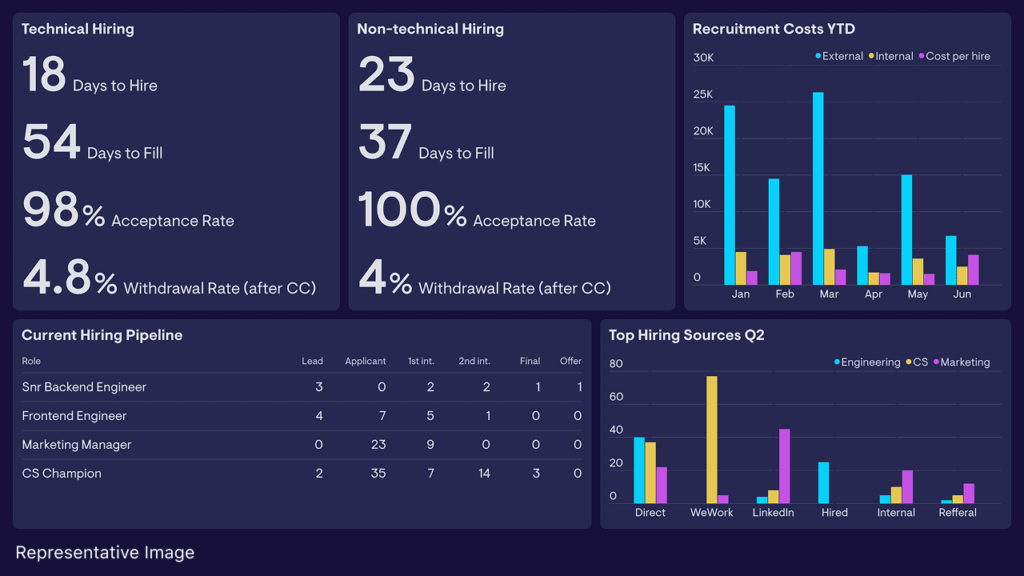
Recruitment Dashboard is a tool that displays all the hiring process-related KPIs, like Time to Hire, Cost per Hire, Quality of Hire, and Offer Acceptance Rate, all on one screen. It helps HR visualize the hiring process and see whether the trajectory of their hiring process is meeting the company’s objectives or not.
6. Foster DEI Culture
Talent intelligence-driven recruitment, through its blind screening and evaluation, weeds out human prejudice. Furthermore, companies can optimize their hiring funnel for diversity by adopting a science-based behavioral approach like the “Inclusion-Nudges Framework”, which utilizes behavioral insights to encourage more inclusive hiring.
KPIs You Should Measure For An Effective Hiring Strategy
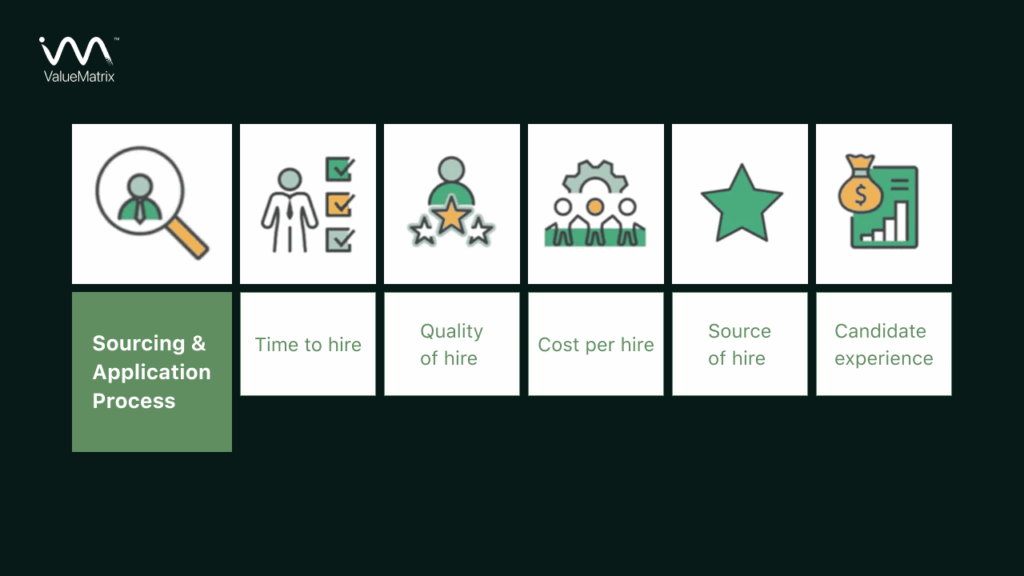
Talent intelligence hiring still needs a human eye to track the data. Here are the best practices you should follow to achieve your hiring goals.
1. Time to Hire
You can track your Time-To-Hire through your company’s ATS timestamps and figure out exactly where the bottlenecks(if there are any) in your hiring funnel are, i.e., screening, interviewing, and approvals.
2. Quality of Hire
One of the most important metrics for any hiring team. Quality of Hire is a tricky metric to judge because it’s a qualitative metric and not quantitative. But you can still track it by reviewing your performance reviews, attrition rates among new hires, and manager feedback.
Know more about Quality of Hire.
3. Cost per Hire
Cost Per Hire can be calculated by dividing the total recruiting expenditure by the total number of hires. Any recruitment analytics dashboard can do the job for you. You can segment Cost Per Hire by many categories, like departments, positions, gender, etc.
4. Source of Hire
Talent intelligence-driven assessments help you track down the recruitment channels that are responsible for providing you with your best talent pool.
Whether it is Job Boards like LinkedIn, Indeed, Monster, etc., a Company’s career page, social media, or campus hiring, tracking tags inside an Applicant Tracking System, called ATS source codes, tell you where a candidate originally came from.
5. Candidate Experience (cNPS)
It’s always a good habit to check in with the candidates, typically through post-process surveys.
You should always ask the candidates, whether hired or not, about their whole journey through your hiring funnel. Ask them how likely they are to recommend your company to their friends and peers on a scale of 1 to 10.
This will give you a pretty good insight into the rough patches in your hiring funnel.
What are some other best practices?
1. Keep it simple
Recruiters should remember that not every metric is worth tracking. Recruiters should only focus on metrics that affect hiring and ignore the rest.
The important ones are like time-to-hire, cost-per-hire, or quality-of-hire.rest.
Recruiters sometimes run after many vanity metrics. Focus on the few that move the needle and ignore the rest.
2. Build a recruitment dashboard
It’s very important to invest in a stack dashboard. A dashboard is like a command centre that brings all your hiring data on one single screen. It also allows you to visualize different metrics and have a clear picture of the trajectory your hiring process is taking.
3. Set clear goals and track progress
Data without direction is just clutter. Define what success looks like for your organisation, ie, faster hiring, higher retention, lower attrition, diversified workforce, and measure your progress against those benchmarks.
This gives meaning to your recruitment strategy.
4. Review, compare, and iterate
Hiring metrics are dynamic. And they fall in and out of fashion fast.
Metrics like offer acceptance rate and Interview-to-offer ratio were once widely respected; now they have fallen out of favour with most companies around the world.
So the recruitment challenges and their solutions will keep changing, Hr must keep a sharp eye on the ever-changing landscape of the hiring industry.
Some Real World Examples of Successful Integration of Talent Intelligence
Let’s look at some real-world examples of companies improving their hiring metrics with the help of Talent Intelligence-driven recruitment.
- Google replaced unstructured, subjective interviews with a data-backed and AI-assisted screening. This change enhanced the consistency of hiring decisions and Google saved hundreds and thousands of hours of employee time, while also improving candidate quality and alignment.
- Unilever also started using gamified assessments in its screening rounds, and the results were staggering; Unilever saved over £1 million, reduced recruiting time by 75%, and was able to achieve its diversity goals.
- The Hotel Chain giant, Hilton, used AI-based video interviews to cut down its time to hire from 42 days to just 5, saving itself a ton of money while speeding up its hiring process.
What is the Future of Talent intelligence-driven recruitment?
Where is it heading?
Talent intelligence-driven hiring is mainstream in 2025. This is no longer a SCI-FI fantasy. The era of hunches and guesses in hiring is being phased out by analytics.
Here are a few numbers that might surprise you:
- 95% of recruiters believe AI significantly enhances the candidate experience, providing timely communication, personalized feedback, and a smoother journey from application to offer.
- 72% of recruiters say AI has significantly enhanced candidate sourcing. Some of these now scan large talent pools to identify candidates aligned with job requirements and company culture.
- Companies using intelligent automation report up to a 70% reduction in time-to-hire, allowing them to act faster in competitive hiring markets.
- AI scheduling assistants have resulted in a 20% increase in candidate show-up rates for interviews.
The brave new world of analytics is upon us.
What does the future look like for candidates?
Data analytics in hiring isn’t just good news for companies, but for candidates as well. They can expect more fairness, less transparency, and
Take a look at these stats:
- AI-selected candidates are 14% more likely to pass interviews and receive job offers, proving the predictive power of analytics over human instinct.
- Companies using recruitment analytics see up to 18% higher offer acceptance rates, as data allows for better alignment between the role and the candidate.
So, they can say goodbye to:
- Frustratingly slow hiring process.
- Being ghosted by the companies after discussing the remuneration.
- Being judged for your pin code, accent, or surname.
Conclusion
The good, the bad, the ugly.
Nobody could’ve predicted the speed at which Talent intelligence-driven recruitment has caught on. Gut-based hiring is standing on its last legs. These statistics from Insights Global will prove that the AI takeover is almost complete:
- 99% of hiring managers use AI in the hiring process
- 98% saw significant improvements in hiring efficiency using AI
- 74% think AI can assess the compatibility of an applicant and a job
Does that mean we’ll see a complete wipeout of the human recruiters from the hiring funnel?
Even though it has become increasingly hard to predict the future, especially when it comes to AI, it’s safe to say the recruiters aren’t going anywhere soon. Here’s a food for thought.
Just because your hiring strategy involves AI doesn’t mean it’s leak-proof. Talent intelligence is in its developing arc; we’re yet to see where it leads:
In a recent article published in the Proceedings of the National Academy of Sciences (PNAS), researchers discovered a phenomenon called “AI Assessment Effect”. It reveals that candidates change their self-presentation when they believe they are being evaluated by AI.
This study revealed that human recruiters would’ve been 27% more effective in identifying these sudden behavioral shifts among candidates.
Besides this, not everyone is crushing over the arrival of Talent Intelligence in hiring.
Take this Guardian article, for instance. It says that many candidates miss the human touch during interviews and find the whole idea of a bot trying to mimic human mannerisms a bit unsettling.
So, even though Talent intelligence-driven hiring is becoming standard, it is not without its naysayers, and Sundar Pichai, Ceo of Google, seems to be one of them.
He says, “Google will now include at least one round of in-person interviews to ensure candidates possess core competencies that AI-based assessments might overlook.”
If none other than Google is treading softly with Talent intelligence in hiring, then the rest should at least steady their heels, take a stock of their hiring funnel, and do a fair evaluation before integrating AI.
About Us
ValueMatrix is an AI-powered talent intelligence platform that helps companies hire better, faster, and without bias. We go beyond resumes to assess skills, behavioral traits, and cultural fit using advanced AI and proven psychological frameworks. Our platform delivers data-driven insights that improve hiring accuracy, reduce time-to-hire, and elevate candidate quality.
ValueMatrix AI enables hiring teams to make confident hiring decisions and build high-performing teams at scale.
FAQs
1. Is the integration of talent intelligence based on pure performance metrics, or is it a bandwagon effect?
It’s more substance than hype. The numbers don’t lie. Data analytics appears to be outperforming human counterparts, but it’s not to say that there’s a bit of FOMO element in there as well.
2. What size of company should integrate Talent intelligence in their hiring? Are there any specific industries that can do without it completely?
All the large enterprises and fast-scaling mid-sized companies should integrate Talent Intelligence because they deal with high hiring volume, global competition.
If you are a small-scale business with fewer than 50 employees, you can probably hold off on Talent Intelligence integration as the hassle will far outweigh the benefits.
3. As a CHRO/Hr, should I be worried about people worrying about gaming our company’s AI assessments and evaluations?
Any technology in its nascent stages is bound to face some hiccups. Although it was found that some candidates were successful in gaming AI-based evaluations by modulating their behaviour, more advanced versions like ValueMatrix use adaptive designs to counter any attempt at manipulating the system.
4. Can AI assessments mistakenly filter out good candidates?
It can. The system is not yet perfect. That’s why companies should look for a collaborative effort between recruiters and AI, so they can play to each other’s strengths and weed out each other’s weaknesses instead of competing against each other.