

Table of contents
HR is evolving from an administrative function to a critical growth driver. Hybrid work models, heightened employee expectations, and talent shortages have catalyzed the transformation of HR’s organizational role. In this context of expanding responsibilities, legacy systems and manual processes hamper team effectiveness, creating chaos in recruitment and onboarding, inefficiencies in employee management, and gaps in learning and development. Organizations must invest in HR digital transformation to keep pace with the rapidly evolving function.
What Is HR Digital Transformation?
The digital transformation of HR refers to a shift from manual, paper-based processes to a comprehensive automation of human resource functions. It is more than the movement of physical files to cloud storage. Transformation encompasses core HR functions, including hiring, onboarding, payroll, performance management, learning, and employee engagement. It uses AI, automation, analytics, and cloud platforms to enhance HR processes and employee experience. The digital HR transformation strategy of an organization typically includes:
- Cloud-based HR management systems (HRMS) and integrated platforms
- Automation of recruitment, onboarding, payroll, and performance management
- Self-service portals enabling employees to access information independently
- AI and machine learning for talent analytics and predictive insights
Why HR Digital Transformation Is Imperative
As organizations increasingly adopt artificial intelligence (AI) in various functions, HR must keep pace with these changes. Moreover, hybrid work models and rapid skill shifts made it imperative for HR to move away from traditional functioning toward digitization. The benefits of HR digital transformation are too evident to be missed.
Operational speed and efficiency
Automation of repetitive and mechanical tasks, such as screening of resumes or scheduling interviews, will speed up work. It will free the HR to focus on more human-centric strategic tasks of capability building, employee experience, and leadership development. Organizations can improve efficiency by reducing human error and turnaround times in HR functions.
Data-driven decision-making
An AI-driven hiring and talent management system provides real-time data on employees. Data-equipped HR enables more accurate workforce planning, early identification of attrition risks, and tailored interventions that improve productivity and retention. Metrics-based approach improves ROI on HR investments.
Employee experience and engagement
The Gen Z workforce expects a consumer-grade experience with HR services. Digitization will provide them a seamless experience through self-service portals, real-time updates, and mobile-first tools. HR can personalize employee journeys using data insights instead of one-size-fits-all policies. They can drive continuous employee engagement with AI-powered pulse surveys, analytical dashboards, and feedback tools.
Business agility
Rapid organizational changes require flexible, scalable HR systems. Digital transformation enables quick adaptation to market shifts. HR transformation supports business resilience by ensuring continuity, agility in hiring, and real-time decision-making during disruptions.
Regulatory compliance
As organizations scale, digital systems enable the standardization of processes, compliance, and secure employee data management. Standardized processes minimize the risk of non-compliance with labor regulations. Automated systems ensure accurate record-keeping and audit trails.
Competitive advantage
Digital transformation gives a competitive edge to organizations in attracting top talent. Tech-enabled recruitment and seamless communication don’t just speed up the process; they make the company attractive to top-tier candidates.
Strategic Roadmap For HR Digital Transformation
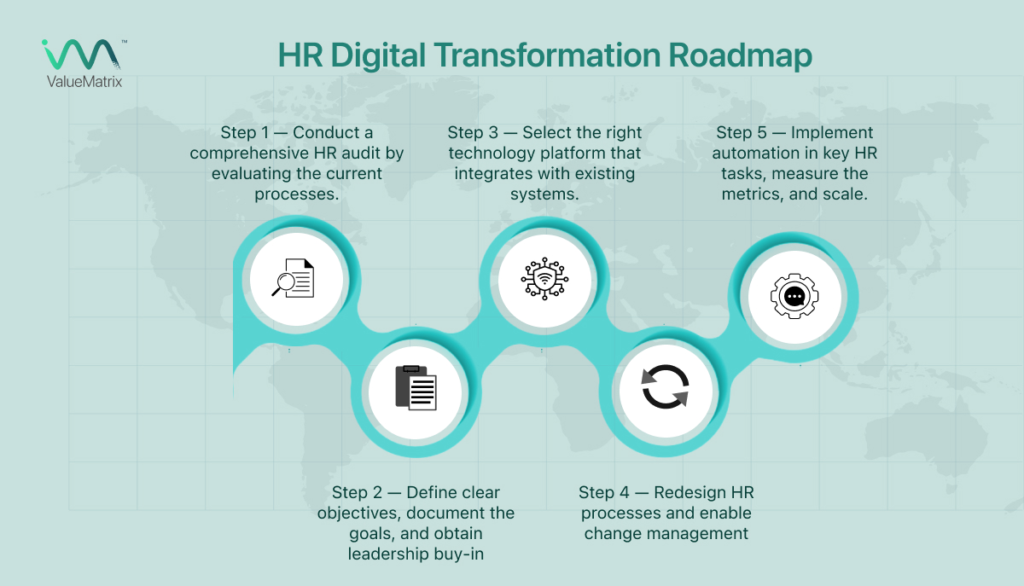
Step 1: Conduct a comprehensive HR audit
Evaluate the current processes and technologies in use, and identify the pain points. Document the repetitive manual tasks that can be automated. Conduct discussions with the leadership, HR members, and employees to understand the limitations of the existing processes and their expectations. Compare the current state with the desired state and identify the need for digitization.
Step 2: Define clear objectives
After identifying the gaps in the current HR systems, define the objectives for digitizing these processes. Map the end-to-end employee lifecycle from hire to retire and prioritize the processes where digitization creates immediate value. Document the goals you want to achieve and the RoI you expect from the transformation. Present your business case and obtain leadership buy-in.
Step 3: Select the right technology stack
Research various technology platforms; review case studies and success stories of similar organizations. Identify the technology requirements that align with your transformation objectives. Select platforms that integrate seamlessly with existing systems and offer cloud-based solutions. AI-driven HR systems are the way forward; therefore, consider AI tools for recruitment, engagement, learning, and workflows. Choose a vendor that offers customized solutions, unhindered support, and an upgrade roadmap. Try a pilot before enterprise rollout.
Value Matrix offers an AI-based end-to-end hiring platform that integrates with the existing HR system. Its advanced algorithms provide data-driven insights and support HR decisions with predictive analytics.
Step 4: Redesign HR processes and enable change management
Before undertaking digitization, optimize the HR processes by removing redundant steps, such as paper-based tasks and excessive approvals. Create SoPs to support adoption and implementation, test the redesigned process, and refine before scale-up.
Design training plans to address the capability gaps among managers and the HR team. Run demos and workshops, and appoint change ambassadors to spread the message among their peer groups. Use multiple channels (emails, town halls, intranet, videos) to explain the need for transformation and how it will benefit the employees. Address the resistance to change among the HR team members by demonstrating the importance of digitization.
Step 5: Implement, evaluate, and scale
Implement automation in a few key HR tasks (hiring, for example) using the 80/20 prioritization (20% of tasks that deliver 80% of value). Measure the success metrics such as time-to-hire, retention, and request resolution time. Set up dashboards providing real-time visibility into HR operations and workforce trends; conduct regular pulse surveys to identify the gaps. Address the gaps, fine-tune the process, and expand it to a few other tasks.
Digital transformation is not a one-time project but a continuous process. Keep optimizing workflows and user experience based on feedback; review vendor upgrades and integrations. Prepare a roadmap for next-generation capabilities.
Key Technologies Powering HR Digital Transformation
Digital transformation is iterative, driven by evolving technologies that continually transform HR functions. Organizations typically start with core platforms and expand their digital ecosystem as business needs emerge.
| Technology | Key Features | Business Impact |
| Cloud-Based HR Platform (HRIS, HRMS) | Onboarding, employee database, payroll, leaves, time tracking, reporting | Integrated platform manages all HR functions from a centralized system |
| Artificial Intelligence & Machine Learning | Resume screening, candidate matching, chatbots, workforce planning, attrition prediction | Improves decision-making with automation and predictive insights |
| Applicant Tracking System (ATS) | Job posting, candidate sourcing, resume parsing, interview scheduling, candidate communication | Accelerates hiring, streamlines recruitment process, improves candidate experience |
| Learning Management System (LMS) | Online courses, skill assessments, certification tracking, personalized learning paths | Enables continuous upskilling of employees, reduces training costs, supports career development at scale |
| Employee Self-Service Portal and Mobile App | Personal information updates, leave requests, paystub access, expense submission | Enables employees to manage HR-related tasks on their own |
| Chatbots and Virtual Assistants | HR query resolution, onboarding assistance, helpdesk | Enhances employee and candidate experience |
| Robotic Process Automation (RPA) | Data entry, payroll processing, compliance reporting, employee record updates | Software robots to automate repetitive, rule-based HR tasks |
| Employee Engagement Platform | Pulse surveys, recognition programs, feedback tools, sentiment tracking | Measures employee satisfaction and improves engagement |
Common Pitfalls And Challenges
The ever-expanding scope for HR digitization can overwhelm decision-makers. Without proper planning, organizations risk either over-investing in unnecessary tools or under-leveraging critical capabilities. Like any major initiative, digitization requires careful consideration and a comprehensive assessment to minimize implementation challenges in HR digital transformation.
Unclear vision and lack of strategy
Organizations must avoid the temptation to rush through the transformation without a clear roadmap. The FOMO over advanced technologies can push companies to adopt systems that are either unnecessary for their operations or do not integrate with their existing setup. Hasty implementation can result in a chaotic situation. This can be avoided with a clear vision and roadmap that provides direction and coordination.
Inadequate technology selection and integration
A fallout of an unclear vision is investing in technologies based on their features instead of their alignment with HR needs. This will result in technology overload, but the platforms may lack essential features to support core workflows. Equally problematic is the lack of integration across HRIS, ATS, LMS, payroll, and other tools, each functioning in silos and thereby duplicating HR work.
Resist the temptation to choose tools based on trends because effective transformation requires selecting technology that fits the organization’s context and seamlessly integrates within the HR ecosystem.
Unrealistic expectations
Organizations cannot expect technology to change things overnight. Overestimating its capability to deliver immediate results, eliminate all manual work, or automatically improve employee experience will lead to loss of stakeholder confidence and undue pressure on HR. Do not rush to call the initiative a failure because transformation requires time, capability building, and change management.
Resistance to change and poor user adoption
Employees may be reluctant to adopt new tools because they are comfortable in their current state or fear job displacement due to automation. Gaps in digital literacy and insufficient training also make them resist change.
Change management, including structured training and ongoing support, is critical for automation to be accepted by stakeholders. Employees should receive clear communication about the future of their jobs and how the nature of their work might change.
Insufficient leadership support and resources
Lack of executive sponsorship and insufficient budgets for implementation, training, and maintenance will undermine the project. If leaders do not actively pursue the initiative, it will be perceived as a low priority, resulting in limited budgets and inadequate staffing. Employees are less likely to engage with the new systems. Therefore, transformation requires committed leadership support.
Best Practices For Successful Digital Transformation
Think big but start small. Phase out the implementation by aligning it with the business strategy. Focus on quick wins, such as quicker resume screening or visibility into employee attendance, while also investing in some major initiatives that might take time to show results.
Strengthen HR capabilities by investing in digital literacy, analytics knowledge, and change leadership within HR teams. Build trust in them to accept the technological changes without fearing for their jobs.
Elevate employee experience by designing solutions that are intuitive, mobile-ready, and aligned with employee needs and behaviors.
Formulate a robust governance system that ensures data privacy and security. Have a transparent policy on data ownership and usage, and access control. Ensure the governance policy complies with local regulations. Have regular audits and updates to the governance policy.
Measuring The ROI Of HR Digital Transformation
A good return on investment justifies the funding to the leadership, holds the transformation team accountable for implementation, and offers visibility into future investments. RoI requires the evaluation of both quantitative and qualitative outcomes to demonstrate its overall effectiveness.
- Measure the efficiency gains and cost savings through the reductions in manual workload, processing time, and administrative errors. Calculate the savings achieved by automating tasks such as payroll, onboarding, and document generation.
- Gauge the improvement in talent acquisition through reduced time-to-hire, improved candidate quality, lower sourcing costs, and enhanced HR productivity through AI-enabled hiring tools.
- Use pulse surveys, adoption analytics, and satisfaction scores to quantify enhanced employee experience and engagement.
- Assess workforce productivity and capability development via learning participation, skill development velocity, and internal mobility rates.
- Track the reduction in employee turnover and early attrition to measure improvement in retention.
- Evaluate the accuracy, speed, and impact of insights generated through dashboards, analytics, and predictive models.
- Measure the organization’s ability to support hybrid work, expand to new locations, or respond quickly to workforce changes.
Industry Success Stories Of HR Transformation
HR automation has become widespread, with organizations across industries adopting it to improve efficiency and reduce costs. Here are examples of companies that have transformed their HR operations through digital solutions.
- Heidelberger Druckmaschinen, Germany
The challenge
- Lack of visibility into HR matters, including employee turnover, employee profile insights for future recruitment, and the age structure of the workforce.
- Implementation of global HR reporting and personnel cost planning.
The solution
HR digital transformation was implemented with three modules – Core HCM, Learning, and Absence. Core HCM provides master data management through the employee lifecycle. Learning manages training and education of the company’s employees worldwide by mapping all processes and data. Absence integrates processes and data on employee absence, including vacation and sick days.
The impact
- An improved HR database and employee self-service.
- A globally connected HR team and standardized processes.
- Scope for future expansion with new modules and features.
- KPMG, Belgium
The challenge
- Absence of a pre-boarding process, especially for graduates.
- Long waiting periods between recruitment and onboarding of candidates.
The solution
The company implemented an integrated onboarding software solution that starts the onboarding process immediately after the contract is signed. The app sends the recruits all the information they need before onboarding, including their colleagues’ contact details.
The impact
- 81% app activation rate.
- Hiring experience rating 4.45 out of 5.
- Employees’ first week experience rating 4.12.
HR digital transformation is no longer a ‘nice-to-have’ initiative but a strategic imperative to streamline operations and drive efficiency. However, organizations must resist the temptation to adopt technology indiscriminately. The roadmap to digitization must be holistic, human-centered, and analytics-enabled. Organizations that invest smartly will gain a competitive advantage in attracting and retaining talent.
FAQs
The timeline depends on the organization’s size, complexity, and scope of transformation. Small to mid-sized companies may take 6-18 months, while large enterprises may need 18-36 months for a comprehensive transformation. Transformation is ongoing and must be implemented in a phased manner, with several short-term goals.
The HR team must have data literacy to read dashboards and interpret the data. They must be trained in the usage of various tools, such as HRIS and LMS, and AI. They should have change management skills to support employees in embracing HR digitization.
Selecting technology before defining the transformation strategy, trying to change too much too fast, underestimating the need for change management, ignoring data quality, and a lack of executive buy-in are a few common mistakes that organizations must avoid for a smooth transformation.
Build flexibility into your technology architecture, establish regular technology review cycles, stay informed about HR technology trends, create a continuous improvement culture, and maintain vendor partnerships to know about the latest developments.
About Us
ValueMatrix helps organizations build culturally cohesive teams with AI-powered recruitment and retention strategies. We educate corporate leaders on the need to involve and encourage all generations to adapt to enterprise values and participate actively to gain excellence.
Our AI-powered platform transforms talent acquisition with intelligent hiring techniques backed by established psychological frameworks. We partner with HR professionals to conduct unbiased and holistic assessments for aspiring candidates.